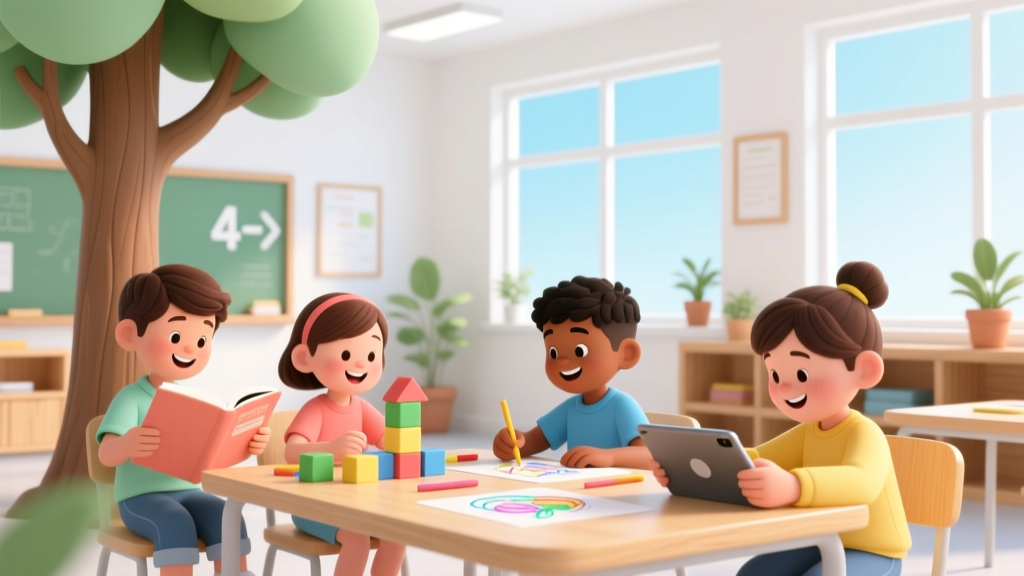
Screen Time Limits for Kids: AAP Guidelines (2026)
Why This Question Keeps Waking Parents Up at 2 a.m.
Every night, thousands of parents scroll through parenting forums asking the same urgent, emotionally charged question: should kids have screen time limits? It’s not just about minutes on a tablet — it’s about anxiety over attention spans shrinking, bedtime battles escalating, homework taking twice as long, and that gnawing fear that your child is falling behind socially or academically while glued to a glowing rectangle. In 2024, screen exposure begins before kindergarten — 92% of toddlers use mobile devices regularly (JAMA Pediatrics, 2023), and the average 8–12-year-old spends 4 hours 44 minutes per day on entertainment screens alone (Common Sense Media, 2023). Yet most families are stuck between two extremes: authoritarian ‘no screens before dinner’ rules that crumble by Wednesday… or guilt-ridden permissiveness that leaves everyone exhausted. What if the real answer isn’t ‘how much?’ — but ‘what kind, when, and with whom?’
The Developmental Reality: Screens Aren’t All Created Equal
Here’s what pediatric neurologists and child development specialists emphasize repeatedly: not all screen time impacts the developing brain the same way. Passive consumption (e.g., autoplaying YouTube videos) triggers low-level dopamine loops without cognitive engagement — a recipe for attention fragmentation. Interactive, co-viewed, purpose-driven screen use — like video-calling Grandma, coding a simple game with Scratch Jr., or researching monarch butterfly migration for a school project — activates executive function, language centers, and social-emotional processing. Dr. Jenny Radesky, developmental behavioral pediatrician and lead author of the American Academy of Pediatrics’ (AAP) 2016 and 2020 screen time policy statements, puts it plainly: “We must stop counting minutes and start evaluating context, content, and connection.” Her team’s longitudinal research shows children whose families prioritize co-engagement (watching or playing together) and intentional curation (choosing high-quality, age-aligned content) demonstrate stronger vocabulary growth, empathy markers, and self-regulation — even with identical screen durations as peers in passive-use households.
Consider Maya, a 7-year-old in Portland, OR. Her parents initially enforced a strict 1-hour daily limit. But Maya became increasingly frustrated during ‘screen time,’ rushing through educational apps just to hit her quota — then begging for more. After consulting a pediatric occupational therapist, they shifted to a ‘Screen Purpose Framework’: 20 minutes of math practice on Prodigy (learning goal), 15 minutes of collaborative Minecraft building with her cousin (social goal), and 10 minutes of nature documentary clips followed by sketching animals (creative goal). No timer. No negotiation. Just clear intention. Within three weeks, Maya initiated offline activities more often — and her teacher reported improved task persistence.
What the Evidence Says: Age-Appropriate Thresholds & Why They Exist
The AAP doesn’t prescribe a universal ‘safe’ number. Instead, its guidelines reflect critical windows of neurological development. For infants under 18 months, screen exposure beyond video-chatting is discouraged because neural pathways for language and social cognition form most rapidly through live human interaction — not two-dimensional stimuli. Between 18–24 months, high-quality programming (like PBS Kids) *can* support learning — only when co-viewed and discussed. At ages 2–5, the AAP recommends ≤1 hour/day of high-quality programming — but crucially adds: “This should be co-viewed to help children understand what they are seeing and apply it to the world around them.” For children 6+, the emphasis shifts from duration to consistency, balance, and family media plans.
Why do these thresholds matter? Brain imaging studies show excessive passive screen use before age 5 correlates with thinner cortical gray matter in regions governing attention and impulse control (Nature Communications, 2022). Meanwhile, children aged 6–12 who engage in balanced digital diets — pairing screen time with outdoor play, creative arts, and unstructured social time — demonstrate 23% higher resilience scores on standardized assessments (Child Development, 2023).
Your Actionable Screen Time Framework: Beyond the Timer
Forget rigid clocks. Build a sustainable, adaptable system grounded in your family’s values and your child’s temperament. Start with this 4-step process:
- Map Your Current Landscape: For 3 days, log not just how long, but what (app/game/show), why (boredom? reward? learning?), where (bedroom? kitchen table?), and who with (alone? sibling? parent?). Patterns will emerge — e.g., “30 minutes of Roblox after school = stress decompression,” or “YouTube Shorts before bed = 47-minute delay falling asleep.”
- Define Your Non-Negotiables: Based on AAP guidance and your values, set 2–3 hard boundaries. Examples: “No screens in bedrooms,” “No screens 60 minutes before bedtime,” or “All gaming requires pre-approved friend lists.” These protect sleep hygiene, privacy, and emotional safety — not arbitrary minutes.
- Create ‘Green Light’ Zones: Identify 2–3 screen activities that align with your goals (e.g., “Family movie night every Friday,” “Coding Club Tuesdays,” “Digital art journaling Sundays”). These become predictable, valued rituals — not forbidden fruit.
- Build Co-Regulation Skills: Teach your child to recognize their own screen fatigue cues (“My eyes feel heavy,” “I’m getting grumpy”) using simple body scans. Practice transitions: “When the chime sounds, we’ll pause, stretch, and name one thing we’re grateful for before logging off.” This builds metacognition — far more valuable than compliance.
Screen Time by Age: What Research Actually Recommends
Below is a concise, evidence-based reference table synthesizing AAP, WHO, and Canadian Paediatric Society guidelines — focused on developmental appropriateness, not just duration.
| Age Group | AAP/WHO Recommended Max (Entertainment) | Critical Developmental Considerations | High-Value Alternatives to Prioritize |
|---|---|---|---|
| Under 18 months | None (except video-chatting) | Brain prioritizes face-to-face interaction for language acquisition; screen light disrupts melatonin onset | Tummy time, responsive babbling games, sensory bins, singing with gestures |
| 18–24 months | ≤15–20 min/day of high-quality, co-viewed content | Joint attention skills emerging; need adult narration to connect 2D images to real-world objects | Picture book walks, simple puzzles, pretend play with household items |
| 2–5 years | ≤1 hour/day of high-quality programming with adult co-viewing | Executive function (impulse control, working memory) develops rapidly; passive viewing weakens self-regulation circuits | Outdoor exploration, open-ended art, dramatic play, cooking together |
| 6–12 years | No fixed cap — but must be balanced with physical activity, sleep (9–12 hrs), homework, and face-to-face social time | Peer relationships and identity formation accelerate; social media exposure carries unique mental health risks | Team sports, volunteering, journaling, learning an instrument, family hikes |
| 13+ years | Guided autonomy: youth co-create family media plan with input on goals, boundaries, and consequences | Prefrontal cortex (decision-making center) still maturing until ~25; needs scaffolding, not surveillance | Mentorship programs, part-time work, creative projects, civic engagement |
Frequently Asked Questions
Is screen time causing my child’s ADHD symptoms?
No — screen time does not cause ADHD. However, research shows excessive passive screen use exacerbates core symptoms like impulsivity and attention dysregulation in children with ADHD (Journal of the American Academy of Child & Adolescent Psychiatry, 2021). Think of screens like sugar: not the root cause of diabetes, but a significant accelerator when consumed without balance. Children with ADHD benefit most from highly structured, interactive screen use (e.g., typing practice, strategy games) paired with frequent movement breaks and strong offline routines.
What if my child uses screens for school? Does that count toward the limit?
No — educational screen time is categorically different. The AAP explicitly excludes schoolwork, telehealth visits, and video calls with loved ones from recreational screen time limits. The concern lies in entertainment-focused use that displaces sleep, physical activity, or face-to-face interaction. That said, monitor for digital fatigue: if your child complains of eye strain, headaches, or irritability after online learning, discuss ergonomic setup (screen height, lighting, 20-20-20 rule) with their teacher or school nurse.
How do I enforce limits when my teen hides their phone use?
Covert monitoring erodes trust and rarely works long-term. Instead, shift to collaborative problem-solving. Say: “I notice you’ve been up late scrolling — I’m worried about your sleep and mood. Can we look at your screen time reports together and brainstorm solutions that honor your growing independence *and* protect your well-being?” Use built-in tools (iOS Screen Time, Android Digital Wellbeing) transparently — not as spyware, but as shared data points. A 2023 study in Pediatrics found teens were 3x more likely to adopt healthy habits when involved in setting their own boundaries versus having rules imposed.
Are ‘educational’ apps really beneficial for toddlers?
Most are not — and some may be harmful. A landmark study published in JAMA Pediatrics (2019) tracked 2,441 toddlers and found those using baby-directed apps scored lower on communication tests at age 2 than peers with minimal screen exposure. Why? These apps often lack the contingent responsiveness of human interaction — they don’t pause when a child looks away, adjust pace based on confusion, or celebrate genuine effort. True learning happens in reciprocal exchanges. If using apps, choose ones requiring active participation (e.g., Toca Boca series) and always co-play, narrating choices and connecting concepts to real life (“You built a bridge! Like the one we saw at the park!”).
Debunking Common Myths
- Myth #1: “If I set a firm limit, my child will learn self-control.” Reality: Self-regulation isn’t built through external restriction alone — it’s developed through guided practice. Children learn impulse control by noticing their urges (“I want to keep watching”), pausing, and choosing alternatives — with adult support. Rigid limits without teaching the skill create rebellion or shame, not mastery.
- Myth #2: “Screen time is the main reason kids aren’t playing outside anymore.” Reality: While screens compete for attention, systemic factors matter more — reduced access to safe green spaces, overscheduled academic calendars, parental safety concerns, and neighborhood design. A 2022 University of British Columbia study found children spent 37% less time outdoors than in 1995 — but only 12% of that decline correlated directly with device use. Addressing screen time alone won’t restore outdoor play without parallel community action.
Related Topics (Internal Link Suggestions)
- How to create a family media plan — suggested anchor text: "free printable family media plan template"
- Best educational apps for preschoolers — suggested anchor text: "pediatrician-approved learning apps for ages 3–5"
- Signs of screen addiction in children — suggested anchor text: "when screen use crosses into problematic behavior"
- Screen-free activities for rainy days — suggested anchor text: "indoor play ideas that build focus and creativity"
- How to talk to kids about social media — suggested anchor text: "age-appropriate social media conversations"
Next Steps: Start Small, Stay Consistent
You don’t need to overhaul your family’s digital life overnight. Pick one actionable step from this article — maybe mapping your current screen landscape tonight, defining one non-negotiable boundary this week, or initiating a co-viewing session with your 4-year-old during Saturday morning cartoons. Remember: the goal isn’t perfection. It’s presence. It’s modeling mindful tech use yourself. It’s showing your child that attention is their most precious resource — and you’ll help them steward it wisely. Download our free Family Media Plan Kit (includes age-specific conversation starters, screen time tracker, and co-viewing discussion prompts) — and take your first intentional step toward screen harmony, not screen warfare.
More Articles
 What Peter Pan Teaches Kids (2026)
 General Hospital Custody Laws: Real vs. TV (2026)
 When to Tell Kids About Santa (2026 Guide)
 Kids Before Marriage: Theology, Psychology & Real Outcomes
 What Size Kids Shoes Is A Women'S 7
 Kid Cudi Gay Rumors: What Parents Need to Know (2026)
 Travis Scott Kids: Co-Parenting Truths & Fatherhood (2026)
 Does Macron Have Kids? Family, Privacy & Leadership
 How Many Kids Does John Daly Have? (2026)
 Who Are Diddy’s Kids? Parenting Insights (2026)