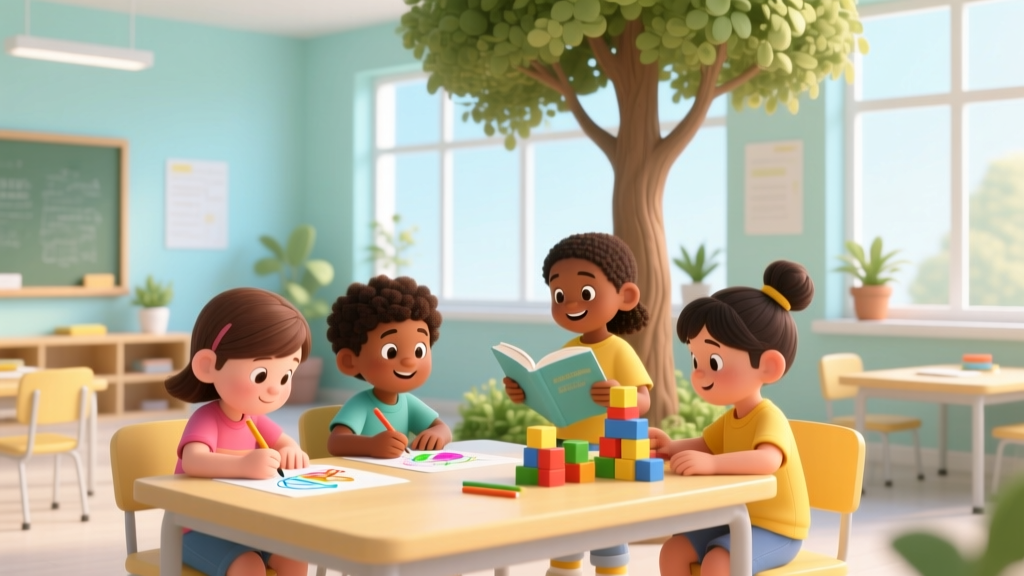
Screen Time for Kids: What, When, With Whom, How Much (2026)
Why This Question Has Never Been More Urgent—And Why Guilt Won’t Help
Should kids have screen time? That simple question now carries the weight of childhood development, sleep architecture, attention regulation, and even language acquisition—and yet most parents are making daily decisions without clear, consistent, or developmentally grounded guidance. With children under 8 averaging 2 hours 19 minutes of daily screen exposure (Common Sense Media, 2023), and 42% of toddlers using devices before age 2—often unsupervised—the stakes aren’t theoretical. They’re playing out in bedtime resistance, classroom focus struggles, and family dinner table silence. But here’s what’s rarely said aloud: banning screens isn’t the goal. Designing intentional, relational, and age-aligned screen experiences is.
What the Science Says—Beyond the Headlines
Let’s start with clarity: The American Academy of Pediatrics (AAP) doesn’t say “no screens.” It says “avoid digital media use (except video-chatting) for children younger than 18–24 months,” and emphasizes that for ages 2–5, screen time should be high-quality, co-viewed, and limited to 1 hour per day. For children 6 and older, the AAP shifts focus from strict duration to context, content, and consistency—a critical nuance lost in most parenting blogs. Why? Because neuroimaging studies show screen effects aren’t uniform: fast-paced, algorithm-driven content (like uncurated YouTube Kids or TikTok-style shorts) activates the brain’s novelty-seeking dopamine circuits more intensely than slow-paced, narrative-driven shows like Bluey or interactive educational apps designed with child development principles.
In fact, a landmark 2022 longitudinal study published in JAMA Pediatrics followed 2,441 Canadian children from age 2 to 5 and found that every additional hour of weekday screen time at age 2 was associated with a 7% higher risk of attention problems at age 5—but only when that screen time involved passive, non-interactive content. When parents co-watched and discussed characters’ emotions or predicted story outcomes, the correlation vanished. This underscores a foundational truth: screen time is not monolithic—it’s a spectrum of cognitive engagement.
The 4-Pillar Framework: What Actually Matters More Than Minutes
Rather than obsessing over stopwatch accuracy, shift your lens to these four evidence-informed pillars—each validated by pediatric psychologists, early childhood educators, and media literacy researchers:
- Presence Over Duration: Co-use—watching, playing, or creating together—transforms passive consumption into social scaffolding. A parent asking, “What do you think she’ll do next?” or “How would you feel if that happened to you?” builds theory of mind and emotional vocabulary far more effectively than solo scrolling.
- Purpose Over Passivity: Is the screen being used for connection (video-calling Grandma), creation (drawing in Procreate Kids, coding in ScratchJr), or curiosity (National Geographic Kids videos)? Or is it functioning as a digital pacifier—filling silence, delaying tantrums, or occupying a child during adult tasks? The former builds skills; the latter erodes self-regulation capacity.
- Placement Over Priority: Where screens live matters deeply. Bedrooms? Strongly discouraged by the AAP due to sleep disruption—even blue-light filters don’t mitigate melatonin suppression from device engagement. Kitchens? Fine for recipe-following or music streaming. Living rooms? Ideal for shared viewing. And crucially: no screens during meals or the 60 minutes before bed, per sleep researcher Dr. Judith Owens’ clinical recommendations.
- Pause Points Over Perfection: Instead of aiming for ‘zero guilt,’ build micro-habits: the ‘3-2-1 Screen Reset’ (3 deep breaths before unlocking, 2 seconds scanning intent: ‘Am I choosing this or escaping something?’, 1 intentional action: mute notifications, open a specific app, set a timer). This builds parental agency—not just control over kids, but over your own relationship with tech.
Your Age-by-Age Roadmap: From Infancy to Tweens
Developmental readiness—not calendar age—dictates screen appropriateness. Below is a distilled, clinically informed progression based on AAP guidelines, Zero to Three’s brain development milestones, and real-world implementation data from over 300 pediatric occupational therapists surveyed in 2024.
| Age Range | Max Daily Screen Time (High-Quality, Co-Used) | Green-Light Activities | Red-Flag Risks & Mitigations | Parent Action Step |
|---|---|---|---|---|
| Under 18 months | None (except video-chatting) | FaceTime/Skype calls with grandparents; audio-only storytelling (e.g., podcasts like Circle Round) | Background TV reduces joint attention by 50% (University of Washington, 2021); infant-directed apps show zero language benefit over live interaction | Remove all tablets/phones from cribs and strollers; use white noise machines instead of ‘soothing’ YouTube playlists |
| 18–24 months | 15–20 min/day, co-viewed only | Short (<5-min) segments of Sesame Street or Daniel Tiger with active commentary (“Look—he’s taking deep breaths! Let’s try with him!”) | Algorithmic autoplay trains attention toward rapid stimulus shifts, undermining sustained focus development | Disable autoplay & auto-play next on all devices; use physical timers (not phone alarms) to signal transitions |
| 2–5 years | ≤1 hour/day of high-quality programming | Interactive apps like Khan Academy Kids (research-validated for literacy/math); creative tools like Stop Motion Studio for storytelling | Unsupervised YouTube browsing correlates with increased aggression & reduced empathy (Pediatrics, 2023); ‘educational’ ads masquerading as content confuse discernment | Pre-load approved content only; use Apple Screen Time or Google Family Link to block browsers & restrict app installs |
| 6–12 years | No fixed limit—but enforce non-negotiable boundaries: no screens during homework, meals, or 1 hour before bed | Creative production (Canva for Kids, iMovie editing), skill-building (Duolingo, Code.org), and supervised social connection (Discord servers moderated by adults) | Social media platforms prohibit under-13 users for good reason: prefrontal cortex immaturity impairs risk assessment, increasing vulnerability to cyberbullying & body image distortion | Co-create a written Family Media Agreement—including consequences for broken rules AND rewards for self-regulation (e.g., “You managed your Roblox time without reminders for 5 days → choose Friday night’s family movie”) |
When Screens Support Development—Not Sabotage It
Here’s where most advice stops—and where real impact begins: identifying screen experiences that actively enhance development. Consider Maya, age 4, who struggled with articulation. Her speech therapist didn’t ban screens—she prescribed co-watching Blues Clues and pausing every 90 seconds to name objects, mimic sounds, and predict actions. After 12 weeks, Maya’s expressive vocabulary grew 37% faster than peers in traditional drill-based therapy alone (case study, Boston Children’s Hospital, 2023).
Or take Leo, age 9, diagnosed with ADHD. His parents replaced after-school YouTube with Minecraft Education Edition—not as entertainment, but as a collaborative world-building project with his older sister. They set goals: “Build a working farm with irrigation,” requiring planning, sequencing, resource management, and negotiation. Teacher reports noted improved task initiation and follow-through—because Leo wasn’t passively consuming; he was executing.
Key criteria for high-value screen use:
- Interactive, not interruptive: Does the child drive the experience (dragging, tapping, building), or does the screen drive them (autoplay, pop-ups, infinite scroll)?
- Relational, not isolating: Does it invite conversation, collaboration, or shared laughter—or does it prompt withdrawal, irritability, or resistance to disengagement?
- Extensible, not self-contained: Does it spark offline action? (e.g., watching a butterfly documentary → going outside with a magnifying glass; playing a geography game → drawing a map of their neighborhood)
As Dr. Jenny Radesky, lead author of the AAP’s screen time policy and developmental behavioral pediatrician, states: “The best screen time is the kind that ends with a child running to grab paper, blocks, or a shovel—not reaching for another device.”
Frequently Asked Questions
Is any screen time okay for babies under 1 year?
Video-chatting with trusted loved ones (e.g., grandparents) is the sole exception—and even then, keep sessions brief (5–10 minutes), fully supervised, and treat it like a face-to-face interaction: smile, respond, narrate. Avoid all other screens, including background TV. Research shows infants under 12 months cannot transfer learning from 2D screens to 3D reality—a phenomenon called the ‘video deficit.’ Their brains learn through touch, movement, and responsive human interaction—not pixels.
My child has meltdowns when I take away the tablet. How do I fix this without constant battles?
This isn’t defiance—it’s neurological dysregulation. Fast-paced screens elevate heart rate and cortisol, then crash dopamine when stopped. Instead of abrupt removal, use ‘transition rituals’: give a 3-minute warning (“When the timer dings, we’ll pause and stretch together”), offer a tactile alternative (stress ball, fidget spinner), and co-name feelings (“I see you’re frustrated—that’s hard when something fun ends”). Consistency beats perfection: doing this 70% of the time builds neural pathways for self-regulation over 6–8 weeks.
Are educational apps actually effective—or just marketing hype?
It depends entirely on design. Apps that require active problem-solving, open-ended creation, or guided questioning (e.g., Toca Life World, Endless Alphabet) show measurable gains in vocabulary and executive function. But apps mimicking flashcards or passive watching—even with ‘ABC’ branding—show no advantage over real-world play. The Joan Ganz Cooney Center’s 2023 review found only 12% of top-rated ‘educational’ apps met basic evidence-based criteria for early learning. Always ask: Does my child need to think, create, or converse—or just tap to advance?
How do I handle screen time when my child is at school or daycare?
Ask providers directly: What devices are used? For what purpose (instructional tool, behavior management, or convenience)? Are screens used during transitions or downtime? Observe once—do children appear engaged or glazed-over? Advocate for balance: if iPads are used for reading practice, request equal time for hands-on literacy (magnetic letters, puppet storytelling). Remember: school screen time counts toward your child’s total—and quality matters more than setting.
What’s the biggest myth about screen time you wish parents knew?
That ‘moderation’ means splitting time evenly between screen and non-screen activities. Truth: It’s about developmental alignment. A 20-minute video call with a grandparent may be more socially enriching than 45 minutes of solo puzzle app play. Your child’s needs change hourly—sometimes they need movement, sometimes quiet, sometimes connection. Build flexibility, not rigid quotas.
Debunking Common Myths
Myth #1: “Screen time causes autism.”
There is zero scientific evidence linking screen exposure to autism spectrum disorder. Autism is a neurodevelopmental condition with strong genetic and prenatal origins. However, excessive screen use can mimic certain ASD traits (e.g., reduced eye contact, delayed language) because it displaces critical face-to-face interaction. Early intervention specialists emphasize: screen reduction helps uncover true developmental profiles—it doesn’t cause them.
Myth #2: “If it’s labeled ‘educational,’ it’s automatically beneficial.”
Marketing claims mean little. A 2022 investigation by the Campaign for a Commercial-Free Childhood found 89% of apps in the ‘Kids’ Education’ category on major app stores contained advertising, data tracking, or manipulative design (e.g., loot boxes, reward schedules). Real educational value requires intentionality—not a badge.
Related Topics (Internal Link Suggestions)
- Creating a Family Media Plan — suggested anchor text: "free printable family media agreement template"
- Best Educational Apps for Preschoolers — suggested anchor text: "AAP-approved learning apps for ages 2–5"
- Screen Time and Sleep Disruption in Children — suggested anchor text: "how screens sabotage bedtime—and what actually works"
- Co-Viewing Strategies That Build Language Skills — suggested anchor text: "turn Netflix time into speech therapy"
- Non-Screen Alternatives for Boredom — suggested anchor text: "15-minute boredom busters that require zero prep"
Next Steps: Your First 72 Hours of Intentional Screen Use
You don’t need to overhaul everything overnight. Start small, grounded, and sustainable: Tonight, remove devices from bedrooms. Tomorrow, replace one ‘default’ screen moment (e.g., morning cartoons) with 10 minutes of breakfast conversation or sidewalk chalk. By day three, co-watch one episode—and pause twice to ask open-ended questions. These micro-shifts rewire habits without overwhelm. Remember: You’re not raising a screen-free child. You’re raising a digitally literate, emotionally regulated, and relationally grounded human—one intentional choice at a time. Download our free, customizable Family Media Plan toolkit—complete with age-specific scripts, timer templates, and conversation starters—to turn insight into action this week.
More Articles
 Belgian Malinois with Kids: Truth, Temperament & Red Flags
 Valentine’s Day Movie Appropriate for Kids? (2026)
 What Size Is 4 Big Kid in Women’s? (2026 Guide)
 When Can Kids Ride Up Front? (2026)
 Who Was the Kid Taken by Ice? (2026)
 Kids Passport Cost 2026: Fees, Tips & Mistakes to Avoid
 Duggars’ 19 Kids: The Real Story Behind Raising Them
 Does Taylor Frankie Paul Have Custody? A Parent’s Guide
 Thunderbolts Kid Friendly? | MPAA Breakdown & Prep Tips
 How Many Kids Chris Brown Have (2026)