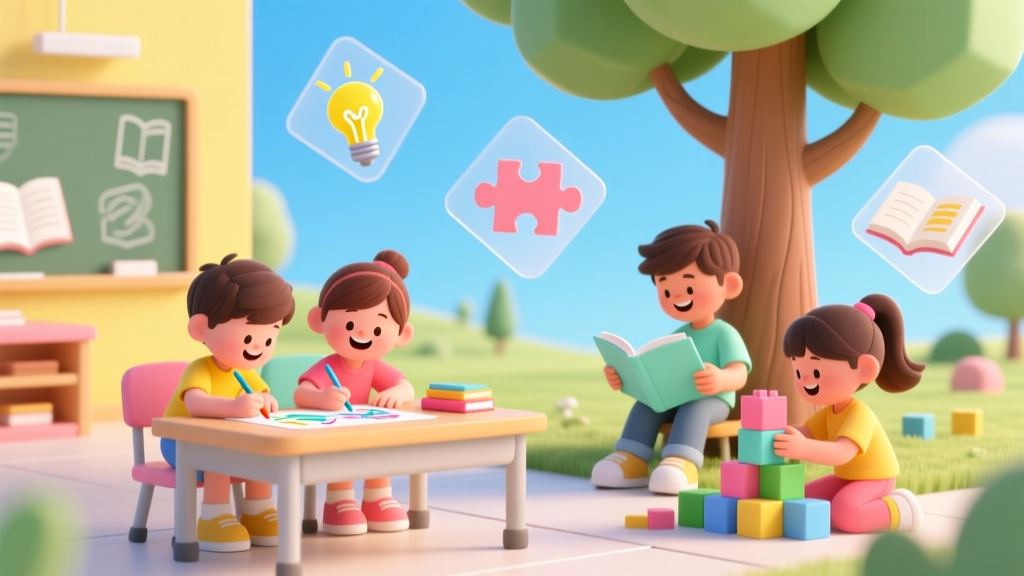
Must Love Kids: A Skill You Can Build (2026)
Why 'Must Love Kids' Is the First—and Most Misunderstood—Requirement of Care
If you’ve ever scanned a job posting for a nanny, scrolled through adoption agency guidelines, or heard a well-meaning friend say, 'You really must love kids to do this,' you’ve felt the weight behind those three words. But here’s what no one tells you: 'Must love kids' isn’t a personality test—it’s a developmental commitment, a relational skill set, and, increasingly, a non-negotiable component of healthy child-adult dynamics backed by decades of pediatric psychology research. In fact, the American Academy of Pediatrics (AAP) emphasizes that consistent, attuned adult presence—not just warm feelings—is what drives secure attachment, neural integration, and lifelong emotional regulation in children. So if you’re wondering whether you ‘measure up,’ or if your occasional frustration disqualifies you? You’re not failing. You’re human—and exactly who this guide is for.
The Myth of Innate Affection (and Why It Hurts Everyone)
We’ve been sold a dangerous story: that loving children is either automatic—or it isn’t. That some people are just ‘born with it,’ while others are ‘not cut out for kids.’ This binary thinking does real harm. It silences caregivers who feel overwhelmed but fear judgment. It pressures teachers to perform perpetual cheerfulness instead of modeling emotional honesty. And it erases the reality that love, especially in caregiving, is less about constant euphoria and more about reliable responsiveness—showing up even when you’re tired, uncertain, or irritated.
Dr. Ross Thompson, developmental psychologist and co-author of Early Childhood Development: A Multicultural Perspective, puts it plainly: 'Affection isn’t a static trait—it’s a verb. It’s seen in the way an adult pauses before reacting, adjusts expectations based on developmental stage, and repairs ruptures after conflict. That’s where real love lives—not in the absence of difficulty, but in the consistency of repair.'
Consider Maya, a 32-year-old preschool assistant who joined our caregiver cohort last year. She told us, 'I thought I loved kids—I volunteered at summer camp, babysat cousins, even cried watching baby videos. But the first time a 4-year-old threw a tantrum over a blue cup instead of a red one, I froze. I didn’t hate him—I just had zero idea what to *do*. I felt like a fraud.' Her experience isn’t failure. It’s data: her instinct to connect was there—but her toolkit wasn’t. And that’s entirely fixable.
Building the 4 Pillars of Sustainable Kid-Love
Research from the Yale Child Study Center identifies four interlocking pillars that transform ‘must love kids’ from vague expectation into actionable practice. These aren’t abstract ideals—they’re teachable, measurable, and reinforced daily through small, intentional choices.
1. Developmental Literacy: Speaking Their Language (Without Translation)
When a toddler screams because their tower fell, they’re not ‘being difficult’—they’re expressing prefrontal cortex limitations. When a 7-year-old withdraws after losing a game, it’s often shame flooding their still-maturing emotional regulation system. Developmental literacy means recognizing behavior as communication—not defiance. According to the National Association for the Education of Young Children (NAEYC), adults who receive even 6 hours of foundational child development training show a 42% increase in accurate behavioral interpretation and a 35% reduction in punitive responses.
Actionable step: Pick one age group you interact with regularly (e.g., ages 3–5). For one week, keep a ‘behavior decoder journal’: note the behavior, your initial reaction, then pause and ask: ‘What brain-based need might this be meeting?’ (e.g., autonomy, safety, sensory input, connection). Review weekly—you’ll spot patterns faster than you think.
2. Emotional Co-Regulation: Your Calm Is Their Compass
Children don’t learn calm by being told to ‘take deep breaths.’ They learn it by feeling your regulated nervous system in proximity. Neuroscientist Dr. Dan Siegel calls this ‘interpersonal neurobiology’—the literal syncing of physiological states. When you lower your voice, soften your shoulders, and breathe deeply *before* speaking during a meltdown, you’re not just modeling—you’re biologically entraining their stress response.
A landmark 2022 study published in Child Development tracked 127 parent-child dyads over 18 months. Researchers found that parents who practiced 90 seconds of intentional self-regulation *before responding* to distress saw their children’s recovery time from emotional spikes decrease by an average of 63%. Not because they ‘fixed’ anything—but because their presence became an anchor.
3. Relational Repair Rituals: Fixing What Breaks (Because It Will)
Every caregiver loses their cool. Every teacher misreads a cue. Every parent says something they regret. What separates thriving relationships from strained ones isn’t perfection—it’s repair. The AAP’s 2023 guidance on nurturing relationships stresses that timely, age-appropriate repair builds trust *more* than flawless interactions ever could.
For young children: Get down to eye level, name your feeling (“I got frustrated and raised my voice—that wasn’t kind”), name theirs (“You were scared when I yelled”), and offer reconnection (“Can we hug and try again?”). For school-age kids: Invite collaboration (“What helps you feel better when things get loud? Let’s write it on our calm-down list”). For teens: Lead with humility (“I owe you an apology for interrupting. Can we restart that conversation?”).
4. Boundary Integrity: Love That Holds Space, Not Just Warmth
This is where ‘must love kids’ gets confused with ‘must please kids.’ True love includes clear, consistent, compassionate boundaries. Psychologist Dr. Becky Kennedy, founder of Good Inside, explains: ‘Boundaries aren’t walls—they’re bridges built with respect. Saying “no” to screen time before bed isn’t withholding love; it’s protecting their developing brain. Insisting on gentle hands isn’t controlling—it’s teaching empathy in real time.’
Boundary integrity means distinguishing between *your* needs (e.g., needing quiet after work) and *their* needs (e.g., needing physical comfort after school). It means holding limits with warmth—not rigidity—and adjusting them as children grow. A 2021 longitudinal study from the University of Minnesota showed children with high-boundary, high-warmth caregivers were 3.2x more likely to demonstrate advanced executive function skills by age 12.
What ‘Must Love Kids’ Looks Like Across Real-Life Roles
The expression takes different forms depending on context—and each demands its own calibration. Below is a practical comparison of how the four pillars manifest across five common caregiving roles, including key pitfalls and evidence-backed adjustments.
| Role | Developmental Literacy Focus | Co-Regulation Priority | Repair Strategy | Boundary Integrity Tip |
|---|---|---|---|---|
| Parent | Recognizing regression during transitions (e.g., new sibling, school entry) as normal—not ‘backsliding’ | Using ‘body doubling’ (quiet shared presence) during homework meltdowns instead of problem-solving | Modeling self-apology: “I snapped because I’m tired—not because you did something wrong.” | Separating ‘non-negotiables’ (safety, sleep, kindness) from ‘negotiables’ (clothing choices, snack options) |
| Teacher | Understanding that ‘off-task’ behavior may signal unmet sensory or language needs—not defiance | Implementing 60-second ‘calm corners’ with tactile tools (weighted lap pads, fidgets) *before* escalation | Group debriefs after classroom conflicts: “What helped us feel safe again? What can we try next time?” | Using ‘when-then’ language: “When your math work is complete, then you may choose your center activity.” |
| Nanny/Caregiver | Tracking individual cues (e.g., lip biting = anxiety, humming = self-soothing) across days/weeks | Matching vocal pitch and pace to child’s state—slowing speech when child is dysregulated | Creating visual ‘repair cards’ with simple icons: hug, drawing together, walk outside | Co-creating routines with families—ensuring consistency between home and care settings |
| Foster/Adoptive Parent | Recognizing trauma responses (hypervigilance, food guarding, dissociation) as survival adaptations—not ‘bad behavior’ | Practicing ‘parallel play’ (engaging in same activity nearby) to build safety without demand | Using ‘time-in’ over timeout: sitting beside child during overwhelm, offering silent presence + water/snack | Explicitly naming needs: “My body needs quiet right now. Your body needs closeness. Let’s find a way both are true.” |
| Extended Family Member | Respecting parents’ rules—even when you disagree—while finding creative ways to connect (e.g., special ‘auntie rituals’) | Asking permission before physical contact (“Can I give you a high-five?”) to model bodily autonomy | Writing short notes: “I loved building that Lego castle with you today—even though I didn’t know all the pieces!” | Setting your own limits kindly: “I love visiting, but I need to leave by 4 p.m. so I can rest for tomorrow.” |
Frequently Asked Questions
Does ‘must love kids’ mean I shouldn’t feel frustrated or angry?
Absolutely not—and expecting otherwise is both unrealistic and harmful. Research from the Center on the Social and Emotional Foundations for Early Learning (CSEFEL) shows that suppressing emotions correlates with increased caregiver burnout and inconsistent responses. Healthy love includes acknowledging your feelings *and* choosing your response. The goal isn’t emotionless perfection—it’s awareness, regulation, and repair. As Dr. Mona Delahooke, clinical psychologist and author of Brain-Body Parenting, reminds us: ‘Your feelings are data—not directives. Anger tells you something matters. Frustration signals a need for support. Naming them honestly is the first step toward responsive action.’
I love my own kids, but struggle with other people’s children—does that mean I ‘don’t love kids’?
No—it means your relational capacity is context-dependent, which is completely normal. Neuroscience confirms that oxytocin release (the ‘bonding hormone’) is strongest with familiar individuals and under conditions of safety and reciprocity. Interacting with unfamiliar children—especially in high-stakes or unsupervised settings—activates different neural pathways. Try reframing: instead of ‘Do I love this child?,’ ask ‘What small, concrete thing can I do right now to make them feel seen and safe?’ Often, that shifts everything.
Can I learn to ‘love kids’ if I never had positive childhood role models?
Yes—and this is where intentionality becomes transformative. A 2023 meta-analysis in Development and Psychopathology followed 214 adults with adverse childhood experiences who completed evidence-based caregiver training (including Circle of Security and Tuning into Kids). After 12 weeks, 78% reported significantly higher self-efficacy in caregiving, and their children showed measurable improvements in attachment security scores. Healing isn’t about replicating your past—it’s about building new neural pathways through deliberate, supported practice.
How do I know if I’m truly ‘loving’ kids—or just performing?
Ask yourself three questions: (1) Do I feel curious about *why* they behaved that way—not just how to stop it? (2) Do I notice and celebrate small growth—not just compliance? (3) Do I protect their dignity during correction (e.g., speaking privately, avoiding shaming language)? If yes to two or more, you’re embodying love—not performance. As early childhood educator and author L.R. Knost writes: ‘Love doesn’t flinch at mess. It kneels in it. It names the feeling. It holds the space. It believes in the person beneath the behavior.’
Is ‘must love kids’ relevant for professionals who work with teens or adults with developmental disabilities?
Profoundly. The core principles—developmental literacy, co-regulation, repair, and boundary integrity—scale across the lifespan. A 2022 study in Journal of Intellectual Disability Research found that support staff trained in trauma-informed, relationship-first approaches reduced behavioral incidents by 57% and increased client engagement in daily activities by 41%. ‘Loving kids’ evolves into ‘loving humans in development’—honoring neurodiversity, honoring autonomy, honoring the lifelong journey of growth.
Common Myths About ‘Must Love Kids’
- Myth #1: “If you don’t feel instant, overwhelming affection, you’re not cut out for it.” — Reality: Secure attachment forms through thousands of tiny, attuned moments—not grand gestures. Pediatrician Dr. T. Berry Brazelton observed that infants bond most strongly with adults who respond *consistently*, not necessarily *enthusiastically*. A calm, steady presence builds deeper safety than effusive but unpredictable warmth.
- Myth #2: “Loving kids means putting their needs before your own—always.” — Reality: Sustainable caregiving requires reciprocal care. The AAP explicitly warns against ‘self-sacrifice culture,’ citing evidence that caregiver depletion directly correlates with increased harsh discipline and decreased emotional availability. True love includes modeling self-respect—it teaches children that care is abundant, not scarce.
Related Topics (Internal Link Suggestions)
- Age-Appropriate Discipline Strategies — suggested anchor text: "gentle discipline techniques by age"
- Trauma-Informed Care for Children — suggested anchor text: "how to recognize and respond to childhood trauma"
- Building Secure Attachment — suggested anchor text: "secure attachment activities for parents and caregivers"
- Caregiver Burnout Prevention — suggested anchor text: "signs of caregiver burnout and recovery steps"
- Neurodiversity-Affirming Practices — suggested anchor text: "supporting neurodivergent children with respect"
Your Next Step Isn’t Perfection—It’s One Intentional Choice
You don’t need to overhaul your entire approach overnight. You don’t need to become someone else. You just need to choose—one time today—to respond instead of react. To name a feeling before acting. To pause and ask, ‘What does this child need right now—and what do I need to meet them well?’ Because ‘must love kids’ isn’t a gate you pass through. It’s a path you walk—with curiosity, humility, and the quiet courage to grow alongside the children in your life. Ready to start? Download our free Developmental Literacy Quick-Reference Guide (ages 0–12) with printable cue cards, script starters, and milestone checklists—designed by pediatric occupational therapists and early childhood educators. Your first intentional choice begins now.
More Articles
 Hiya for Kids: Pediatrician-Backed Safety & Value (2026)
 Does Doja Cat Have Kids? (2026) | Truth & Expert Insights
Beginner Parent Gear & Routines: Evidence-Based Picks
Does Doja Cat Have Kids? (2026) | Truth & Expert Insights
Beginner Parent Gear & Routines: Evidence-Based Picks
 Boston Terriers With Kids: Truth & Safety Tips
 Kenneth Petty Kids: What Parents Must Verify Before Blending
 Make-A-Wish Survival Rates: What Research Shows (2026)
 Squid Game for Kids? Why 12-Year-Olds Aren’t Ready (2026)
 Apple TV Kids Section: Setup & Safety Guide (2026)
 Best Tablet for Big Kids (2026)
 Tackle Football for Kids: Safety Facts & 5 Key Benchmarks