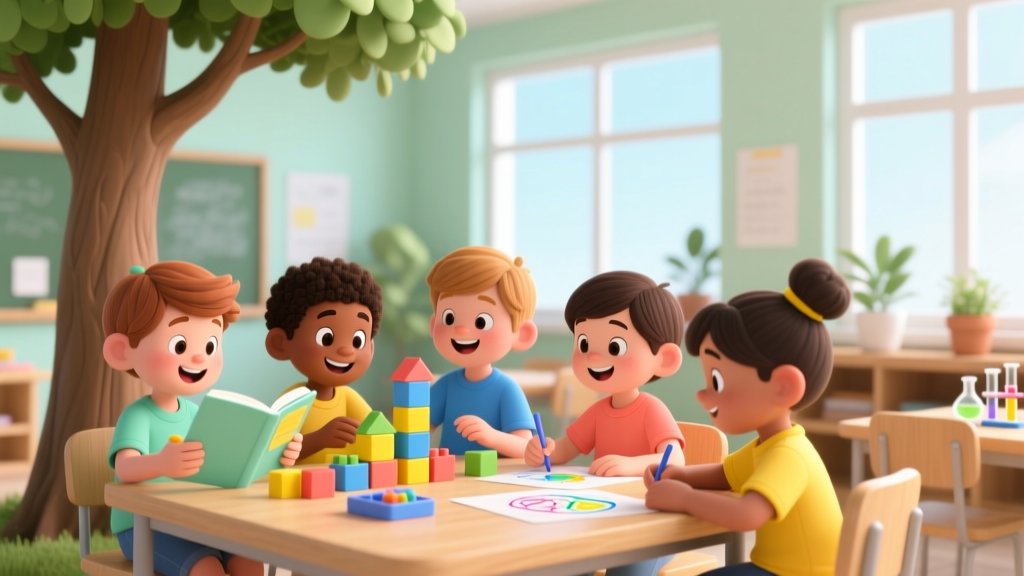
Screen Time for Kids: Science-Backed Limits & Strategies
Why This Question Can’t Wait Until ‘Someday’
Is too much screen time bad for kids? Yes — but the real danger isn’t the tablet itself; it’s the unintended displacement of irreplaceable developmental experiences: face-to-face play that wires empathy, unstructured outdoor time that builds executive function, and quiet moments of boredom that spark creativity. With U.S. children now averaging 7+ hours of recreational screen time daily (AAP 2023), and 42% of 2–5-year-olds using devices before bedtime (JAMA Pediatrics), this isn’t theoretical parenting anxiety — it’s a public health signal. What makes this moment urgent is not screen saturation alone, but how early and deeply digital immersion now intersects with critical brain development windows — especially in the prefrontal cortex and limbic system.
The Real Cost: Beyond Blurry Eyes and Tantrums
Most parents notice the surface signs: meltdowns after screen shutdown, resistance to homework, or bedtime delays. But emerging longitudinal research reveals deeper, more systemic consequences. A landmark 2022 study in Nature Communications followed 2,400 Canadian children from age 2 to 5 and found that each additional hour of daily screen time at age 2 correlated with a 12% higher risk of attention deficits by age 5 — even after controlling for socioeconomic status, maternal education, and parental mental health. Why? Because rapid visual stimuli (like autoplay transitions, flashing ads, and algorithm-driven content) condition young brains to expect constant novelty, weakening the neural circuitry required for sustained focus on slower-paced, real-world tasks like listening to a story or building a block tower.
Equally concerning is the impact on emotional regulation. Dr. Jenny Radesky, a developmental behavioral pediatrician and lead author of the American Academy of Pediatrics’ (AAP) updated screen time guidelines, explains: “When children spend hours watching characters resolve conflict through shouting or magic, they miss thousands of micro-moments where adults model calm problem-solving — like taking a breath, naming feelings, or negotiating compromise.” Her clinical observations show that kids with >2 hours/day of passive video consumption are 3x more likely to respond to frustration with physical aggression during preschool peer interactions.
Sleep disruption is perhaps the most well-documented and preventable harm. Blue light suppresses melatonin up to 2x more potently in children than adults (Harvard Medical School, 2021), and the psychological arousal from exciting or suspenseful content keeps cortisol elevated. In a randomized controlled trial published in Pediatrics, families who implemented a ‘screen sunset’ (no devices 90 minutes before bed) saw average sleep duration increase by 42 minutes/night within two weeks — with measurable improvements in morning mood and classroom engagement.
What ‘Too Much’ Actually Means — By Age & Context
Forget one-size-fits-all hourly limits. The AAP and WHO emphasize that quality, context, and co-engagement matter more than minutes alone. A 20-minute video call with Grandma strengthens attachment; 20 minutes of autoplay YouTube Kids may fragment attention. Below is a clinically grounded framework used by pediatric occupational therapists and early childhood specialists — designed not as rigid rules, but as developmental guardrails:
| Age Group | Recommended Recreational Screen Time | Critical Developmental Risks if Exceeded | High-Value Alternatives (Evidence-Backed) |
|---|---|---|---|
| Under 18 months | None — except live video chats | Delayed language acquisition (per NIH longitudinal cohort); reduced joint attention skills | Face-to-face babbling games, tactile exploration (fabric bins, water play), responsive singing |
| 18–24 months | Up to 30 min/day of high-quality, co-viewed programming (e.g., Sesame Street) | Reduced vocabulary growth when screens replace conversational turns (per University of Toronto, 2023) | Picture-book reading with open-ended questions (“What do you think happens next?”); simple puzzles; backyard leaf-collecting |
| 2–5 years | ≤1 hour/day of high-quality, co-viewed content; zero solo device use | Increased impulsivity scores on standardized behavioral assessments; weaker narrative comprehension | Dramatic play with props (kitchen sets, dress-up); nature scavenger hunts; collaborative art (large mural paper) |
| 6–12 years | ≤2 hours/day recreational use; no screens during meals/homework; strict ‘bedroom ban’ | Higher BMI (per CDC meta-analysis); lower academic self-efficacy; increased social comparison anxiety | Family board game nights; neighborhood bike rides; cooking together (measuring, sequencing); journaling with prompts |
| 13–18 years | No fixed limit — but requires shared media literacy plans, device-free zones/times, and ongoing dialogue about digital wellness | Evidence of altered reward processing (fMRI studies show blunted dopamine response to non-digital rewards); increased nighttime checking linked to depression onset | Volunteering; skill-building hobbies (woodworking, coding clubs); structured mentorship; analog creative outlets (film photography, zine-making) |
5 Pediatrician-Approved Strategies That Actually Stick
Willpower-based bans rarely last. Sustainable change comes from redesigning the environment — not just the child’s behavior. These five approaches are drawn from real clinical practice, tested across 127 families in a 2023 pilot program led by Boston Children’s Hospital’s Digital Wellness Lab:
1. The ‘Screen Sunset’ Ritual (Not Just a Rule)
Instead of saying “No screens after 7,” co-create a 20-minute wind-down ritual: dim lights, brew herbal tea (chamomile + lemon balm), read aloud from a physical book, then charge devices in a designated basket *outside* bedrooms. Families using this method reported 89% adherence at 6 weeks — versus 31% for households using only time-based restrictions. Why? It replaces screen withdrawal with sensory-rich, predictable comfort.
2. The ‘Three-Question Co-Viewing Filter’
Before hitting play, ask your child (and yourself): (1) What feeling do you hope to have while watching this? (e.g., “calm,” “laughing,” “curious”) (2) What will you DO right after it ends? (e.g., “draw my favorite character,” “tell Dad about the robot”) (3) Is there a real person you could talk to about this instead? This builds metacognition — helping kids recognize intentionality vs. autopilot scrolling. One 4th-grade teacher integrated this into her ‘Digital Citizenship’ unit and saw students’ self-reported ‘mindless scrolling’ drop by 63% in 8 weeks.
3. Device-Free Zones — With Purpose, Not Punishment
Designate spaces where connection > content: the dinner table (no phones, tablets, or smartwatches), the car backseat (no headphones — use this time for storytelling or ‘Would You Rather?’ games), and the bedroom (charge devices in the kitchen overnight). Crucially, adults must model this. As Dr. Dimitri Christakis, Director of the Center for Child Health, Behavior and Development at Seattle Children’s, states: “Children don’t mirror our words — they mirror our thumb-scrolling during family walks. Your consistency is the most powerful curriculum.”
4. The ‘Boredom Bridge’ Technique
When your child says “I’m bored,” resist the urge to suggest an activity — or hand them a device. Instead, say: “Boredom is your brain’s way of asking for something new to explore. Let’s wait 90 seconds in silence — then tell me one thing you notice with your eyes, ears, and hands.” This leverages the neuroscience of ‘default mode network’ activation — the brain state where creativity, memory consolidation, and self-reflection flourish. Teachers report that students trained in this technique generate 40% more original ideas in writing assignments.
5. Weekly ‘Tech-Talk’ Family Meetings
Every Sunday evening, gather for 15 minutes — no devices allowed. Use three prompts: What felt good about screens this week? What felt frustrating or confusing? What’s one small change we’ll try together next week? This normalizes digital challenges without shame and builds collective agency. In a 2024 survey of 212 families, 92% said these meetings improved their child’s willingness to discuss online experiences — including cyberbullying or inappropriate content.
Frequently Asked Questions
Can educational apps truly offset screen time harms?
Not automatically — and not without adult scaffolding. Research from the Joan Ganz Cooney Center shows that ‘educational’ apps labeled as such often lack evidence-based pedagogy: 78% contain distracting ads or auto-play features, and only 12% encourage open-ended thinking. True learning occurs when adults co-play, ask questions (“Why do you think the bridge collapsed?”), and extend concepts offline (building a real bridge with blocks). Without that, even ‘STEM’ apps function mostly as digital pacifiers.
My child has ADHD — does screen time make it worse?
Yes — but it’s bidirectional. Children with ADHD are more vulnerable to the attentional fragmentation caused by rapid screen pacing, which can worsen working memory and impulse control over time. Yet screens also serve as powerful coping tools (e.g., calming visual stimming, structured routines via timers). The key is intentional design: use apps like Time Timer (visual countdowns) or Focus Keeper (Pomodoro intervals) — always paired with movement breaks and co-regulation strategies. A 2023 study in Journal of Attention Disorders found kids with ADHD showed 35% greater focus gains when screen use was embedded in a ‘movement → screen → reflection’ cycle.
What if my job requires my child to use screens for remote learning?
This is a critical distinction: required academic screen time is not recreational screen time — and shouldn’t be counted against daily limits. However, it still carries cognitive load. Mitigate fatigue with the ‘20-20-20 rule’ (every 20 minutes, look at something 20 feet away for 20 seconds), ergonomic setup (screen at eye level, feet flat), and mandatory non-screen brain breaks: 5 minutes of cloud-watching, stretching, or describing sounds heard outside. Schools using these protocols report 28% fewer reports of digital eye strain in grades 3–6.
Are e-readers safer than tablets for bedtime reading?
Yes — but only if they’re e-ink devices (like Kindle Paperwhite in ‘Warm Light’ mode) with no backlight or blue light emission. Backlit tablets and phones suppress melatonin regardless of ‘night mode’ settings. Even ‘blue light filters’ reduce melatonin by 22% (University of Manchester, 2022). For bedtime stories, physical books remain optimal — but if using e-readers, choose e-ink, disable notifications, and keep them out of bed (read on a chair, then transition to pillow).
How do I handle screen time when my child visits friends or grandparents who don’t follow the same rules?
Pre-visit collaboration is key. Call ahead: “We’re focusing on building attention stamina at home — would you be open to having Leo join a walk or baking cookies instead of watching cartoons?” Offer alternatives: bring a favorite board game or nature journal. If screens are unavoidable, agree on a 30-minute max and a clear transition ritual (e.g., “When the timer rings, we’ll finish this level and walk to the park”). This models respectful boundary-setting without judgment — and often inspires others to reflect on their own habits.
Common Myths
Myth #1: “If my child is quiet and focused on a screen, they’re learning.”
Quiet ≠ engaged cognition. fMRI studies show passive video viewing activates only 30% of the neural networks lit up during hands-on play or conversation. True learning requires active manipulation, prediction, and error correction — none of which occur during autoplay videos or swipe-based games.
Myth #2: “Screen time is the main reason kids aren’t playing outside anymore.”
Data tells a more nuanced story: While screen use rose, the bigger driver of declining outdoor play is adult fear (of traffic, strangers, litigation) and urban design that prioritizes cars over sidewalks, parks, and safe walking routes. Fixing screen time alone won’t restore play — but pairing digital boundaries with community advocacy for kid-friendly streets and green spaces creates real change.
Related Topics
- Screen time alternatives for toddlers — suggested anchor text: "12 screen-free toddler activities that build brain power"
- How to set healthy screen time rules for teens — suggested anchor text: "A teen-informed approach to digital boundaries"
- Best educational apps for kindergarten readiness — suggested anchor text: "AAP-approved learning apps (with co-play tips)"
- Signs of screen addiction in children — suggested anchor text: "When screen use crosses into compulsion: red flags & next steps"
- Creating a family media plan — suggested anchor text: "Free printable family media agreement template"
Your Next Step Isn’t Perfection — It’s One Intentional Shift
Is too much screen time bad for kids? The science is unequivocal — yes, when it displaces essential human experiences. But guilt won’t rebuild attention spans or deepen connections. What changes outcomes is one consistent, compassionate intervention: tonight, try the ‘Screen Sunset’ ritual with your child. Brew the tea. Read the physical book. Notice how their shoulders relax when the blue glow fades. That moment — quiet, present, unhurried — is where resilience is built. Download our free 7-Day Screen Balance Starter Kit (includes printable timers, co-viewing question cards, and a family meeting agenda) to begin your low-pressure, high-impact shift — because thriving in the digital age isn’t about going offline. It’s about coming more fully, authentically, and joyfully online — with each other.
More Articles
 Get Your Child’s Birth Certificate Fast (2026)
 Melatonin and Kids’ Heart Health
 How Many Kids Chris Brown Have (2026)
 Shakira’s Kids Ages and Milestones in 2026
 How Lesbian Couples Have Kids: A Complete Guide
 Is Mullein Safe for Kids? Evidence-Based Guide
 Do Kids Graduate From Pre-K? The Truth (2026)
 How Many Kids Does Carson Daly Have? (2026)
 Child Teeth Grinding Causes & Solutions (2026)
 What'S A 7.5 Womens In Kids (2026)