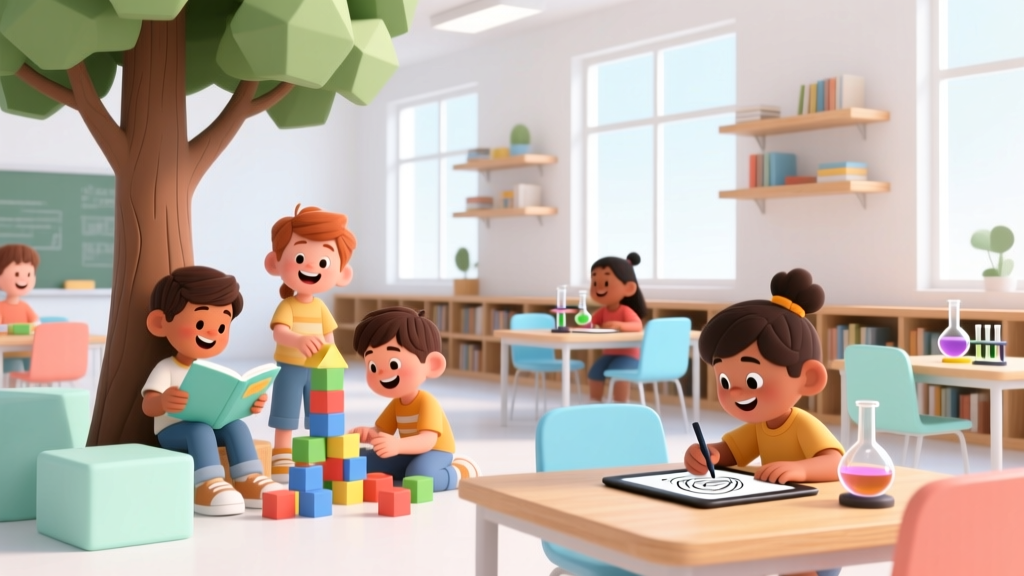
Is Technology Bad for Kids? Evidence-Based Answers
Why This Question Has Never Been More Urgent — And Why the Answer Isn’t Simple
Is technology bad for kids? That question pulses through pediatric waiting rooms, PTA meetings, and late-night scrolling sessions — and it’s more urgent than ever. With children under age 8 now averaging 2 hours and 19 minutes of daily screen time (Common Sense Media, 2023), and 42% of toddlers using tablets before age 2, parents aren’t just asking for opinions — they’re seeking grounded, developmentally informed clarity. The truth is, technology itself is neither villain nor savior; it’s a tool whose impact depends entirely on design, context, intention, and adult scaffolding. What makes this moment critical isn’t the devices themselves — it’s that we’re raising the first generation whose neural architecture, social wiring, and attentional habits are being shaped in real time by algorithmically optimized interfaces designed for engagement, not growth.
What the Science Actually Says — Beyond the Headlines
Let’s start with what decades of longitudinal research confirm: technology isn’t inherently harmful — but unstructured, unsupervised, or developmentally mismatched use is. A landmark 2022 study published in JAMA Pediatrics followed 2,441 Canadian children from ages 2 to 5 and found that each additional hour of screen time at age 2 correlated with a 7% higher risk of expressive language delay by age 3 — but only when that screen time replaced interactive play or caregiver conversation. Crucially, children who used high-quality, co-viewed educational apps (like those validated by the Fred Rogers Center) showed no language delays — and in some cases, modest gains in vocabulary acquisition.
This nuance matters because it shifts the focus from screen time limits alone to experience quality and relational context. According to Dr. Jenny Radesky, developmental behavioral pediatrician and lead author of the American Academy of Pediatrics’ (AAP) 2016 and 2023 screen time guidelines, “It’s not the device that changes brain development — it’s whether the child is actively processing, responding, and connecting. Passive consumption rewires attention circuits differently than interactive, responsive, or creative use.”
Consider Maya, a 4-year-old in Portland whose parents replaced background TV with 20 minutes of shared iPad storytelling using the app Tales of Tahuti. They paused to ask questions (“What do you think she’ll do next?”), drew characters afterward, and acted out scenes. Within 8 weeks, her preschool teacher noted improved narrative sequencing and sustained attention during circle time — not because the tablet was ‘good,’ but because it became a scaffold for human-led learning.
The Three Pillars of Healthy Tech Integration
Rather than chasing arbitrary time limits, leading child development specialists recommend anchoring tech use in three non-negotiable pillars: Intentionality, Interactivity, and Integration.
- Intentionality: Every screen session begins with a clear ‘why.’ Is it to learn letter sounds? To connect with Grandma? To calm sensory overload? If the purpose isn’t named — aloud, to the child — it defaults to habit or avoidance.
- Interactivity: The child must be an active agent, not a passive recipient. Swiping, choosing, creating, narrating, problem-solving, or co-viewing with commentary all qualify. Watching autoplay videos or algorithmic feeds — even ‘educational’ ones — does not.
- Integration: Tech use must flow into offline life. A coding game should spark block-building. A nature documentary should lead to backyard observation. An art app should end with paper, glue, and glitter. Without this bridge, digital experiences remain isolated neural events — not building blocks for holistic development.
These pillars transform tech from a potential disruptor into a catalyst. In a 2021 pilot program across 17 Montessori-aligned preschools, teachers trained in intentional integration saw a 31% reduction in off-task behavior during transition times — not by banning tablets, but by using them as deliberate ‘focus bridges’: 3-minute guided breathing animations before circle time, followed by tactile breathing buddies (stuffed animals with weighted bellies).
Your Age-by-Age Tech Compass — What Works, What Doesn’t, and Why
Developmental readiness matters more than calendar age — but age ranges provide essential guardrails. Below is a research-backed framework aligned with AAP, Zero to Three, and the Erikson Institute’s neurodevelopmental milestones:
| Age Range | Brain & Behavior Priorities | High-Value Tech Use | Risks of Misalignment | Parent Action Step |
|---|---|---|---|---|
| 0–2 years | Sensory integration, joint attention, babbling reciprocity, motor planning | Video calls with trusted adults (with caregiver co-participation); audio-only stories (e.g., podcasts like Circle Round) | Background TV reduces parent-child verbal exchanges by 50% (University of Washington, 2020); fast-paced visuals impair sustained attention circuitry | Use a physical timer (not device-based) for any screen use; always sit side-by-side, narrating what’s happening (“Look — Grandma’s waving! Can you wave back?”) |
| 3–5 years | Symbolic play, emotional regulation, phonemic awareness, fine motor control | Co-played creation apps (Toca Life World, Stop Motion Studio); voice-recorded storytelling; simple coding games (Code-a-Pillar) | Algorithm-driven autoplay erodes impulse control; excessive passive viewing correlates with poorer self-regulation scores (Pediatrics, 2023) | Pre-load 1–2 apps per device; disable notifications, autoplay, and in-app purchases; require verbal request (“Can I make a story?”) before unlocking |
| 6–9 years | Executive function growth, perspective-taking, collaborative problem solving, identity exploration | Family media projects (podcast recording, stop-motion films); research-based learning platforms (Khan Academy Kids, ScratchJr); safe, moderated creative communities (Minecraft Education Edition) | Unsupervised social media exposure increases anxiety symptoms by 34% (NIH Adolescent Brain Cognitive Development Study, 2024); comparison culture begins early | Install Screen Time or Google Family Link with time-based (not just bedtime) limits; co-create a ‘Digital Citizenship Charter’ outlining expectations for kindness, privacy, and help-seeking |
| 10–13 years | Abstract reasoning, moral reasoning, peer validation sensitivity, emerging autonomy | Project-based learning (designing websites, editing videos, building Arduino prototypes); ethical AI literacy modules; curated news literacy tools (New York Times Learning Network) | 24/7 connectivity disrupts sleep architecture (melatonin suppression peaks at 11pm); cyberbullying incidents rise sharply without adult-coached response protocols | Implement ‘Charging Station’ outside bedrooms; conduct monthly ‘Tech Check-Ins’ (not interrogations) using open-ended prompts: “What made you proud online this week? What felt confusing or uncomfortable?” |
Turning Anxiety Into Agency — Your 7-Day Intentional Tech Reset
Feeling overwhelmed? Don’t overhaul — observe, then adjust. This science-informed reset builds awareness before action:
- Day 1–2: Audit & Map — Track all screen use (yours and theirs) for 48 hours: device, duration, purpose (e.g., “YouTube — distraction during sibling conflict”), and emotional state before/after. Note patterns: Is screen use highest during transitions? Does it spike when you’re tired?
- Day 3: Co-Design One ‘Tech Anchor’ — Choose one daily routine (morning, after-school, dinner prep) to redesign. Example: Replace 15 minutes of solo tablet time with a ‘Family Soundtrack’ ritual — everyone chooses one song, discusses why, then draws its mood. Tech is present (playing music), but humans drive meaning.
- Day 4: Upgrade One App — Audit one frequently used app. Does it encourage creation or consumption? Does it require reading or tapping reflexes? Swap one passive app (e.g., generic YouTube Kids) for an active alternative (e.g., Book Creator for making digital storybooks).
- Day 5: Build a ‘Pause Protocol’ — Agree on a universal signal (e.g., hand over heart) meaning “I need a tech break.” Practice it — no explanation needed. This builds self-regulation muscle without shame.
- Day 6: Conduct a ‘Benefit Scan’ — For each regular tech activity, ask: “What specific skill, connection, or joy does this uniquely provide? Could we get 80% of that offline?” If not — keep it. If yes — prototype an analog version.
- Day 7: Celebrate Micro-Wins — Acknowledge one small shift: “I noticed you asked for the tablet *after* finishing your puzzle today — that shows growing awareness!”
This isn’t about perfection. It’s about moving from reactive restriction to proactive design — where technology serves your family’s values, not the other way around.
Frequently Asked Questions
Does ‘educational’ screen time really boost learning — or is it just marketing?
Research confirms some educational media delivers measurable benefits — but only under strict conditions. A 2023 meta-analysis in Early Childhood Research Quarterly found significant vocabulary gains only when: (1) content was co-viewed and discussed, (2) apps required active manipulation (not just tapping), and (3) concepts were reinforced offline within 24 hours. Apps like Endless Alphabet show strong results because they demand vocalization, sequencing, and tactile feedback — unlike passive letter-recognition videos. The key isn’t the label ‘educational’ — it’s whether the experience mirrors high-quality, responsive human teaching.
My child has meltdowns when screens are taken away — is this addiction, or something else?
What looks like ‘addiction’ is usually underdeveloped emotional regulation skills meeting a highly stimulating, dopamine-rich environment. Neuroscientist Dr. Victoria Dunckley, author of Reset Your Child’s Brain, explains: “Screens don’t cause addiction in the clinical sense for most children — but they can become a primary coping mechanism when kids haven’t practiced calming their nervous system through breath, movement, or connection.” Instead of labeling, try this: When meltdown begins, kneel to eye level and say, “Your body feels big right now. Let’s breathe together — in for 4, hold for 4, out for 4.” Do this before screen time starts, building regulation capacity proactively.
How much screen time is ‘safe’ for my 7-year-old?
The AAP moved away from rigid hour-based limits in 2023, emphasizing quality, context, and individual needs over quantity. Their updated guidance recommends: No screens 1 hour before bed; no screens during meals or homework unless integral to the task; and co-viewing for children under 12. For a 7-year-old, aim for intentional use: 30–45 minutes of creative or learning-focused tech, balanced by 2+ hours of unstructured play, physical movement, and face-to-face interaction. What matters most isn’t the clock — it’s whether screen time displaces foundational developmental activities.
Are parental controls effective — or do they just create secrecy?
Controls work best as temporary scaffolds, not long-term locks. University of Michigan researchers found that families using controls plus ongoing dialogue had stronger digital citizenship outcomes than those using controls alone. Start with transparency: “We’re using these settings to help us both learn how to make good choices — like how we use seatbelts in the car.” Gradually relax controls as trust and competence grow, replacing restrictions with shared reflection: “What happened when you clicked that link? How did your body feel? What would you do differently?”
Debunking Two Persistent Myths
- Myth #1: “Screen time damages children’s eyes permanently.” While digital eye strain (dryness, blurred vision, headaches) is real and rising — especially with poor posture and blue light exposure — there’s no credible evidence that screens cause permanent structural damage like myopia progression. However, research from the National Eye Institute shows that lack of outdoor time is the strongest modifiable risk factor for childhood myopia. So the real prescription? 2+ hours of daylight exposure daily — which also happens to reduce screen time organically.
- Myth #2: “If it’s not violent or explicit, it’s automatically safe.” Content safety isn’t binary. Algorithm-driven platforms (even ‘kid-safe’ versions) optimize for watch time — meaning they serve increasingly intense, emotionally charged, or novelty-driven content to retain attention. A 2024 Mozilla Foundation audit found that 78% of YouTube Kids videos recommended after innocuous searches contained unexpected commercial messaging, jump cuts, or rapid visual pacing — all known contributors to attention fragmentation in developing brains.
Related Topics (Internal Link Suggestions)
- Screen time rules for toddlers — suggested anchor text: "toddler screen time guidelines"
- Best educational apps for preschoolers — suggested anchor text: "top-rated learning apps for ages 3–5"
- How to talk to kids about online safety — suggested anchor text: "age-appropriate digital citizenship conversations"
- Non-screen activities for rainy days — suggested anchor text: "indoor play ideas that build focus and creativity"
- Signs of tech-related anxiety in children — suggested anchor text: "when screen use signals deeper emotional needs"
Conclusion & Your Next Step
Is technology bad for kids? No — but unexamined, unbalanced, or unconnected technology use absolutely can be. You don’t need to eliminate devices to raise resilient, curious, empathetic children. You need a plan rooted in your child’s unique development, your family’s values, and the best available science — not fear or fads. Start small: tonight, choose one screen habit to observe without judgment. Notice what happens before, during, and after. That awareness — gentle, curious, and compassionate — is the first, most powerful act of intentional parenting. Ready to go deeper? Download our free Intentional Tech Family Toolkit — including printable age-specific checklists, conversation starters, and vetted app recommendations — at [yourdomain.com/toolkit].
More Articles
 How Many Biological Kids Does Nelly Have? (2026)
 Kids Shoe Sizes: Age-by-Age Guide (2026)
 Is Kicking and Screaming Appropriate for Kids? (2026)
 Christmas Gifts for Kids: Stress-Free 7-Step Checklist
 What Is “6 7” on TikTok? A Parent’s Guide (2026)
 Chili's Kids Eat Free Nights: Truth & Rules (2026)
 How to Read Outsider Kids Ebook for Free (2026)
 Vanderbeek Kids’ Ages: What Parents Really Want (2026)
 Best Tablet for Kids in 2026: Pediatrician-Vetted
 Missing Kids in Virginia: Facts & Safety Steps (2026)