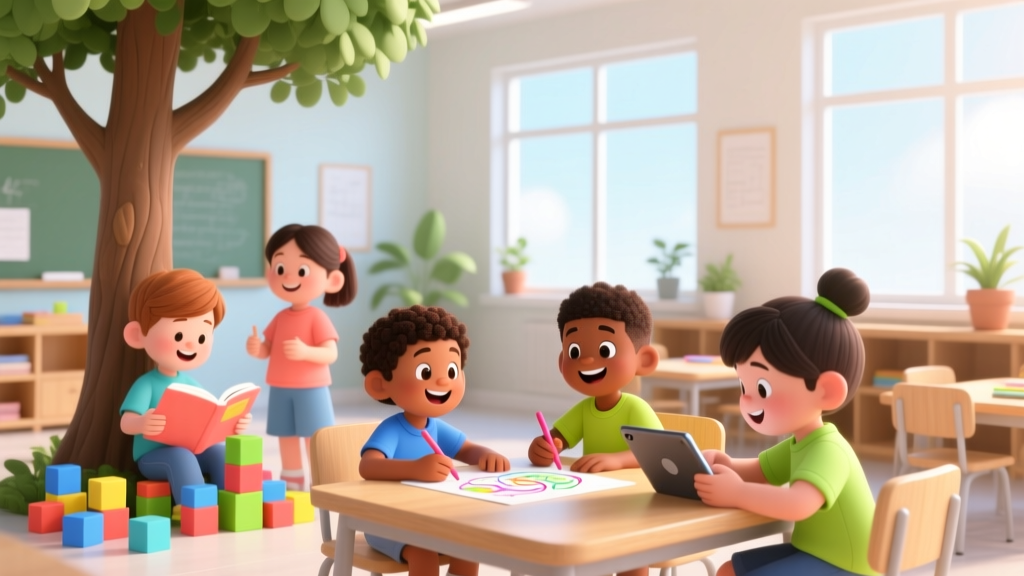
Kindergarten Readiness: Signs, Skills & Checklist
Is Your Child Truly Ready—or Just Chronologically Eligible?
Every August, thousands of parents quietly whisper the same question: is my kid ready for kindergarten? It’s not just about turning five—it’s about whether your child can sit through circle time without melting down, follow two-step directions during transitions, hold a pencil with emerging control, and separate from you without prolonged distress. And yet, many families rely on vague advice like “they’ll be fine” or compare their child to siblings or neighbors—missing subtle but critical developmental signals that predict early academic engagement, peer relationships, and even long-term confidence. With kindergarten expectations rising nationwide—and nearly 30% of U.S. districts now requiring formal readiness screenings (National Center for Education Statistics, 2023)—this isn’t a philosophical question. It’s a practical, evidence-informed one.
What Kindergarten Readiness *Really* Means (Hint: It’s Not Just ABCs)
Kindergarten readiness isn’t a single milestone—it’s a dynamic interplay of four core domains: social-emotional development, language and communication, early literacy and numeracy foundations, and physical independence. According to Dr. Laura Jana, pediatrician and co-author of The Toddler Brain, “Readiness isn’t about knowing all letters or counting to 100. It’s about having the self-regulation to wait for a turn, the language to ask for help, and the motor skills to manage a lunchbox—skills that predict classroom success more reliably than early academics.”
Consider Maya, a bright 5-year-old who could recite the alphabet backward and identify 20 sight words—but struggled to transition between activities, frequently cried when asked to clean up, and avoided group play. Her preschool teacher recommended a year of transitional kindergarten. By age six, Maya entered mainstream kindergarten with strong executive function strategies in place—and outperformed peers academically within months. Her story underscores what decades of longitudinal research confirm: social-emotional readiness is the strongest predictor of kindergarten success (Duncan et al., Developmental Psychology, 2019).
So how do you assess it objectively? Start by observing—not testing. Watch your child for at least three days across different settings: at home during unstructured play, at a library storytime, and during a short group activity like a park playdate. Note patterns—not isolated incidents. Does she initiate conversations? Can he re-engage after disappointment? Does she persist with a puzzle for more than 90 seconds? These micro-behaviors reveal far more than flashcards ever could.
The 5-Minute Home Observation Checklist (No Worksheets Required)
Forget standardized assessments for now. Try this low-pressure, real-world observation method used by early intervention specialists:
- Observe listening stamina: Read aloud for 8–10 minutes. Does your child stay seated, make eye contact, and answer simple ‘what happened next?’ questions—or does attention drift after 2–3 minutes, with fidgeting or wandering?
- Test direction-following: Give a two-step instruction (“Please put your shoes in the closet, then bring me your water bottle”). Does your child complete both steps in order, without repeating the request?
- Assess frustration tolerance: Introduce a mildly challenging task—like building a tower with 10 blocks. Note: Does she take a breath and try again after it falls? Or does she throw blocks, yell, or shut down entirely?
- Evaluate self-care independence: Watch her get dressed, wash hands, and use the toilet—including wiping, flushing, and handwashing independently. Can she manage zippers/buttons? Open a lunchbox? Wipe her own nose?
- Check peer interaction: In a small group setting, does she take turns, share materials (even briefly), respond to others’ emotions (“Are you sad?”), and resolve minor conflicts with words instead of hitting or grabbing?
If your child consistently meets ≥4 of these 5 benchmarks, they’re likely on track. If only 1–2 are met—even with advanced letter knowledge—consider consulting your district’s early childhood team. As Dr. Rebecca London, education researcher at UC Santa Cruz, emphasizes: “We’ve conflated ‘advanced’ with ‘ready.’ A child who reads at age four but can’t manage big feelings will struggle more than one reading at grade level with solid self-regulation.”
When ‘Almost Ready’ Is Actually ‘Needs Strategic Support’
Many children fall into the gray zone: socially sweet but easily overwhelmed; verbally fluent but unable to retell a simple story; physically coordinated but unwilling to try new tasks. This isn’t failure—it’s data. And it’s where targeted, joyful interventions make all the difference.
For emotional regulation gaps: Introduce the “Zones of Regulation” framework using color-coded emotion cards (blue = tired/sad, green = calm/focused, yellow = excited/frustrated, red = angry/scared). Practice identifying zones daily—not as labels, but as weather reports for feelings. A 2022 study in Early Childhood Research Quarterly found children who used Zones vocabulary for 10 minutes/day over 6 weeks showed 42% faster de-escalation during classroom meltdowns.
For language & narrative gaps: Ditch rote drills. Instead, narrate your child’s world: “You’re stacking the red block *on top* of the blue one—that’s a tall tower! What happens if we add the green one *next to* it?” Use spatial, temporal, and descriptive words naturally. Then, reverse roles: Ask your child to tell *you* how to build something. This builds sequencing, vocabulary, and perspective-taking simultaneously.
For fine motor & independence lags: Embed practice into routines—not worksheets. Have them peel bananas, tear lettuce for salads, snap buttons on dolls’ clothes, or use tongs to move pom-poms. Occupational therapists report these functional tasks build hand strength and coordination 3x faster than pencil-grip drills alone.
Crucially: Avoid “summer crash courses.” Rushed skill-building increases anxiety and undermines intrinsic motivation. As Montessori educator Maria Montessori wrote, “The child is not a blank slate to be filled, but a living organism seeking to develop itself.” Meet them where they are—with scaffolding, not pressure.
Kindergarten Readiness Benchmarks: What Experts Actually Measure
While districts vary, most use frameworks aligned with the National Association for the Education of Young Children (NAEYC) and AAP guidelines. The table below synthesizes key benchmarks observed by kindergarten teachers, early intervention specialists, and pediatricians—not based on arbitrary cutoffs, but on documented thresholds for sustainable classroom participation.
| Domain | Typical Expectation (Age 5–5.5) | Red Flag Threshold | Support Strategy |
|---|---|---|---|
| Social-Emotional | Separates from caregiver with brief reassurance; takes turns in games; names 2+ emotions in self/others | Frequent meltdowns lasting >15 mins; avoids all peer interaction; cannot name any emotion | Use emotion charades + “feelings thermometer” visuals; practice separation with 5-min timed goodbyes |
| Language & Communication | Tells 3+ sentence stories with beginning/middle/end; follows 2–3 step directions; asks clarifying questions | Uses <50 words; rarely initiates conversation; confuses pronouns (he/she/they); omits word endings (-ing, -ed) | Play “story chain” games; model expansions (“You built a tower → Yes, I built a tall, wobbly tower!”); consult speech-language pathologist |
| Literacy Foundations | Recognizes own name in print; matches sounds to letters (e.g., “B says /b/”); identifies rhyming words | No letter-sound awareness; cannot rhyme common words (cat/hat); reverses letters consistently (b/d, p/q) beyond age 6 | Play sound scavenger hunts (“Find something that starts with /m/!”); sing nursery rhymes with exaggerated rhymes; avoid forcing writing |
| Motor & Independence | Cuts along lines with scissors; copies basic shapes (circle, square, cross); manages bathroom routine independently | Cannot hold pencil in tripod grasp; avoids all drawing/writing; requires full assistance for toileting | Strengthen hands with playdough, tweezers, and stringing beads; practice dressing with Velcro/zippers first; consult OT if grip is painful or weak |
Frequently Asked Questions
My child knows all letters and numbers—why would they not be ready?
Academic precocity doesn’t guarantee readiness. Kindergarten demands sustained attention, flexible thinking, and emotional resilience—not just recall. A child who reads fluently but melts down when asked to share markers may lack the self-regulation needed for collaborative learning. In fact, research shows academically advanced children with poor social-emotional skills are at higher risk for burnout and disengagement by third grade (Rimm, Gifted Child Quarterly, 2021). Focus on balancing cognitive growth with emotional scaffolding.
Should I delay kindergarten if my child has a summer birthday?
“Redshirting” (delaying entry) isn’t inherently beneficial—and may backfire. A landmark 2022 Stanford study tracking 15,000 children found summer-born kindergarteners who started on time had better long-term social outcomes and equal academic performance by fifth grade compared to delayed peers. What matters more is *quality of support*, not extra time. If your child shows readiness gaps, target them with play-based interventions—not calendar-based decisions.
How do I talk to my child’s preschool teacher about readiness concerns?
Frame it collaboratively: “I’m trying to understand how [Child] is doing in areas like following group directions or managing frustration—I’d love your observations and any suggestions for supporting those skills at home.” Avoid leading questions (“Do you think they’re behind?”). Instead, ask: “What strengths do you see? Where do they need the most scaffolding right now?” Teachers are invaluable partners—but they observe your child in context you can’t replicate.
Our district offers no screening—how do I get help?
Contact your public school district’s Early Childhood Special Education (ECSE) team directly—even if you’re not enrolled. Federal law (IDEA Part B) guarantees free developmental screenings for children ages 3–5. You don’t need a referral. Simply call and say: “I’d like to request a developmental screening for my child before kindergarten.” Most districts schedule these within 30 days. Results provide objective data—not diagnoses—to inform your decision.
Debunking Two Common Kindergarten Readiness Myths
- Myth #1: “If they’re not reading by 5, they’ll fall behind forever.”
False. The National Institute of Child Health and Human Development confirms that children who begin formal reading instruction at age 6–7 show no long-term deficits—and often demonstrate stronger comprehension and motivation. What matters is oral language foundation, not decoding speed. Pushing early reading can trigger anxiety and negative associations with books.
- Myth #2: “Kindergarten is just play—no need to prepare.”
Outdated. Today’s kindergarten curricula cover 90+ minutes of literacy instruction daily, introduce foundational math concepts (counting to 100, composing/decomposing numbers), and expect independent work habits. But “preparation” means nurturing curiosity, resilience, and communication—not drilling worksheets. Play *is* the preparation—when it’s rich, open-ended, and socially engaged.
Related Topics (Internal Link Suggestions)
- Transitional Kindergarten Programs — suggested anchor text: "what is transitional kindergarten and is it right for my child"
- Preschool vs. Pre-K Differences — suggested anchor text: "preschool versus pre-k: which program builds true kindergarten readiness"
- Executive Function Skills for Kids — suggested anchor text: "executive function activities for preschoolers"
- Kindergarten Supply List Essentials — suggested anchor text: "kindergarten must-haves: what teachers really want"
- Back-to-School Anxiety Relief — suggested anchor text: "how to ease kindergarten separation anxiety"
Your Next Step Starts With One Honest Observation
There’s no universal “ready” switch—and no shame in choosing an extra year of growth, support, or play. What matters is making that choice with clarity, not confusion. So today, pick just one item from the 5-Minute Home Observation Checklist. Observe your child for 10 minutes—not with a stopwatch or checklist, but with warm, curious attention. Notice what they *can* do—not just what they can’t. That shift—from deficit-focused to strength-based—is where true readiness begins.
Then, download our free Kindergarten Readiness Snapshot Guide—a printable, non-judgmental tool with visual prompts, sample scripts for talking with teachers, and a timeline for gentle skill-building. Because readiness isn’t a destination. It’s a relationship—with your child, their pace, and the quiet, steady confidence that grows when we meet them exactly where they are.
More Articles
 Ashwagandha for Kids: Pediatrician Advice (2026)
 529 Plan Options If Your Kid Doesn’t Go to College
 Did Toby Keith Have Kids? Truth, Parenting Tips & More
 Jackie Robinson’s Parenting Lessons (2026)
 When to Keep Kids Home From School: Pediatrician Checklist
 Cheap Toys for Kids: Safe, Educational & Budget-Friendly
 Is Naruto for Kids? Evidence-Based Age Guide (2026)
 Is School Good for Kids? Evidence-Based Alternatives
 Shielding Kids from Traumatic Media Exposure
 Bad Bunny Halftime Kid: What Parents Need to Know