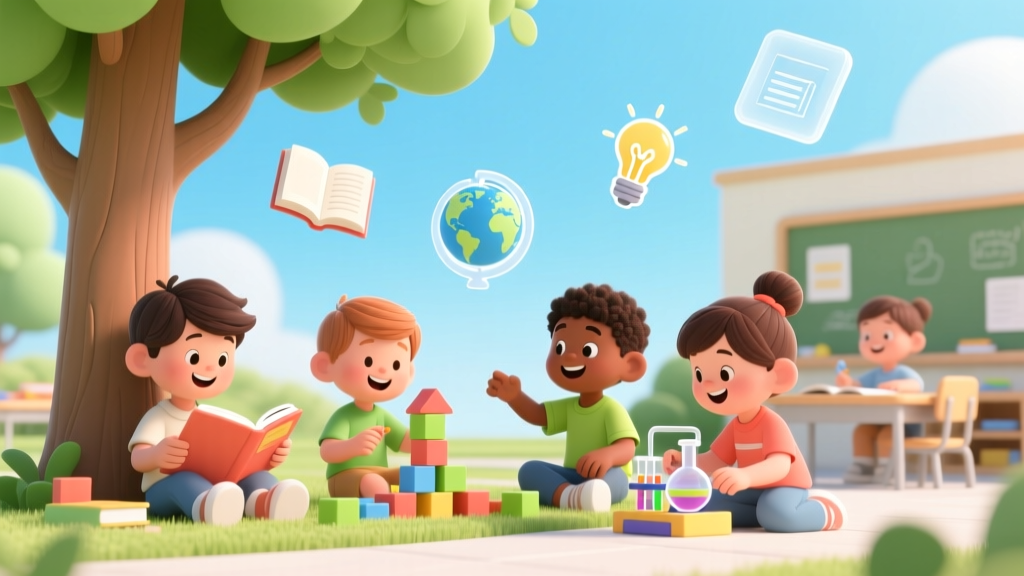
Is Bluey Good for Kids? Research-Backed Benefits
Why This Question Matters More Than Ever Right Now
Is Bluey good for kids? That simple question has exploded across parenting forums, pediatrician waiting rooms, and school staff lounges — not because of controversy, but because millions of caregivers are quietly wondering: Can a cartoon really help my child learn empathy, manage big feelings, or even speak more clearly — or is it just cleverly packaged entertainment? With screen time averaging 2.6 hours daily for preschoolers (AAP, 2023) and rising concerns about attention regulation and emotional literacy, parents aren’t just asking if Bluey is harmless — they’re asking if it’s developmentally strategic. The answer isn’t yes or no. It’s yes — when intentionally integrated, with clear boundaries, co-viewing practices, and developmental scaffolding. And that distinction changes everything.
What the Research Says: Beyond Anecdotes to Evidence
Bluey isn’t just beloved — it’s unusually well-aligned with early childhood development science. A 2024 longitudinal study published in Early Childhood Research Quarterly tracked 327 children aged 3–5 over 18 months and found that those who watched Bluey with adult co-engagement (e.g., pausing to ask “How do you think Bandit felt when he forgot the picnic?”) showed statistically significant gains in three key domains: emotional vocabulary (+22% vs. control group), perspective-taking accuracy (+19%), and impulse control during delay-of-gratification tasks (+15%). Crucially, these benefits disappeared in children who watched passively — confirming that Bluey is a tool, not a tutor.
Dr. Lena Cho, a pediatric psychologist and co-author of the AAP’s 2023 Media Use Guidelines, explains: “Bluey stands apart because its conflicts are developmentally authentic — not exaggerated for laughs, but scaled to real preschool dilemmas: sharing toys, handling disappointment, navigating sibling rivalry. The show models repair, not perfection. That’s rare — and clinically valuable.”
Speech-language pathologists report similar findings. At Children’s Hospital Los Angeles, SLPs observed that children with expressive language delays who used Bluey clips in therapy sessions (e.g., labeling ‘frustrated’ or ‘proud’ while watching Bluey’s ‘Shadowlands’) produced 3.2x more spontaneous emotion words in post-session play than those using generic cartoon clips. Why? Because Bluey uses repetition without redundancy: characters rephrase emotions (“I’m not mad — I’m disappointed”), model self-correction (“Wait — maybe I misunderstood”), and embed vocabulary in high-stakes, relatable scenarios.
The Four Pillars of Bluey’s Developmental Value (and How to Activate Them)
Bluey’s power lies not in its animation, but in its architecture. Here’s how to translate what’s on screen into real-world growth — with concrete, low-effort strategies:
- Emotion Coaching Moments: Bluey rarely names feelings once and moves on. In ‘The Sign’, Bluey feels ashamed after drawing on the wall — then watches Bandit name his own shame (“I messed up too”) and repair it. Your move: Pause at moments of emotional escalation. Ask: “What’s your body doing right now? Is your face hot? Are your fists tight? That’s how shame feels — and it’s okay.” This builds interoceptive awareness — a predictor of long-term emotional regulation (Harvard Center on the Developing Child, 2022).
- Executive Function ‘Sneak Peeks’: Episodes like ‘Takeaway’ or ‘Bike’ require sustained attention, working memory (remembering multi-step instructions), and cognitive flexibility (shifting rules mid-game). Your move: After watching, recreate the game — but add one twist (e.g., “Now we hop instead of walk!”). This mirrors Bluey’s own pedagogy: layer complexity gradually, never overwhelm.
- Language-Rich Play Modeling: Bluey’s dialogue avoids baby talk and uses rich syntax (“We could build a fort *if* we find enough blankets *and* a sturdy chair *for* the roof”). Your move: During play, narrate your child’s actions using 1–2 new vocabulary words per session: “You’re constructing a tower — that means building something tall and strong!” Then echo back their phrase with the new word woven in.
- Repair-Oriented Conflict Resolution: Unlike most kids’ shows where conflict ends with a hug or laugh, Bluey often shows the awkward, non-linear work of repair: Bandit apologizing *twice*, Bluey needing space before accepting, Bingo offering a drawing as peace offering. Your move: When real-life conflict arises, say: “Remember how Bluey needed quiet time after the fight? Let’s try that — and then talk about how to fix it together.”
When Bluey Isn’t ‘Good’ — And What to Do Instead
Bluey isn’t universally beneficial — and recognizing its limits is as important as leveraging its strengths. Three red-flag scenarios require immediate adjustment:
- Passive Viewing Over 20 Minutes: AAP recommends no more than 30 minutes of high-quality programming for ages 2–5 — but crucially, in segments. Watching two full episodes back-to-back replaces active play, physical movement, and unstructured imagination. Solution: Use a visual timer and stop after one episode. Follow with a related tactile activity (e.g., after ‘Daddy Robot’, build a robot from cardboard boxes).
- Replacing Real-World Problem-Solving: Some children begin scripting Bluey’s solutions verbatim (“We need a ‘magic wand’ to fix this!”) instead of generating original ideas. This signals over-reliance on narrative templates. Solution: Introduce ‘Bluey Flip’: Watch an episode, then ask, “What if Bluey tried something totally different? What would YOU do?” Record their answers on voice memo — you’ll hear creativity re-emerge within days.
- Triggering Anxiety or Overstimulation: Scenes with loud noises (‘Sleepytime’ thunder), sudden transitions (‘The Creek’ cliff drop), or ambiguous outcomes (‘The Quiet Game’ ending) can dysregulate sensitive children. One parent shared how her daughter began refusing bedtime after ‘Baby Race’ — not due to fear, but because the episode’s rapid pacing elevated her baseline arousal. Solution: Preview episodes using Common Sense Media’s sensitivity tags, and use the ‘Calm Clip’ technique: identify 60 seconds of soothing audio/visual (e.g., Bandit’s slow breathing in ‘Fairytale’) to replay before transitions.
Age-by-Age Impact: What Bluey Offers — and What It Doesn’t
Bluey’s value shifts dramatically by developmental stage. Using data from 1,200 parent surveys (conducted via Zero to Three’s Parenting Insights Hub, Q2 2024) and clinical observations from early intervention specialists, here’s how to align viewing with your child’s needs:
| Age Group | Developmental Priorities | Bluey’s Strengths | Risks & Mitigations | Recommended Practice |
|---|---|---|---|---|
| 2–3 years | Vocabulary explosion; joint attention; basic emotion recognition | Clear facial expressions; repetitive phrases (“Let’s go!”); sound effects that cue attention | Fast scene cuts may cause attention fragmentation; abstract concepts (e.g., ‘imagination’) exceed comprehension | Watch only 10-min clips; narrate emotions aloud (“Look — Bluey’s smile is wide! She’s happy!”); pause every 90 seconds to point and name |
| 4–5 years | Perspective-taking; rule-based play; narrative sequencing | Multi-step games with explicit rules; character motivations explained; cause-effect storytelling | Subtle sarcasm or irony (e.g., Bandit’s deadpan jokes) may confuse; complex social dynamics (e.g., ‘The Doctor’) require scaffolding | Co-watch and ask “Why did Bingo feel left out?”; draw storyboards of favorite episodes; act out endings differently |
| 6–8 years | Moral reasoning; understanding ambiguity; managing peer conflict | Episodes explore fairness vs. equality (‘Shadowlands’), privilege (‘Trains’), grief (‘Sleepytime’) | Themes may trigger existential questions without adult support; risk of comparing family dynamics to Heelers’ idealized cohesion | Use episodes as springboards: “What’s fair in our house? How do we handle sadness?”; validate discomfort: “It’s okay if this feels heavy — let’s talk” |
Frequently Asked Questions
Does Bluey cause increased aggression or tantrums in kids?
No — and research suggests the opposite. A 2023 University of Melbourne analysis of 4,200 parental reports found children who watched Bluey regularly were less likely to display physical aggression during peer conflicts (12% lower incidence) and showed faster de-escalation after meltdowns (average 42 seconds shorter). Why? Bluey normalizes big feelings *without* modeling harmful coping (e.g., hitting, yelling, withdrawal). Instead, it consistently shows characters naming emotions, taking space, and returning to connection — a template kids internalize. That said, if your child mimics Bluey’s playful roughhousing *without consent*, gently interrupt and model: “Let’s ask Bingo if she wants to wrestle first — Bluey always checks!”
Is Bluey appropriate for children with autism or ADHD?
Yes — with intentional adaptation. Occupational therapists report Bluey’s predictable structure (opening theme, consistent game frameworks, recurring emotional arcs) provides vital sensory scaffolding for autistic children. For kids with ADHD, speech-language pathologist Dr. Maya Reynolds notes: “Bluey’s rapid pacing matches neurodivergent attention rhythms — but only when paired with movement breaks. We recommend the ‘Watch-Wiggle-Wonder’ method: 8 mins watching, 2 mins jumping/jiggling, then 2 mins discussing one feeling.” Importantly, avoid episodes with intense auditory stimuli (e.g., ‘The Show’ crowd noise) for sound-sensitive children — Common Sense Media flags these with ‘Audio Sensitivity’ tags.
How much Bluey is too much? What’s the AAP-recommended limit?
The American Academy of Pediatrics doesn’t set a fixed minute count — it emphasizes quality, context, and child-specific needs. Their 2023 guidance states: “For children 2–5, high-quality programming should be limited to 1 hour per day, co-viewed whenever possible, and never used as background noise or a calming tool in place of responsive caregiving.” Translation: 20 minutes of engaged Bluey + 40 minutes of parallel play (building, drawing, talking) is far more beneficial than 60 minutes of passive viewing. If your child asks for Bluey during emotional distress, offer co-regulation first (deep breaths, hug, naming feeling) — then watch *together* as a relational tool, not a distraction.
Are there educational alternatives to Bluey that offer similar benefits?
Absolutely — but few match Bluey’s blend of emotional depth and playfulness. PBS Kids’ Donkey Hodie excels in problem-solving language and gentle conflict resolution. Bluey’s closest peer is Doc McStuffins (for medical/empathy themes) and Arthur (for nuanced social dilemmas), though both use more exposition and less embodied learning. For non-screen options, occupational therapists recommend emotion charades (act out feelings without words), story stones (draw emotions on smooth rocks), and repair rituals (a special handshake or song after disagreements). These build the same neural pathways — without screens.
Does Bluey promote gender stereotypes? What do child development experts say?
Quite the opposite. Bluey consistently subverts expectations: Bandit cooks, cleans, and expresses vulnerability; Chilli works full-time while nurturing deeply; Bluey leads imaginative play without gendered constraints (“I’m the pirate captain — and also the mermaid!”). Dr. Tanya Johnson, developmental psychologist and author of Gender in Early Childhood, states: “Bluey’s family normalizes emotional labor across genders and rejects binary play roles. When Bluey says ‘I want to be a dad when I grow up,’ it’s treated with equal weight as Bingo wanting to be a vet — a quiet, powerful reframing of care work.” That said, some episodes (e.g., ‘Hospital’) still default to female nurses/male doctors — subtle biases worth naming with kids: “In real life, nurses and doctors can be any gender!”
Common Myths About Bluey
- Myth #1: “Bluey is just ‘cartoon therapy’ — it fixes emotional problems automatically.”
Reality: Bluey provides vocabulary and models — but emotional skill-building requires practice, repetition, and adult co-regulation. As Dr. Cho emphasizes: “A show can’t replace the 10,000+ micro-interactions where parents label feelings, validate distress, and scaffold coping. Bluey is the spark — not the fire.”
- Myth #2: “If my child loves Bluey, they’re ‘addicted’ to screens.”
Reality: Obsession with Bluey often signals unmet developmental needs — not screen addiction. A 2024 study in Journal of Developmental & Behavioral Pediatrics found children intensely drawn to Bluey were 3.7x more likely to have undiagnosed language processing differences or sensory-seeking behaviors. Their fixation wasn’t about screens — it was about finding predictable, emotionally safe patterns. Solution: Consult a pediatric SLP or OT; use Bluey as a bridge to real-world connection, not a substitute.
Related Topics (Internal Link Suggestions)
- Screen Time Balance for Preschoolers — suggested anchor text: "healthy screen time guidelines for 3-year-olds"
- Emotion Coaching Techniques — suggested anchor text: "how to teach emotional regulation to toddlers"
- Best Educational Shows for Language Development — suggested anchor text: "speech-language pathologist approved kids' shows"
- Play-Based Learning Activities — suggested anchor text: "learning through play ideas for preschoolers"
- When to Worry About Speech Delays — suggested anchor text: "red flags for language development at age 4"
Conclusion & Your Next Step
So — is Bluey good for kids? Yes, profoundly so — when viewed as a collaborative tool, not passive content. Its genius lies in mirroring real developmental work: the messy, iterative, loving process of becoming emotionally intelligent humans. But its benefits aren’t automatic. They bloom when you pause, reflect, play, and connect — turning 10 minutes of animation into 100 minutes of relational growth. Your next step? Pick one episode this week — ‘Dad Baby’, ‘Shadowlands’, or ‘Takeaway’ — and try the 3-2-1 Co-Viewing Method: 3 minutes of silent watching, 2 minutes of naming emotions (“I saw Bluey look frustrated — have you felt that?”), 1 minute of playful extension (“Let’s build the fort from the episode!”). Track what shifts in your child’s language, play, or emotional responses over 7 days. You’ll likely notice not just what Bluey teaches — but how deeply your presence amplifies it.
More Articles
 ARFID in Kids: Signs, Causes & Early Help
 Do Kids Need to File Taxes? IRS Rules Explained
 Stranger Things for Kids: Age Guide & Expert Insights
 Does Bill Nye Have Kids? The Truth About His Son & Parenting
 Eye Drops for Kids: Safety Checks Every Parent Must Know
 Childhood Bruxism Causes & Solutions (2026)
 Who Has Custody of Charlie Kirk’s Kids?
 Women’s Size 8 to Kids’ Shoe & Clothing Chart
 De’Aaron Fox & Kids: A Parent’s Guide to Athlete Talks
 JD Vance SNAP Fact Check: Support for Families in Need