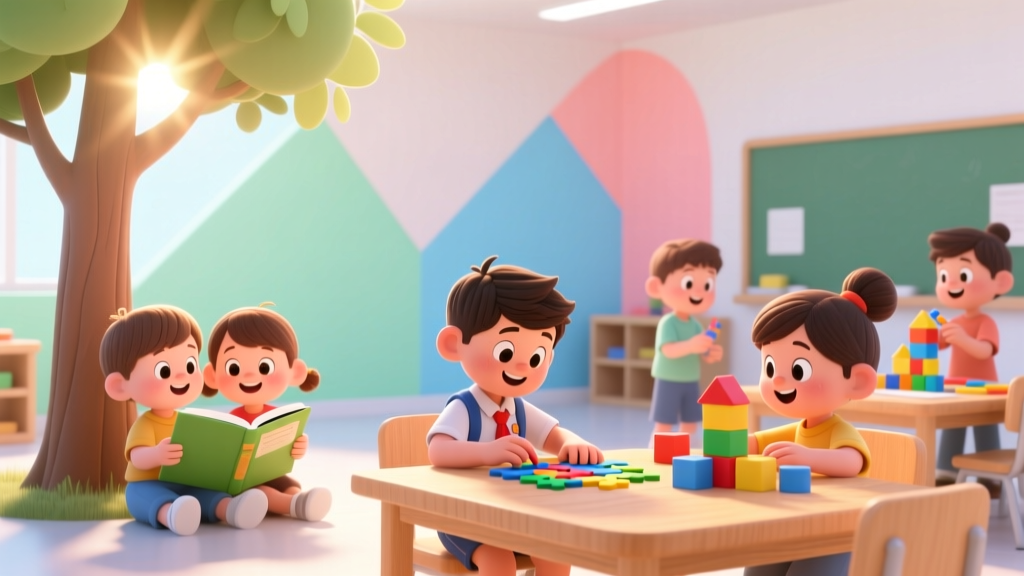
Autism Strategies for Kids: 7 Research-Backed Tips (2026)
Why 'How to Work with Kids with Autism' Is the Most Misunderstood Question in Modern Parenting
If you've ever searched how to work with kids with autism, you've likely encountered overwhelming advice—some well-intentioned but outdated, some overly clinical, and some dangerously prescriptive. The truth? There is no universal 'manual.' What works isn’t about fixing, controlling, or normalizing—it’s about building safety, honoring neurology, and adapting your approach to the child’s unique sensory profile, communication style, and developmental pace. According to the American Academy of Pediatrics (AAP), over 75% of autistic children experience co-occurring sensory processing differences—and yet, fewer than 30% of early intervention providers receive formal training in sensory-informed practice (AAP Clinical Report, 2023). That gap leaves families navigating daily challenges—from transitions and meltdowns to social connection and academic engagement—without foundational, actionable tools. This guide bridges that gap with strategies rooted in decades of developmental neuroscience, occupational therapy research, and lived autistic expertise.
1. Start With Co-Regulation—Not Correction
Before any instruction, before any behavior plan, before any expectation—you must first establish shared nervous system safety. Co-regulation is the biological bedrock of learning and connection for autistic children. It means your calm becomes their anchor—not through suppression or redirection, but by modeling regulated breathing, lowering vocal pitch, slowing movement, and offering predictable presence. Dr. Stuart Shanker, founder of the Self-Reg framework, emphasizes: 'When a child is dysregulated, their brain is in survival mode. You cannot teach executive function while their amygdala is hijacked.'
Here’s how to apply it in real time:
- Pause before prompting: When a child covers their ears, withdraws, or begins stimming intensely, resist the urge to say “Stop” or “Look at me.” Instead, take three slow breaths yourself—and sit quietly beside them (not facing them) for 60–90 seconds. Your stillness signals safety more powerfully than words.
- Use rhythmic, low-frequency input: Gently tap a steady beat on your thigh, hum a monotone note, or offer a weighted lap pad (if tolerated). Rhythm soothes the vagus nerve—key to shifting out of fight-or-flight.
- Name the state—not the behavior: Say “Your body feels wiggly right now” instead of “You’re being disruptive.” This validates internal experience without judgment—and builds interoceptive awareness over time.
A 2022 study published in Journal of Autism and Developmental Disorders tracked 42 preschoolers across six months of co-regulation-first interventions. Children whose caregivers prioritized physiological attunement before academic or behavioral goals showed 2.3× faster gains in joint attention and 41% fewer escalation episodes—without any discrete trial teaching.
2. Replace 'Nonverbal' With 'Pre-Verbal' or 'Differently Verbal'
Over 30% of autistic children are labeled 'nonverbal' by age 5—but many develop robust communication later using augmentative and alternative communication (AAC). Yet, only 12% of general education teachers have received AAC training (ASHA, 2023). Assuming silence equals absence of thought is not just inaccurate—it’s harmful. Autistic children process language differently: many are auditory-delayed (needing 5–10 seconds to decode spoken words), visually dominant, or rely on gestural, written, or tech-based expression.
Practical steps to honor and expand communication:
- Assume competence—and respond to all output: A hand-flap, a gaze shift, a dropped toy, or a hum may be intentional communication. Narrate it back: “You looked at the red car—that means you want to play with it!”
- Introduce AAC *before* frustration peaks: Don’t wait for ‘failure’ to introduce picture exchange (PECS), core-word boards, or speech-generating devices. Begin with 3–5 high-motivation core words (“more,” “stop,” “help,” “break”) paired with consistent motor patterns (e.g., always tapping “break” in the top-left corner).
- Model AAC constantly—even when they’re speaking: If a child says “juice,” simultaneously point to the “juice” icon on their board. This builds neural pathways between sound, symbol, and meaning.
Case in point: Maya, age 6, was labeled ‘nonverbal’ and excluded from group literacy time. Her SLP introduced a simple core-word board during snack. Within three weeks, she began pointing to “same” and “different” during sorting tasks—and by month two, was combining icons to request “same apple, different cup.” Her teacher reported, “She wasn’t silent—she was waiting for a language that fit her brain.”
3. Design Environments for Sensory Integrity—Not Just 'Quiet'
Sensory differences aren’t preferences—they’re neurobiological realities. An autistic child’s auditory processing may amplify background noise 12 dB above typical perception (per fMRI studies at UC San Diego, 2021). Their tactile system may interpret clothing tags as sandpaper or fluorescent lighting as strobing. Yet most classrooms and homes default to ‘one-size-fits-all’ sensory design—leading to chronic stress, masking, and eventual burnout.
Instead of asking “What can we remove?” ask “What does this space *need* to feel safe and functional?”
- Create sensory ‘zones,’ not just quiet corners: A calming zone (weighted items, dim light, vibration), an alerting zone (resistance bands, chewelry, textured surfaces), and a movement zone (wall push-ups, scooter board, rocking chair) give autonomy and self-regulation options.
- Use visual + auditory anchors for transitions: Replace verbal countdowns (“Clean up in 5 minutes!”) with a visual timer + chime tone *paired with a physical cue* (e.g., gently tapping the child’s shoulder twice). This cross-modal input improves predictability.
- Normalize sensory tools—not just for ‘big moments’: Keep fidget rings on desks, offer chew necklaces during circle time, allow noise-dampening headphones *during instruction*, not just ‘meltdown recovery.’ As autistic educator and advocate Lydia Brown states: “Accommodations aren’t rewards. They’re access.”
4. Shift From Behavior Charts to Relationship Maps
Traditional reward systems often backfire with autistic children. Why? Because extrinsic motivation (stickers, praise, tokens) can erode intrinsic drive, increase anxiety around performance, and fail to address underlying needs (e.g., pain, hunger, sensory overload, or communication breakdown). A landmark 2023 meta-analysis in Autism Research found behavior charts correlated with increased shutdown frequency in 68% of autistic participants—and zero long-term skill retention beyond chart duration.
Try this alternative: the Relationship Map—a collaborative, strengths-based tool developed by occupational therapist and autistic parent Dr. Emily D’Agostino:
- Identify one recurring challenge (e.g., “refuses to wear socks”).
- Ask: What is the child communicating? (Discomfort? Texture aversion? Motor planning difficulty?)
- Co-create 2–3 solutions *with* the child (e.g., “Try bamboo socks?” “Wear socks only at school?” “Go barefoot at home?”).
- Test one option for 5 days—then reflect together: “What worked? What felt hard? What do you want to try next?”
This builds agency, reduces power struggles, and teaches self-advocacy. One family used it to resolve years of toothbrushing resistance—not by enforcing compliance, but by discovering their daughter needed warm water (not cold) and a silicone brush (not nylon). The result? Daily brushing without prompts—and her first unprompted request: “Can I pick the flavor?”
| Strategy | Primary Neurological Benefit | Developmental Domain Supported | Evidence Base (Key Study) |
|---|---|---|---|
| Co-regulation-first response | Downregulates sympathetic nervous system; strengthens vagal tone | Social-emotional, self-regulation | Shanker Institute, Self-Reg Framework (2022) |
| Core-word AAC modeling | Builds semantic networks & cross-modal integration | Language, cognitive flexibility | ASHA Practice Portal, AAC Evidence Map (2023) |
| Sensory zone design | Reduces allostatic load; preserves cognitive bandwidth | Sensory processing, executive function | UCSD fMRI Sensory Study, J. Neurodevelopment (2021) |
| Relationship Mapping | Strengthens prefrontal cortex–amygdala connectivity | Self-determination, problem-solving | D’Agostino et al., Occupational Therapy in Mental Health (2023) |
Frequently Asked Questions
Is ABA therapy the best approach for my child?
ABA (Applied Behavior Analysis) remains widely used—but its legacy is deeply contested. While some modern, play-based, consent-centered ABA models show benefit, traditional ABA has been criticized by autistic self-advocates and researchers for promoting masking, suppressing natural coping mechanisms (like stimming), and lacking long-term quality-of-life data. The Autistic Women & Nonbinary Network (AWN) and the AAP now recommend trauma-informed, neurodiversity-affirming alternatives—including SCERTS, DIR/Floortime, and RDI—as first-line supports. Always prioritize approaches where the child’s autonomy, joy, and self-expression are central—not compliance.
My child lines up toys or repeats phrases—is this 'just autism' or should I be concerned?
Repetitive behaviors (stimming, scripting, lining up) are often regulatory tools—not deficits. They help manage sensory input, reduce anxiety, express emotion, or process information. Suppressing them without replacement strategies increases distress and can lead to internalized shame. Instead, ask: What need is this meeting? Does it interfere with safety, health, or desired participation? If not—honor it. If yes, co-create alternatives: e.g., if lining up blocks causes classroom disruption, offer a designated ‘order shelf’ or tactile fidget with linear motion (like a bead slider).
How do I explain autism to siblings or classmates?
Use concrete, strength-based language—not medical labels. Try: “Your brother’s brain notices sounds, lights, and feelings more intensely—that’s why he sometimes covers his ears or needs quiet time. His brain also helps him remember every dinosaur fact and notice tiny details others miss!” For peers: “Everyone’s brain works differently—like different operating systems. His helps him focus deeply on things he loves, and he communicates in ways that make sense to him.” Avoid terms like “disorder,” “deficit,” or “suffers from.” Resources like My Brother Charlie (Holly Robinson Peete) and All My Stripes (Shaina Rudolph) model this beautifully.
Will my child ever speak or make friends?
Outcomes vary widely—and that’s okay. Many non-speaking autistic people build rich relationships via typing, art, sign, or AAC. Friendships often look different: deeper one-on-one connections, shared interests over small talk, longer processing time before responding. Focus on connection—not conformity. As autistic author and researcher Dr. Nick Walker reminds us: “Autistic people don’t lack empathy—we experience it intensely, often too much. We just express it differently.” Prioritize mutual respect, shared joy, and accommodations—not forced eye contact or scripted greetings.
Common Myths
- Myth #1: “Autistic kids don’t want friends.” Research consistently shows autistic children desire connection—but often struggle with the unspoken rules, reciprocity pacing, and sensory demands of typical peer interaction. They may prefer parallel play, topic-based bonding (e.g., LEGO clubs), or digital connection—and that’s valid friendship.
- Myth #2: “If they don’t make eye contact, they’re not listening or caring.” Eye contact taxes working memory and triggers anxiety for many autistic people. Studies using eye-tracking show they often attend *more* to faces—but avoid direct gaze to conserve cognitive resources. Looking away while listening is often a sign of deep focus—not disengagement.
Related Topics
- Autism-friendly classroom setup — suggested anchor text: "how to create an autism-friendly classroom"
- Best AAC apps for nonverbal children — suggested anchor text: "top AAC apps for autistic kids"
- Sensory diet activities for home — suggested anchor text: "sensory diet ideas for autism at home"
- Neurodiversity-affirming parenting books — suggested anchor text: "best neurodiversity-affirming parenting books"
- IEP goals for autistic students — suggested anchor text: "meaningful IEP goals for autism"
Your Next Step Isn’t Perfection—It’s Presence
How to work with kids with autism isn’t about mastering techniques—it’s about cultivating curiosity, humility, and responsiveness. Every child holds wisdom about their own needs—if we learn to listen beyond words, observe beyond stereotypes, and adjust our expectations to match their neurology. Start small: today, pause one extra second before speaking. Tomorrow, replace one correction with one validation. In a week, co-design one sensory choice. These micro-shifts compound into profound trust—and that trust is where growth, joy, and authentic connection begin. Download our free Co-Regulation Starter Kit—including printable core-word boards, sensory zone checklists, and a Relationship Map template—designed with autistic educators and pediatric OTs.
More Articles
 How Long Are Kids Passports Good For? (2026)
 Are Boxers Good With Kids? Vet-Reviewed Truth (2026)
 Leslie Bibb’s Intentional Child-Free Choice
 Is Robert Richie Kid Tock? Viral Rumor Debunked
 Trump Accounts for Kids: Why They Don’t Exist (2026)
 Does Nick Bosa Have Kids? The Truth Behind the Rumors
 Does Zyrtec Make Kids Drowsy? Pediatrician Insights
 Ashley Gutermuth Kids? Modern Parenthood Insights (2026)
 Teaching Kids to Save Money: A Parent’s Guide
 Why Kids Can’t Drink Coffee: Science-Backed Risks