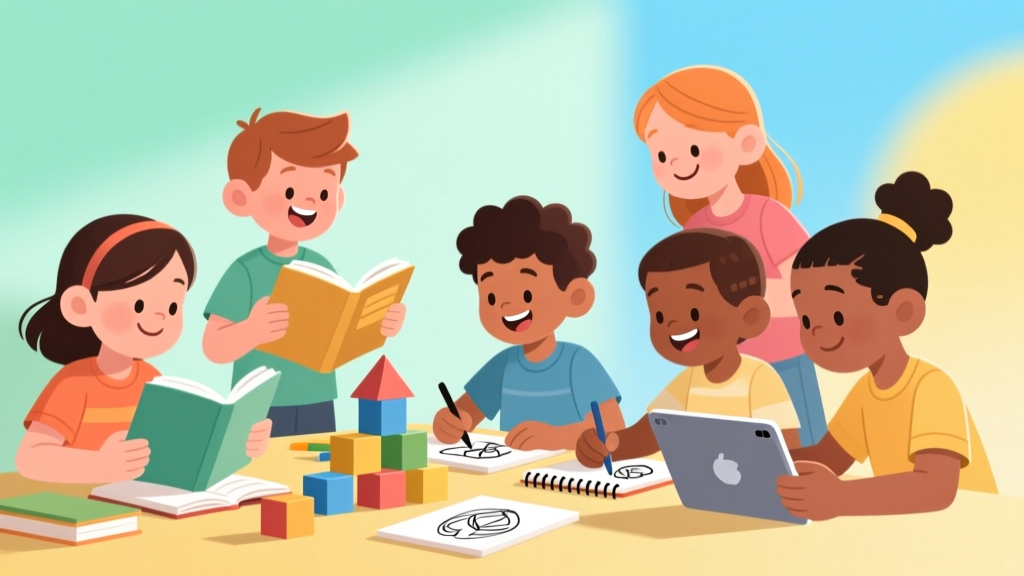
Teach Problem-Solving to Kids: 7 Real-Life Strategies
Why Teaching Problem-Solving Isn’t Just ‘Nice to Have’—It’s Neurological Necessity
If you’ve ever watched your 4-year-old stare blankly at a snapped LEGO tower, or heard your 7-year-old sigh, “I can’t do it,” before even trying a new math worksheet, you’ve glimpsed the urgent need behind the question how to teach problem-solving to kids. This isn’t about raising mini engineers or future chess champions—it’s about wiring resilient neural pathways. According to Dr. Laura Jana, pediatrician and co-author of The Toddler Brain, the first decade of life is when executive function skills—including working memory, cognitive flexibility, and inhibitory control—are most malleable. And problem-solving sits squarely at their intersection. Yet 68% of parents report feeling unprepared to nurture this skill (2023 Zero to Three Parent Survey), often defaulting to quick fixes (“Here, let me fix it”) that unintentionally erode agency. The good news? You don’t need lesson plans or apps. You already have everything you need: curiosity, patience, and the ordinary, messy moments of daily life.
Start With Your Own Mindset—Before You Say a Word
Before diving into techniques, pause and reflect: What’s your automatic response when your child struggles? Do you swoop in with a solution? Offer praise for effort—or only for success? Your reaction shapes their internal narrative more than any instruction. Research from Stanford’s Project for Education Research That Scales (PERTS) shows children whose caregivers use ‘process praise’ (“You kept trying different ways—that’s how we solve hard things!”) are 40% more likely to persist through challenges than those who hear ‘person praise’ (“You’re so smart!”). Why? Because process praise reinforces controllable actions—not fixed traits.
Try this micro-shift: Replace ‘Let me help you’ with ‘What’s your plan?’ Even for toddlers, this simple reframe signals trust. A 2022 study published in Child Development tracked 120 preschoolers over 9 months and found that those whose parents consistently asked open-ended questions like “What could we try next?” showed significantly stronger problem-solving fluency on standardized assessments—even after controlling for socioeconomic status and baseline IQ.
Real-world example: When 5-year-old Maya couldn’t zip her coat, her mom resisted grabbing the zipper. Instead, she knelt and said, “Hmm—what part feels tricky?” Maya pointed to the slider. Mom replied, “Right! It’s stuck. What’s one thing we could try?” Maya tried wiggling it sideways—no luck. Then she remembered seeing her brother hold the bottom tab. She did—and zipped it herself. Her triumphant grin wasn’t just about clothing; it was the dopamine hit of self-efficacy, reinforcing neural circuits for future challenges.
Turn Daily Routines Into ‘Problem Labs’ (No Prep Required)
Forget dedicated ‘problem-solving time.’ Embed practice into existing rituals where stakes are low and repetition is high. Think of these as ‘micro-opportunities’: moments so ordinary they’re invisible—until you redesign them intentionally.
- Breakfast Battles: Instead of choosing cereal for your 6-year-old, lay out 3 options and ask, “Which one solves your ‘I need energy for soccer’ problem best? Why?” This builds cause-effect reasoning and decision criteria.
- Toy Cleanup: Rather than saying “Pick up your blocks,” try “We need all blocks off the rug before storytime. How should we make that happen in 3 minutes?” Let them design the system—timing, roles, tools. One family’s 8-year-old invented a ‘block relay race’ with timed passes—cutting cleanup time by half while practicing sequencing and collaboration.
- Weather Woes: If rain cancels park plans, resist solving it. Ask, “Our goal is outdoor fun. What are 3 possible solutions—and what’s one pro/one con for each?” This models divergent thinking and trade-off analysis.
Key principle: Delay assistance by 10 seconds. Count silently. That gap is where neural connections fire. As Dr. Dan Siegel, clinical professor of psychiatry at UCLA, explains: “The space between stimulus and response is where resilience is built. Our job isn’t to fill that space—it’s to hold it gently.”
The 4-Step Scaffold (Adapted for Ages 3–12)
Research from the National Association for the Education of Young Children (NAEYC) confirms that scaffolding—providing just-enough support to stretch but not overwhelm—is the gold standard for teaching complex thinking. Here’s how to apply it across ages, using the same framework but adjusting language and autonomy:
- Notice & Name: “I see you’re trying to fit that puzzle piece. It’s not going in. What’s happening?” (Validates emotion + identifies obstacle)
- Brainstorm Options: “What are some ways we could try? Let’s list them—even silly ones!” (Encourages divergent thinking; write ideas on paper or whiteboard)
- Test & Tweak: “Which idea feels most doable? Let’s try it—and watch what happens.” (Emphasizes experimentation over ‘right answer’)
- Reflect & Refine: “What worked? What surprised you? If we did this again, what might we change?” (Builds metacognition—the ‘thinking about thinking’ skill linked to lifelong learning)
This isn’t linear. Some days, step 1 is all you’ll get. That’s progress. A 2021 longitudinal study in Developmental Psychology followed 150 children from age 4 to 10 and found that consistent use of reflective questioning (step 4) predicted higher academic achievement in middle school—even more strongly than early literacy scores.
When Emotions Hijack the Process (And How to Re-Engage the Brain)
Here’s the uncomfortable truth: Problem-solving shuts down when amygdala activation spikes. In other words—your child can’t think when they’re flooded with frustration, shame, or fear. That meltdown over a broken crayon isn’t defiance; it’s neurological overload. According to the American Academy of Pediatrics’ 2022 clinical report on emotional regulation, co-regulation (calming *with* the child, not *for* them) must precede cognitive engagement.
Try the ‘Name-Connect-Redirect’ sequence:
- Name: “Your face looks tight. I’m guessing you feel really frustrated right now.” (Labels emotion without judgment)
- Connect: “That makes sense—this puzzle is tricky! I get frustrated too when things don’t work.” (Normalizes emotion + builds safety)
- Redirect: “Let’s take 3 big breaths together—and then ask: What’s one tiny step we could try?” (Re-engages prefrontal cortex)
Crucially, avoid logic during dysregulation (“But it’s just one piece!”). Wait until shoulders relax and eye contact returns. One kindergarten teacher reported that after training staff in this method, classroom problem-solving incidents decreased by 52% in one semester—not because fewer problems occurred, but because children regained capacity to engage with them.
| Age Range | Developmental Readiness | Sample Problem Scenario | Scaffolding Strategy | Red Flags (When to Pause & Regulate) |
|---|---|---|---|---|
| 3–5 years | Emerging symbolic thinking; limited working memory (2–3 items); concrete reasoning | Blocks won’t balance in tower | Use physical props: “Show me where it falls. Try holding the base with both hands.” Limit choices to 2 options. | Body stiffening, screaming, hiding face—shift to co-regulation first |
| 6–8 years | Can hold 4–5 items in working memory; understands cause/effect; developing self-talk | Lost library book before due date | Guide brainstorming: “Who knows where it might be? What’s step one? Step two?” Use graphic organizer (draw boxes for steps). | Shutting down (“I don’t care”), blaming others excessively—check for shame or anxiety |
| 9–12 years | Abstract reasoning emerging; can weigh pros/cons; developing moral reasoning | Group project conflict: teammate isn’t doing work | Role-play conversations; draft respectful messages together; discuss long-term consequences of different approaches. | Withdrawal, sarcasm, physical complaints (headaches/stomachaches)—explore underlying social stress |
Frequently Asked Questions
At what age should I start teaching problem-solving?
You’re already doing it—from birth. Newborns ‘solve’ hunger by rooting; toddlers ‘solve’ access by pulling chairs to counters. Formal scaffolding begins around age 2–3, when language and symbolic play emerge. But the foundation is laid earlier through responsive caregiving—answering cries consistently teaches infants that their actions have predictable effects on the world (a core problem-solving premise). Per AAP guidelines, focus on ‘serve-and-return’ interactions: when your baby babbles, you respond—not with a solution, but with curiosity (“Oh! You’re telling me something important!”).
My child gives up instantly. Is this a sign of laziness or something deeper?
Almost never laziness. More likely: learned helplessness (repeated experiences where effort didn’t yield results), undiagnosed learning differences (e.g., dyspraxia making fine-motor tasks exhausting), or anxiety masking as avoidance. Watch for patterns: Does giving up happen only with certain tasks (writing vs. building)? Only with adults present? A pediatric occupational therapist can assess motor planning and sensory processing; a child psychologist can explore emotional barriers. Meanwhile, rebuild confidence with ‘micro-wins’: break tasks into steps so small success is guaranteed (e.g., “Hold the pencil” → “Make one dot” → “Draw one line”).
Does screen time help or hurt problem-solving development?
It depends entirely on design and context. Passive scrolling? Harmful—it trains attentional fragmentation and reduces tolerance for productive struggle. But well-designed games with escalating challenges (e.g., Thinkrolls, Cargo Bot) can build logic and spatial reasoning—if co-played with adult commentary (“What happened when you moved the block left? Why do you think that worked?”). The key is interactivity + reflection. A 2023 University of Michigan study found children who played puzzle games with parents asking open-ended questions showed 2.3x greater gains in flexible thinking than solo players.
How do I handle it when my own frustration flares during problem-solving attempts?
First—normalize it. Your nervous system is wired to protect your child from distress. When you feel heat rising, use the ‘STOP’ acronym: Stop (pause mid-sentence), Take a breath (4 seconds in, 6 out), Observed (name your feeling: “I’m feeling rushed”), Proceed with intention (“I’ll ask one question instead of fixing”). Keep a sticky note on your fridge: ‘Their struggle is their work. My job is to hold space—not the solution.’ And forgive yourself. One mindful moment resets the interaction.
Are there cultural differences in how problem-solving is taught or valued?
Absolutely. In many East Asian cultures, persistence through difficulty (‘grit’) is explicitly praised, and struggle is framed as necessary for mastery. In some Indigenous communities, problem-solving is taught through storytelling and land-based inquiry—where solutions emerge from relationship with place and ancestors. Western individualism sometimes overemphasizes ‘independent’ solutions, missing the power of collaborative, community-rooted problem-solving. Honor your family’s values—but also consider expanding your toolkit. Ask: ‘What problem-solving strengths does my child show in contexts outside school? How can I notice and name those?’
Common Myths
Myth 1: “Kids will naturally develop problem-solving skills if they just play enough.”
While unstructured play builds creativity and social negotiation, it doesn’t automatically teach systematic problem decomposition, hypothesis testing, or reflection—skills that require intentional modeling and guided practice. A landmark 2018 study in Early Childhood Research Quarterly found that children in play-based preschools showed strong social-emotional gains but lagged in structured problem-solving metrics compared to peers in programs integrating explicit strategy instruction.
Myth 2: “Giving hints is the same as scaffolding.”
Not quite. Hints often carry implicit pressure (“You should know this”) or steer toward a predetermined answer (“What shape has three sides?”). True scaffolding asks open questions that preserve agency (“What do you notice about the corners?”) and adjusts in real-time based on the child’s cues—not the adult’s agenda.
Related Topics (Internal Link Suggestions)
- Building Executive Function Skills — suggested anchor text: "executive function activities for preschoolers"
- Positive Discipline Techniques — suggested anchor text: "how to discipline without yelling"
- Growth Mindset Activities for Kids — suggested anchor text: "growth mindset books for elementary students"
- Screen Time Guidelines by Age — suggested anchor text: "healthy screen time limits for kids"
- Montessori-Inspired Learning at Home — suggested anchor text: "Montessori practical life activities"
Your Next Step Starts With One Tiny Shift
You don’t need a curriculum, a budget, or more time. You need just one conscious choice today: when your child encounters a small, solvable challenge—spilled juice, a tangled shoelace, a disagreement with a friend—pause before helping. Take that 10-second breath. Ask one open question: “What’s your idea?” Then listen—not to fix, but to witness their mind at work. That moment, repeated daily, is where resilience is forged. Download our free Problem-Solving Prompt Cards (designed by early childhood specialists) to keep 12 age-adapted questions handy on your phone or fridge. Because the most powerful teaching tool you own isn’t a toy, an app, or a textbook—it’s your curious, patient presence.
More Articles
 What Causes Autism in Children? Science vs. Myths
 Is Scream 7 for Kids? Evidence-Based Parent Guide
 Does Lex Wexner Have Kids? Family, Legacy & Succession
 Best Age for Kids’ Braces: Timing Tips (2026)
 How Many Kids Did Chespirito Have? (2026)
 What Does Size 150 Mean in Kids? (2026)
 How Many Kids Does Johnny from 90 Day Have?
 Does Kid Flash Die? A Parent’s Guide (2026)
 Age-Shift Storytelling in Kids’ Media: A Parent’s Guide
 Renee Good Child Abuse Case: Facts & Warning Signs