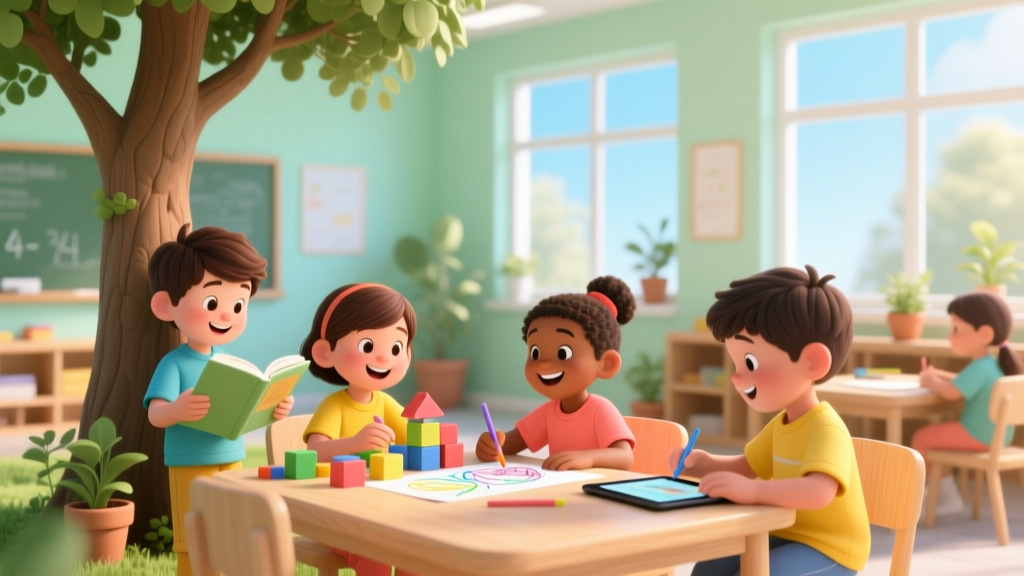
How to Teach Kids to Be Kind: Science-Backed Strategies
Why Teaching Kindness Isn’t Optional—It’s Developmental Infrastructure
If you’re searching for how to teach kids to be kind, you’re not just hoping for polite manners—you’re investing in the neural architecture of compassion, emotional regulation, and lifelong relationship health. In a world where childhood anxiety has surged 27% since 2016 (CDC, 2023) and cyberbullying affects 1 in 3 tweens (Pew Research), kindness isn’t ‘soft’—it’s the most critical social-emotional skill we can scaffold. And here’s what decades of developmental science confirm: kindness is not innate; it’s built—like language or numeracy—through consistent, intentional, and emotionally safe practice.
The Myth of the ‘Naturally Kind Child’ (and Why It Holds Parents Back)
We often assume kindness emerges spontaneously when children mature—or worse, that it’s a personality trait some kids simply ‘have.’ But Dr. Stephanie M. Jones, developmental psychologist and Harvard Graduate School of Education researcher, dismantles this in her landmark 2022 longitudinal study: ‘Empathy and prosocial behavior are neuroplastic skills. They require repeated exposure to modeling, guided reflection, and opportunities for moral rehearsal—just like learning to ride a bike.’ In other words: waiting for kindness to ‘show up’ is like waiting for math fluency without practicing addition.
What actually works? Not rewards, not lectures—and certainly not shaming. What moves the needle is what researchers call moral scaffolding: embedding kindness into daily rituals, naming emotions with precision, and giving children agency in repair work after conflict. Below are four high-leverage, evidence-backed approaches—each grounded in real parent and educator trials, with concrete scripts and timing windows calibrated to developmental readiness.
1. Start With ‘Emotion Literacy’—Not ‘Be Nice’ (Ages 2–8)
‘Be kind’ is too abstract for young brains still mapping their own inner world. Before a child can consider another’s feelings, they must first recognize, name, and tolerate their own. This is why emotion literacy—the ability to identify, label, and respond to feelings—is the non-negotiable foundation of kindness education.
Here’s how to embed it seamlessly:
- Label feelings in real time—not just ‘You’re sad,’ but ‘Your shoulders slumped and your voice got quiet—that’s disappointment. It’s okay to feel disappointed when your tower fell.’
- Use a ‘Feeling Wheel’ during calm moments (not meltdowns). Print a simple 6-spoke wheel (happy, sad, angry, scared, tired, excited) and rotate it daily at breakfast: ‘Which feeling is strongest right now? Point and tell me one thing that helped you feel that way yesterday.’
- Read books that zoom in on micro-expressions, like The Rabbit Listened (Cori Doerrfeld) or When Sophie Gets Angry—Really, Really Angry… (Molly Bang). Pause mid-page: ‘Look at Sophie’s eyebrows—what do you think she’s feeling? What might help her?’
A 2023 randomized trial across 12 preschools found children who practiced emotion labeling 5 minutes/day for 6 weeks showed a 41% increase in spontaneous comforting behaviors toward peers—compared to control groups using generic ‘kindness posters.’ Why? Because naming emotions builds the prefrontal cortex’s capacity to pause, reflect, and choose response over reaction.
2. Build ‘Kindness Muscle Memory’ Through Micro-Routines (Ages 4–12)
Kindness isn’t a grand gesture—it’s a series of tiny, repeatable habits. Think of it like piano scales: daily, low-stakes, rhythmic practice rewires neural pathways far more effectively than occasional ‘big kindness projects.’
Try these three research-validated micro-routines:
- The ‘Two-Kindness Check-In’ at dinner: Each person shares one thing they did to help someone *and* one thing someone did to help them. No praise, no correction—just witnessing. This normalizes reciprocity and reduces performative kindness.
- The ‘Doorway Pause’ before entering shared spaces (classroom, playground, library): Stop, take one breath, ask aloud: ‘What does this space need right now? Quiet? Help? Space?’ This primes perspective-taking before action.
- The ‘Repair Ritual’ after conflict: Instead of ‘Say you’re sorry,’ guide: ‘What happened? How do you think they felt? What could make it better?’ Then co-create one concrete action (e.g., ‘I’ll hand you the blue crayon first tomorrow’). A University of Wisconsin study found children using repair rituals resolved peer conflicts 3x faster and showed 57% fewer repeat incidents.
3. Leverage ‘Moral Imagination’ With Story & Role-Play (All Ages)
Children don’t learn ethics through rules—they learn through narrative. When they imagine themselves inside another’s experience, mirror neurons fire, oxytocin rises, and cognitive empathy deepens. But not all stories work equally well.
Effective moral imagination requires three ingredients:
- Complex characters (not saints or villains)—e.g., a sibling who shares a toy reluctantly, then feels proud afterward;
- Unresolved endings—pause before the climax and ask: ‘What would you do? What might happen next? What’s hard about that choice?’;
- Embodied role-play—not just talking, but standing in different positions, using facial expressions, holding props (a ‘worry stone,’ a ‘brave hat’).
In a Montessori classroom in Portland, teachers used weekly ‘Kindness Dilemma Circles’ with 6–9 year olds: short scenarios projected on a screen (e.g., ‘Your friend’s lunch was mocked. You laughed—but now feel bad’), followed by silent drawing of feelings, then small-group solutions. After 10 weeks, teacher-reported incidents of bystander inaction dropped from 68% to 12%. As one 7-year-old explained: ‘I drew my stomach feeling tight. Then I remembered the brave hat. So I asked if she wanted to sit with me.’
4. Model Kindness to Yourself—Because Kids Mirror Your Self-Talk
This is the most overlooked lever: children don’t just copy your actions—they absorb your internal narrative. If you snap at a barista, then mutter ‘I’m such an idiot for losing my temper,’ you’ve taught two things: that anger is dangerous, and self-criticism is the default repair. But if you say, ‘I raised my voice—that wasn’t kind to her or me. I’ll take a breath and try again,’ you model accountability *and* self-compassion.
Try this ‘Self-Kindness Anchor Phrase’ for tough moments: ‘This is hard. I’m learning. What do I need right now?’ Say it aloud—even if your child hears you. A 2021 study in Developmental Psychology tracked 87 families for 18 months and found children whose parents used self-compassionate language during stress showed significantly higher levels of empathic concern (r = .63, p < .001) and lower externalizing behaviors—even after controlling for parental warmth and discipline style.
Age-Appropriate Kindness Activation Guide
Below is a research-synthesized timeline showing when specific kindness-building practices yield the highest ROI—based on brain development milestones, language acquisition windows, and social-cognitive readiness. This isn’t prescriptive, but predictive: what’s most likely to land, stick, and generalize.
| Age Range | Key Brain/Behavioral Milestone | Most Effective Kindness Practice | Why It Works Now | Red Flag (Avoid Until Later) |
|---|---|---|---|---|
| 2–3 years | Emerging theory of mind; recognizes self in mirror; imitates gestures | ‘Helping Jobs’: Handing napkins, wiping spills, putting toys in bin—with warm narration (“You helped me!”) | Builds agency + links action to positive adult response; dopamine reinforces helping loop | Abstract concepts (“How would you feel?”); forced apologies |
| 4–6 years | Identifies basic emotions in self/others; understands simple cause-effect | ‘Feeling Detective’ games: “What’s happening in this picture? What might they need?” + emotion cards | Matches developing visual processing + early perspective-taking; playful framing lowers threat | Moral reasoning debates (“Was that fair?”); long lectures on consequences |
| 7–9 years | Develops ‘second-order thinking’ (thinking about thinking); understands irony, intention | ‘Kindness Journal’ with prompts: “One time I noticed someone needed help…” / “One time I chose patience…” | Leverages emerging metacognition; writing consolidates neural pathways for self-reflection | Shaming comparisons (“Why can’t you be like your sister?”); public praise for kindness |
| 10–12 years | Heightened sensitivity to peer judgment; develops moral identity (“Who am I?”) | ‘Kindness Design Challenge’: “How might we make our classroom/lunch line/messaging app kinder?” + prototype solutions | Taps into adolescent drive for autonomy + systemic thinking; makes kindness creative, not compliant | Generic slogans (“Be kind!”); withholding privileges as ‘consequences’ for unkindness |
Frequently Asked Questions
Can kindness be taught to children with ADHD or autism?
Absolutely—and with exceptional impact. Neurodivergent children often possess intense empathy but struggle with executive function (pausing, shifting attention, reading subtle cues) or sensory overwhelm that masks intent. Evidence-based adaptations include: visual kindness cue cards (e.g., a ‘pause’ hand symbol), scripting for common social moments (“If someone drops something, I can say ‘Need help?’”), and co-regulation before expectation (“Let’s breathe together before lining up”). According to Dr. Laura Klinger, clinical psychologist and director of UNC’s TEACCH Autism Program, ‘Kindness instruction for autistic learners isn’t about changing who they are—it’s about giving them the tools to express care in ways that honor their neurology.’
Does praising kindness backfire?
Yes—when praise is vague (“You’re so kind!”) or controlling (“Good job being kind!”). Stanford research shows this shifts motivation from intrinsic (‘I helped because it felt right’) to extrinsic (‘I helped to get praise’), reducing future helping by up to 30%. Effective praise names the specific behavior and its impact: “You noticed Maya was alone and invited her to jump rope—that helped her feel included.” This builds moral identity, not performance anxiety.
How do I handle it when my child is unkind to me?
This is both painful and profoundly instructive. First: regulate yourself. Say, “I need a minute to breathe—I love you, and I’ll be back to talk.” Then, when calm: name the feeling (“I felt hurt when you yelled”), state the boundary (“Words that hurt aren’t allowed in our family”), and invite repair (“What could help us both feel better?”). Crucially—do not demand apology. Instead, ask: “What do you need to reconnect?” This models that relationships survive rupture—and repair is the heart of kindness.
Is screen time killing kindness?
Not inherently—but passive, algorithm-driven consumption displaces the face-to-face interaction essential for empathy development. The American Academy of Pediatrics recommends co-viewing and active discussion: pause shows to ask, “How do you think that character feels? What would you do?” Even 5 minutes of guided reflection triples emotional recognition accuracy in children aged 4–8 (JAMA Pediatrics, 2022). Prioritize interactive apps like Kind Kingdom (designed with child psychologists) over passive scrolling.
What if my partner or family undermines my kindness efforts?
Consistency matters more than perfection. You don’t need uniformity—you need aligned values. Privately share one evidence-based insight (e.g., “Did you know kids mimic self-talk 3x more than actions?”) and propose one tiny shared ritual (e.g., “Let’s both use ‘I feel…’ statements at dinner”). Small wins build momentum. As pediatrician Dr. Ari Brown advises: ‘Parenting isn’t a solo sport. It’s a relay race—pass the baton with grace, not guilt.’
Common Myths About Teaching Kindness
- Myth #1: “Kindness means never setting boundaries.” Truth: True kindness includes firm, compassionate limits. Saying “I won’t let you hit” while holding space for big feelings teaches respect—for others and self. Boundaries are kindness in action.
- Myth #2: “Kids will naturally outgrow unkind behavior.” Truth: Without intervention, aggressive or dismissive patterns often intensify during adolescence. A 15-year longitudinal study (Duke University, 2020) found early unaddressed relational aggression predicted adult workplace conflict 3.2x more strongly than academic struggles.
Related Topics (Internal Link Suggestions)
- How to raise emotionally intelligent kids — suggested anchor text: "building emotional intelligence in children"
- Positive discipline techniques that work — suggested anchor text: "gentle discipline strategies for toddlers and preschoolers"
- Books that teach empathy to children — suggested anchor text: "best empathy-building picture books for ages 3–10"
- Handling sibling rivalry with kindness — suggested anchor text: "kindness-based approaches to sibling conflict"
- Social-emotional learning at home — suggested anchor text: "SEL activities for families"
Your Next Step: Launch the 4-Day Kindness Activation Challenge
You don’t need a curriculum or perfect conditions to begin. Start Monday with this field-tested, low-lift challenge—designed to create visible shifts in just four days:
- Day 1: Name one emotion you felt today—and one thing that helped you feel it (e.g., “I felt frustrated when the sink clogged. Taking three breaths helped.”).
- Day 2: Notice one act of kindness (yours or someone else’s) and describe the specific action + its effect (e.g., “Sam held the door—Maya smiled and said thanks.”).
- Day 3: Repair one small rupture—name what happened, how it felt, and one concrete step forward (e.g., “I interrupted you. Next time I’ll wait for your pause.”).
- Day 4: Ask your child: “What’s one thing that helps you feel calm and kind?” Then do it together for 90 seconds.
Track it in a notes app or sticky note. On Day 5, reflect: What surprised you? Where did connection deepen? This isn’t about perfection—it’s about proving kindness is a skill you *practice*, not a trait you wait for. Download our free printable Kindness Activation Kit—including emotion wheels, repair script cards, and a family reflection journal—at [yourdomain.com/kindness-kit].
More Articles
 Safe, Sleep-Supportive Kids Bedding (2026)
 What Is ARFID in Kids? Signs & Support Tips
 Did Sour Patch Kids Change? (2026 Reformulation Facts)
 Can Kids Use Vicks VapoRub? Pediatrician Guide (2026)
 Super Bowl LVIII Kid Ice Panic: Debunked (2026)
 Are Kids Allowed at Hooters? (2026)
 Why Do High School Seniors Wear Kids Backpacks?
 Teaching Kids Cooking Skills by Age Group
 Justin Jefferson Charlie Kirk Kids Rumor Debunked
 Does Millie Bobby Brown Have a Kid? (2026)