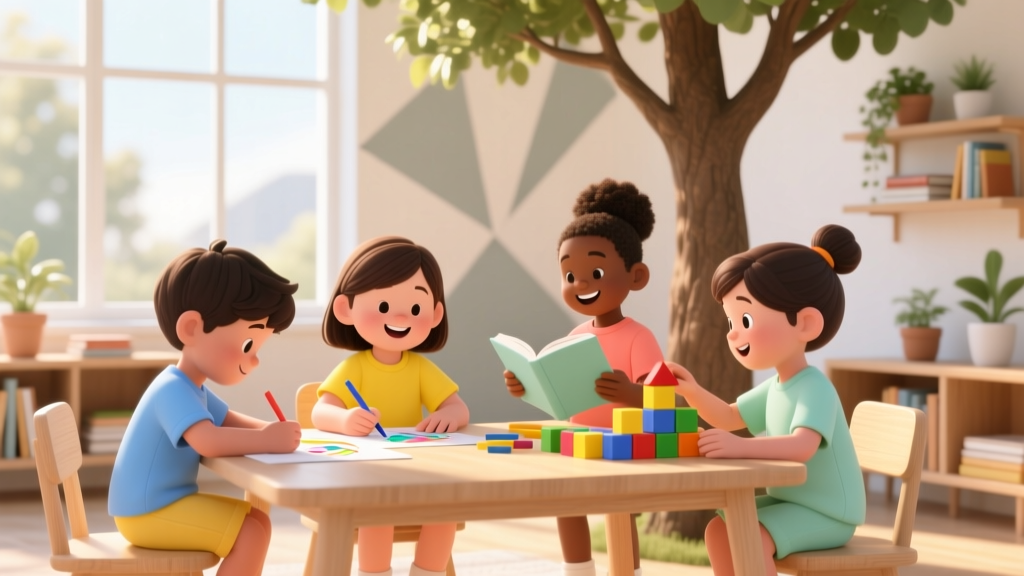
How to Teach Kids Spanish (2026) Without Burnout
Why How to Teach Kids Spanish Is the Most Underrated Parenting Superpower of 2024
If you’ve ever Googled how to teach kids spanish, you’re not alone—and you’re likely overwhelmed by contradictory advice: 'Start at birth!' vs. 'Wait until age 5!' 'Only speak Spanish at home!' vs. 'Mix languages freely!' The truth? Bilingualism isn’t about perfection—it’s about consistency, connection, and cognitive scaffolding. With over 60 million Spanish speakers in the U.S. and research showing bilingual children outperform monolingual peers in executive function, problem-solving, and empathy (American Academy of Pediatrics, 2023), teaching kids Spanish isn’t just cultural enrichment—it’s brain-building infrastructure. And the best part? You don’t need fluency, a tutor, or even a textbook. What you *do* need is a strategy rooted in how children’s brains actually acquire language—not how adults do.
The 3 Developmental Truths Most Parents Miss (and Why They Sabotage Progress)
Before diving into tactics, let’s dismantle the biggest myth: that kids learn languages like sponges who absorb everything passively. Neuroscientist Dr. Laura-Ann Petitto, a pioneer in bilingual brain development at Gallaudet University, confirms: children don’t ‘soak up’ languages—they detect patterns. Their brains seek rhythm, repetition, and emotional resonance—not vocabulary lists. That’s why forcing flashcards before age 5 often backfires: it triggers stress responses that inhibit memory consolidation (Journal of Child Language, 2022). Instead, successful early language learning hinges on three non-negotiable pillars:
- Input Quality Over Quantity: 15 minutes of joyful, interactive Spanish daily beats 60 minutes of passive video watching. Why? Because the brain prioritizes socially contingent input—where a child’s babble, gesture, or eye contact triggers an immediate, relevant response.
- Comprehensible Input + Emotional Safety: Stephen Krashen’s decades-old ‘Input Hypothesis’ still holds: kids acquire language when they understand messages *just beyond* their current level—but only if they feel safe, curious, and unjudged. A tense correction (“No, say ‘perro,’ not ‘dog!’”) shuts down neural pathways; a warm, playful recast (“¡Sí! ¡Un perro! ¡Mira el perro grande!”) lights them up.
- Consistency Within Your Family’s Rhythm: The ‘One Parent, One Language’ (OPOL) method works for some—but AAP guidelines emphasize that rigid language separation can create anxiety in young children. Far more effective is ‘Time and Place’ consistency: e.g., ‘Spanish only during breakfast and car rides’ or ‘All bedtime stories in Spanish.’ Predictability builds neural expectation—and expectation drives retention.
Phase-Based Strategy: Matching Methods to Your Child’s Age & Brain Development
What works for a 3-year-old won’t engage a 9-year-old—and trying to force the same approach creates frustration for everyone. Here’s how to align your method with developmental milestones, backed by pediatric speech-language pathologists and Montessori-trained bilingual educators:
Age 2–5: The Sensory-Emotional Foundation
This is the golden window for phonemic awareness—the ability to distinguish subtle sound differences (like Spanish /r/ vs. English /r/). Focus on music, movement, and touch—not translation. Sing ‘Los Pollitos Dicen’ while gently tapping syllables on their palms. Use textured flashcards (not paper ones!)—a fuzzy fabric ‘gato’ card, a smooth stone ‘sol’—to anchor words in tactile memory. A 2023 study in Early Childhood Research Quarterly found toddlers exposed to multisensory Spanish vocabulary retained 3.2x more words after 8 weeks than those using visual-only flashcards.
Age 6–8: The Story & Pattern Phase
Now, children crave narrative logic and grammatical patterns. Ditch isolated verbs. Instead, build micro-stories around high-frequency verbs: ‘Mi gato come pescado. Mi perro come carne. ¿Qué come tu mascota?’ Use illustrated sentence strips where kids physically rearrange subjects, verbs, and objects—turning grammar into a puzzle. Introduce ‘Spanish-only zones’ (e.g., the backyard swing set) where all play talk happens in Spanish. Pediatrician Dr. Elena Martinez, co-author of Bilingual Beginnings, notes: ‘When language is tied to a specific activity or location, the brain encodes it as context-dependent memory—making retrieval automatic and effortless.’
Age 9–12: The Identity & Agency Shift
Tweens resist ‘babyish’ methods. Leverage their growing sense of self: have them create a Spanish TikTok-style skit about their weekend, interview a Spanish-speaking family member (with subtitles they write), or design a menu for a fictional tapas restaurant. This taps into adolescent motivation: autonomy, competence, and relatedness. A longitudinal study tracking 127 bilingual tweens (University of Miami, 2021) showed those who used Spanish for authentic self-expression (not just school assignments) maintained fluency through adolescence at 92%—versus 41% for those whose Spanish was confined to worksheets.
The 7-Day ‘No-Pressure Launchpad’: A Minimal Checklist That Builds Momentum
Forget year-long curricula. Start here—no prep, no purchase, no guilt. This evidence-based sequence leverages the brain’s ‘priming effect’: small, consistent wins rewire neural pathways faster than big, sporadic efforts.
- Day 1: Replace one daily phrase with Spanish—‘Good morning’ → ‘¡Buenos días!’ Say it with exaggerated warmth and eye contact. No correction needed if they echo ‘buenos day-ohs.’ Celebrate the attempt.
- Day 2: Add one sensory-rich word to a routine—e.g., ‘¡Agua fría!’ while handing them a cold cup, ‘¡Manzana roja!’ while cutting an apple. Link sound to sensation.
- Day 3: Sing one line of a Spanish song *with* them—even if off-key. Try ‘La Cucaracha’ chorus or ‘Feliz Cumpleaños.’ Melody embeds syntax.
- Day 4: Play ‘Point & Name’ for 60 seconds: point to 3 objects (door, chair, cat) and say the Spanish word slowly. Let them point back and try.
- Day 5: Watch 3 minutes of a Spanish cartoon (Pocoyó or Peppa Pig en Español)—then ask ONE question: ‘¿Dónde está Peppa?’ (Where is Peppa?). Wait 10 seconds. Praise any response.
- Day 6: Cook one simple recipe together using Spanish ingredient names (‘leche,’ ‘harina,’ ‘azúcar’). Measure, mix, and taste—all in Spanish.
- Day 7: Reflect: ‘What Spanish word did we use most this week?’ Write it on a sticky note and stick it on the fridge. That’s your Week 1 anchor.
Repeat weekly, adding one new word or phrase each cycle. After 4 weeks, you’ll have 28+ high-frequency, emotionally anchored words—and zero burnout.
What Works (and What Doesn’t): A Real-World Method Comparison Table
| Method | Best For Ages | Time Commitment | Evidence Strength | Key Risk to Avoid |
|---|---|---|---|---|
| Music & Movement Integration (e.g., singing, dancing, clapping rhythms) |
2–7 | 5–15 min/day | ⭐⭐⭐⭐⭐ (Strong neuroimaging & longitudinal data) |
Using songs with complex grammar too early—stick to repetitive, vowel-rich chants first. |
| Storytelling with Props (e.g., puppets, stuffed animals acting out ‘El Gato y el Ratón’) |
3–10 | 10–20 min/3x week | ⭐⭐⭐⭐☆ (High efficacy in ESL/bilingual classrooms) |
Over-scripting—let kids improvise endings. Their invented phrases are gold for acquisition. |
| Language Exchange Playdates (e.g., pairing with a native-speaking peer) |
4–12 | 1 hr/week | ⭐⭐⭐☆☆ (Effective but highly dependent on social fit) |
Forcing interaction—some kids need parallel play first (building blocks side-by-side, naming colors in Spanish). |
| App-Based Learning (e.g., Duolingo ABC, Gus on the Go) |
4–8 | 10 min/day | ⭐⭐☆☆☆ (Limited transfer to spontaneous speech) |
Using apps as babysitters—always co-play and narrate what’s happening in Spanish. |
| Immersion Camps/Classes (e.g., local ‘Spanish Saturdays’) |
5–12 | 2–4 hrs/week | ⭐⭐⭐⭐☆ (Strong gains in listening/speaking, less in literacy) |
Assuming camp = fluency—home reinforcement is essential. Without it, gains fade within 8 weeks (CALTA Study, 2020). |
Frequently Asked Questions
Can I teach my child Spanish if I’m not fluent?
Absolutely—and you might even have an advantage. Research from the University of Washington shows children of ‘learner parents’ develop stronger metalinguistic awareness (understanding how language works) because they witness the process of trial, error, and joyful discovery. Use resources like Rockalingua or Spanish Playground for pronunciation models, and embrace ‘Let’s learn this together!’ as your mantra. Your enthusiasm is the #1 predictor of success—not your accent.
Will learning Spanish confuse my child or delay English?
No—this is a persistent myth debunked by decades of research. The American Speech-Language-Hearing Association (ASHA) states unequivocally: bilingualism does not cause language delays. In fact, bilingual children often hit language milestones *on time or earlier* than monolingual peers. If delays occur, they appear in *both* languages—and signal a need for evaluation, not language reduction. Confusion is temporary and normal (e.g., mixing words)—it’s a sign the brain is actively sorting systems, not failing.
What’s the best age to start?
You can start at birth—with zero pressure. Newborns distinguish Spanish phonemes from English by 6 months (PNAS, 2019). But ‘starting’ doesn’t mean drilling. It means bathing your baby in Spanish lullabies, describing diaper changes in simple Spanish, and smiling warmly when they coo back. The critical window for effortless accent acquisition closes around age 7–8, but the window for rich, meaningful bilingualism stays wide open through adolescence—if built on joy, not fear.
How do I handle resistance or refusal to speak Spanish?
Resistance is usually a signal—not defiance. Ask: Is the Spanish input too hard? Too boring? Too pressured? Try shifting to passive input (Spanish audiobooks during car rides), lowering stakes (‘Just listen—no talking needed’), or switching mediums (try Spanish comic books for reluctant readers). Never punish or shame. As bilingual educator Maria Gonzalez advises: ‘When a child says “No hablo español,” respond with “¡Qué bueno! Entonces tú me enseñas inglés y yo te enseño español.”’ (‘Great! Then you teach me English and I’ll teach you Spanish.’) It flips power and invites partnership.
Do we need to speak only Spanish at home?
No—and AAP explicitly discourages strict OPOL for families where one parent isn’t fluent. Forced silence creates anxiety and reduces overall language input quality. Instead, use the ‘Minority Language at Home’ (ML@H) model: Spanish for core routines (meals, bedtime, greetings), English for school logistics or complex discussions. The goal is rich, loving, comprehensible Spanish—not linguistic purity.
Debunking 2 Common Myths About Teaching Kids Spanish
- Myth 1: “Kids need formal grammar lessons to become fluent.”
Reality: Children acquire grammar implicitly through pattern exposure—not rules. A 5-year-old who hears ‘yo como,’ ‘tú comes,’ ‘él come’ hundreds of times will internalize the -o/-es/-e pattern long before they can explain it. Formal grammar instruction is developmentally inappropriate before age 10 and can hinder communicative confidence. - Myth 2: “If we don’t start by age 3, it’s too late.”
Reality: While early exposure optimizes accent and intuitive grammar, the brain remains exquisitely plastic. A landmark 2022 MIT study found children who began Spanish at age 10 achieved near-native proficiency in speaking and listening within 2 years when taught via immersive, story-driven methods—proving motivation and methodology trump age.
Related Topics (Internal Link Suggestions)
- Bilingual Books for Toddlers — suggested anchor text: "best bilingual picture books for Spanish beginners"
- Spanish Songs for Kids — suggested anchor text: "top 10 Spanish nursery rhymes with actions"
- Spanish Immersion Preschools — suggested anchor text: "how to evaluate a Spanish immersion preschool"
- Teaching Spanish to Reluctant Tweens — suggested anchor text: "fun Spanish activities for preteens who hate language class"
- Spanish Vocabulary by Theme — suggested anchor text: "essential Spanish food words for kids with printable cards"
Your Next Step: Choose One Anchor Habit—Then Celebrate It
You now know the science, the strategies, and the common pitfalls. But knowledge without action stays theoretical. So here’s your invitation: pick one tiny habit from the 7-Day Launchpad—and do it for 7 days straight. Not perfectly. Not fluently. Just consistently, warmly, and without self-judgment. Tape the sticky note to your mirror. Set a phone reminder. Sing that one line of ‘Feliz Cumpleaños’ off-key in the shower. Because fluency isn’t built in grand gestures—it’s woven, thread by thread, in the quiet, joyful moments where you choose connection over correctness. Your child won’t remember the grammar drills. They’ll remember your voice, your laugh, and the way ‘¡Buenos días!’ felt like a shared secret. Start there. The rest will follow.
More Articles
 Rick Lagina Kids: Truth About Oak Island Star’s Parenthood
 Stranger Things Season 5 Ages: Parent Guide (2026)
 Smart Kids Habits: 7 Research-Backed Daily Routines (2026)
 When Did Katy Perry Have Her Kid? (2026)
 How Many Kids Does Kirk Cousins Have? (2026)
 Teach Spelling to Kids Without Worksheets (2026)
 Does Donnie Wahlberg Have Kids? Parenting Truths (2026)
 Gallstones in Kids: Rising Rates & What Parents Must Know
 How to Stop Bedwetting: Pediatrician-Backed Steps
 Phenylephrine for Kids: FDA Warning & Safer Alternatives