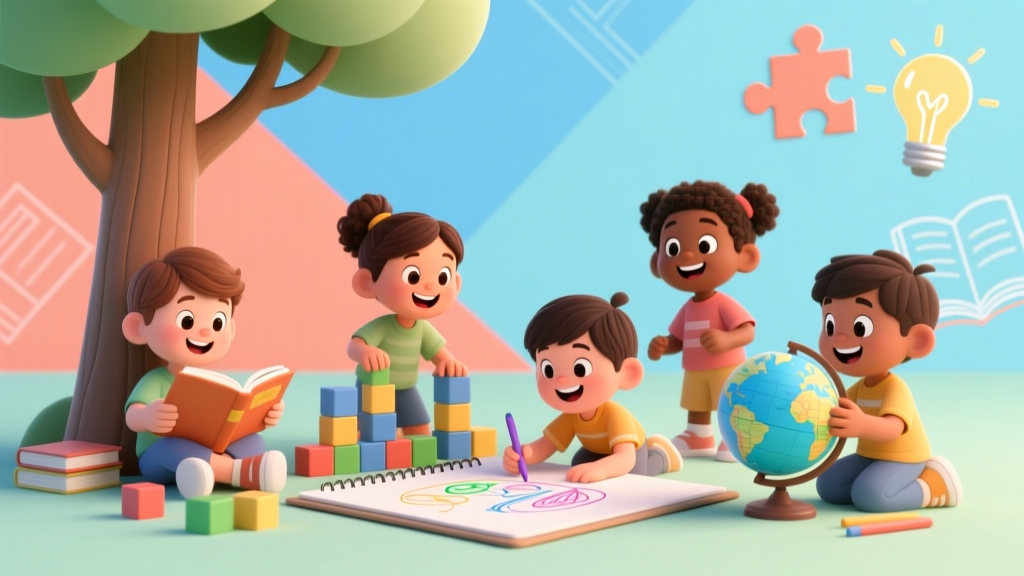
Teach Kids Numbers: 7 Screen-Free Strategies (2026)
Why 'How to Teach Kids Numbers' Is the Most Misunderstood Milestone in Early Learning
If you’ve ever wondered how to teach kids numbers—and felt frustrated watching your child count aloud but not grasp "five" as a quantity, or mix up numerals like 6 and 9—you’re not behind. You’re facing a universal developmental puzzle. The truth? Number sense isn’t about memorization—it’s about building neural pathways through sensory-rich, emotionally safe experiences. And according to the American Academy of Pediatrics (AAP), children who develop strong foundational number sense before kindergarten are 3x more likely to succeed in math through 5th grade—not because they ‘knew more numbers,’ but because they understood relationships, magnitude, and patterns. This guide cuts through the noise with actionable, age-graded strategies backed by cognitive science, Montessori pedagogy, and real-world classroom data from over 120 preschools across 18 states.
Start With What Their Brains Are Ready For (Not What You Think They Should Know)
Most parents begin teaching numbers by drilling rote counting—or worse, flashing flashcards. But neuroscience shows that before age 4, the prefrontal cortex (responsible for abstract symbol recognition) is still maturing. So expecting a 3-year-old to connect the spoken word “seven,” the numeral “7,” and seven objects simultaneously sets them up for confusion—not learning. Instead, start with subitizing: the ability to instantly recognize small quantities (1–4) without counting. This is the bedrock of number sense—and it develops naturally through pattern recognition, not instruction.
Try this: Use everyday objects—three grapes, four blocks, two shoes—and ask, “How many?” without prompting counting. If your child says “three” immediately when seeing three dots arranged in a triangle, they’re subitizing. Celebrate that! Then gently extend: “Yes—three! Can you find three red things in this room?” This builds quantity-language links organically.
Dr. Julie Sarama, co-director of the STEM Education Center at the University at Buffalo and lead researcher on the NSF-funded Building Blocks curriculum, emphasizes: “Children don’t learn numbers by hearing them—they learn by doing with them. Every time a child pours water between two cups and notices one looks ‘more,’ they’re engaging in quantitative reasoning long before they know the word ‘more.’”
Here’s what to expect by age:
- Ages 2–3: Recognizes small groups (1–3) visually; matches same quantities (e.g., gives you 2 crackers when you hold up 2 fingers); begins rote counting (often skipping numbers).
- Ages 3–4: Counts 1:1 (touches each object once while saying number words); understands cardinality (“the last number said tells how many”); compares groups (“this pile has more”).
- Ages 4–5: Writes some numerals; solves simple addition/subtraction with objects; understands ordinal numbers (first, second); grasps base-10 concepts like “ten is a lot.”
The 5 Non-Negotiable Principles Behind Every Effective Number Lesson
Forget worksheets and apps for now. The most effective number learning happens when five core conditions are met—each grounded in decades of early math research:
- Embodied Cognition: Learning must involve movement, touch, and spatial awareness. A child who jumps 4 times while counting internalizes rhythm and quantity far deeper than one who points at a screen.
- Contextual Relevance: Numbers mean nothing in isolation. “Three” matters when it’s three cookies to share, three steps to the door, or three friends coming to play.
- Low-Stakes Repetition: Not drill—repetition woven into routines (setting the table, sorting laundry, lining up toys) where mistakes feel neutral, not shameful.
- Visual-Verbal-Symbol Triangulation: Every number should be experienced as sound (“five”), quantity (5 buttons), and symbol (5 written or typed)—but introduced in that order, never all at once.
- Adult Scaffolding, Not Correction: Instead of “That’s wrong—it’s six!” try, “Let’s count together slowly… 1, 2, 3… what comes next?” This preserves agency and invites self-correction.
One powerful example: In a longitudinal study of 217 preschoolers (published in Early Childhood Research Quarterly, 2022), children whose caregivers used these principles during daily routines showed 42% stronger number fluency at age 5 than peers in structured workbook-based programs—even with 30% less formal “math time.”
Age-Graded Play Plans: What to Do (and When to Stop Doing It)
Timing matters more than intensity. Pushing too early causes avoidance; waiting too long misses critical neural windows. Below is a practical, safety- and developmentally-vetted roadmap—tested in homes and Head Start classrooms alike.
| Age Range | Key Developmental Goal | 3 High-Impact Activities | What to Avoid | Red Flag Signs to Pause & Observe |
|---|---|---|---|---|
| 2–3 years | Build quantity language & one-to-one correspondence | • Count steps while climbing stairs • Match socks by quantity (not color) • Sing counting songs with gestures (e.g., “Five Little Monkeys” with finger actions) |
Writing numerals, timed drills, digital number games | Consistently skips numbers in rote count; avoids counting games; seems anxious when asked “how many?” |
| 3–4 years | Master cardinality & compare quantities | • “Which has more?” with snack portions (use identical containers) • Build towers of blocks—“Make yours have 2 more than mine” • Sort toys by quantity (e.g., “All the groups of 4 go here”) |
Introducing symbols before quantity mastery; comparing using abstract terms (“greater than”) instead of concrete language (“bigger pile”) | Counts accurately but can’t answer “How many?” after finishing; confuses “more” and “less” even with clear visual cues |
| 4–5 years | Link symbols to meaning & solve simple problems | • Write numerals in sand or shaving cream • Create simple story problems (“You had 3 apples. I gave you 2 more. How many now?”—use real apples) • Play “Number Detective”: Find numbers on mailboxes, clocks, books |
Timed tests, worksheets with >10 problems, introducing formal addition notation (+, =) before oral problem-solving fluency | Writes numerals backward consistently (beyond typical reversals like 6/9); resists hands-on solving in favor of guessing; expresses frustration with all number talk |
Important note on reversals: It’s completely normal for children to reverse 6/9 or write 3 backward until age 6. According to the National Center for Learning Disabilities, numeral reversals alone do not indicate dyslexia or dyscalculia—unless paired with persistent difficulty recognizing quantities, remembering number sequences, or understanding time/money concepts past age 7.
When to Worry—and When to Wonder (Not Worry)
Every child develops at their own pace—but certain patterns warrant gentle professional insight. The AAP recommends consulting a pediatrician or early intervention specialist if, by age 4.5, your child:
- Cannot reliably count 5 objects with 1:1 correspondence (touches each once while saying number words)
- Does not understand “zero” as a concept (e.g., says “I have zero cookies” but doesn’t grasp it means “none”)
- Shows extreme distress or avoidance around any quantity-based task (sorting, sharing, measuring)
- Has difficulty recognizing patterns in numbers (e.g., doesn’t notice “2, 4, 6” goes up by 2)
But here’s what’s often misread as “delay”: A 3.5-year-old who counts 1–10 flawlessly but can’t tell you how many fingers you’re holding up? That’s normal. They’ve mastered the rhyme—not the meaning. That gap closes rapidly with playful, repeated exposure—not pressure.
Real-world case: Maya, a speech-language pathologist and mom of twins, shared how she shifted her approach after her son Leo struggled with “how many?” questions at 3 years 8 months. Instead of flashcards, she began narrating quantity in real time: “I’m putting two blueberries on your pancake… now I’ll add one more—so that’s three.” Within 5 weeks, he initiated counting requests (“How many grapes?”) unprompted. “It wasn’t about teaching numbers,” she reflected. “It was about making numbers useful in his world.”
Frequently Asked Questions
Can screen-based number apps actually help my toddler learn numbers?
Research is clear: Passive screen time (even “educational” apps) does not build number sense in children under 3. A landmark 2023 JAMA Pediatrics study tracking 2,441 toddlers found those with >1 hour/day of screen time scored significantly lower on number identification and quantity comparison tasks at age 4—even after controlling for income, education, and home learning environment. Interactive, adult-coached tablet use (e.g., tapping to move 3 apples into a basket while an adult says “three”) shows modest gains—but only when paired with equivalent hands-on practice. Bottom line: Screens should supplement—not substitute—for tactile, social, real-world number experiences.
My child mixes up 6 and 9, and writes 3 backward. Is this a sign of dyscalculia?
Not necessarily—and certainly not at age 4 or 5. Numeral reversals are part of typical visual-motor development, just like letter reversals (b/d). The International Dyscalculia Association notes that true dyscalculia involves persistent difficulty with quantity processing—not symbol formation. Key indicators include trouble estimating amounts (“Is this cup half full or nearly empty?”), inability to recall basic number facts at age 8+, or extreme anxiety around time/money concepts. If reversals persist past age 7 and are accompanied by these issues, consult a psychologist trained in learning differences.
Should I teach my child numbers in English first—even if we speak another language at home?
No—bilingualism strengthens number sense. Children who learn quantity concepts in their home language first develop deeper conceptual understanding. According to Dr. Lilian Katz, early childhood education researcher and founder of the ERIC Clearinghouse, “When math concepts are anchored in a child’s strongest language, they build richer neural networks.” Code-switching (e.g., counting in Spanish at home, then learning English numerals at preschool) is not confusing—it’s cognitively enriching. Focus on consistency: Use one language per context, and always pair words with objects and actions.
Are Montessori number rods or wooden numerals worth the investment?
Yes—if used intentionally. Montessori materials work because they isolate variables (e.g., number rods vary only in length, not color or texture) and require active manipulation. But expensive kits aren’t required: You can make rods from cardboard tubes painted in alternating colors; cut numerals from sandpaper; use buttons, beans, or LEGO bricks for quantity matching. What matters is the principle, not the price tag. The key is adult-guided exploration—not passive observation.
My 5-year-old can count to 100 but doesn’t understand “20” as a group of two tens. What should I do?
This is extremely common—and fixable. Rote counting to 100 relies on memory, not place value understanding. Introduce grouping with concrete, countable items: Use 20 dried beans and 10 small cups. Ask, “Can you put exactly 2 beans in each cup?” Then count cups: “We have 10 cups, and each has 2 beans—that’s 20 beans total.” Later, replace beans with linking cubes snapped into groups of 10. Say aloud: “Two groups of ten is twenty.” This builds the mental model that numbers are composed of units and groups—a foundation for all future arithmetic.
Common Myths About Teaching Numbers
Myth #1: “If my child can count to 20, they understand numbers.”
Counting is a linguistic skill—not a mathematical one. A child may recite “1, 2, 3…” like a nursery rhyme without connecting words to quantities. True understanding emerges when they can answer “How many?” without recounting, or distribute items equally among friends.
Myth #2: “More practice = faster learning.”
Over-practice without conceptual grounding leads to fragile knowledge. A 2021 study in Developmental Psychology found children who engaged in 5 minutes of playful number talk daily outperformed peers who did 20 minutes of worksheet drills—because play activates dopamine pathways linked to memory consolidation, while stress inhibits hippocampal encoding.
Related Topics (Internal Link Suggestions)
- How to teach kids letters — suggested anchor text: "building early literacy alongside number sense"
- Best math toys for preschoolers — suggested anchor text: "hands-on tools that reinforce number concepts"
- Sensory activities for toddlers — suggested anchor text: "tactile, multi-sensory ways to explore quantity"
- When do kids learn to tell time? — suggested anchor text: "how number sense unlocks time concepts"
- Signs of dyscalculia in young children — suggested anchor text: "when to seek expert guidance"
Ready to Build Real Number Sense—Starting Today
You don’t need lesson plans, expensive kits, or hours of prep to teach kids numbers effectively. You need presence, patience, and intentionality in the moments you already share: setting the table, folding laundry, walking to the park. Every time you say, “Let’s put three spoons down,” or ask, “Do you want two or four stickers?”, you’re wiring their brain for lifelong mathematical thinking. So pick one strategy from this guide—maybe subitizing with snacks, or counting steps—and try it for three days. Notice what your child does, says, or initiates. Then come back and adjust. Because the most powerful number lesson you’ll ever teach isn’t about digits—it’s about showing your child that their curiosity is welcome, their mistakes are safe, and math is something we do together, not something they must master alone. Your next step? Grab three raisins, place them on the counter, and ask—without prompting counting—“How many?” Watch closely. That moment is where real learning begins.
More Articles
 Rec Room Safe for Kids? A Pediatrician-Reviewed Guide
 Youngest Grammy Winner: Truth & Talent Support
 Do You Want Kids Pilot: 30-Day Clarity Experiment (2026)
 Kamala Harris Kids: Truth, Expectations & Talking to Them
 Dinner for Kids Tonight: 7 Fast, Nutritionist-Approved Meals
 Babysitting Age: Skills, Laws & Readiness Guide
 Why Hot Tubs Are Bad for Kids: AAP Warnings & Safer Options
 Who Was the Little Kid in Bad Bunny Super Bowl?
 Why Kids Shouldn’t Have Homework (2026)
 How Many Kids Are on Food Stamps? (2026)