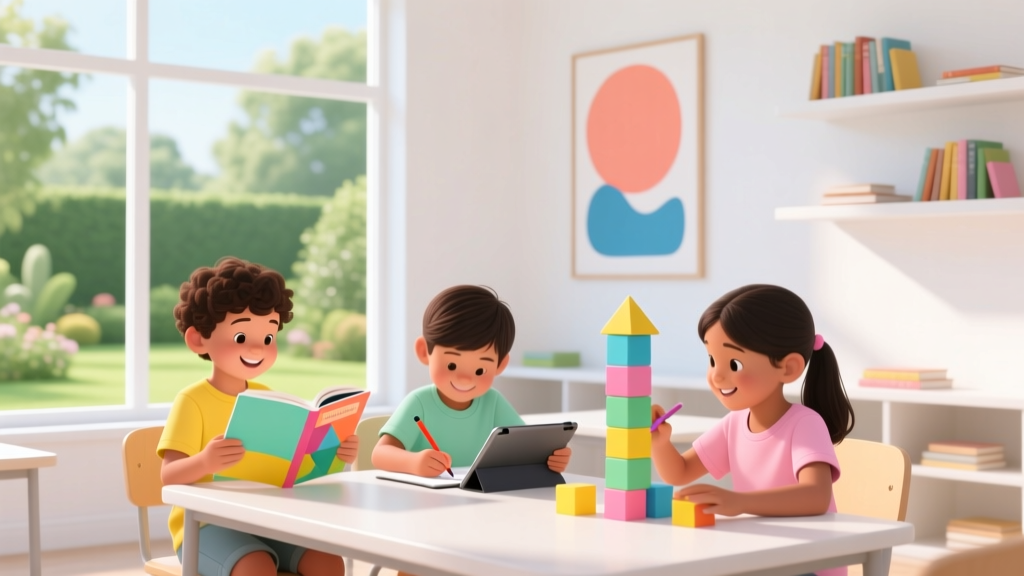
Teach Kids Kindness: 7 Everyday Empathy-Building Moments
Why Teaching Kindness Isn’t Just ‘Nice’ — It’s Neurologically Necessary
If you’ve ever wondered how to teach kids kindness in a world saturated with digital distraction, social comparison, and rising childhood anxiety, you’re not alone — and your instinct is spot-on. Kindness isn’t a soft skill relegated to ‘character education’; it’s a core component of healthy brain development. According to the American Academy of Pediatrics (AAP), children who regularly practice perspective-taking and compassionate action show measurably stronger prefrontal cortex activation — the region governing self-regulation, decision-making, and emotional resilience. What’s more, longitudinal studies from the Harvard Graduate School of Education’s Making Caring Common project reveal that kids raised with intentional kindness scaffolding are 42% less likely to engage in relational aggression by middle school — and report significantly higher life satisfaction at age 18. This isn’t about raising ‘polite’ children. It’s about wiring their nervous systems for connection, safety, and moral courage.
1. Start With Your Own ‘Kindness Reflex’ — Not Their Behavior
Most parents begin with correction: “Say sorry!” “Share your toy!” “Don’t yell at your sister!” But developmental neuroscientist Dr. Daniel Siegel emphasizes that children learn empathy through *mirroring*, not mandates. When a child witnesses a parent pause mid-frustration, name their emotion (“I’m feeling really impatient right now”), and choose a regulated response (“Let me take three breaths before I respond”), they absorb the neural blueprint for self-soothing and compassion. This isn’t performative — it’s physiological modeling. A 2023 study published in Child Development tracked 127 families over 18 months and found that parental emotional labeling + calm repair attempts predicted a 3.2x greater increase in child empathy scores than direct instruction alone.
Try this instead of correction:
- When your child hits: Kneel to eye level, place a hand gently on their back (if safe), and say: “Your body feels really big and loud right now. My hand is here so you know you’re safe while your feelings settle.” Then model regulation: “I’m going to breathe with you — in for 4… hold for 4… out for 6.” No lecture. Just presence + co-regulation.
- When they refuse to share: Narrate the tension without judgment: “You really love that train set. You want to keep playing with it all by yourself — and your friend wants a turn too. Both of those things are true.” Naming both truths builds cognitive flexibility and reduces shame.
This approach transforms conflict into a kindness laboratory — where emotions aren’t suppressed but *witnessed*, and boundaries aren’t punishments but expressions of care.
2. Embed Kindness in Daily Routines — Not Just ‘Kindness Week’
One-off lessons (“Let’s make a kindness jar!”) rarely transfer to real-life choices. The magic happens in predictable, low-stakes moments woven into existing rhythms. Pediatric occupational therapist and author Dr. Laura MacFarlane calls these ‘kindness anchors’ — tiny, repeatable interactions that activate mirror neurons and reinforce neural pathways daily.
Here’s how to anchor kindness across four universal routines:
- Morning Transition: Replace “Hurry up!” with “What’s one kind thing you’ll do today — for someone else or yourself?” Let them answer literally (“I’ll let Sam go first on the slide”) or abstractly (“I’ll be gentle with my words”). Write it on a sticky note and stick it on their lunchbox.
- Mealtime Connection: At dinner, ask: “Who did something kind for you today? Who did you notice doing something kind for someone else?” Focus on observation, not performance. Notice when they describe a classmate helping another pick up dropped crayons — that’s neural reinforcement in action.
- Bedtime Reflection: Skip “What did you do today?” Try “What made someone’s face light up today?” This trains attention toward impact, not just action.
- Errand Integration: At the grocery store, assign a ‘kindness mission’: “Can you find someone who looks like they could use a smile? Practice giving one — no words needed.” Then debrief: “How did your face feel when you smiled? How do you think theirs felt?”
Consistency matters more than duration. A 90-second kindness anchor practiced 5x/week builds stronger neural habits than a 45-minute lesson once a month.
3. Use Storytelling to Grow Moral Imagination — Not Just Morals
Stories don’t just entertain — they simulate social scenarios in the brain’s default mode network, activating the same regions used in real-life empathy. But not all stories work equally well. Research from the University of Toronto shows that stories where characters *struggle* with kindness — making mistakes, feeling conflicted, repairing harm — build deeper moral reasoning than tales where kindness is effortless and rewarded.
Choose books and media that feature:
- Complex motivations: e.g., The Rabbit Listened (Cori Doerrfeld) — where the rabbit doesn’t fix the problem but simply stays present, modeling attuned listening over solution-giving.
- Repair arcs: e.g., Enemy Pie (Derek Munson) — where the protagonist actively works to undo his unkindness, showing kindness as a verb, not a trait.
- Diverse perspectives: e.g., Each Kindness (Jacqueline Woodson) — which centers consequences of exclusion and the quiet weight of missed opportunities.
After reading, avoid “What did the character learn?” Try: “What do you think the character felt in their body when they chose to help? What would have happened if they’d chosen differently? What’s something small you’ve done that felt like that?” These questions activate embodied empathy — linking emotion, consequence, and personal relevance.
4. Turn ‘Mistakes’ Into Kindness Rehearsals — Not Failures
When children act unkindly — whether grabbing, excluding, or name-calling — our instinct is often to isolate, shame, or demand immediate apology. But AAP guidelines strongly advise against forced apologies, which teach children to prioritize adult approval over authentic remorse. Instead, frame unkind behavior as data — not destiny.
Use the 3R Framework (Recognize, Repair, Rehearse):
- Recognize: “I saw you push Maya when she took your block. Your body was showing big feelings.” (Name behavior + emotion without blame)
- Repair: “What can we do to help Maya feel safe again?” Guide them to offer water, draw a picture, or sit beside her quietly. Repair is action-oriented and relationship-focused.
- Rehearse: “Let’s practice what you could say next time your block gets taken. Try: ‘I’m still using this. Can you wait?’” Role-play 2–3 times — speed, tone, and body language matter more than perfect words.
This transforms discipline into developmental coaching. A 2022 randomized control trial in Pediatrics found children whose caregivers used repair/rehearse protocols showed 68% faster de-escalation of peer conflicts within 6 weeks versus traditional timeout approaches.
| Age Range | Developmental Strengths | Kindness Strategy That Fits | What to Avoid | Sample Script |
|---|---|---|---|---|
| 2–3 years | Emerging sense of self; limited impulse control; concrete thinking | Model + narrate simple actions (“I’m handing you the cup — that’s kind!”); use tactile tools (stuffed animals to practice gentle touches) | Abstract concepts (“Be nice”), long explanations, expecting spontaneous sharing | “Your hands are gentle. Let’s pat the dog softly together.” |
| 4–6 years | Developing theory of mind; beginning to understand others’ feelings; strong desire for fairness | “Kindness Detective” games (spotting kind acts); simple role-play with puppets; co-create family kindness rules | Shaming language (“Why are you so mean?”), ignoring their perspective in conflicts | “You wanted that truck, and Sam wanted it too. What’s one fair way to decide?” |
| 7–9 years | Increased capacity for perspective-taking; developing moral reasoning; sensitive to peer opinion | Empathy journals (draw/write about someone’s day); kindness challenges with friends; discuss media characters’ choices | Over-praising (“You’re such a kind girl!”), which ties identity to performance | “What do you think made your friend look sad when you said that? What might help them feel better?” |
| 10–12 years | Abstract thinking; questioning fairness/injustice; forming identity through values | Service projects with reflection; analyze news stories for bias/empathy gaps; co-design family kindness rituals | Assuming they ‘should know better’; dismissing their moral dilemmas as ‘dramatic’ | “That situation sounds complicated. What values mattered to you in that moment? What would kindness require — and what would make it hard?” |
Frequently Asked Questions
Does teaching kindness actually reduce bullying — or is it just ‘feel-good’ fluff?
It’s evidence-based prevention. A meta-analysis of 67 school-based social-emotional learning (SEL) programs — including robust kindness curricula — published in Review of Educational Research (2021) found consistent reductions in bullying perpetration (average effect size d = 0.22) and victimization (d = 0.19). Crucially, programs that emphasized *practice* (role-play, peer feedback, real-world application) outperformed those focused solely on knowledge. Kindness isn’t about eliminating conflict — it’s about building the neural and behavioral infrastructure to navigate it constructively.
My child is kind at home but rude to peers. Is this normal — and what should I do?
Yes — and it’s a sign their emotional regulation is still developing. Home is often the ‘safe container’ where big feelings surface; school demands constant social navigation under stress. Observe *when* it happens: during transitions? After screen time? Before lunch? Often, unkindness is a signal of unmet needs (hunger, fatigue, sensory overload). Partner with teachers to identify patterns, then co-create micro-strategies: a ‘calm corner’ pass, a fidget tool, or a pre-agreed signal when they need a break. As Dr. Mona Delahooke, clinical psychologist and author of Brain-Body Parenting, reminds us: “Behavior is communication. Rude behavior isn’t defiance — it’s distress asking for support.”
How much screen time is too much for kindness development?
It’s not about minutes — it’s about *interactivity*. Passive scrolling (TikTok, YouTube shorts) correlates with reduced empathy in longitudinal studies (Twenge et al., 2023), likely due to diminished face-to-face neural mirroring. But co-viewing empathic content (e.g., Bluey, Arthur) and discussing characters’ feelings boosts perspective-taking. Set a ‘kindness filter’: “Before we watch, let’s name one feeling we hope to see modeled. Afterward, let’s talk about how that character handled it.” Even 5 minutes of intentional co-viewing builds more neural empathy than hours of passive consumption.
Are some kids just ‘not wired’ for kindness — or is it always teachable?
Neuroscience confirms kindness is a trainable skill — not an innate trait. While temperament influences expression (a shy child may show kindness through quiet support; a bold one through advocacy), the underlying neural circuitry for empathy is plastic throughout childhood and adolescence. The key is matching strategy to neurodevelopmental stage and individual wiring. For example, children with ADHD may benefit from movement-based kindness practices (e.g., “Let’s walk to the mailbox together and wave kindly to Mrs. Chen”), while autistic children often thrive with explicit scripts and visual supports. As Dr. Rebecca Branstetter, pediatric neuropsychologist, states: “Kindness isn’t about being ‘soft’ — it’s about building the brain’s capacity for connection. And every brain can grow that capacity with the right scaffolds.”
Common Myths About Teaching Kindness
- Myth #1: “If I reward kindness with stickers or praise, they’ll only do it for rewards.” Research shows specific, process-focused praise (“I noticed how you waited patiently for your sister to finish speaking — that took real self-control!”) strengthens intrinsic motivation far more than generic praise (“Good job being kind!”) or tangible rewards. The brain lights up for authenticity, not tokens.
- Myth #2: “Kids will naturally learn kindness by watching adults — no need to teach it directly.” While modeling is essential, children need explicit scaffolding to decode *why* certain actions are kind, *how* they affect others’ bodies and feelings, and *when* to apply them. Without naming, connecting, and practicing, kindness remains invisible — like grammar rules we use but never studied.
Related Topics (Internal Link Suggestions)
- How to raise emotionally intelligent kids — suggested anchor text: "building emotional intelligence in children"
- Positive discipline techniques for toddlers — suggested anchor text: "gentle discipline strategies that work"
- Best empathy-building books for preschoolers — suggested anchor text: "top picture books that teach empathy"
- Social-emotional learning activities for kindergarten — suggested anchor text: "SEL games and lessons for early learners"
- How to handle sibling rivalry with kindness — suggested anchor text: "turning sibling conflict into connection"
Your Next Step Starts With One Micro-Moment
You don’t need a curriculum, a budget, or perfection to begin. You need one intentional pause today — when your child expresses frustration, makes a mistake, or witnesses someone else’s struggle. In that pause, choose to name the feeling, validate the need, and model a grounded response. That 10-second choice rewires brains. That’s how to teach kids kindness: not as a lesson to master, but as a shared language to speak — imperfectly, repeatedly, and with deep, unwavering belief in their capacity to grow. So tonight at dinner, try one question: “What’s one small way someone showed you kindness today?” Then listen — not to fix, but to witness. That’s where the transformation begins.
More Articles
 When Do Kids Learn to Jump? (2026)
 Why Does Vecna Kidnap Kids? Parent Guide (2026)
 Does Charlie Kirk's Parents Have Custody? Truth Revealed
 How Many Kids Does Headkrack Have? (2026)
 Is Big Mouth for Kids Normal? 7 Truths Parents Need
 Ruby Franke's Kids: Custody & Guardianship Facts (2026)
 Male Diabetes Fertility Prep: Step-by-Step (2026)
 Kids Responsible for Parents' Debt After Death? (2026)
 Hilaria Baldwin’s 7 Kids: Surrogacy, Adoption & Fertility
 Is NeuroGum Safe for Kids? Evidence-Based Answers