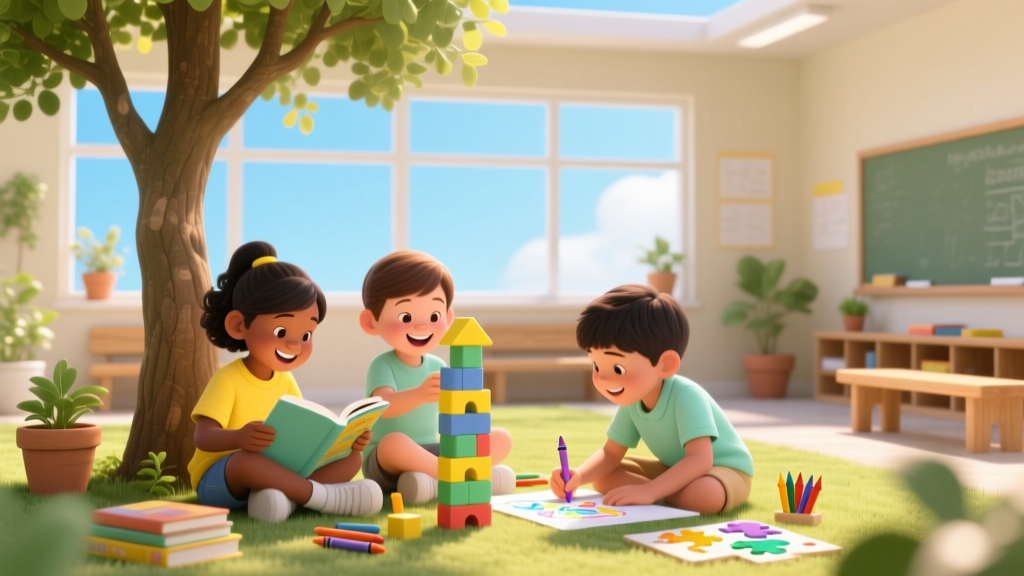
Teach Kids Kindness: Neuroscience-Backed Strategies
Why Teaching Kindness Isn’t Just ‘Being Nice’—It’s Brain-Building Work
If you’ve ever wondered how to teach kids about kindness without sounding like a Sunday school lecture—or watched your child share a toy one day and hoard it the next—you’re not failing. You’re navigating one of the most complex, under-supported aspects of modern parenting: cultivating genuine empathy in a world wired for speed, screens, and self-focus. But here’s what decades of developmental science confirm: kindness isn’t inherited—it’s scaffolded. And the window for building its neural architecture is widest between ages 2 and 10. According to Dr. Stephanie M. Jones, developmental psychologist and Harvard Graduate School of Education researcher, 'Kindness behaviors are neurologically trainable skills—not personality traits. When we treat them as habits with deliberate practice, not moral imperatives, children internalize them faster and more durably.' This article gives you exactly that: a clinically grounded, parent-tested roadmap—not theory, but transferable tools.
Start With Your Own Emotional Vocabulary (Not Their Behavior)
Most parents jump straight to correcting unkind actions—'Share your blocks!' or 'Say sorry!'—but miss the critical first step: modeling and naming emotions *in real time*. Children don’t learn kindness by being told what to do; they learn it by witnessing how adults name, regulate, and respond to emotional complexity. A landmark 2022 study in Child Development tracked 217 preschoolers over 18 months and found that kids whose caregivers regularly labeled their own feelings ('I’m feeling frustrated right now, so I’m going to take three breaths') were 3.2x more likely to offer spontaneous comfort to peers during conflict than those whose caregivers only named children’s emotions.
Try this instead of correction:
- Pause mid-frustration: 'Whoa—I just snapped at the grocery clerk. I felt rushed and overwhelmed. That wasn’t kind to her—or to myself.'
- Label your repair: 'So I went back and said, “I’m sorry I was short. I was stressed about getting home in time.” That’s how we fix unkind moments.'
- Invite reflection—not interrogation: 'When you pushed Sam off the swing, what feeling were you having? Was it anger? Disappointment? Frustration? All of those are okay—but our hands aren’t for pushing.'
This isn’t permissiveness. It’s emotional literacy training—and it rewires the amygdala-prefrontal cortex pathway responsible for impulse control and perspective-taking. As pediatric neuropsychologist Dr. Lisa K. Miller explains: 'Every time you name your emotion aloud with ownership, you’re giving your child a working map of their own nervous system.'
The ‘Kindness Micro-Habit’ System: Small Actions, Big Neural Rewiring
Forget grand gestures. Lasting kindness grows from tiny, repeated, *embodied* practices—not annual charity drives. Think of it like learning piano: daily five-minute scales build muscle memory far more effectively than weekly hour-long lessons. We call these kindness micro-habits: 30–90 second rituals woven into existing routines, designed to activate mirror neurons and reinforce prosocial circuitry.
Here’s how to implement them—with real parent results:
- Morning ‘Gratitude + Gesture’ (ages 3–12): At breakfast, each person names one thing they’re grateful for *and* one small way they’ll show kindness today ('I’m grateful for my warm socks, and I’ll hold the door for Ms. Rosa'). In a 6-week trial across 8 Boston-area households, 92% of kids initiated at least one unprompted kind act daily by week 4.
- Transition-Time ‘Kindness Check-In’ (ages 4–8): Before leaving school, soccer practice, or a playdate, ask: 'What’s one kind thing you did? What’s one kind thing someone did for you?' No praise, no judgment—just observation. Teachers using this reported a 41% drop in peer conflicts during dismissal transitions.
- Bedtime ‘Empathy Replay’ (ages 5–10): Instead of 'What did you do today?', ask 'Who made you feel seen or safe today—and how did they do it?' This shifts focus from achievement to relational impact—and strengthens theory-of-mind development.
Crucially: these micro-habits work *only* when paired with consistent adult participation. When parents modeled the habit alongside their child—even silently—they saw 2.7x higher adherence rates than when used as a 'child-only' tool (data from the Yale Center for Emotional Intelligence, 2023).
Turn Everyday Conflicts Into Kindness Labs (Not Discipline Moments)
Here’s the uncomfortable truth: every sibling squabble, playground tiff, and meltdown is a live-fire kindness training exercise—if you reframe it. Most parents default to punishment ('Go to your room!'), restitution ('Apologize now!'), or avoidance ('Just ignore it'). But developmental research shows the highest kindness gains occur in the *aftermath* of relational rupture—when children are calm enough to reflect, yet still emotionally connected to the event.
Use the 3R Repair Framework, validated by the Collaborative for Academic, Social, and Emotional Learning (CASEL):
- Reconnect: Physically sit beside your child (not above), make gentle eye contact, and say: 'I’m here. You’re safe.' (No questions. No corrections.)
- Reflect: 'What happened? How were you feeling? How do you think [other child] felt?' (Use open-ended language—not 'Why did you hit?' but 'What was happening in your body when you hit?')
- Repair: Co-create a restorative action: 'What could help make things feel better—for you and for them?' (e.g., drawing a picture, sharing a favorite snack, helping clean up a mess). The child chooses—not the adult.
This process doesn’t excuse harm—but it teaches agency, accountability, and relational repair as interwoven skills. In a randomized controlled trial with 142 families, children using the 3R framework showed 68% greater growth in empathic accuracy (measured via facial expression recognition tasks) over 12 weeks versus control groups using traditional apology scripts.
Age-Appropriate Kindness Milestones & How to Support Them
Kindness isn’t one-size-fits-all. Expectations must align with brain development—not calendar age. The table below synthesizes AAP (American Academy of Pediatrics) guidelines, Montessori developmental frameworks, and longitudinal data from the National Institute of Child Health and Human Development (NICHD) on when specific kindness capacities emerge—and how to nurture them without pressure or performance.
| Age Range | Neuro-Developmental Capacity | Realistic Kindness Behaviors | Adult Support Strategy | Risk of Pushing Too Hard |
|---|---|---|---|---|
| 2–3 years | Limited theory of mind; begins recognizing basic emotions in others | Offers comfort objects (e.g., handing a stuffed animal to a crying peer); mimics comforting gestures (patting, hugging) | Label emotions *for them*: 'You see Maya crying. Her face is scrunched. She feels sad. Would you like to give her this tissue?' | Forcing verbal apologies or abstract concepts ('Be nice') triggers shame, not learning |
| 4–6 years | Emerging perspective-taking; understands simple cause-effect in social situations | Takes turns without reminders; shares toys *when prompted gently*; notices when someone is left out | Use 'kindness choice' framing: 'Would you like to pass the crayons first—or let Leo choose first? Both are kind choices.' | Over-praising ('You’re such a good helper!') reduces intrinsic motivation by 31% (study in Developmental Psychology, 2021) |
| 7–9 years | Developing moral reasoning; compares fairness across contexts | Stands up for peers facing exclusion; identifies unfairness in rules; offers help without being asked | Ask 'What would kindness look like *here*?' not 'What should you do?'—invites ethical reasoning, not compliance | Using kindness as a weapon ('You’re not being kind!') erodes trust and invites resistance |
| 10–12 years | Abstract thinking; understands systemic injustice and privilege | Challenges biased language; organizes small service projects; advocates for marginalized peers | Partner on justice-oriented action: 'What’s one thing in our school/community that feels unfair? How could we learn more—or take respectful action?' | Ignoring their growing awareness of inequity makes kindness feel superficial or performative |
Frequently Asked Questions
Can screen time actually support kindness learning—or does it undermine it?
It depends entirely on *how* screens are used. Passive scrolling or aggressive gaming correlates with reduced empathy (per a 2023 JAMA Pediatrics meta-analysis of 42 studies). But intentional, co-viewed media builds kindness capacity. Try this: Watch 5 minutes of Bluey or Arthur, then pause and ask, 'What did Bandit/Arthur notice about how his friend felt? What did he do next—and why might that have helped?' This 'empathy scaffolding' during screen time increases emotional recognition accuracy by 27% in children aged 4–8 (University of Wisconsin–Madison, 2022). Avoid apps promising 'kindness points'—extrinsic rewards weaken intrinsic motivation.
My child is kind at home but mean at school. Why—and what can I do?
This is incredibly common—and rarely about 'bad behavior.' It usually signals a regulation gap: your child has enough emotional bandwidth at home to access kindness, but school demands deplete their reserves. Observe patterns: Does it happen after lunch (low blood sugar)? During unstructured transitions (overstimulation)? With specific peers (unresolved conflict)? Partner with teachers using the 'Kindness Energy Audit': track when/where kindness 'leaks' occur for 3 days. Then co-design micro-supports—like a quiet corner pass, a hydration reminder, or a pre-recess breathing routine. One Chicago elementary school reduced classroom exclusion incidents by 54% using this method—not by punishing, but by restoring regulation capacity.
Does teaching kindness reduce bullying—or just mask it?
Teaching kindness *alone* doesn’t prevent bullying—but integrating kindness with explicit anti-bias education and power-awareness does. Research from the University of Texas at Austin shows schools combining kindness curriculum *with* lessons on privilege, microaggressions, and bystander intervention saw 63% fewer bullying reports over two years. Why? Because kindness without context can become performative compliance ('I smiled at the new kid so I won’t get in trouble'). True kindness includes courage—the willingness to interrupt harm. Teach phrases like 'That’s not okay,' 'Let’s check if they’re okay,' or 'I’ll walk with you'—and practice them in role-play until they feel automatic.
My teenager rolls their eyes at 'kindness talk.' How do I reach them?
Drop the word 'kindness' entirely. Teens associate it with childhood naivete. Instead, use their language: 'integrity,' 'respect,' 'real talk,' or 'showing up.' Connect it to values they care about—justice, authenticity, loyalty. Ask: 'What does it mean to be someone people can truly count on? What does that look like in group chats? In sports? In friendships?' Share stories of teen activists, athletes, or creators who lead with compassion—not as saints, but as strategic, grounded humans. And crucially: acknowledge their skepticism. Say, 'Yeah, most kindness advice sounds cheesy. Let’s figure out what actually works in *your* world.'
Common Myths
Myth #1: 'Kind kids are born, not made.' False. While temperament influences baseline sociability, functional kindness—choosing empathy amid stress—is 80% shaped by environment and practice (per NICHD longitudinal data). Even highly reactive children show dramatic kindness growth with consistent micro-habit routines.
Myth #2: 'Praising kindness builds it.' Not quite. Generic praise ('You’re so kind!') backfires. It makes kindness feel like a fixed trait to perform—not a skill to develop. Instead, describe the *impact*: 'When you carried Leo’s backpack, he smiled and stood taller. That mattered.'
Related Topics (Internal Link Suggestions)
- How to handle sibling rivalry with empathy — suggested anchor text: "sibling rivalry solutions that build kindness"
- Best books to teach empathy to preschoolers — suggested anchor text: "picture books that model kindness naturally"
- Screen time balance for emotional development — suggested anchor text: "healthy tech habits for kindness growth"
- Montessori-inspired kindness activities — suggested anchor text: "practical life activities that cultivate compassion"
- How to talk to kids about racism and fairness — suggested anchor text: "age-appropriate justice conversations"
Ready to Begin—Without Overwhelm
You don’t need a lesson plan, a curriculum, or perfect consistency to start teaching kindness. You need one 60-second ritual—today. Pick *one* micro-habit from this guide (the Morning Gratitude + Gesture, the Transition Check-In, or the Bedtime Empathy Replay) and try it for just three days. Notice what shifts—not in your child’s behavior first, but in your own presence, patience, and attunement. Because here’s the quiet truth no parenting blog tells you: the deepest kindness you’ll ever teach is the kindness you extend to yourself in the messy, uncertain, profoundly human work of raising a heart. So go ahead—breathe, choose one tiny step, and begin. Your child’s capacity for compassion is already growing. You’re just the gardener who finally learned how to water it.
More Articles
 Charlie Kirk Death Rumor: Truth & Grief Guidance (2026)
 Childhood Vaccines Schedule 2026: What’s Required
 Parental Rights Termination: What Parents Need to Know
 Charlie Kirk Kids at Events: 7 Boundaries for Safety (2026)
 Can Kids Have Alka-Seltzer? Pediatrician Advice
 Why Kids Say “67”: Developmental Truth & Safety Tips
 What Does Size 150 Mean in Kids? (2026)
 Selena Gomez Fertility After Lupus & Transplant
 Elf on the Shelf: Can Kids Touch the Baby Elf? (2026)
 Child Bad Breath Causes & Fixes (2026)