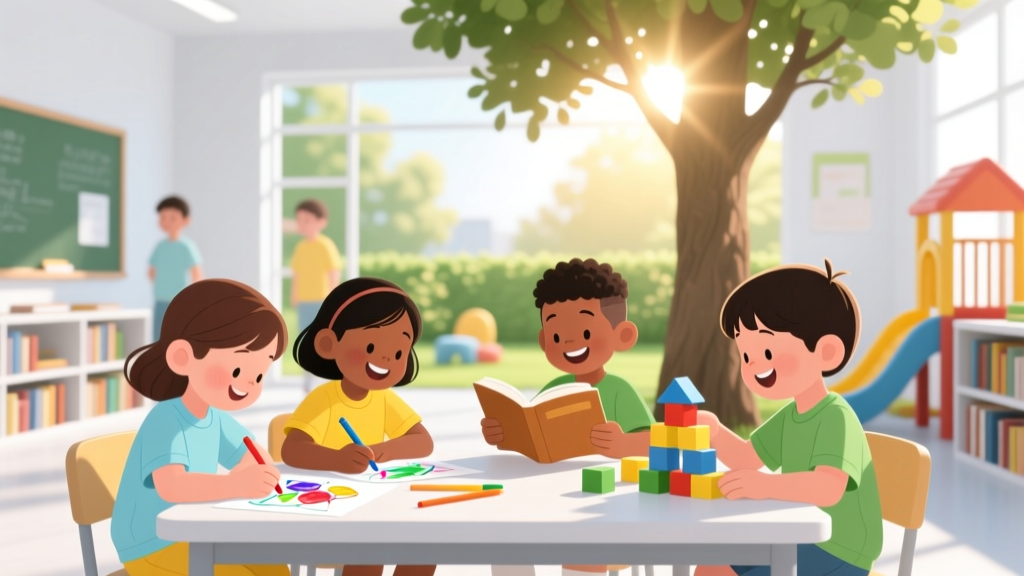
How to Teach Kids to Read: Research-Backed Steps
Why "How to Teach Kid to Read" Is the Most Misunderstood Milestone in Early Childhood
If you've ever stared at your 4-year-old while they flip through a picture book, pointing to words but not sounding them out—or watched them confidently recite 'The Very Hungry Caterpillar' from memory without recognizing a single letter—you're not failing. You're navigating one of the most complex neurocognitive developments in human growth. How to teach kid to read isn’t about speed, worksheets, or early pressure—it’s about aligning with how the brain wires itself for language. And the good news? With the right sequence, even children with dyslexia risk factors or speech delays can build strong, joyful reading foundations before kindergarten. In fact, a landmark 2023 longitudinal study published in Pediatrics found that children whose caregivers used responsive, phoneme-rich interactions (not drills) before age 5 were 3.2x more likely to read at or above grade level by third grade—regardless of socioeconomic background.
The 3 Non-Negotiable Foundations (Before Any Letters)
Most parents jump straight to ABCs—but neuroscience shows that reading is built on three invisible pillars. Skip these, and letters become abstract symbols without meaning. Build them first, and every subsequent step feels intuitive.
1. Oral Language Richness: Not just talking to your child—but with them. Use descriptive, varied vocabulary (e.g., instead of “dog,” say “the fluffy, yapping terrier”); ask open-ended questions (“What do you think the squirrel is feeling?”); and narrate your own thinking aloud (“I’m choosing the red apple because it looks shiny and crisp”). According to Dr. Susan Brady, cognitive psychologist and co-founder of the Haskins Laboratories’ Reading Success Initiative, “Oral language comprehension is the single strongest predictor of later reading comprehension—stronger than phonics instruction alone.”
2. Phonological Awareness (Not Phonics!): This is the ability to hear and manipulate sounds in spoken words—rhyming, clapping syllables, identifying beginning sounds (“What sound does ‘ball’ start with?”), and blending (“/c/ /a/ /t/—what word?”). Crucially, this happens orally, no print required. A 2022 meta-analysis in Reading Research Quarterly confirmed that preschoolers who received 10–15 minutes/day of playful phonological awareness games (like ‘I Spy’ with sounds or silly rhyming songs) showed 47% greater decoding gains by first grade than peers who started formal letter-sound instruction earlier but skipped this step.
3. Print Awareness & Book Handling Skills: Let your child hold books, turn pages left-to-right, point to words as you read (tracking print), notice that letters form words, and understand that text—not pictures—carries the story. Try ‘book walks’: before reading, flip through and ask, “What do you think this story is about? Where do we start reading?” This builds the mental model of how written language works.
The Right Sequence: When & How to Introduce Letters, Sounds, and Blending
Timing matters more than intensity. Push too early, and you create anxiety. Wait too long, and missed windows for neural plasticity make remediation harder. Here’s the evidence-backed progression—based on the National Institute of Child Health and Human Development (NICHD) framework and adapted for home use:
- Ages 2–3: Focus exclusively on oral language + phonological play (rhymes, songs, sound games). No letters needed. Example: Sing “Apples and Bananas” exaggerating vowel sounds; play “Sound Scavenger Hunt” (“Find something that starts with /b/!”).
- Ages 3–4: Introduce letter names and sounds simultaneously—but only 2–3 letters per month, tied to meaningful words (“B is for ball—/b/ /b/ ball!”). Use tactile materials (sandpaper letters, magnetic letters in dough) to engage motor memory. Avoid uppercase-only charts—introduce lowercase first (95% of text is lowercase).
- Ages 4–5: Begin simple CVC (consonant-vowel-consonant) blending with high-frequency words (cat, dog, sun). Use sound boxes (draw 3 boxes, tap each for /c/ /a/ /t/) and ‘sound stretching’ (“Say /ssss/…/aaaa/…/ttt/… now say it fast!”). Never force full-word reading—celebrate segmented sounds as wins.
- Ages 5–6: Add sight words (the, and, is) using orthographic mapping (linking spelling, sound, and meaning)—not rote memorization. Pair with decodable books (texts where >90% of words follow taught phonics patterns) to reinforce success.
Remember: This isn’t linear. Some kids master rhyming at 3 but need extra time blending at 5. That’s normal—and expected. As Dr. Sally Shaywitz, author of Overcoming Dyslexia, emphasizes: “Dyslexia isn’t a sign of low intelligence—it’s a different wiring pattern. Early, structured, multisensory instruction closes the gap, but only if it’s delivered with patience and precision.”
Play-Based Strategies That Outperform Worksheets (Every Time)
Forget flashcards and timed drills. The brain learns best when emotion, movement, and curiosity are engaged. These aren’t ‘fun extras’—they’re neurologically optimal pathways.
- Sound Sorting with Real Objects: Gather 5–6 small items (toy car, cup, sock, spoon, sun-shaped cookie cutter). Say each name slowly, then sort by beginning sound into labeled bins (/k/, /c/, /s/, etc.). Adds tactile + auditory + visual input.
- Phoneme Hopscotch: Draw a chalk grid with 3–5 squares. Call out a sound (/m/); child hops while saying words that start with it (“moon,” “mouse,” “milk”). Builds rapid retrieval and motor memory.
- Story Chain with Sound Substitution: Start a silly story: “Once there was a cat…” Then change one sound: “What if it was a bat? What would a bat do?” This strengthens phonemic manipulation—the skill most predictive of reading fluency.
- Environmental Print Hunts: Walk around your neighborhood spotting logos, signs, and labels (“STOP,” “MOM’S,” “WALGREENS”). Ask: “What letter do you see? What sound does it make? Can you find another word with that sound?” Connects literacy to real-world meaning.
Case in point: Maya, a speech-language pathologist in Portland, worked with Leo, age 4, who struggled with sound blending despite knowing all letter names. Instead of drilling, she introduced “Robot Talk”: speaking in slow, segmented sounds (“I… wa…nt… a… cr…ac…ker”). Within 3 weeks, Leo began self-correcting his own speech and spontaneously blending words like “cupcake” and “butterfly.” Play wasn’t the detour—it was the highway.
When to Worry (and When to Breathe): Red Flags vs. Normal Variability
Every child develops at their own pace—but certain patterns warrant gentle, proactive support. The American Academy of Pediatrics (AAP) recommends screening for early literacy risk by age 4, especially if multiple signs cluster together:
- Doesn’t enjoy being read to or avoid books entirely (beyond typical toddler wiggling)
- Cannot rhyme common words by age 4 (e.g., “cat” → “hat”)
- Struggles to remember or produce nursery rhymes
- Confuses similar-sounding letters repeatedly (b/p, d/t, f/v)
- Shows extreme frustration or avoidance during any sound-play or letter activities
Crucially, not knowing letters by age 4 is NOT a red flag. But not hearing rhymes is. Why? Because rhyming relies on phonological processing—the same brain network used for decoding. As Dr. Laura Justice, early literacy researcher at Ohio State, explains: “Rhyme awareness is the canary in the coal mine. It’s accessible, observable, and highly predictive—if it’s missing, it signals a need for targeted support, not a label.”
| Age Range | Typical Literacy Behaviors | Supportive Adult Actions | When to Consult a Specialist |
|---|---|---|---|
| 2–3 years | Points to pictures, names familiar objects, repeats rhymes, enjoys songs, may scribble “writing” | Read daily with expression; pause for predictions; play sound games; describe print in environment | Rarely responds to sounds or voices; no babbling or first words by 24 months (refer to pediatrician/speech therapist) |
| 3–4 years | Recognizes some letters (especially in name); generates rhymes; claps syllables; tells simple stories | Introduce 2–3 letters/month with sound + symbol + meaningful word; play rhyming bingo; use alphabet puzzles with sound cues | No rhyming by age 4; cannot identify beginning sounds in simple words; avoids all sound-play |
| 4–5 years | Matches letters to sounds; blends 2–3 sounds orally; recognizes some sight words; attempts writing letters | Use decodable readers; practice sound-boxing; write grocery lists together; play “I Spy” with sounds, not just letters | Cannot blend any CVC words after 8+ weeks of consistent play-based practice; reverses letters frequently (b/d, p/q) beyond occasional slips |
| 5–6 years | Reads simple decodable texts independently; spells phonetically; writes short sentences; self-corrects misreads | Encourage journaling with invented spelling; discuss story elements (“What was the problem?”); introduce chapter books with audio support | Still relying heavily on picture guessing; cannot decode unfamiliar CVC words; avoids reading aloud; significant letter/number reversals persisting past age 7 |
Frequently Asked Questions
Can I start teaching my 3-year-old to read?
Yes—but not with flashcards or worksheets. At age 3, “teaching to read” means building oral language, phonological awareness, and print concepts through play. Introducing letter names and sounds is appropriate if your child shows interest (e.g., points to letters, asks “What’s that?”), but never force it. The goal is joyful exposure, not mastery. According to AAP guidelines, structured phonics instruction before age 4–5 has no added benefit and can backfire if it creates stress or disengagement.
My child reads fluently but doesn’t understand what they read—what should I do?
This is called “hyperlexia” or “word calling”—and it’s more common than many realize. It signals strong decoding skills but underdeveloped language comprehension. Immediately shift focus: stop asking “What does this word say?” and start asking “What do you think will happen next?” “Why did the character feel sad?” “How is this like something that happened to you?” Read aloud *above* their reading level and discuss deeply. Research shows comprehension grows fastest when adults model inferential thinking—not when kids decode faster.
Are apps and videos effective for teaching reading?
Most are not—and some actively hinder development. A 2024 study in JAMA Pediatrics tracked 2,400 toddlers and found those using >30 mins/day of “educational” literacy apps scored significantly lower on phonological awareness tests at age 4 than peers who engaged in live, interactive book reading and sound games. Why? Screens lack the responsive feedback, joint attention, and social contingency that wire the brain for language. If you use apps, co-view and talk *about* what’s happening—not just watch passively.
My child confuses b/d/p/q—does that mean they have dyslexia?
Letter reversals are extremely common and developmentally normal until age 7. Dyslexia is not defined by reversals—it’s a neurobiological difference in how the brain processes speech sounds and links them to print. True indicators include persistent difficulty with rhyming, segmenting, and blending sounds, slow and effortful reading, and trouble remembering sight words—even with consistent practice. If concerns persist past age 6–7, seek evaluation from a licensed educational psychologist or reading specialist—not a vision therapist (vision issues rarely cause reading problems).
Should I correct every mispronunciation when my child reads aloud?
No—over-correction kills confidence and disrupts fluency. Use the “3-Second Rule”: if your child hesitates for 3 seconds on a word, gently supply it (“That’s ‘jump’”) and reread the sentence together. If they self-correct, celebrate that! If they substitute a word that makes sense (“He went to the park” for “He walked to the park”), let it go—it shows comprehension is working. Save corrections for errors that change meaning or block understanding.
Common Myths About Teaching Kids to Read
Myth #1: “Learning letters first is the best way to start reading.”
Reality: Letter names are arbitrary labels. What matters is linking sounds to symbols. Children who learn letter names without sounds often struggle to decode. Start with sounds (“This is /s/, like snake”) and introduce the symbol alongside it. The letter name (“ess”) can come later.
Myth #2: “If my child isn’t reading by kindergarten, they’ll fall behind forever.”
Reality: The “reading wars” created false urgency. Research shows children who begin formal instruction at age 6 (as in Finland, consistently top-ranked in literacy) perform equally well—or better—by age 10 than peers who started at 4. What matters is the quality and responsiveness of instruction—not the calendar date. Many brilliant readers (including Einstein and Agatha Christie) didn’t read fluently until age 9.
Related Topics (Internal Link Suggestions)
- Best Decodable Books for Beginners — suggested anchor text: "top decodable readers for emerging readers"
- Sight Words vs. Phonics: What to Teach First — suggested anchor text: "sight words versus phonics balance"
- How to Choose Age-Appropriate Books — suggested anchor text: "best books for preschool readers"
- Signs of Dyslexia in Preschoolers — suggested anchor text: "early dyslexia indicators ages 3–5"
- Screen Time Guidelines for Language Development — suggested anchor text: "healthy screen time for pre-readers"
Your Next Step Starts Today—No Lesson Plans Required
You don’t need a curriculum, a tutor, or a Pinterest-perfect learning space to support your child’s reading journey. You already have the most powerful tool: your voice, your presence, and your willingness to play with language. Pick one strategy from this article—maybe sound scavenger hunts at breakfast, or reading aloud with dramatic pauses and prediction questions—and try it for just 5 minutes today. Notice what sparks your child’s curiosity. Follow that lead. Because literacy isn’t built in a week—it’s grown, day by patient day, in the quiet moments between “What sound does that make?” and “Tell me more about that story.” Your calm consistency is the bedrock. So breathe, trust the process, and know this: you’re not teaching letters. You’re nurturing a lifelong relationship with ideas, stories, and the profound power of understanding.
More Articles
 How to Introduce Trump to Kids Safely (2026)
 Bedtime Routine That Actually Works
 Kids Drinking with Parents in Texas: What the Law Says
 Make-A-Wish Age Limit: Teens & Young Adults Qualify
 How Old Are Ash Trevino Kids? Privacy & Parenting Truths
 How to Measure Kids Bike Size: Pediatrician-Approved Guide
 How Old Are Deion Sanders’ Kids? (2026)
 Cerebral Palsy Life Expectancy: What Parents Need to Know
 Trevor Noah Kids? His Fatherhood Choices Explained
 When Should Kids Learn to Ride a Bike? (2026)