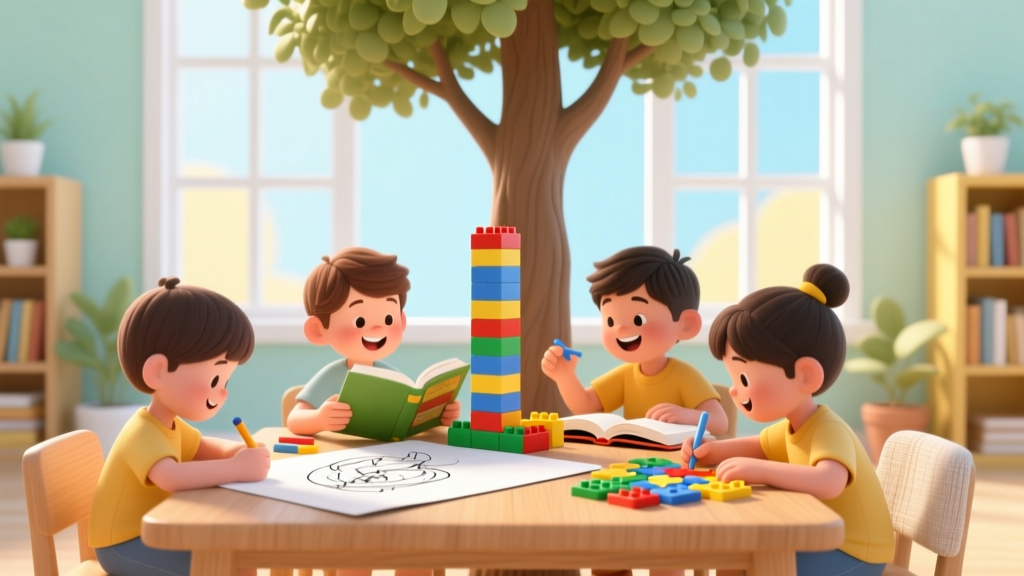
Teach Empathy to Kids: Neuroscience-Backed Strategies
Why Empathy Isn’t ‘Taught’ — It’s Grown (And Why Your Child Needs It Now More Than Ever)
If you’ve ever searched how to teach empathy to kids, you’re likely wrestling with something deeper than a parenting hack: maybe your 5-year-old snatched a toy without apology, your 9-year-old rolled their eyes when Grandma cried, or your teen muted a friend’s vulnerable Instagram story. You’re not failing — you’re responding to a quiet crisis. Neuroscientists at the Yale Center for Emotional Intelligence confirm that empathy isn’t innate in its full form; it’s a neural circuit built through repeated, attuned experiences — and today’s children face unprecedented empathy erosion: a 40% decline in empathic concern among college students since 2000 (University of Michigan meta-analysis), linked to rising screen time, accelerated academic pressure, and shrinking unstructured peer play. The good news? Empathy is the most malleable social skill in childhood — and it’s cultivated not in lesson plans, but in the micro-moments you already inhabit: bedtime chats, grocery line waits, sibling spats, and even silent car rides.
Start With Your Own Mirror Neurons: Modeling > Instruction
Children don’t learn empathy by hearing ‘You should care.’ They absorb it by witnessing how *you* respond to distress — theirs, yours, and others’. When your 4-year-old spills milk and bursts into tears, your knee-jerk ‘It’s fine! Let’s clean it up!’ may solve the mess but erases their emotional data. Instead, try this three-part ‘Name-Validate-Anchor’ response: Name the feeling (“You’re frustrated — that milk surprised you”), Validate its legitimacy (“It’s okay to feel upset when things go differently”), then Anchor it to shared humanity (“I spill things too — remember when I dropped the cereal box last week?”). This isn’t coddling; it’s neurobiological scaffolding. According to Dr. Daniel Siegel, clinical professor of psychiatry at UCLA, such ‘connect-and-redirect’ interactions literally strengthen the prefrontal cortex’s ability to regulate emotion and consider others’ perspectives. A 2023 longitudinal study in Child Development tracked 217 families for 5 years and found children whose parents consistently used emotion-labeling language were 2.3x more likely to demonstrate spontaneous comforting behavior toward peers during observed play sessions.
Pro tip: Record yourself for one 10-minute interaction (with consent) — no editing. Listen back not for content, but for your ratio of problem-solving statements (“Let’s fix it”) vs. emotion-acknowledging phrases (“That felt scary”). Aim for 60/40 in favor of acknowledgment. Bonus: Narrate your own feelings aloud — ‘I’m feeling impatient waiting for this coffee’ or ‘I’m proud of myself for calling Grandma today.’ Children internalize empathy vocabulary when they hear it applied to adult inner lives.
The ‘Empathy Pause’: Turning Conflicts Into Neural Rewiring Moments
Most discipline moments are empathy goldmines — if we pause before reacting. When your 7-year-old shoves their sibling, the instinct is to demand an immediate ‘I’m sorry.’ But forced apologies train children to perform remorse, not understand impact. Try the Empathy Pause instead — a 90-second ritual grounded in trauma-informed pedagogy:
- Stop & Breathe: Kneel to eye level. Say nothing for 5 seconds. This signals safety and resets both nervous systems.
- Describe, Don’t Judge: “I saw you push Sam’s arm when he took the controller.” (Not “You’re being mean.”)
- Invite Perspective: “What was happening in your body right then? Was your heart fast? Jaw tight?” (This builds interoceptive awareness — the foundation of empathy.)
- Bridge to Other: “What do you think Sam’s face looked like? What might his body have felt?” (Use photos or drawings if needed — visual cues activate mirror neurons.)
- Co-Create Repair: “What’s one small thing that would help Sam feel better? Would you like to draw him a picture, share the controller for 2 minutes, or just sit with him?”
This isn’t permissiveness — it’s precision teaching. A randomized controlled trial published in Pediatrics (2022) showed classrooms using this protocol reduced aggressive incidents by 68% over one semester while increasing peer-helping behaviors by 41%. Why? Because it transforms conflict from a moral failure into a cognitive-emotional puzzle the child solves *with* you — building agency and insight simultaneously.
Storytelling That Builds Theory of Mind (Without a Single Textbook)
Stories are empathy simulators. But not all stories work equally. Research from Harvard’s Graduate School of Education reveals that narratives with *ambiguous motives* — where characters act in ways that contradict surface behavior — uniquely develop theory of mind (the ability to infer others’ mental states). Skip predictable ‘kindness tales’ where the hero always shares. Instead, choose books where characters make confusing choices — like The Rabbit Listened (a child’s anger isn’t soothed until someone simply sits quietly with them) or Enemy Pie (a boy tries to ‘destroy’ a rival by baking him pie — only to discover shared interests). After reading, ask open-ended questions that resist binary answers:
- “What do you think [character] believed would happen when they did that?”
- “If you could whisper one question to [character] right now, what would it be?”
- “What’s something [character] might be feeling that they’re not showing?”
For older kids, use real-world ambiguity: Watch a muted news clip of a protest or sports moment. Ask, “What might each person in this frame be thinking? What evidence do you see in their posture? What might they need right now?” This trains the brain to hold multiple perspectives — the core muscle of empathy. As Dr. Michele Borba, author of Unselfie, emphasizes: “Empathy isn’t about agreeing — it’s about accurately guessing the emotional weather inside another person’s skull.”
Play as Empathy Incubator: From Pretend to Prosocial
Unstructured, imaginative play isn’t ‘just fun’ — it’s where children rehearse emotional roles they’ll need for life. In pretend scenarios, a 4-year-old who insists on being the ‘doctor’ while assigning ‘sick patient’ to their doll practices regulating distress, making decisions under uncertainty, and offering comfort — all without real stakes. But modern play often lacks the friction that builds empathy. Consider these evidence-backed upgrades:
- Introduce ‘Role Reversal’ Rules: During tea party play, require switching who serves whom every 3 minutes. In superhero play, mandate that ‘villains’ get monologues explaining their backstory.
- Add Sensory Constraints: Play ‘grocery store’ blindfolded (with supervision) — asking, “How does it feel to shop when you can’t see prices or labels? What would help you?”
- Embed ‘Repair Objects’: Keep a ‘Kindness Kit’ nearby — not toys, but tools: a soft scarf (‘for when someone feels cold inside’), a smooth stone (‘to hold when words are hard’), a tiny notebook (‘to write wishes for others’).
A landmark 2021 study in Developmental Psychology observed 184 preschoolers across 6 months. Those engaged in structured role-reversal play showed 3.2x greater growth in affective empathy scores (measured via facial mimicry response to emotional videos) compared to control groups doing standard free play. Crucially, gains persisted at 12-month follow-up — proving play isn’t just practice; it’s neural architecture.
| Age Range | Key Developmental Milestones | Empathy-Building Activities (Evidence-Based) | Safety & Supervision Notes |
|---|---|---|---|
| 2–3 years | Emerging self-awareness; begins recognizing basic emotions in faces; limited impulse control | Mirror games (copying facial expressions); ‘feeling faces’ sticker charts; narrating baby dolls’ needs (“She’s crying — maybe she’s hungry or tired?”) | Avoid abstract concepts (“How would you feel?”); focus on concrete cues (tears, frowns, loud voice). Supervise all object-based activities for choking hazards. |
| 4–6 years | Developing theory of mind; understands simple intentions; begins sharing & turn-taking | “Emotion Charades” with family photos; collaborative art projects requiring negotiation (“Should the sky be blue or purple?”); reading books with character dilemmas | Limit screen-based empathy tools (apps/games) to ≤15 mins/day per AAP guidelines. Prioritize embodied, face-to-face interaction. |
| 7–9 years | Recognizes mixed emotions; understands perspective shifts; develops moral reasoning | Writing ‘unsent letters’ to fictional characters explaining their choices; creating ‘empathy maps’ for historical figures; volunteering with clear, tangible tasks (packing food boxes) | Pre-screen volunteer opportunities for developmental appropriateness. Avoid exposure to graphic suffering. Focus on agency (“You packed 20 meals”) not tragedy. |
| 10–13 years | Abstract thinking emerges; heightened self-consciousness; peer influence peaks | Debating ethical dilemmas (“Is it okay to lie to protect someone’s feelings?”); analyzing song lyrics for emotional subtext; mentoring younger kids in structured programs | Discuss digital empathy explicitly: “What’s lost when we text ‘lol’ instead of seeing a friend’s smile?” Monitor for compassion fatigue in high-responsibility roles. |
Frequently Asked Questions
Can empathy be taught to children with autism or ADHD?
Yes — but it requires neurodiversity-affirming approaches. Children with autism often excel at cognitive empathy (understanding others’ thoughts) but struggle with affective empathy (sharing feelings), while some with ADHD may hyper-focus on their own needs due to executive function challenges. The key is shifting from ‘teaching empathy’ to ‘building connection bridges.’ Occupational therapists recommend sensory-friendly tools like emotion thermometers (visual scales from ‘calm’ to ‘overwhelmed’) and social scripts for common scenarios. As Dr. Temple Grandin notes, “Autistic brains process emotion differently, not deficiently — we need pathways, not pressure.” Evidence shows video modeling and explicit social narrative instruction significantly improve perspective-taking in autistic children (Journal of Autism and Developmental Disorders, 2020).
My child seems empathetic at home but cruel online — why?
This ‘empathy gap’ is alarmingly common. Screens remove vital empathy triggers: facial micro-expressions, vocal tone shifts, and physical proximity — all of which activate mirror neurons. A 2023 Common Sense Media report found 62% of tweens couldn’t identify sarcasm or sadness in text-only messages. Combat this with ‘digital detox moments’: require video calls instead of texts for friend check-ins, co-watch YouTube comment sections to analyze tone, and institute ‘pause-and-reflect’ rules before posting (“What might this look like to someone who doesn’t know me?”). Crucially, model it: narrate your own digital pauses (“I’m stepping away from this thread because my heart rate went up — let me breathe first.”).
Does punishment reduce empathy?
Harsh, shame-based discipline actively undermines empathy development. When children feel chronically shamed or fearful, their brains prioritize survival over connection — shutting down the prefrontal cortex networks needed for perspective-taking. Research by Dr. John Gottman shows punitive responses correlate with lower empathy scores long-term, while ‘emotion-coaching’ parents (who validate feelings before guiding behavior) raise children with higher emotional intelligence. Discipline isn’t about consequences — it’s about repair. As pediatrician Dr. Laura Markham advises: “The goal isn’t obedience. It’s helping your child become the kind of person who *chooses* kindness because they feel connected to others’ humanity.”
How much screen time is too much for empathy development?
The American Academy of Pediatrics recommends zero screens for children under 18 months (except video-chatting), and consistent limits thereafter — but the *quality* matters more than quantity. Passive scrolling (TikTok, YouTube Shorts) correlates strongly with empathy decline in tweens (JAMA Pediatrics, 2022), while interactive, co-viewed content (e.g., watching documentaries about animals and discussing motivations) shows neutral or positive effects. The litmus test: Does this screen activity require your child to imagine someone else’s inner world? If not, it’s likely empathy-depleting.
Common Myths About Teaching Empathy
- Myth #1: “Empathy is fixed — either you have it or you don’t.” Neuroscience confirms empathy is a skill built through experience-dependent plasticity. MRI studies show increased gray matter density in empathy-related brain regions (anterior insula, anterior cingulate cortex) after just 8 weeks of compassion meditation — and children’s brains are even more adaptable.
- Myth #2: “Teaching empathy means making kids overly sensitive or people-pleasing.” True empathy includes healthy boundaries. We’re not raising martyrs — we’re raising discerning humans who can say “I see you’re hurting, and I need to step away to recharge.” Model this daily: “I love helping, but I need quiet time now so I can be fully present later.”
Related Topics (Internal Link Suggestions)
- Helping kids manage big emotions — suggested anchor text: "how to help kids name and regulate strong feelings"
- Building resilience in children — suggested anchor text: "resilience-building activities for elementary-aged kids"
- Positive discipline strategies — suggested anchor text: "gentle discipline techniques that strengthen connection"
- Social-emotional learning at home — suggested anchor text: "simple SEL routines for busy families"
- Screen time balance for families — suggested anchor text: "practical digital wellness plans for parents"
Your Next Step: Start Small, Start Today
You don’t need a curriculum, a budget, or extra time. You need one intentional micro-moment: tonight at dinner, replace ‘How was school?’ with ‘What’s one thing someone said or did today that made you feel seen?’ Next week, when your child complains about a classmate, pause and ask, ‘What’s one thing that might be hard for them right now?’ These aren’t tricks — they’re invitations to co-create a more compassionate world, one neural pathway at a time. Download our free Empathy Pause Quick-Reference Guide (with printable prompts and age-specific scripts) — because empathy isn’t caught in grand gestures. It’s grown in the quiet, consistent way you choose to meet your child’s humanity, again and again.
More Articles
 Does Rod Wave Have Kids? Verified Facts & Fatherhood Truth
 What Grade Are the Kids in Stranger Things Season 1?
 How Many Kids Do Beyoncé Have (2026)
 Maya Angelou’s Motherhood: Truth, Trauma & Wisdom
 Did Ed Gein Babysit Kids? The Truth for Parents
 Alexis Bledel Kids: What We Know (2026)
 How Many Days Do Kids Go to School in 2026
 What Is a Latchkey Kid? Facts, Risks & Parent Tips
 Kids Wipe Own Bum: When & How (2026)
 Does Noah Sebastian Have a Kid? The Truth (2026)