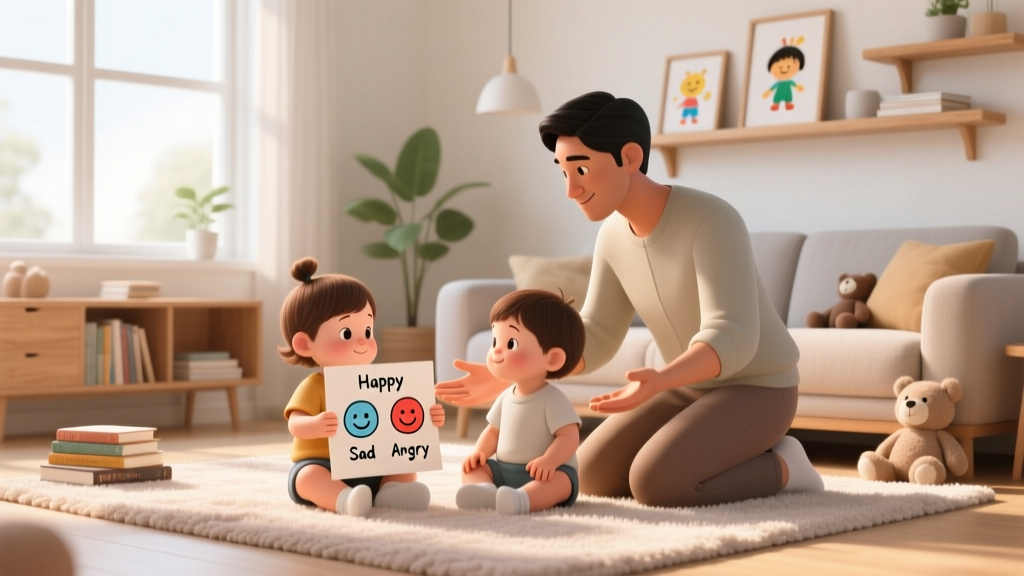
7 Evidence-Based Toddler Emotional Regulation Strategies
When your toddler collapses on the grocery store floor because you bought the wrong crackers, it's easy to feel like you're failing. But developmental psychologists have a different take: toddler meltdowns aren't bad behavior — they're a sign that your child's emotional regulation system is still under construction. The good news? You can actively teach emotional regulation skills starting as early as 18 months. This guide walks you through 7 evidence-based strategies that reduce tantrums, build emotional intelligence, and help both you and your child stay calm when big feelings hit.
Why Toddlers Have Meltdowns: The Neuroscience
Between ages 1 and 3, a child's emotional center (the amygdala) is fully active, but the part of the brain that regulates emotions (the prefrontal cortex) won't mature until their mid-20s. This means toddlers literally cannot regulate big emotions on their own. They're not being manipulative, spoiled, or defiant — they're neurologically overwhelmed.
Dr. Dan Siegel, clinical professor of psychiatrist at UCLA, describes this as the "downstairs brain" (emotions, survival instincts) being fully online while the "upstairs brain" (reasoning, self-control) is still under construction. When a toddler has a meltdown, it's not a choice — it's a neurological event.
Research from the University of Oregon's Prevention Science Institute shows that children who learn emotional regulation skills before age 4 have significantly better outcomes in kindergarten: fewer behavioral problems, stronger peer relationships, and higher academic readiness. The skills you teach now compound over years.
7 Evidence-Based Strategies That Actually Work
1. Name the Emotion Before the Explosion
When you see early warning signs — clenched fists, flushed face, whining — name what you're seeing: "I can see you're getting frustrated." Research by Dr. Lisa Feldman Barrett shows that simply labeling an emotion activates the prefrontal cortex and reduces amygdala activity. This is called "affect labeling" and it works for adults and children alike.
What to say: "You're feeling angry because we have to leave the park. That's hard."
What to avoid: "Stop crying, it's not a big deal." This invalidates the emotion and escalates the response.
2. The Co-Regulation Principle
Children don't learn self-regulation by being told to self-regulate. They learn it through co-regulation — experiencing calm alongside a calm adult. Dr. Mona Delahooke, pediatric psychologist and author of Beyond Behaviors, emphasizes: "You can't teach a child to calm down if you're dysregulated yourself. Your nervous system is their blueprint."
When your child is escalating, your job is to stay regulated. Take deep breaths. Lower your voice. Sit at their level. Your calm presence is the intervention — not your words.
3. Create a "Calm-Down" Space (Not a Time-Out Corner)
A calm-down space is a cozy corner with soft pillows, a weighted blanket, emotion cards, and comfort items — not a punishment zone. The goal is to teach children that when emotions feel overwhelming, they can go to a safe place to feel and recover.
Research published in Early Childhood Research Quarterly found that children who had access to a calm-down space at home and preschool showed 40% fewer intense tantrums over a 6-month period compared to children in traditional time-out systems.
4. Teach the "Stop-Think-Do" Routine
For children ages 3 and up, you can begin teaching a simple self-regulation routine:
- Stop: Put your hands on your belly and take 3 breaths
- Think: "What am I feeling? What do I need?"
- Do: Choose a helpful action (ask for help, use words, take space)
Practice this during calm moments, not during meltdowns. Role-play with stuffed animals or during story time. When children practice the routine when calm, they're more likely to access it when stressed.
5. Validate Before You Correct
This is the single most powerful technique in the emotional regulation toolkit. Before addressing behavior, validate the feeling:
- Instead of: "Don't hit your sister!" → Say: "You're so angry at your sister. It's okay to be angry. It's not okay to hit. Let's find a safe way to show that anger."
- Instead of: "Stop screaming!" → Say: "Your voice is so loud. You must be really upset. I'm here. Let's breathe together."
Validation doesn't mean agreement — it means acknowledgment. Children who feel heard are significantly less likely to escalate. Dr. John Gottman's research on "emotion coaching" found that children whose parents validated their emotions showed better emotional regulation, fewer behavior problems, and stronger social skills than children whose parents dismissed or punished emotions.
6. Use "Emotion Cards" and Visual Supports
Toddlers lack the vocabulary to express complex emotions. Emotion cards (pictures of faces showing happy, sad, angry, frustrated, scared, tired, hungry) give them a communication tool when words fail.
How to use them: When your child is escalating, hold up the cards and ask, "Which face feels like what you're feeling?" This simple act shifts activity from the emotional brain to the thinking brain, often interrupting the escalation cycle.
7. Build Emotional Literacy During Calm Moments
Emotional regulation isn't taught during crises — it's taught during peaceful times. These daily practices build the foundation:
- Read books about emotions: "The Color Monster," "When Sophie Gets Angry — Really, Really Angry," and "The Feelings Book" help children build emotional vocabulary
- Model naming your own emotions: "I'm feeling frustrated because I can't find my keys. I'm going to take three deep breaths."
- Play emotion games: "Show me your happy face. Now your surprised face. Now your silly face." Laughter builds neural pathways for emotional flexibility
- Reflect on the day: At bedtime, ask "What made you happy today? What was hard?" This builds emotional awareness and processing skills
When Tantrums Are More Than Typical
Most toddler tantrums are developmentally normal. However, seek professional guidance if:
- Tantrums regularly last more than 20–25 minutes
- Your child is frequently aggressive toward themselves (head-banging, biting themselves, scratching)
- Tantrums occur 10+ times per day after age 3
- Your child cannot be consoled after tantrums — no recovery, no reconnection
- Tantrums are accompanied by significant speech delays, social withdrawal, or sensory sensitivities
These patterns may indicate underlying issues such as sensory processing differences, anxiety, or developmental concerns that benefit from professional support.
The Prevention Framework: HALT + R
Most tantrums are preventable if you check for these five triggers:
| Trigger | Signs | Prevention |
|---|---|---|
| Hungry | Whining, irritability, saying "no" to everything | Regular snacks every 2–3 hours; carry emergency snacks |
| Angry/Anxious | Tension, withdrawal, clinginess | Name the feeling; provide physical comfort; reduce demands |
| Lonely | Attention-seeking behavior, interrupting, acting out | 10 minutes of focused, device-free connection time |
| Tired | Rubbing eyes, slowed movements, emotional reactivity | Protect nap time; move bedtime earlier by 30 minutes |
| Restricted | Frustration at boundaries, "I can't do it" meltdowns | Offer choices within boundaries; break tasks into smaller steps |
Frequently Asked Questions
At what age do tantrums stop?
Most children have significantly fewer tantrums by age 4. By age 5, the average child has fewer than 1 tantrum per day. However, some children continue to have occasional meltdowns through age 6–7, especially when tired, sick, or overwhelmed. The frequency and intensity should gradually decrease as language skills and self-regulation abilities develop.
Should I ignore my child's tantrum?
No — but you shouldn't reward it either. "Ignoring" a tantrum abandons a child in emotional distress. Instead, stay present and calm without giving in to the demand that triggered the tantrum. Sit nearby, offer physical comfort if they accept it, and wait for the storm to pass. This is called "ignoring the behavior, not the child."
Is it bad if my toddler still hasn't said their first word at 18 months?
Emotional regulation and language development are connected. Children who can't yet verbalize their feelings are more likely to express them through behavior (tantrums, hitting). If your 18-month-old has limited speech, focus heavily on emotion cards, modeling emotion words, and co-regulation strategies until their language catches up. If speech concerns persist beyond 24 months, consult a speech-language pathologist.
What if my toddler's tantrums are getting worse, not better?
If tantrums are increasing in frequency or intensity despite consistent use of emotional regulation strategies, consider whether something has changed: a new sibling, starting daycare, illness, sleep disruption, or a shift in family dynamics. Sometimes tantrums increase temporarily before they improve — this is called an "extinction burst" in behavioral science and is a normal part of the learning process. If concerns persist beyond 4–6 weeks, consult your pediatrician.
Can you spoil a toddler by comforting them too much during tantrums?
No. Decades of attachment research show that responding warmly to a child's distress builds security, not dependency. Children who receive consistent emotional support actually develop stronger self-regulation over time, not weaker. The myth of "spoiling" through comfort has been thoroughly debunked by developmental science. What matters is responding to the emotion (always) while maintaining boundaries on the behavior (when needed).
Common Myths Debunked
Myth #1: "Tantrums are manipulation."
They're not. Tantrums are emotional overflow. A toddler's brain literally cannot process big emotions without adult support. The idea that young children "manipulate" through tantrums misunderstands child development. What looks like manipulation is actually desperation — the child doesn't have the tools to regulate and is using the only tool they have: their body.
Myth #2: "Time-outs teach children to calm down."
Traditional time-outs (isolation, silence, "go think about what you did") teach children to suppress emotions, not regulate them. Research by Dr. Daniel Siegel shows that isolation during emotional distress increases cortisol levels and activates the brain's threat response. Children need connection during distress, not separation. A calm-down space with supportive presence is fundamentally different from a punitive time-out corner.
Myth #3: "Some kids are just more dramatic than others."
While temperament plays a role in emotional reactivity, all children can learn regulation skills. Children with more sensitive temperaments may need more coaching, more practice, and more patience — but the strategies work across temperaments. The difference isn't "dramatic" versus "calm" children — it's whether the child has been taught the skills to manage big feelings.
The Bottom Line
Teaching emotional regulation to toddlers isn't about stopping tantrums — it's about building skills that will serve your child for the rest of their life. Every time you name an emotion, stay calm during a meltdown, validate feelings before correcting behavior, or practice the stop-think-do routine, you're literally building neural pathways in your child's developing brain. This work is slow, invisible, and rarely dramatic. But it compounds. The toddler who learns to say "I'm mad" instead of hitting is the kindergartener who can take turns. The kindergartener who can take turns is the 10-year-old who can resolve conflicts with friends. The 10-year-old who resolves conflicts is the teenager who can manage stress. It all starts with the big feelings of the toddler years — and your calm, consistent presence through them.
More Articles
 Kids and Coffee: Pediatrician Advice on Caffeine (2026)
 Trump Account for Kids: Rules & Risks (2026)
 Does Ninja Have Kids? Verified Family Facts
 Does Reba McEntire Have Kids? The Truth (2026)
 How Old Are Beyoncé’s Kids in 2026? (Ages & Insights)
 Ed Gein Babysitting Myth: Truth & Caregiver Red Flags
 How Much Does a Kid Cost Per Month (2026)
 How Many.Kids Does Elon Musk Have
 School Transfer for Kids: Confidence, Grades & Sanity (2026)
 What to Make for Lunch for Kids: Nutritionist Tips (2026)