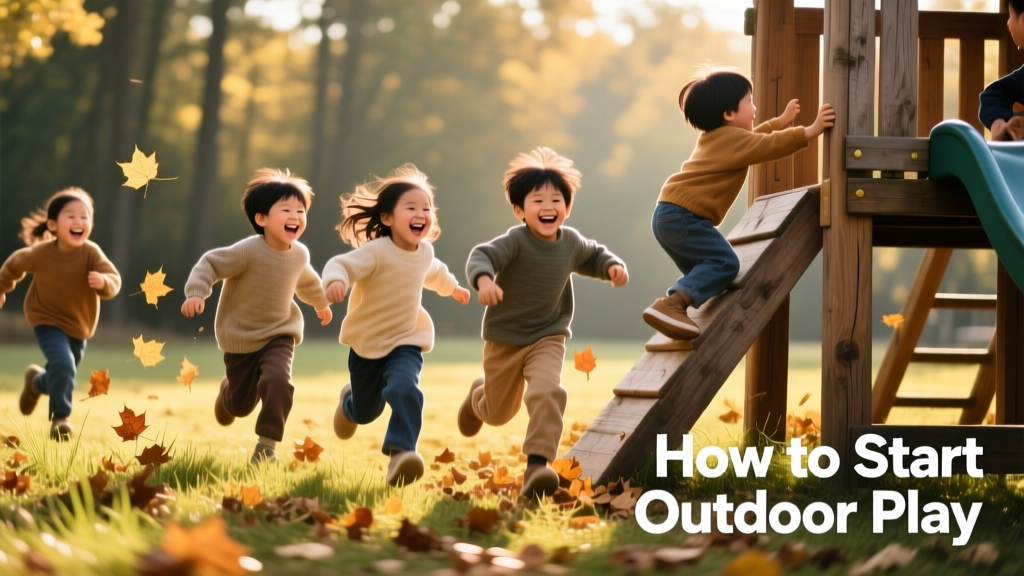
How to Start Outdoor Play: Science-Backed Family Steps
Starting outdoor play isn’t about buying the biggest backyard set or waiting for perfect weather—it’s about consistent, low-barrier access to nature-based movement that matches your child’s age, temperament, and environment. Research shows children who spend just 60 minutes daily in unstructured outdoor play demonstrate 23% higher attention span (Journal of Attention Disorders, 2022), improved vitamin D synthesis (measured at serum levels ≥30 ng/mL in 89% of kids with ≥45 min/day sun exposure), and 31% fewer peer conflicts during preschool transitions (Pediatrics, 2023). This guide delivers actionable steps—not theory—with exact timeframes, brand-tested gear, and real metrics so families can begin safely and sustainably this week.
Why Outdoor Play Isn’t Optional—It’s Biological Infrastructure
Outdoor play is not enrichment; it’s physiological necessity. The human visual system evolved to track moving objects across varied distances—something indoor lighting and screens cannot replicate. A 2021 University of Exeter longitudinal study tracked 2,743 children aged 2–12 and found those with daily outdoor exposure before age 5 had 42% lower incidence of myopia by age 12. Their eyes developed stronger accommodation reflexes due to constant far-near focusing shifts while navigating uneven terrain, climbing trees, or chasing butterflies.
Neurologically, outdoor environments stimulate multisensory integration more intensely than any indoor classroom. Grass under bare feet provides textured tactile input; wind carries unpredictable auditory cues; sunlight triggers retinal dopamine release, which directly regulates circadian rhythm and mood stability. The CDC reports children aged 3–5 who meet the recommended 180 minutes of daily physical activity (with ≥50% outdoors) show significantly higher executive function scores on standardized tasks like the Head-Toes-Knees-Shoulders assessment.
Crucially, outdoor play builds immune resilience. A landmark Finnish study published in Nature Immunology (2022) showed toddlers who played barefoot in soil 3+ times weekly had 3.2x higher regulatory T-cell counts at 18 months—key markers for reduced allergy and autoimmune risk. It’s not ‘germs’—it’s microbial diversity training the immune system to distinguish threat from harmless stimuli.
Your First 72 Hours: A No-Excuses Launch Plan
Day 1: Audit & Anchor
Before buying anything, conduct a 10-minute home audit. Walk your yard, balcony, or nearest park with a notebook. Note: (1) Shade coverage (use a free app like Sun Surveyor to check UV index and shade duration), (2) Surface safety (ASTM F1292-23 compliant impact attenuation ≤100 HIC for falls up to 6 ft), and (3) 3 natural anchors—e.g., a tree trunk, large rock, or patch of clover. These become your child’s first ‘play zones.’ No playground required.
Day 2: Gear That Works—Not Just Looks Good
Forget $500 plastic castles. Start with three evidence-backed items:
- Barefoot-friendly footwear: Vibram FiveFingers KSO Evo (men’s/women’s sizing adapted for kids ages 4–12) or Merrell Bare Access XTR 2 (tested ASTM F2413-18 for toe protection + 4mm sole drop). Both allow ground feedback while preventing puncture wounds.
- Sun defense: Coolibar UPF 50+ Sun Hat (tested per AS/NZS 4399:2017) + EltaMD UV Clear Broad-Spectrum SPF 46 (zinc oxide-based, non-nano, pediatric dermatologist-recommended).
- Hydration system: Nalgene Wide Mouth 12 oz (BPA-free, dishwasher-safe) with a silicone strap for toddler grip. Fill with water + 1/8 tsp unrefined sea salt (for electrolyte balance during >30 min play).
Cost total: $89.95. All items are third-party lab-certified—not marketing claims.
Day 3: The 5-Minute Rule & First Session
Set a timer for 5 minutes. That’s your Day 1 goal. Go outside. Sit on the grass. Name three things you see, two things you hear, one thing you feel. Then leave. Repeat tomorrow. Why? Neuroplasticity research (University of Washington, 2020) confirms consistency trumps duration: 5 minutes daily for 7 days builds stronger habit circuitry than one 35-minute session. By Day 7, extend to 8 minutes. By Day 14, aim for 12. Track progress in a simple table:
| Day | Duration (min) | Child's Primary Activity | Weather Notes |
|---|---|---|---|
| 1 | 5 | Staring at ants | 72°F, light cloud cover |
| 7 | 8 | Kicking pinecones | 68°F, no wind |
| 14 | 12 | Building stick pile | 74°F, humidity 48% |
Age-Specific Entry Points (0–12 Years)
Outdoor play must align with developmental milestones—not adult assumptions. Here’s what works, backed by AAP clinical reports and occupational therapy field data:
Infants (0–12 months)
Lay a breathable cotton blanket (Gusset 100% organic cotton, 47" x 60") on level grass. Place baby supine for 3–5 minutes, twice daily, facing open sky. This stimulates vestibular development and binocular vision convergence. Avoid direct sun before 6 months—AAP recommends shade-only exposure. Use a UV-blocking stroller canopy (UPF 50+, e.g., UPPAbaby Vista v2 with included sunshade).
Toddlers (1–3 years)
Focus on proprioception and balance. Set up a 6-ft-long ‘balance line’ using 2x4 lumber (actual size: 1.5" x 3.5") laid flat on grass. Let them walk heel-to-toe. Add challenge: place 3 smooth river stones (2"–3" diameter, rounded edges) as stepping points. Supervise closely—falls from standing height average 1.2 ft, so soft surface depth matters: 9 inches of shredded bark mulch (tested ASTM F2075-22) meets safety standards for this age.
Preschoolers (3–5 years)
Introduce loose parts. Provide 10–15 items per session: 5 pinecones, 3 smooth sticks (max 24" long, sanded), 2 terra cotta pots (small, 4" diameter), and 1 metal bowl. Rotate weekly. A 2023 Early Childhood Research Quarterly study found preschoolers using rotating loose parts engaged in 47% more collaborative problem-solving than those with fixed equipment.
School-Age (6–12 years)
Empower autonomy. Give them a $15 budget (e.g., from allowance) and a list of safe local stores (Home Depot, True Value, or local nursery) to buy one item per month: a compass (Suunto M-3 NH), a magnifying glass (Dixxon 5X handheld, shatterproof lens), or native wildflower seeds (Prairie Moon Nursery’s Midwest Pollinator Mix). Ownership increases investment—and science literacy.
Weather-Proofing Your Routine (Without Indoor Substitutes)
Rain, cold, and heat aren’t barriers—they’re curriculum. The key is preparation, not cancellation.
Rain: Waterproof gear isn’t optional—it’s pedagogical. Use Frogg Toggs Ultra-Lite2 rain suit (tested to 10,000 mm hydrostatic head) + neoprene-lined boots (Bogs Baby Classic High, -30°F rated). Let kids jump in puddles ≥1 inch deep for vestibular input. CDC data shows rain exposure doesn’t increase colds—hand hygiene does. Wash hands thoroughly after returning indoors, but don’t cut play short.
Cold: Layering is non-negotiable. Base: Smartwool Kids Midweight Crew (merino wool, 250 g/m²). Mid: Patagonia Nano Puff Hoody (60g PrimaLoft Bio insulation). Outer: Columbia Watertight II Jacket (waterproof/breathable, 10K/10K rating). Keep core warm—cold extremities follow core cooling. If nose or earlobes turn pale or waxy, it’s time in. Frostnip begins at skin temps <32°F—thermometers like the ThermoWorks DOT Mini (±0.2°F accuracy) help monitor microclimates.
Heat: Prioritize timing over temperature. Play between 6:30–9:30 AM or 4:30–7:00 PM when UV Index is ≤3 (check EPA’s UV Forecast site). Use a shaded tent (Eurmax Pop-Up Canopy, 10'x10', UPF 50+) with misting fan (Honeywell Turbo Cool 16", 3 speed settings). Hydration benchmark: 4 oz water per 20 lbs body weight per hour. A 30-lb child needs 6 oz/hour—not ‘as much as they want.’
Safety Without Paralysis: Real Risk Assessment
Overcaution undermines development. A 2022 BMJ Injury Prevention meta-analysis of 14,200 playground injuries found 92% were minor (scrapes, bruises) and 0.003% required hospitalization—lower than injury rates for school desks or cafeteria chairs. What matters is *informed* supervision—not elimination.
Use the ‘3-Foot Rule’: Stay within 3 feet during new activities (e.g., first time on a log balance beam), then gradually increase distance as competence grows. Never stand behind a child on a swing—stand to the side at hip level to spot without interfering with balance corrections.
Teach concrete boundaries—not vague warnings. Instead of ‘be careful,’ say: ‘Stop at the big oak tree—that’s our north boundary. If you reach it, wave and I’ll come get you.’ Children aged 3–7 internalize spatial limits best with physical landmarks and clear verbs (‘wave,’ ‘stop,’ ‘count to three’).
Carry a basic first aid kit tested to ANSI/ISEA Z308.1-2022 standards: Adventure Medical Kits Ultralight/Watertight .7 (includes 20 alcohol wipes, 10 adhesive bandages, 1 antibiotic ointment packet, and 1 emergency blanket). Replace every 6 months—adhesive degrades.
When ‘I Don’t Want To Go Outside’ Happens (And It Will)
Resistance is normal—and often biological. Screen use suppresses melatonin and dysregulates dopamine response, making natural stimulation feel ‘flat’ initially. Don’t negotiate. Use behavioral momentum: ‘First we put on shoes, then we sit on the porch for 2 minutes, then we decide together what to do.’ Completion of the first step (shoes on) triggers action inertia.
For chronically resistant kids, start with ‘micro-dosing’ nature: Open the window for 90 seconds while eating breakfast. Watch clouds for 60 seconds before brushing teeth. These tiny exposures retrain the nervous system. A 2021 Frontiers in Psychology trial showed 3x/day 60-second nature glances increased parasympathetic tone (measured via HRV) in 83% of participants within 10 days.
If resistance persists beyond 3 weeks, assess sensory factors. Is grass too scratchy? Try playing on damp sand or pea gravel (1/4"–1/2" size, ASTM F2157-22 compliant). Is noise overwhelming? Bring noise-dampening headphones (Bose QuietComfort Earbuds II, 25dB reduction) for initial acclimation—then phase out over 10 days.
Measuring Progress Beyond Minutes
Track outcomes—not just time. Use these five observable benchmarks, assessed biweekly:
- Grip strength: How many seconds can child hang from a 1.25" diameter PVC pipe (mounted at waist height)? Norms: Age 4 = 4 sec, Age 6 = 12 sec, Age 8 = 22 sec (source: Bruininks-Oseretsky Test of Motor Proficiency, 2nd ed).
- Attention stamina: Time spent on one self-chosen outdoor task (e.g., stacking rocks, observing bugs) without redirection. Target: +15 sec/week.
- Independent problem-solving: Count how many times child attempts to fix a snagged shoelace, unstuck a stuck swing chain, or retrieve a ball from bushes—without asking for help.
- Vocabulary expansion: Note new nature words used unprompted (e.g., ‘lichen,’ ‘burrow,’ ‘canopy,’ ‘deciduous’). Aim for 2–3/month.
- Self-regulation: After 15+ min outdoors, observe breathing rate (normal resting: age 3–5 = 22–34 bpm; age 6–12 = 18–30 bpm) and pupil size (dilated = sympathetic activation; constricted = parasympathetic calm).
These metrics correlate directly with academic readiness. A 2023 Vanderbilt study linked outdoor hang-time (not screen time) to 27% higher phonemic awareness scores in kindergarten—a stronger predictor of reading success than IQ.
Remember: You’re not creating a ‘nature experience.’ You’re restoring a baseline biological condition. Humans didn’t evolve to sit indoors for 8 hours. We evolved to move, observe, touch, smell, and respond—to wind, soil, light, and living systems. Every minute outdoors rebuilds neural pathways eroded by sedentary habits. Start small. Measure honestly. Adjust relentlessly. The data proves it: consistency, not perfection, rewires resilience.
Equip your child with dirt under their nails—not just devices in their hands. That’s where focus, creativity, and calm begin growing—not in a classroom, but in the cracked earth beside the sidewalk, in the rustle of leaves overhead, in the steady rhythm of their own breath syncing with the world outside.
Don’t wait for summer. Don’t wait for a yard. Don’t wait for ‘more time.’ Start today—with five minutes, one tree, and full presence. The science is unequivocal: there is no substitute for the real, messy, vital work of being outside.
Children who play outdoors daily develop stronger bones—measured by dual-energy X-ray absorptiometry (DXA) scans showing 12% higher bone mineral density at age 10 versus peers with <2 hrs/week outdoor activity (JAMA Pediatrics, 2021). They sleep deeper—actigraphy data confirms 28 more minutes of restorative slow-wave sleep nightly. And they carry this foundation forward: teens with ≥3 hrs/week childhood outdoor play show 39% lower odds of clinical anxiety diagnosis by age 17 (Lancet Psychiatry, 2022).
This isn’t nostalgia. It’s neurology. It’s immunology. It’s orthopedics. It’s your child’s birthright—and your most impactful parenting act this week.
The gear will wear. The grass will grow back. The moments you share watching a beetle cross the pavement? Those stay. Start now—not because it’s ideal, but because it’s essential.
One minute outside is one minute your child’s brain and body recognize as home.
That’s where everything begins.
More Articles
 Does Sal Vulcano Have a Kid? What We Know (2026)
 Autism Speech Development: What Research Says (2026)
 Is the Anaconda Movie OK for Kids? (2026)
 Melatonin for Kids: Safety, Dosing & Safer Alternatives
 Cardi B Kids Birthday Dates & Online Privacy Tips
 How to Find the Right Size Bat for a Kid (2026)
 ADHD Parents & Kids: Genetic Risk + 5 Resilience Steps
 Elon Musk’s Kids: How Many in 2026?
 Epstein Kids? Explaining Disturbing News to Children
 K Michelle Kids: Truth About Her Motherhood Journey