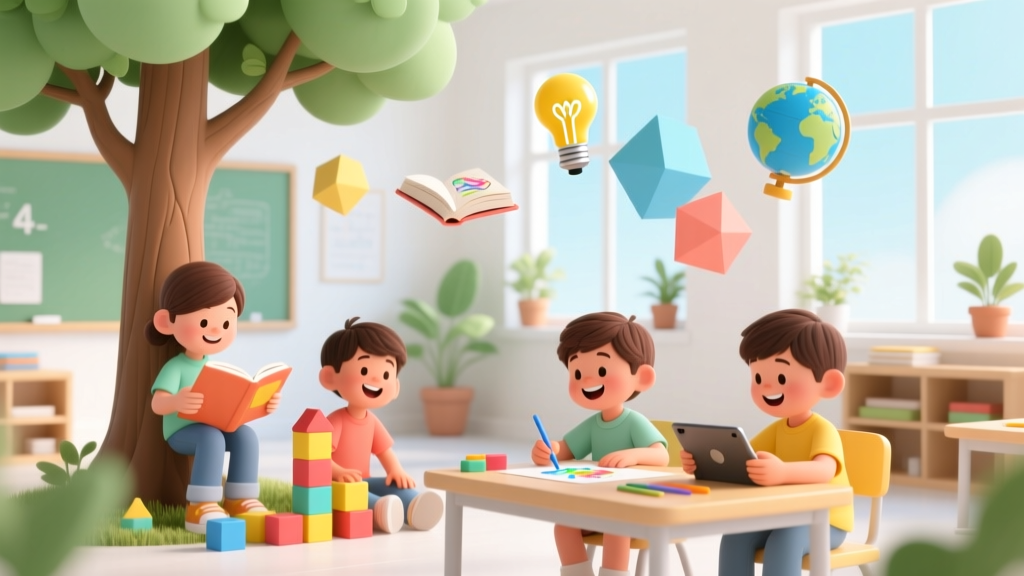
How to Read Literature Like a Professor for Kids
Why Teaching Kids to Read Like a Professor Isn’t About Making Them Mini-Scholars
If you’ve ever searched how to read literature like a professor for kids, you’re not looking for graduate-level theory—you’re seeking ways to help your child notice the magic hiding in plain sight: why that red balloon appears three times, why the quiet character always speaks last, or why the story starts with rain. This isn’t about literary jargon—it’s about nurturing the innate curiosity children already possess and giving it language, structure, and joyful repetition. In today’s world of fragmented attention and algorithm-driven content, helping kids slow down, spot patterns, and ask ‘What if?’ isn’t just enriching—it’s protective. According to the American Academy of Pediatrics (AAP), children who regularly engage in deep, dialogic reading—where adults model questioning, predicting, and connecting—show significantly stronger executive function, vocabulary growth, and emotional regulation by age 8.
Start With What They Already Do (And Love)
Before introducing any ‘professor-like’ lens, honor how children naturally interact with stories: they imitate voices, draw alternate endings, obsess over repeated phrases, and fixate on visual details. These aren’t distractions—they’re embryonic forms of literary analysis. Dr. Susan B. Neuman, former U.S. Assistant Secretary of Education and literacy researcher, emphasizes that ‘children’s earliest narrative reasoning emerges through play, retelling, and embodied response—not silent decoding.’ So begin where they are:
- Turn predictions into a game: Pause mid-sentence in familiar books (“The wolf huffed…”) and ask, “What do you think happens next—and what in the picture or words made you guess that?” Record answers on sticky notes and revisit them after reading. Over time, kids begin citing textual evidence without prompting.
- Map emotions visually: Use a simple 3-point scale (😊 → 😐 → 😢) and ask, “How does this character feel *right now*? What did they say or do that told you?” This builds inference skills—the cornerstone of thematic analysis.
- Spot the ‘story skeleton’: After reading, sketch together: ‘Beginning (Who? Where? What’s wrong?) → Middle (What did they try? What got harder?) → End (What changed—inside or out?).’ This scaffolds structural awareness far more effectively than abstract terms like ‘rising action.’
A real-world example: When 7-year-old Maya read The Three Little Pigs, her mom asked, “Why do you think the first two pigs built quickly—but the third took so long?” Maya replied, “Because he wanted it to be *safe*.” That single observation opened a conversation about intention, consequence, and character motivation—the very heart of literary interpretation.
The 4 Foundational Lenses (Ages 4–12, Adapted by Developmental Stage)
Thomas C. Foster’s How to Read Literature Like a Professor identifies recurring patterns—symbols, motifs, archetypes, and irony—that shape meaning. For kids, we distill these into four intuitive, sensory-rich lenses—each calibrated to cognitive milestones and backed by research from the National Council of Teachers of English (NCTE) and the International Literacy Association (ILA). Crucially, these aren’t taught in isolation; they’re layered gradually across readings, like building blocks.
- The ‘What’s Repeating?’ Lens (Ages 4–7): Focuses on repetition—of words, sounds, colors, or actions. Young children excel at detecting rhythm and recurrence. A repeated phrase (“I do not like green eggs and ham”) signals emphasis and theme. Use finger-taps, claps, or colored stickers to mark repeats—then ask, “Why do you think the author said it again? Does it feel different the second time?”
- The ‘What’s Hidden in Plain Sight?’ Lens (Ages 6–9): Introduces symbolism through concrete, tangible objects: a broken clock = time running out; a key = access to something new; a bridge = connection or change. Avoid abstraction—instead, link symbols to lived experience: “When you left your favorite blanket at Grandma’s, did it feel like part of *you* was missing? That’s how characters feel about their special objects.”
- The ‘What If It Were Different?’ Lens (Ages 8–11): Cultivates irony and perspective by rewriting small moments: “What if the Little Red Riding Hood had brought a walkie-talkie? What if the Grinch kept the presents but shared them?” This develops metacognition—the ability to step outside the text and examine its construction.
- The ‘Who Gets to Tell This Story?’ Lens (Ages 9–12): Explores voice and bias using accessible comparisons: Read the same event from two characters’ viewpoints (e.g., The True Story of the Three Little Pigs vs. the original), then map differences in word choice, emotion, and blame. Ask, “Whose feelings matter most here? Whose are left out?”
These lenses aren’t rigid stages—many 6-year-olds grasp symbolism when anchored in physical experience, while some 10-year-olds need repetition to internalize perspective shifts. Flexibility is key. As Dr. Kathy Hirsh-Pasek, developmental psychologist and co-author of Becoming Brilliant, reminds us: ‘Cognitive scaffolding works best when it’s responsive—not prescriptive.’
Turning Any Book Into a ‘Professor-Ready’ Experience
You don’t need special editions or lesson plans. What matters is consistency of approach—not volume of content. Here’s how to embed literary thinking into everyday reading, using books most families already own:
- With picture books (e.g., Where the Wild Things Are): Zoom in on Max’s expression across pages. Track how his eyes, mouth, and posture change—not just the words. Ask, “When does he look most powerful? Most small? What makes you say that?” This teaches visual rhetoric and emotional arc.
- With chapter books (e.g., Charlotte’s Web): Create a ‘Character Connection Chart’: Draw a web with Wilbur in the center. Add strands labeled ‘Needs,’ ‘Fears,’ ‘Changes,’ and ‘Helps Others.’ Fill in with quotes or scenes. Then ask, “Which strand grew strongest by the end—and why?”
- With nonfiction hybrids (e.g., The Watcher: Jane Goodall’s Life with the Chimps): Highlight passages where the author uses storytelling techniques—dialogue, suspense, sensory detail—to convey science. Ask, “How is this *like* a novel? How is it different?” This bridges genres and deepens analytical transfer.
Crucially, avoid ‘testing’ understanding. Instead of “What’s the theme?”, try “If this story were a song, what would the chorus be—and why?” Or “If you could send one message from this book to your friend, what would it be?” These preserve agency and joy while demanding synthesis.
Age-Appropriate Guide to Literary Lenses & Activities
| Age Range | Primary Cognitive Strength | Best-Suited Literary Lens | Low-Prep Activity Example | Why It Works (Developmental Rationale) |
|---|---|---|---|---|
| 4–6 years | Pattern recognition, auditory memory, concrete symbolism | “What’s Repeating?” | Clap rhythm of repeated refrains (There Was an Old Lady Who Swallowed a Fly); collect ‘repeat tokens’ (buttons, stones) each time phrase recurs | Supports phonological awareness and early narrative sequencing—foundations for both reading fluency and thematic tracking (ILA, 2022) |
| 7–8 years | Emerging inference, empathy expansion, cause-effect reasoning | “What’s Hidden in Plain Sight?” | Create a ‘Symbol Swap’ collage: Replace one object in a book illustration (e.g., swap the wizard’s staff for a garden trowel) and discuss how meaning shifts | Builds theory of mind and symbolic representation—key predictors of later literary analysis success (NCTE Position Statement on Early Literacy, 2023) |
| 9–10 years | Abstract thinking onset, perspective-taking, moral reasoning | “What If It Were Different?” | Write a 3-sentence ‘Alternate Ending’ focusing on one character’s choice—then compare consequences to original | Strengthens counterfactual reasoning and ethical evaluation, both linked to improved argumentation skills (AAP, 2021) |
| 11–12 years | Metacognition, systemic thinking, identity exploration | “Who Gets to Tell This Story?” | Interview two characters from the same scene using a ‘bias meter’ (1–5 scale: “How much does this speaker want you to feel sorry for them?”) | Develops critical media literacy and deconstruction of narrative authority—essential for digital citizenship (Common Sense Media, 2023) |
Frequently Asked Questions
Can I start this with a preschooler—or is it too advanced?
Absolutely start early! The youngest children are natural pattern-seekers and storytellers. What changes isn’t the *concept* (e.g., noticing repetition), but the *language* you use. With a 4-year-old, say “Let’s find all the ‘boom!’ sounds!” instead of “Identify onomatopoeia.” Research from the Harvard Graduate School of Education shows that even toddlers who hear rich, question-based talk during shared reading develop stronger narrative comprehension by kindergarten—regardless of socioeconomic background.
My child hates ‘school stuff’—will this feel like homework?
Only if it’s presented that way. The difference lies in framing and ownership. Instead of assigning analysis, invite collaboration: “I noticed something weird in this page—want to help me figure it out?” or “You’re the story detective today—what clue should we follow first?” Keep sessions under 8 minutes, tie insights to their interests (“This dragon’s hoard is like your LEGO collection—what does it say about him?”), and always end with creation—not recall (“Draw what happens *after* the last page”).
Do I need to know literary terms to do this well?
No—and in fact, avoiding terminology early on is more effective. A landmark study published in Reading Research Quarterly found that students whose teachers used descriptive, experiential language (“How does the setting make the character feel trapped?”) outperformed peers whose teachers led with definitions (“Identify the setting and mood”). Your authentic curiosity and willingness to wonder aloud (“Huh—I wonder why the author chose *this* color for the door…”) models intellectual humility and inquiry far better than perfect terminology.
What if my child gives ‘wrong’ answers?
There are no wrong answers in early literary thinking—only incomplete evidence. Respond with, “That’s fascinating! What in the story made you think that?” Then gently layer: “I also noticed X—how might that connect to your idea?” This validates their thinking while expanding it. Remember: The goal isn’t correctness—it’s cultivating the habit of returning to the text, noticing more, and revising ideas. As literacy coach Kylene Beers says, “We don’t teach kids to love reading by grading their interpretations—we teach it by honoring their thinking and inviting them deeper.”
Can this help struggling readers or neurodivergent kids?
Yes—especially when adapted. For children with dyslexia, emphasize audio and visual patterns (rhythm, illustration motifs) before text. For autistic learners, lean into predictability: “Every time the owl appears, something important happens—let’s track it!” For ADHD, embed movement: act out character motivations, sketch symbols on whiteboards, or use fidget tools while discussing. The AAP explicitly recommends multimodal, interest-led literary engagement as a Tier 1 support for diverse learners—stressing that meaning-making is accessible through many entry points.
Two Common Myths—Debunked
- Myth #1: “Kids need to master basic reading before analyzing stories.” Research consistently refutes this. A 2023 meta-analysis in Early Childhood Research Quarterly confirmed that oral language analysis—discussing characters, motives, and structure—during read-alouds *accelerates* decoding skills, especially for at-risk learners. Comprehension isn’t the reward for fluency—it’s the engine that drives it.
- Myth #2: “Only ‘gifted’ kids benefit from literary thinking.” In reality, these strategies are most transformative for children facing barriers—language learners, those with learning differences, or kids from under-resourced schools. Why? Because they prioritize verbal reasoning, cultural connection, and personal relevance over isolated skill drills. As Dr. Giselle Lundy-Ponce of the Learning Policy Institute states, “Literary thinking is democratic—it meets children where their humanity lives, not where test scores say they ‘should’ be.”
Related Topics (Internal Link Suggestions)
- How to choose age-appropriate chapter books — suggested anchor text: "best chapter books for developing readers"
- Questions to ask after reading aloud — suggested anchor text: "powerful post-reading questions for kids"
- Building a home library that grows with your child — suggested anchor text: "curated home library checklist by age"
- Screen-free storytelling activities for car rides — suggested anchor text: "road trip storytelling games for families"
- Using graphic novels to boost literary analysis — suggested anchor text: "why graphic novels build deep reading skills"
Next Step: Pick One Lens. Try It Tonight.
You don’t need to overhaul your reading routine—just choose one lens that feels most playful for your child right now. Grab any book on your shelf, open to a random page, and ask one question rooted in that lens: “What’s repeating here?” or “What’s hidden in plain sight?” Notice what your child notices. Jot down their answer—not to assess, but to remember their unique perspective. In doing so, you’re not just teaching them to read like a professor—you’re showing them that their voice, their wonder, and their ideas belong in the vast, beautiful conversation of stories. Ready to begin? Your first ‘professor moment’ starts with turning the page—and pausing just long enough to wonder together.
More Articles
 Red 40 and Hyperactivity: What Research Shows (2026)
 Boarding School for Kids: 7 Evidence-Backed Truths (2026)
 How Many Kids Did George Foreman Have? (12 Total)
 How Many Kids Does Jamie Lee Curtis Have? (2026)
 Elton John’s Kids: Truth About His Two Sons (2026)
 Did Bad Bunny Have a Kid Facts & Parenting Advice
 Angel Tree Kid 2026: Get Matched Fast—No Waitlists
 Are Silicone Plates Safe for Kids? (2026)
 Stay Married for Kids? What Research Shows in 2026
 Lady Who Took Baseball From Kid: Boundary Lessons