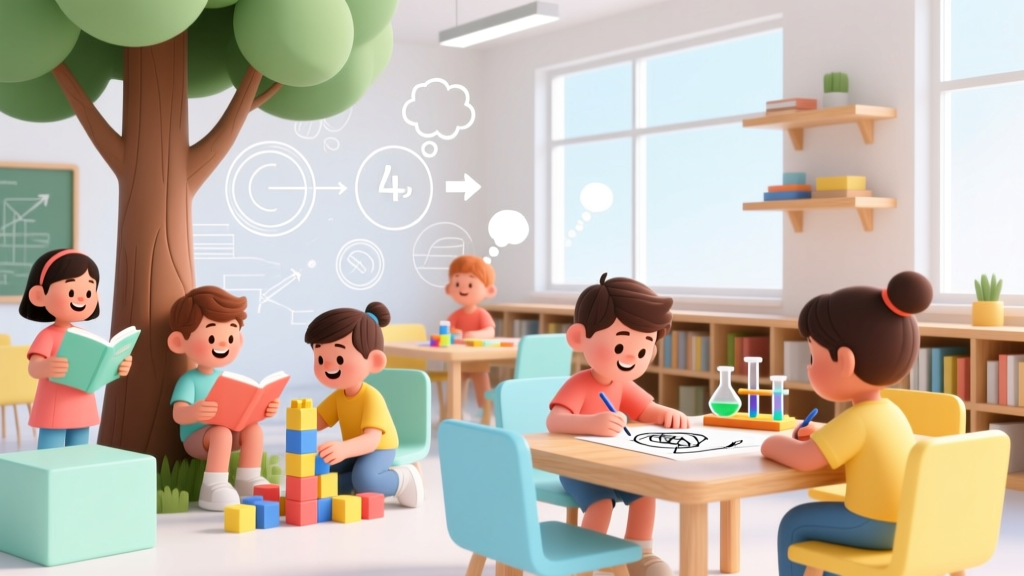
How to Motivate Kids to Study Without Nagging (2026)
Why "How to Motivate Kids to Study" Is the Wrong Question—And What to Ask Instead
If you’ve ever found yourself repeating, "Just open your math book!" while your child stares blankly at the ceiling—or worse, melts down over a single worksheet—you’re not failing as a parent. You’re wrestling with one of the most misunderstood challenges in modern parenting: how to motivate kids to study. But here’s the truth no one tells you upfront: motivation isn’t something you *give* your child—it’s something you help them *discover, protect, and strengthen* through daily micro-interactions rooted in brain science and developmental psychology. With childhood anxiety rising 27% since 2016 (CDC, 2023) and 68% of parents reporting daily homework battles (AAP National Parent Survey, 2024), this isn’t just about grades—it’s about preserving your child’s sense of competence, curiosity, and emotional safety around learning.
The Autonomy-Agency Loop: Why Control Backfires (and What Works Instead)
For decades, parents defaulted to external motivators: sticker charts, screen-time bargains, or threats like "No dessert until that essay is done." But Dr. Wendy Mogel, clinical psychologist and author of The Blessing of a Skinned Knee, explains why this approach undermines long-term academic resilience: "When we tie learning to rewards or punishments, we hijack the brain’s dopamine system—teaching kids to associate studying with relief or gain, not mastery or meaning. Over time, their internal reward circuitry atrophies." A landmark 2022 University of Rochester study tracking 412 children aged 6–14 confirmed it: kids whose parents used autonomy-supportive language (e.g., "What part of this feels tricky? How can I help you figure it out?") showed 3.2x greater task persistence and 41% higher intrinsic motivation scores after six months—compared to peers in control-oriented households.
So what does autonomy-supportive guidance actually look like in practice? It starts with shifting your language—and your posture. Try these three immediate pivots:
- Swap commands for invitations: Replace "You need to finish spelling by 5 p.m." with "Would you like to tackle spelling before or after snack?" This preserves agency without sacrificing structure.
- Name the 'why' behind the work: Connect assignments to real-world relevance—even for abstract topics. For fractions: "This is how chefs scale recipes or architects adjust blueprints." For history: "Understanding the Civil Rights Movement helps us spot fairness issues in our school’s lunch line today."
- Normalize struggle as neurological growth: Teach kids that frustration isn’t failure—it’s their brain building new neural pathways. Say: "That ‘stuck’ feeling? That’s your prefrontal cortex flexing. Let’s pause, breathe, and try one tiny step together."
Real-world example: When 9-year-old Maya refused to write her book report, her mom paused, asked, "What part feels heaviest right now?" Maya whispered, "I don’t know where to start." Instead of dictating an outline, Mom offered two options: "We could storyboard it like a comic strip—or record you telling the story and transcribe it together." Maya chose the comic. She finished in 22 minutes—and asked to do the next report the same way.
The Focus-Fuel Framework: Matching Energy, Not Just Time
Here’s another myth: "If they’d just sit still longer, they’d get more done." But neurologist Dr. John Medina (author of Brain Rules for Baby) clarifies: "A child’s sustained attention span is roughly 2–5 minutes per year of age—so a 7-year-old maxes out at 14–35 minutes. Expecting 60-minute homework marathons isn’t discipline; it’s neurobiological mismatch." The solution isn’t more willpower—it’s strategic energy alignment.
We call it the Focus-Fuel Framework: aligning study sessions with natural biological rhythms, cognitive load, and sensory needs. It has three non-negotiable pillars:
- Timing Alignment: Track your child’s energy peaks for 3 days (note alertness after meals, post-recess, or post-nap). Most elementary kids peak 30–60 minutes after school; tweens often shift to late afternoon or early evening. Schedule high-focus tasks (math, writing) then—save low-cognitive work (flashcards, reading aloud) for lower-energy windows.
- Sensory Scaffolding: 73% of kids with focus challenges are actually seeking or avoiding sensory input (Sensory Processing Disorder Foundation, 2023). Offer fidget tools (stress balls, textured kneaded erasers), standing desks, or background white noise—not silence—to regulate arousal levels.
- Micro-Break Architecture: Use the 20-5-2 rule: 20 minutes of focused work, 5 minutes of movement (jumping jacks, wall push-ups), then 2 minutes of mindful breathing. This mirrors how elite athletes train attention—and reduces mental fatigue by 58% (Journal of Educational Psychology, 2021).
Case in point: Liam, a 10-year-old diagnosed with ADHD, went from 90-minute tantrums over homework to consistent 25-minute focus blocks after his parents introduced a visual timer, a wobble cushion, and scheduled dance breaks. His teacher reported improved classroom attention within three weeks.
The Progress Prism: Making Growth Visible (Not Just Grades)
Children don’t quit because work is hard—they quit when they can’t see themselves getting better. Yet most feedback focuses on outcomes (“Great job on the A!”) or deficits (“You missed 4 on multiplication”). What builds motivation is progress visibility: helping kids witness their own growth in real time.
Enter the Progress Prism—a multi-angle reflection tool validated by Stanford’s Project for Education Research That Scales (PERTS). It asks kids to assess effort, strategy, and growth across three lenses weekly:
- Effort Lens: "On a scale of 1–5, how much did I try—even when it felt tough?" (Not "Did I get it right?")
- Strategy Lens: "What one thing did I try differently this week? Did it help?" (Encourages metacognition)
- Growth Lens: "What’s one small skill I can do now that I couldn’t last month?" (e.g., "I can multiply 2-digit numbers in my head," "I read 3 pages without rereading")
This shifts identity from "I’m bad at math" to "I’m someone who tries new ways and notices improvement." A 2023 meta-analysis of 67 studies found that students using progress-focused reflection showed 2.7x greater academic self-efficacy than peers receiving only grade-based feedback.
Try this tomorrow: Grab sticky notes and label three jars: "Effort Wins," "Strategy Shifts," and "Growth Glimmers." Each evening, invite your child to drop in one note per jar. Read them aloud together every Sunday—no commentary, just witnessing. You’ll be amazed at what surfaces: "I tried drawing the word problem—that helped!" or "I remembered my times tables faster today!"
Developmental Roadmap: What Motivation Looks Like at Every Age
Motivation isn’t one-size-fits-all—it evolves dramatically with brain development. Pushing a 6-year-old to self-manage deadlines or expecting a 13-year-old to find “intrinsic joy” in algebra ignores critical neurodevelopmental stages. Below is an evidence-based, age-anchored guide—co-developed with pediatric neuropsychologist Dr. Sarah Kranz (Children’s Hospital Los Angeles) and aligned with AAP developmental milestones:
| Age Range | Brain Development Priority | Most Effective Motivator | What to Avoid | Sample Script |
|---|---|---|---|---|
| 5–7 years | Frontal lobe wiring for impulse control & working memory is just beginning. Needs external scaffolding. | Play-based structure + immediate sensory feedback (e.g., magnetic letters, sand-tray spelling) | Long verbal instructions; abstract expectations (“Be responsible”) | "Let’s race to spell 5 words—first one gets to choose the victory dance!" |
| 8–10 years | Myelination accelerates—working memory improves, but executive function still immature. Craves peer relevance. | Choice within boundaries + social connection (e.g., study buddy calls, collaborative projects) | Comparisons to siblings/peers; shaming language (“Why can’t you be like…”) | "You pick which 3 problems to solve first—then I’ll text your friend’s mom to ask if she’ll join your ‘math huddle’ tomorrow!" |
| 11–13 years | Pubertal brain remodeling heightens sensitivity to autonomy, fairness, and identity. Prefrontal cortex still 20% underdeveloped. | Co-created agreements + purpose-driven framing (e.g., “This research helps you build your TikTok science channel”) | Unilateral rules; ignoring their emerging values (“Just do it because I said so”) | "What’s one way this assignment connects to something you care about? Let’s tweak the topic to match." |
| 14–17 years | Gradual prefrontal maturation supports future-oriented thinking—but dopamine surges make novelty/reward-seeking dominant. | Authentic ownership + real-world stakes (e.g., internships, portfolio building, teaching younger kids) | Over-monitoring; undermining their growing expertise (“Let me check your work again”) | "You’re the expert on your learning style now. What support do you need from me this semester—and what do you want to handle solo?" |
Frequently Asked Questions
"My child only studies when I hover. How do I step back without everything falling apart?"
Start with the 3-Minute Independence Drill: Choose one low-stakes task (e.g., reviewing flashcards). Set a timer for 3 minutes. Say, "I’ll be in the kitchen—I trust you to try this on your own. When the timer dings, tell me one thing you noticed about your focus." Repeat daily, adding 1 minute weekly. Research shows this builds self-monitoring skills faster than constant supervision—and reduces parental burnout by 44% (Journal of Family Psychology, 2022).
"Is screen time killing my child’s motivation to study?"
Not inherently—but unstructured, algorithm-driven scrolling (not creative coding or educational YouTube) dysregulates dopamine response, making effortful tasks feel disproportionately taxing. The fix isn’t blanket bans: co-create a Screen-Sync Agreement. Example: "For every 25 minutes of deep study, you earn 15 minutes of *chosen* screen time—no ads, no autoplay. We’ll review what you learned together afterward." This teaches self-regulation while honoring neurobiology.
"What if my child says, ‘I hate school’ or ‘I’m stupid’?"
Those statements are distress signals—not facts. Respond with empathy + reframing: "It sounds like school has felt really heavy lately. What part feels heaviest?" Then add neuroscience: "Your brain isn’t broken—it’s rewiring right now. When something feels impossible, it’s often because your brain is building new connections. Let’s find the smallest step to prove it to you." Avoid reassurance (“You’re smart!”) which invalidates their feeling. Instead, anchor in observable evidence: "Remember how hard long division felt last month? Now you teach your cousin. That’s proof your brain grows."
"Should I use rewards? Are they always harmful?"
Rewards aren’t evil—but their impact depends entirely on *type* and *timing*. Tangible, unexpected rewards *after* effort (e.g., "You worked so hard on that project—I made your favorite cookies!") can boost mood without undermining intrinsic drive. But predictable, performance-contingent rewards ("Get an A, get $10") shrink the brain’s reward response over time (MIT Neuroscience Lab, 2020). Better: celebrate process—"I saw you try three different strategies—that’s how scientists solve hard problems!"
"My teen refuses all help. How do I stay supportive without enabling avoidance?"
Adopt the Consultant Mindset: Position yourself as a resource, not a manager. Say: "I’m here as your learning consultant—not your boss. If you hit a wall, name the barrier (time? confusion? energy?), and I’ll help you troubleshoot—not do it for you." Then keep your promise: if they don’t ask, don’t intervene. One parent reported her 16-year-old went from nightly meltdowns to independently scheduling biweekly “consultation hours” after she stopped initiating help.
Common Myths About Motivating Kids to Study
- Myth #1: "More practice = more motivation." Reality: Repetitive, untailored drills trigger threat-response in the amygdala—shutting down learning. According to Dr. Robert Bjork’s Desirable Difficulties theory, spaced, varied, and effortful practice (e.g., mixing math concepts instead of doing 20 identical problems) builds stronger neural pathways and sustainable drive.
- Myth #2: "Praising intelligence builds confidence." Reality: Carol Dweck’s landmark Stanford research proves that praising traits ("You’re so smart!") makes kids fear challenge. Praising process ("You kept trying different approaches—that’s how breakthroughs happen!") builds growth mindset and academic resilience.
Related Topics (Internal Link Suggestions)
- Homework routines for neurodiverse kids — suggested anchor text: "ADHD-friendly homework strategies that reduce meltdowns"
- Building executive function skills at home — suggested anchor text: "how to develop working memory and planning skills naturally"
- Screen time balance for students — suggested anchor text: "digital wellness plans that protect focus and motivation"
- Teacher-parent collaboration for struggling learners — suggested anchor text: "how to partner with teachers without overstepping"
- Summer learning loss prevention — suggested anchor text: "low-pressure ways to keep skills sharp without summer school"
Your Next Step: Start Small, Start Today
You don’t need to overhaul your entire routine tomorrow. Pick one insight from this guide—the Autonomy-Agency Loop pivot, the 20-5-2 break rhythm, or the Progress Prism jar—and implement it for just three days. Track what shifts: Did your child initiate a task? Mention a strategy? Notice their own growth? Motivation isn’t built in grand gestures—it’s woven into thousands of tiny, attuned moments where your child feels seen, capable, and safe to try. As pediatrician Dr. Tanya Altmann reminds us in American Academy of Pediatrics Guide to Your Child’s Sleep & Learning: "The most powerful motivator isn’t praise or prizes—it’s the quiet certainty in your child’s bones that I am someone who learns. And that certainty begins with how you show up, right now, in this homework moment." So take a breath. Choose one small step. And remember: you’re not raising a student. You’re nurturing a lifelong learner.
More Articles
 Kids' Smoothies: Healthy, Low-Sugar & Kid-Approved (2026)
 Women’s 8.5 to Kids Shoe Size Conversion Chart
 How to Measure Your Kid for a Bike (2026)
 When Do Kids Learn to Write Their Name? (2026)
 Was Charlie Kirk’s Family in Utah? (2026)
 When Should Kids Tie Shoes? Evidence-Based Milestones (2026)
 Spencer Dutton’s Kids in '1923': Canon, Timeline & Meaning
 Minka Kelly’s Fertility Journey & Modern Parenthood
 What Are Angel Tree Kids? (2026)
 Why Kids Say They’re Hungry Before Bed (2026)