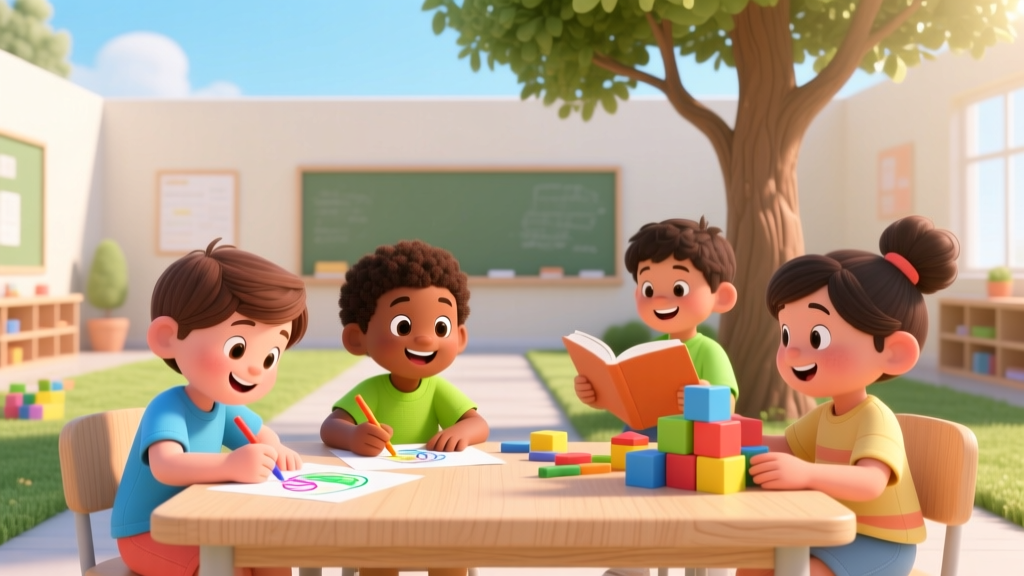
Reading Comprehension Help for Kids: 7 Evidence-Backed Ways
Why Helping Kids With Reading Comprehension Is the Silent Academic Lifeline
If you’ve ever watched your child read aloud fluently—only to blank when asked, 'What just happened?'—you’re not alone. How to help kids with reading comprehension is one of the most searched yet least understood parenting challenges today. Unlike decoding (sounding out words), comprehension is invisible: it happens inside the mind, across neural networks that integrate vocabulary, background knowledge, inference, and emotional engagement. And here’s the urgent truth: according to the National Assessment of Educational Progress (NAEP), only 37% of U.S. 4th graders scored 'proficient' in reading comprehension in 2022—the lowest rate in over a decade. Worse, gaps widen dramatically between students who receive consistent, strategy-rich support at home versus those who don’t. This isn’t about catching up—it’s about building the cognitive architecture for lifelong learning, critical thinking, and even mental health resilience. The good news? You don’t need a teaching degree, expensive tutoring, or screen time. You need intentionality, consistency, and seven surprisingly simple habits—rooted in cognitive science and classroom reality.
Stop Focusing on Words—Start Building Mental Movies
Many well-meaning parents default to quizzing: 'Who was the main character?' 'What was the setting?' But research from Dr. Nell K. Duke, a leading literacy scholar at the University of Michigan, shows that comprehension isn’t retrieved like facts—it’s constructed. Children who excel at comprehension don’t just recall details; they generate vivid, dynamic mental models as they read—what Duke calls 'text worlds.' Your job isn’t to extract answers; it’s to co-create those worlds.
Try this: During shared reading (even with chapter books), pause every 2–3 paragraphs and ask, 'What picture just popped into your head? What sounds or feelings came with it?' Don’t correct—just listen and add one sensory detail of your own: 'I imagined the floorboards creaking under her feet—did you hear that too?' A 2021 study in Reading Research Quarterly found that students who practiced this 'mental imagery scaffolding' for just 8 minutes daily improved inferential comprehension by 2.3x more than peers using traditional question-and-answer drills.
Real-world example: Maya, age 9, struggled to retell stories until her mom started sketching quick stick-figure scenes mid-read—no art skills needed. Within three weeks, Maya began narrating scenes unprompted: 'And then the dragon’s wings made wind swirl around the castle tower!' That’s not memory—it’s world-building.
The 'Before-During-After' Framework That Cuts Confusion in Half
Comprehension isn’t one skill—it’s a sequence of micro-decisions: predicting before reading, monitoring understanding during, and synthesizing after. Yet most home support skips the 'before' and 'after' entirely, jumping straight into the text. The fix? Anchor each reading session with three deliberate, 60-second rituals.
- Before: Flip to the cover or first page and ask, 'What do these clues tell us might happen? What’s our hunch—and what part of the book gave us that idea?' This activates prior knowledge and primes prediction circuits.
- During: Teach your child a silent 'thumbs-up/thumbs-down' signal to show when meaning breaks down. When they signal 'down,' don’t jump in—ask, 'Where did your movie get fuzzy? Let’s re-read just that sentence together.'
- After: Skip 'What happened?' Replace it with 'If this story were a movie poster, what would the tagline be?' or 'What question would you ask the author right now?'
This framework mirrors the evidence-based 'Reciprocal Teaching' model used in high-performing schools—and it works because it makes invisible thinking visible. As Dr. Annie Murphy Paul, author of The Extended Mind, explains: 'When we externalize cognition—through gestures, sketches, or questions—we lighten the load on working memory, freeing up space for deeper processing.'
Turn Everyday Moments Into Comprehension Labs
You don’t need dedicated 'reading time' to build comprehension. In fact, the most powerful practice happens outside books entirely—during breakfast, car rides, or bedtime routines. Why? Because comprehension relies on oral language foundations: vocabulary breadth, syntactic awareness, and narrative reasoning. A landmark 2020 longitudinal study in Child Development followed 1,200 children from age 3 to 12 and found that everyday conversational complexity—not book volume—was the strongest predictor of later reading comprehension scores.
Here’s how to leverage ordinary moments:
- At breakfast: Describe your toast-making process using causal language: 'First I buttered the bread, so it wouldn’t stick to the pan. Then I put it in the toaster because heat makes it crisp.' Invite your child to explain their morning routine the same way.
- In the car: Play 'Story Chain': One person starts a story ('A squirrel found a glittery key…'), the next adds a sentence that includes a 'why' or 'but' ('…but it didn’t know where the door was'), and so on. This builds causal logic and sequencing—the bedrock of inference.
- At bedtime: Retell the day as a 'chapter': 'Chapter 1: The Great Backpack Hunt. Chapter 2: Math Test Surprise. What was the turning point? What might happen tomorrow?'
According to the American Academy of Pediatrics’ 2023 literacy guidelines, these 'language-rich interactions' are more impactful than passive listening to audiobooks or flashcards—because they demand active construction, not passive reception.
When Comprehension Breaks Down: Spotting the Real Root Cause
Before reaching for interventions, pause: Is the issue truly comprehension—or something upstream? Many children labeled 'poor comprehenders' are actually struggling with undiagnosed foundational gaps. Here’s how to differentiate:
| Symptom | Most Likely Root Cause | Low-Stakes Home Check | Next Step If Confirmed |
|---|---|---|---|
| Reads fluently but can’t summarize | Vocabulary gap or weak background knowledge | Ask: 'What does “reluctant” mean? Can you use it in a sentence about your friend?' Observe if definitions rely on rote memorization vs. contextual use. | Introduce 3 new 'rich words' weekly via real-life scenarios (e.g., 'We’re reluctant to leave the park—what makes us hesitate?') |
| Skips punctuation, reads robotically | Prosody deficit (inability to use voice to signal meaning) | Record your child reading 2 sentences. Play it back: Does their voice rise/fall to show questions, pauses, or emotion? | Model expressive reading daily—even for recipes or texts. Use hand motions: raise palm for questions, drop for periods. |
| Frequently misreads common words ('they' → 'them', 'said' → 'sad') | Orthographic mapping weakness (brain hasn’t linked spelling-sound-meaning) | Write 5 high-frequency words on cards. Ask: 'Which two look most alike? Which one doesn’t belong—and why?' | Use multisensory tracing (air-write + say + snap syllables) for 5 minutes daily. Prioritize words they misread repeatedly. |
| Understands oral stories but not written ones | Working memory overload or decoding inefficiency | Read a short paragraph aloud. Immediately ask 2 questions. Then have them read same text silently and answer same questions. Compare accuracy. | Chunk text visually (highlight 1 sentence per color). Pair reading with movement (tap foot for each clause). |
Frequently Asked Questions
My child understands stories I read aloud—but not when reading independently. Why?
This is extremely common and points to a working memory or decoding bottleneck. When you read aloud, you carry the cognitive load: pacing, pronunciation, and prosody—freeing their brain to focus solely on meaning. Independent reading demands simultaneous decoding, fluency, and comprehension. Try 'shared reading' where you alternate pages, or use audiobook + printed text pairing (with finger-tracking) for 5 minutes daily. As literacy specialist Dr. Jan Hasbrouck notes, 'Oral comprehension is the ceiling for silent comprehension—if it’s strong orally, the issue is almost always automaticity, not ability.'
Is screen time helpful or harmful for comprehension development?
It depends entirely on interactivity and design. Passive scrolling or autoplay videos weaken attention stamina and reduce inferential thinking. But high-quality, interactive apps like Epic! Books (with built-in comprehension prompts) or Newsela (with adjustable Lexile levels and embedded questions) show measurable gains—especially when paired with discussion. The AAP recommends co-viewing and asking 'What do you think will happen next?' or 'How would you feel in that situation?' within 5 minutes of screen use. Avoid 'comprehension games' that reward speed over depth—real comprehension is slow, reflective work.
Should I correct every misread word?
No—over-correction fractures flow and signals that accuracy trumps meaning. Instead, use the '3-Second Rule': If your child hesitates for 3+ seconds on a word, gently supply it ('That’s “whisper”—let’s keep going'). Then, after the sentence, ask, 'Did that word make sense there? What other word could fit?' This preserves momentum while building self-monitoring. Research from the University of Delaware’s Reading Clinic shows children whose parents used this method developed stronger metacognitive awareness—and caught 42% more errors themselves within 6 weeks.
My child hates reading. How do I build comprehension without making it feel like 'more school'?
Shift from 'reading as task' to 'reading as tool.' Let them read menus to order lunch, instructions to build a Lego set, comic strips to plan a joke, or fan wikis to settle a debate about their favorite game. Authentic purpose ignites engagement—and engagement fuels comprehension. A 2023 study in Literacy found that students who chose 'non-traditional texts' (game guides, memes, recipes) for comprehension practice showed equal gains to peers using novels—but with 3x higher voluntary engagement. Start where their curiosity lives—and let comprehension grow from there.
Common Myths About Reading Comprehension
- Myth #1: 'More reading = better comprehension.' Reality: Without strategy instruction, rereading the same low-challenge text reinforces weak habits. The National Institute for Literacy emphasizes that 'volume matters only when matched with increasing complexity and explicit strategy modeling.'
- Myth #2: 'Comprehension will naturally improve once fluency catches up.' Reality: Fluency and comprehension are related but distinct neural pathways. Some children become 'word callers'—fluent decoders with near-zero comprehension. Early intervention targeting inference, synthesis, and questioning is essential, not optional.
Related Topics (Internal Link Suggestions)
- How to choose leveled readers for struggling readers — suggested anchor text: "best leveled readers for comprehension growth"
- Signs of dyslexia vs. comprehension delay — suggested anchor text: "dyslexia vs. reading comprehension disorder"
- Free printable reading comprehension worksheets — suggested anchor text: "research-backed comprehension printables"
- Best audiobooks for improving reading comprehension — suggested anchor text: "audiobooks that build comprehension"
- How to talk to teachers about reading comprehension concerns — suggested anchor text: "parent-teacher meeting script for reading"
Your Next Step Starts With One Tiny Shift
You don’t need to overhaul your routine or buy new resources. Pick just one of the seven strategies above—the one that feels most doable tomorrow—and try it for five days. Notice what changes: Did your child volunteer a connection? Pause to visualize? Ask a 'why' question unprompted? Those micro-moments are where neural pathways strengthen. As literacy coach and former classroom teacher Kassia Wedekind reminds us, 'Comprehension isn’t built in grand gestures. It’s woven, thread by thread, in the quiet spaces between words—where curiosity, safety, and your steady presence hold the loom.' So tonight, before lights-out, ask one open-ended question—not about the story, but about their story within it. That’s where real understanding begins.
More Articles
 Kanye’s Kids Tweets Digital Privacy for Co-Parenting
 Epilepsy and Pregnancy: What You Need to Know (2026)
 Kids Tie Shoes: Real Timeline & 7 Proven Strategies (2026)
 How Many Kids Disappear Every Year in the US (2026)
 Kids Poop Without Power Struggles: 7 Pediatrician Tips
 Kyrie Irving Kids: Truth, Co-Parenting & Privacy (2026)
 Is Sincerely Yours Good for Kids? Evidence-Based Review
 Managing Sibling Rivalry: Real Tips
 How Much Should I Charge For Babysitting 2 Kids (2026)
 How to Teach Kids to Read: Research-Backed Steps