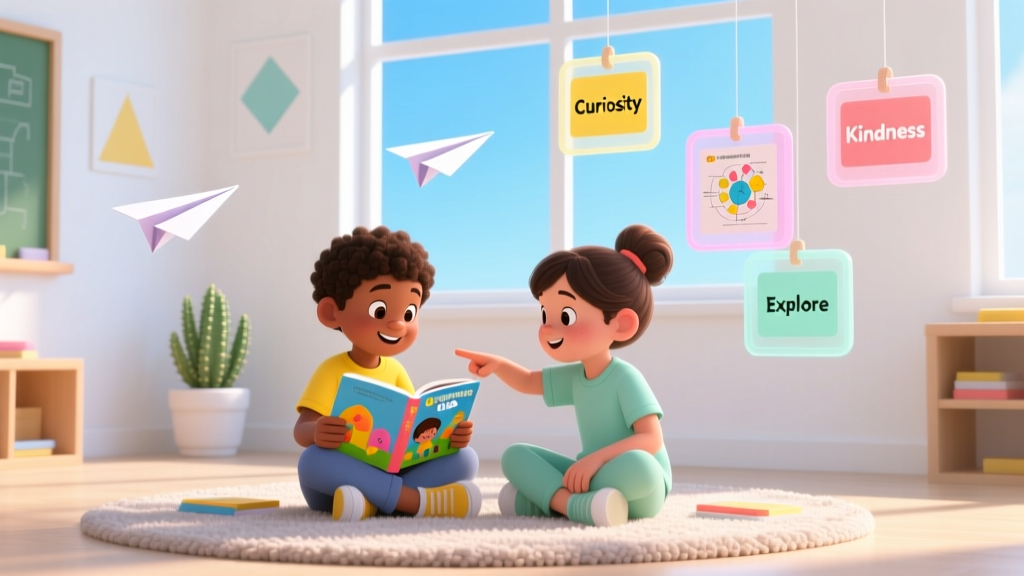
Growth Mindset for Kids: 7 Research-Backed Ways
Why Your Child’s Beliefs About Learning Matter More Than Their IQ Right Now
If you’ve ever watched your child crumple a math worksheet after one wrong answer—or refuse to try a new sport because “I’m just not good at it”—you’ve witnessed the quiet power of a fixed mindset in action. How to help kids develop a growth mindset isn’t about motivational posters or empty affirmations; it’s about rewiring neural pathways through intentional language, responsive feedback, and deeply human modeling. In a world where resilience is now ranked by the World Economic Forum as the #1 skill for future success—and where students with strong growth mindsets outperform peers by up to 30% on standardized assessments (Blackwell, Trzesniewski & Dweck, 2007)—this isn’t optional parenting. It’s foundational emotional infrastructure.
The Language Shift: Replace Praise With Process Feedback
Most parents don’t realize their well-intentioned praise can accidentally cement a fixed mindset. When we say, “You’re so smart!” or “What a talented artist!” we anchor value in innate traits—not effort, strategy, or persistence. Dr. Carol Dweck’s landmark longitudinal study at Columbia University found that children praised for intelligence were 40% more likely to avoid challenging tasks later, fearing failure would ‘disprove’ their ‘smartness.’ In contrast, those praised for effort (“I love how you tried three different ways to solve that puzzle”) showed increased motivation, resilience, and willingness to tackle harder problems.
Here’s how to pivot—starting today:
- Swap “You’re amazing!” → “Tell me what part was hardest—and what helped you push through?” This invites reflection and normalizes struggle.
- Replace “Perfect spelling!” → “I noticed you sounded out each syllable slowly—that’s how expert spellers build memory.” Names the cognitive strategy, not the outcome.
- Instead of “You’re a natural dancer!” → “Your arms stayed lifted even when your legs got tired—that shows serious focus and control.” Highlights controllable behaviors over identity labels.
This isn’t semantics—it’s neuroplasticity in practice. MRI studies show that when children hear process-oriented feedback, their prefrontal cortex (responsible for executive function and self-regulation) activates more robustly than when hearing person praise (Moscarello & Hartley, 2017). You’re literally strengthening their brain’s ‘effort circuitry.’
The Power of ‘Yet’ and Strategic Struggle
One of the simplest, most transformative tools is adding a single word: yet. “I can’t tie my shoes” becomes “I can’t tie my shoes yet.” “I don’t understand fractions” becomes “I don’t understand fractions yet.” That tiny linguistic shift signals to the developing brain that mastery is a timeline—not a binary state.
But ‘yet’ only works when paired with *strategic struggle*. Not frustration. Not overwhelm. Not giving up. According to Dr. Lisa Blackwell, co-author of the seminal 2007 mindset intervention study, effective struggle includes three conditions: (1) the challenge must be within the child’s ‘zone of proximal development’ (just beyond current ability but achievable with support), (2) the adult must provide scaffolding—not solutions—and (3) the child must experience a clear ‘aha’ moment of insight or progress.
Real-world example: Maya, age 8, struggled with multiplication tables. Her mom didn’t drill flashcards. Instead, she introduced a ‘Strategy Menu’ on the fridge: “Draw equal groups,” “Skip-count on a number line,” “Use known facts (e.g., if 5×6=30, then 6×6=30+6),” and “Break apart (e.g., 7×8 = 5×8 + 2×8).” Each day, Maya chose one strategy, documented her attempt in a notebook, and circled what worked—even if the final answer was wrong. Within six weeks, her accuracy jumped from 42% to 89%, and her confidence shifted from “I hate math” to “I haven’t found my best strategy for 7s yet.”
Modeling Mindset: What Your Self-Talk Teaches Them
Children absorb mindset cues like sponges—not from what you tell them, but from what you *do* and *say about yourself*. A 2022 University of Washington study observed 120 parent-child dyads during shared problem-solving tasks (e.g., assembling IKEA furniture, troubleshooting Wi-Fi). Researchers coded parental self-talk: Did they say “I’m terrible at this” or “Let me check the manual again—I’ll figure this out”? Children whose parents used growth-oriented self-talk were 3.2x more likely to persist independently when faced with a novel puzzle later.
Try these authentic modeling moves:
- Verbalize your own learning curve: “I’ve never baked sourdough before—I’m going to watch two tutorials, take notes, and expect my first loaf to be dense. That’s how all bakers start.”
- Share past failures with redemption arcs: “When I was learning Spanish, I ordered ‘a horse’ instead of ‘a fork’ at a restaurant! Everyone laughed—including me. Now I use that story to remind myself: mistakes are data, not destiny.”
- Normalize asking for help: “I’m stuck on this spreadsheet formula. Let me ask Aunt Priya—she’s great with Excel. Smart people know when to collaborate.”
This isn’t performance—it’s integrity. As pediatric psychologist Dr. Laura Jana emphasizes in her AAP-endorsed book The Toddler Brain, “Children don’t need perfect parents. They need transparent, resilient ones who demonstrate that competence is built—not bestowed.”
Reframing Setbacks: Turning ‘Failure’ Into Data Collection
Every child will face setbacks: a lost soccer game, a rejected art entry, a low science grade. The growth mindset response isn’t forced positivity (“It’s okay! You’ll do better next time!”). It’s forensic curiosity. Think of setbacks as diagnostic reports—not verdicts.
Use the 3-Question Debrief after any disappointment:
- What happened? (Fact-based, non-judgmental description)
- What did you try? What worked? What didn’t? (Focuses on agency and strategy)
- What’s one small thing you’ll test next time? (Builds forward momentum)
In a 2023 pilot program across five Title I elementary schools, teachers trained in this debrief method saw a 68% reduction in avoidance behaviors during writing workshops. One 4th grader, Jamal, had refused to submit stories for months after harsh peer feedback. His teacher guided him through the 3-Question Debrief. He realized his draft lacked dialogue (‘What happened?’), he’d rushed the ending without rereading (‘What didn’t work?’), and he’d try reading aloud to catch awkward sentences next time (‘One small thing’). His next story won the class ‘Voice Award.’
Crucially, avoid pairing this with premature reassurance. Don’t say, “You’re still a great writer!” before exploring the data. That undermines the process. Wait until the child names their own insight—then reflect it back: “So you discovered reading aloud helps you hear rhythm. That’s a powerful writer’s tool.”
| Action | Developmental Domain Strengthened | Research-Backed Outcome (Source) | Age-Appropriate Implementation Tip |
|---|---|---|---|
| Using “yet” in daily conversations | Social-emotional & language | 32% increase in task persistence in kindergarten (Dweck Lab, 2019) | Pair with visual cue: Add a “YET” sticker to homework folders or chore charts |
| Process-focused feedback (not person praise) | Cognitive & metacognitive | 2.1x higher growth-mindset scores at age 10 (NSF-funded longitudinal study, 2021) | For ages 3–6: Use gesture + words (“Look—you kept trying!” while pointing to hands) |
| Parental growth self-talk modeling | Social-emotional & observational learning | Children 4.7x more likely to attempt novel challenges (UW, 2022) | Record 1–2 “mindset moments” weekly in a private journal—then share one authentically with your child |
| 3-Question Debrief after setbacks | Executive function & emotional regulation | 41% reduction in tantrums post-failure (Journal of Child Psychology, 2020) | Use emoji cards (🔍 for Question 1, 🧠 for Q2, ➕ for Q3) for pre-readers |
Frequently Asked Questions
Can growth mindset be taught to children under age 5?
Absolutely—and early childhood is the optimal window. Neuroscientists confirm that synaptic pruning peaks between ages 2–7, making the brain exceptionally receptive to belief formation. For toddlers and preschoolers, focus on concrete actions: “Your muscles got tired, so you rested—and then tried again! That’s how we get stronger.” Avoid abstract terms like “mindset.” Instead, narrate effort, recovery, and incremental change using sensory language (“I heard you take a deep breath before trying the slide again”). The Zero to Three organization recommends embedding growth language in routines—diaper changes (“We’re learning how to pull pants up—let’s try together”), meals (“You used your spoon 3 times today—your hand muscles are growing!”).
Does growth mindset conflict with celebrating achievement?
No—when celebration focuses on *how* the achievement happened, not *who* the child is. Instead of “You’re a star student!”, try “You studied with flashcards every night, asked Ms. Lee for extra practice, and reviewed your mistakes—that’s how champions prepare.” The American Academy of Pediatrics stresses that recognition should highlight agency and strategy to reinforce internal locus of control. Bonus: This approach reduces performance anxiety. Children stop chasing approval and start valuing mastery.
My child has learning differences (ADHD, dyslexia). Does growth mindset still apply?
Not only does it apply—it’s essential. Research from the Yale Center for Dyslexia shows children with learning differences who adopt growth mindsets report 57% higher self-efficacy and are 3x more likely to advocate for accommodations. Key nuance: Pair mindset work with explicit skill-building. Say, “Your brain processes letters differently—that’s why we use colored overlays and audiobooks. But your ability to learn strategies? That grows every time you practice.” Always co-create accommodations with your child: “What’s one tool that helps you focus during reading? Let’s test it this week.” This honors neurodiversity while reinforcing agency.
Will praising effort make my child lazy or expect constant rewards?
Only if effort is praised *in isolation*. Effective process praise names the specific behavior AND links it to progress: “You wrote three full sentences without looking at the word wall—that shows your working memory is getting stronger.” Stanford researchers found that vague effort praise (“Good job trying!”) had no impact. But precise, progress-linked praise predicted sustained motivation. Also: Never reward effort that leads nowhere. If a child spends 20 minutes coloring outside the lines on a math worksheet, say, “I see you spent time on this. Let’s look at the instructions together—what part is confusing?” Effort must be strategic to build growth.
How long does it take to see changes in my child’s mindset?
Neuroplasticity means shifts begin in days—but consistency matters more than speed. In classroom interventions, measurable changes in self-reported mindset appear in 4–6 weeks with daily micro-practices (e.g., 2 minutes of “yet” reframing at dinner). However, deep belief change—where a child spontaneously says “I can’t do this… yet” without prompting—typically emerges after 3–6 months of aligned language, modeling, and debriefing. Track subtle wins: longer frustration tolerance, willingness to ask questions, using “mistake” instead of “stupid.” These are neural rewiring in real time.
Common Myths
Myth 1: “Growth mindset means telling kids they can do anything if they just try hard enough.”
Reality: This is toxic positivity—not growth mindset. Dweck herself warns against “false growth mindset,” where adults ignore systemic barriers (learning disabilities, under-resourced schools, trauma) and place sole responsibility on effort. True growth mindset acknowledges reality (“This is hard because fractions involve new rules”) while focusing on actionable levers (“Let’s break it into steps and use fraction bars to see it”).
Myth 2: “Mindset is fixed—if my child has a fixed mindset, it’s too late to change.”
Reality: Neuroplasticity persists across the lifespan. fMRI studies show adult brains form new neural connections in response to mindset interventions—and children’s brains are exponentially more malleable. What matters isn’t starting point, but consistent, compassionate practice. As Dr. David Yeager, leading mindset researcher at UT Austin, states: “Beliefs aren’t DNA. They’re habits. And habits can be unlearned.”
Related Topics (Internal Link Suggestions)
- Positive discipline techniques for toddlers — suggested anchor text: "gentle discipline strategies that build self-regulation"
- Best books to teach resilience to elementary kids — suggested anchor text: "age-appropriate growth mindset picture books"
- How to talk to kids about academic pressure — suggested anchor text: "reducing perfectionism in high-achieving children"
- Screen time guidelines by age — suggested anchor text: "using media to model growth mindset (not passive consumption)"
- Building executive function skills at home — suggested anchor text: "everyday activities that strengthen planning and flexibility"
Your Next Step Starts With One Sentence Today
You don’t need a curriculum, a workshop, or a therapist referral to begin. Your most powerful tool is already in your mouth—and your ears. Tonight, listen for one fixed-mindset phrase your child uses (“I’m bad at this”). Then gently offer the ‘yet’ version—and name the specific effort you observed (“You tried three times—that’s how we grow our math brain”). Track it in your phone notes. Do it for seven days. Watch what shifts—not just in their confidence, but in your own presence. Because helping kids develop a growth mindset begins when we stop trying to fix them—and start believing, out loud, in the beautiful, unfolding process of becoming.
More Articles
 Does Susan Lorincz Have Kids? A Respectful Look
 Who Has Custody of the Franke Kids? Reddit Facts (2026)
 Is Elf Appropriate for Kids? Expert Guidance (2026)
 Florida Back-to-School Dates 2026 + Prep Tips
 Does Zendaya Have Kids? The Truth Behind the Rumors
 Did Sour Patch Kids Change Their Name? (2026)
 Charlie Kirk's Kids in Spotlight: What Parents Should Know
 Child Support for 2 Kids in Indiana: Calculation Guide
 Babysitting for 1 Kid: 2026 Rates & Smart Savings
 Charlie Kirk Death Rumor: What Parents Should Know