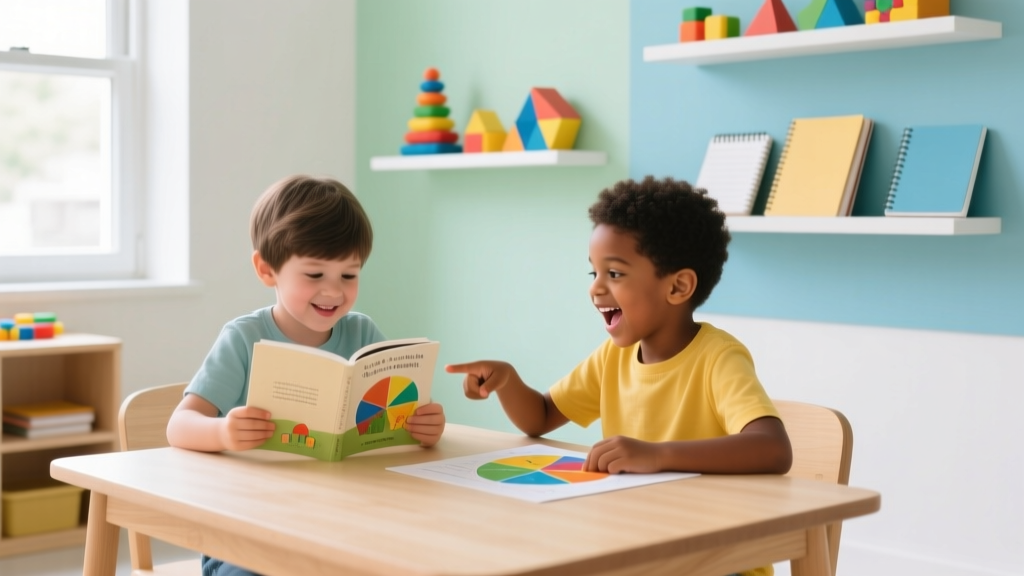
Teaching Opposites to Kids: 7 Play-Based Strategies
Why Teaching Opposites Isn’t Just About Vocabulary — It’s the Hidden Foundation of Thinking
If you’ve ever asked yourself how to explain opposites to kids, you’re not just tackling a simple word game — you’re supporting the very architecture of their cognitive development. Between ages 2 and 5, children’s brains are wiring critical neural pathways for logic, comparison, categorization, and even early math reasoning. According to the American Academy of Pediatrics (AAP), understanding relational concepts like opposites is a strong predictor of later reading comprehension and problem-solving fluency — yet most parents default to rote memorization or passive flashcards, which research shows yields only short-term recall and minimal transfer to real-world use. What if teaching ‘up/down’ could happen while stacking blocks? Or ‘fast/slow’ while blowing bubbles? This isn’t about adding another ‘task’ to your day — it’s about transforming ordinary moments into rich, embodied learning opportunities grounded in how young minds actually learn.
Start With Their Bodies — Not Flashcards
Neuroscience confirms that toddlers and preschoolers learn abstract concepts best through sensorimotor experience — not visual symbols. Dr. Karen Purvis, developmental neuroscientist and founder of the Trust-Based Relational Intervention® model, emphasizes: “When children physically enact a concept — stretching tall for ‘tall,’ crouching low for ‘short’ — they encode it in multiple brain regions simultaneously: motor cortex, somatosensory cortex, and prefrontal areas involved in meaning-making.” So skip the laminated cards. Instead, build an ‘Opposite Obstacle Course’ in your living room: crawl under a blanket tunnel (‘low’) then stand on a cushion to reach a sticker on the wall (‘high’); walk slowly like a sleepy sloth (‘slow’) then zoom like a rocket (‘fast’). Repeat the words *as* they move — not before or after. A 2022 University of Washington study found children who engaged in embodied opposite activities retained 3.2× more vocabulary after one week versus peers using static visuals alone.
Pro tip: Always pair movement with vocal rhythm. Say “UP… and DOWN!” with rising/falling pitch and exaggerated gestures. Your voice becomes a sonic scaffold — and prosody (rhythm, stress, intonation) is one of the strongest predictors of early language acquisition, per speech-language pathologist Dr. Elena Plante’s longitudinal work.
Embed Opposites in Stories — Not Isolated Words
Isolating ‘big’ and ‘small’ as standalone words strips them of meaning. Children grasp opposites relationally — not absolutely. That’s why story context is non-negotiable. Try this: Read *The Three Bears* — but pause at Goldilocks’ choices. Ask, “Why did she say the porridge was ‘too hot’? What would be the opposite? (‘Too cold.’) And what’s just right? (‘Just right’ — not an opposite, but the crucial middle ground!)” This introduces the spectrum concept — vital for later math and science thinking.
For older preschoolers (4–5), co-create ‘Opposite Adventure’ stories. Start with a character: “Lila the Lizard wants to cross the river.” Then ask: “What’s the opposite of ‘deep’?” (Shallow.) “What’s the opposite of ‘wide’?” (Narrow.) Let them invent solutions using opposites: “She finds a narrow bridge!” or “She wades through shallow water!” This builds inferential reasoning and flexible thinking — skills directly linked to executive function growth, as noted in the National Institute for Early Education Research’s 2023 report on narrative-based literacy interventions.
Real-world case study: In Ms. Rivera’s Head Start classroom in Austin, TX, children who participated in weekly ‘Opposite Story Circles’ (where every story had to include at least three opposite pairs) showed a 41% greater improvement in comparative language use on the Peabody Picture Vocabulary Test (PPVT-5) over 12 weeks versus control groups using traditional matching worksheets.
Leverage Everyday Routines — The ‘Stealth Learning’ Approach
The highest-impact teaching happens when you don’t announce it as ‘learning.’ Here’s how to weave opposites into routines without extra prep:
- Mealtime: “This apple slice is crunchy — what’s the opposite? (Soft!) Pass me the soft banana.” Compare temperatures (“hot soup / cold milk”), textures (“smooth yogurt / bumpy blueberries”), and quantities (“full cup / empty cup”).
- Bath time: “Splash loud! Now splash quiet.” “Squeeze the sponge hard — now squeeze soft.” Add colored water drops: “This red is bright — what’s the opposite? (Dull! Or dark!)”
- Dressing: “Let’s put on your dry socks — not your wet ones!” “Zip up fast — now unzip slow.”
This approach works because it anchors opposites in functional, emotionally relevant contexts — not decontextualized drills. As pediatric occupational therapist Dr. Sarah MacLaughlin explains: “When a child experiences ‘wet/dry’ while wiping their own face, or ‘open/closed’ while struggling with a lunchbox latch, the neural connection is reinforced by proprioception, emotion, and purpose — making it far stickier than any worksheet.”
Use Visual Anchors — But Make Them Dynamic & Interactive
Yes, visuals help — but only if they’re active, not static. Ditch the poster with ‘happy/sad’ faces. Instead, create an ‘Opposite Mirror’ game: Stand facing your child. You make a ‘wide’ face (eyes big, mouth stretched) — they mirror you and say “WIDE!” Then you scrunch small — they shout “SMALL!” Add sound: “LOUD!” (clap hard) → “QUIET!” (finger to lips + whisper). This integrates visual, auditory, motor, and verbal channels — hitting the ‘multisensory encoding’ sweet spot identified in the National Center on Improving Literacy’s evidence review.
For concrete learners, use manipulatives with inherent opposition: a magnetic board with ‘+’ and ‘−’ signs (introduce as ‘more/less’); a balance scale with blocks (‘heavy/light’); a light switch (‘on/off’ — emphasize cause/effect). Avoid abstract symbols until the child demonstrates mastery through action and speech. As Montessori educator Maria Montessori observed: “The hands are the instruments of man’s intelligence.” Let them do the opposite before they name it.
| Age Range | Key Developmental Milestones | Best Opposite Pairs to Introduce | Safety & Engagement Tips |
|---|---|---|---|
| 2–3 years | First two-word phrases; understands basic directives; emerging body awareness | Up/down, in/out, on/off, open/closed, hot/cold (with safe tactile cues like warm towel vs. cool cloth) | Avoid abstract pairs (e.g., ‘brave/scared’). Use consistent gestures. Supervise all temperature/tactile exploration. Never use ‘hot’ for stove — say ‘dangerous’ instead. |
| 3–4 years | Uses 3–4 word sentences; compares objects; understands simple time concepts | Big/small, fast/slow, loud/quiet, full/empty, wet/dry, front/back, here/there | Introduce ‘middle’ or ‘just right’ as a third point on the spectrum. Use real objects — avoid cartoon images. Limit screen-based opposites (they lack haptic feedback). |
| 4–5 years | Asks ‘why’ constantly; tells simple stories; grasps basic cause-effect | Hard/soft, smooth/bumpy, light/heavy, near/far, beginning/end, same/different, happy/sad (with photo cards of real children’s expressions) | Discuss emotional opposites with empathy: “When you feel sad, what helps you feel better? Is that like going from sad to happy?” Link to self-regulation. Avoid moralizing (e.g., ‘good/bad’ — too value-laden for this age). |
| 5+ years | Understands analogies; uses complex sentences; grasps time sequences | Strong/weak, thick/thin, straight/curvy, alive/dead (with nature examples), fact/opinion, possible/impossible | Encourage generating their own pairs. Use opposites in writing: “Write a sentence with ‘bright’ and ‘dim.’” Introduce antonyms in spelling lists. Watch for overgeneralization (e.g., “If ‘alive’ is opposite ‘dead,’ is ‘awake’ opposite ‘asleep’?” — explore nuance!). |
Frequently Asked Questions
Can teaching opposites too early overwhelm my child?
No — but timing and method matter. Introducing 1–2 pairs aligned with their current language level (e.g., ‘up/down’ during stair climbing) supports development. Overloading with 10+ abstract pairs at once (like ‘ancient/modern’ or ‘generous/stingy’) can cause confusion and disengagement. The AAP advises following your child’s lead: if they spontaneously say “That’s BIG!” while pointing, expand with “Yes! And this crumb is TINY — so tiny!” Keep it joyful, not evaluative.
My child mixes up opposites — like saying ‘cold’ when they mean ‘hot.’ Is this normal?
Completely normal — especially before age 4. This reflects developing semantic networks, not misunderstanding. Research in Child Development (2021) shows children often reverse opposites during rapid vocabulary growth as their brain strengthens connections between related concepts. Gently model the correct usage without correction: If they say “I want cold soup,” respond with “You’d like hot soup — yes, it’s nice and warm!” Repetition in context rebuilds the pathway faster than direct correction.
Are digital apps effective for teaching opposites?
Most are not — and some may hinder learning. A 2023 study in Pediatrics found toddlers using ‘opposites’ apps showed significantly lower retention and application than peers using physical manipulatives or movement games. Why? Screens lack tactile feedback, spatial relationships, and social contingency (the back-and-forth of shared attention). If using tech, choose video calls with grandparents playing ‘Opposite Simon Says’ — human interaction is the irreplaceable ingredient.
What if my child has speech delays or autism? How should I adapt?
Focus on nonverbal, multisensory input first. Use consistent gestures (thumbs up/down for ‘up/down’), visual schedules with opposite icons (sun/moon for ‘day/night’), and cause-effect toys (press button → light ON/OFF). Speech-language pathologists recommend starting with high-contrast, functional pairs tied to needs: ‘open/closed’ for doors, ‘stop/go’ for walking. The Hanen Centre’s ‘More Than Words’ program emphasizes following the child’s interest — if they love spinning, introduce ‘fast/spin’ and ‘slow/spin’ while holding their hands. Always consult your SLP for personalized strategies.
Common Myths
Myth 1: “Opposites must be taught in pairs — always ‘hot’ with ‘cold,’ never mixed.”
Reality: Children benefit more from seeing a word in *multiple contrasting contexts*. ‘Hot’ can oppose ‘cold’ (soup), ‘cool’ (weather), ‘warm’ (bath), and ‘freezing’ (ice). This builds flexible semantic networks — exactly what strong readers and thinkers do. The goal isn’t binary pairing, but relational understanding.
Myth 2: “If my child knows opposites, they’re ready for kindergarten academics.”
Reality: While important, opposites are just one thread in a rich tapestry of school readiness. The National Association for the Education of Young Children (NAEYC) stresses that self-regulation, curiosity, and cooperative play predict long-term success more strongly than isolated vocabulary. Use opposites as a joyful entry point — not a gatekeeping skill.
Related Topics (Internal Link Suggestions)
- How to teach shapes to preschoolers — suggested anchor text: "play-based shape recognition activities"
- Early literacy milestones by age — suggested anchor text: "what language skills to expect at 2, 3, and 4 years"
- Sensory play ideas for toddlers — suggested anchor text: "tactile learning activities that boost vocabulary"
- Montessori activities for 3-year-olds — suggested anchor text: "hands-on opposites and classification materials"
- Speech delay red flags — suggested anchor text: "when to seek support for expressive language"
Wrap Up: Your Next Step Starts With One Word — and One Movement
You don’t need special tools, lesson plans, or extra time to help your child master opposites. You already have everything you need: your voice, your body, your daily routines, and your attuned presence. Pick *one* pair that fits naturally into tomorrow’s routine — maybe ‘open/closed’ at snack time, or ‘fast/slow’ during a walk — and embody it with joy and repetition. Notice how your child’s eyes light up when they ‘get it’ not as a word, but as a feeling, a motion, a shared laugh. That spark is cognition taking root. Ready to go deeper? Download our free Opposite Play Cards — 24 printable, movement-based prompts designed by early childhood educators (no printing required — just open and play!).
More Articles
 How to Tell Kids Santa Is Not Real (2026)
 Can Kids Take Tums for Upset Stomach? (2026)
 Is Pokémon GO Safe for Kids? (2026)
 When Do Kids Get Their Second Molars? (2026)
 Where Do Kids Eat Free Wednesdays? (2026 Guide)
 How to Measure Kids Feet at Home (2026)
 Beyoncé’s Kids Ages and Privacy in 2026
 Claim Foster Kids on Taxes: IRS Rules Explained
 College Savings: Real Number for Your Income & State (2026)
 Kids and Shingles: Risk, Signs, Prevention (2026)