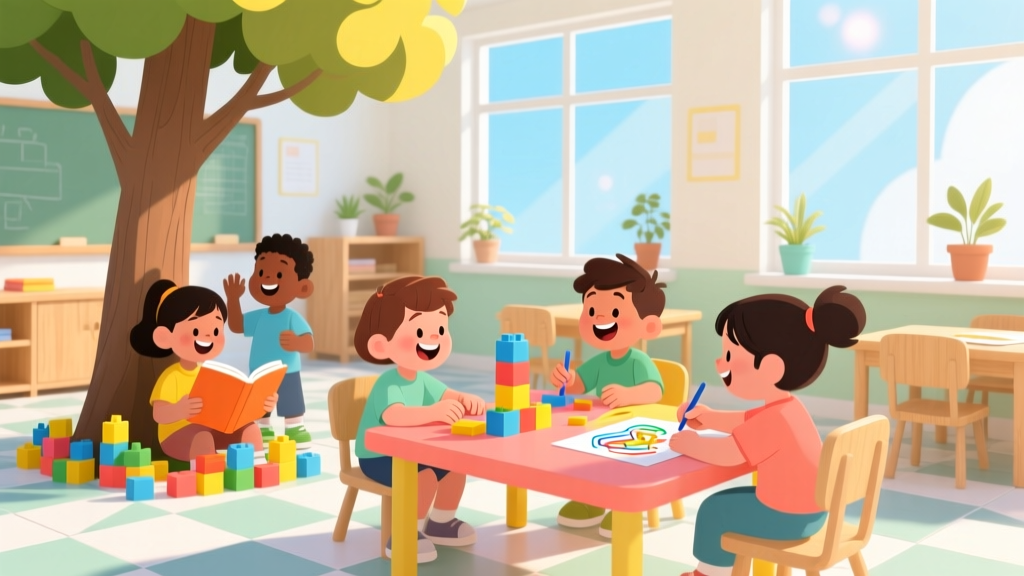
How to Encourage Kids to Talk (2026)
Why Your Child Isn’t Talking—And Why That’s Probably Not What You Think
If you’ve ever searched how to encourage kids to talk, you’re likely holding your breath after every pause—waiting for that first ‘mama,’ that spontaneous ‘look!’ or even just a sustained ‘uh-oh’ during play. You’re not alone: nearly 1 in 5 toddlers shows some delay in expressive language, yet only half receive timely support (CDC, 2023). But here’s what most parents miss: silence isn’t emptiness—it’s neural architecture under construction. The brain isn’t ‘behind’; it’s prioritizing safety, connection, and meaning before words. And the most powerful catalyst for speech isn’t flashcards or apps—it’s the quality of your presence in the quiet.
Stop Fixing—Start Tuning: The ‘Responsive Interaction’ Framework
Decades of research from the Hanen Centre and longitudinal studies at the University of Washington confirm: children develop language fastest not when adults *teach* them to talk—but when adults *tune in* to their communication attempts—even nonverbal ones. Responsive interaction means treating every grunt, gaze, gesture, or babble as intentional and worthy of reply. A 2022 JAMA Pediatrics meta-analysis found that parents who consistently mirrored and expanded their child’s vocalizations (e.g., child points at dog → parent says ‘Yes! Big brown dog! Woof-woof!’) saw 42% faster vocabulary growth by age 3 than those using directive language (‘Say “dog”!’).
Here’s how to shift from ‘prompting’ to ‘partnering’:
- Pause for 5 seconds after your child looks, reaches, or makes a sound—this gives their brain time to process and formulate a response;
- Match their energy level: If they’re whispering or still, soften your voice and slow your pace; if they’re bouncing, mirror their rhythm with animated gestures;
- Expand—not correct: If your toddler says ‘ba-ba’ for bottle, respond with ‘You want your blue bottle? Here’s your cold ba-ba!’—never ‘No, say “bottle.”’
Real-world example: Maya, a mom of 22-month-old Leo (who used only 8 words), began narrating his actions without expectation: ‘Leo’s stacking… red block on top… wobbly tower!’ Within three weeks, he spontaneously said ‘up!’ while reaching—and then ‘up red!’ Two months later, he was combining three words. His pediatrician noted no underlying delay—just a child who needed to feel heard before he felt safe to speak.
The Power of ‘Serve-and-Return’ Play (Not Toys—Just You)
Harvard’s Center on the Developing Child identifies ‘serve-and-return’—where a child initiates (a ‘serve’) and an adult responds meaningfully (a ‘return’)—as the single most critical driver of brain circuitry for language, emotion regulation, and executive function. Crucially, this doesn’t require special tools: it happens over spilled cereal, mismatched socks, or a single wooden spoon.
Try these low-barrier, high-impact routines:
- The ‘One-Object Wonder’: Pick one item (a cup, a leaf, a sock). Spend 5 minutes noticing everything about it together—texture, weight, sound when tapped, shadow it casts. Name what you see *only when your child looks at it*, not before. This builds joint attention—the bedrock of shared meaning.
- ‘Sound Swap’ Singing: Replace lyrics with exaggerated sounds—‘Wheeeeeeel!’ instead of ‘wheels on the bus,’ ‘Squish-squish!’ for stomping in puddles. Children imitate sounds long before words—and sound play activates the same neural pathways as speech.
- ‘Wait-and-Wonder’ Bath Time: Turn off distractions. When your child splashes, pause, lean in, and softly say ‘Whoa… water jumping!’ Then wait—eyes soft, face open—for their response. No demand. Just space for their voice to rise.
According to Dr. Catherine Snow, Professor Emerita of Education at Harvard and co-author of Talking to Children, ‘The magic isn’t in the vocabulary you offer—it’s in the respectful silence you hold while they decide whether, when, and how to fill it.’
When to Worry—and When to Wonder: Decoding Developmental Signals
It’s natural to compare—but developmental timelines vary widely. What matters more than ‘first word by 12 months’ is *progression*: Are gestures increasing? Is eye contact warm and frequent? Do they respond to their name? Do they enjoy back-and-forth games like peekaboo or rolling a ball?
Below is a clinically validated Age-Appropriateness Guide based on AAP and ASHA (American Speech-Language-Hearing Association) benchmarks—designed not to alarm, but to empower informed observation:
| Age Range | Typical Communication Behaviors | Green Light (On Track) | Yellow Light (Monitor & Support) | Red Light (Consult SLP/Pediatrician) |
|---|---|---|---|---|
| 12–18 months | Gestures (waving, pointing), responds to name, babbles with consonants (‘ba-ba’, ‘da-da’) | Uses 2+ gestures + babbles with varied sounds | Only 1 gesture OR no consonant babbling by 15 months | No response to name by 12 months OR no babbling by 12 months |
| 18–24 months | First words, follows simple directions, imitates sounds/words | 10+ words + combines 2 words (‘more milk’, ‘go park’) | Fewer than 5 words by 24 months OR no word combinations | No words by 18 months OR loses previously acquired words |
| 2–3 years | 2–4 word phrases, understands 3-step directions, asks ‘what?’/‘where?’ | Speaks in short sentences + understood by strangers 75% of time | Hard to understand <50% of time OR uses only single words past 2.5 years | No sentence use by age 3 OR frustration leads to frequent meltdowns over communication |
| 3–4 years | Tells simple stories, uses pronouns, asks ‘why?’ frequently | Converses easily with peers/family + tells 3+ part story (‘I went park. Saw dog. Dog ran!’) | Omits word endings (‘run’ vs ‘running’) OR struggles to retell familiar events | Cannot follow 2-part directions OR speech is unintelligible to unfamiliar listeners |
Note: ‘Red light’ signs warrant evaluation—but do not equal diagnosis. Early intervention (EI) services are free in the U.S. for children under 3 through state programs—and 87% of kids receiving EI before age 2 show significant gains in communication (National Early Childhood Technical Assistance Center, 2023).
What NOT to Do: The 3 Most Common (Well-Meaning) Mistakes
Even loving, attentive parents unintentionally hinder language development. These habits stem from anxiety—not neglect—and are easily adjusted once recognized:
- Anticipating needs too quickly: If your child glances at the fridge and you hand them yogurt before they gesture or vocalize, you’ve removed their reason to communicate. Try waiting 3–5 seconds—and if they don’t initiate, offer two choices: ‘Yogurt or apple?’ while holding both.
- Overloading with questions: ‘What’s this?’ ‘What color?’ ‘What sound does it make?’ bombards developing brains. Instead, narrate: ‘This is a shiny red apple. Crunchy and sweet!’ Questions invite one-word answers; statements invite engagement.
- Screen ‘substitution’: Background TV reduces parent-child verbal exchanges by 50% (Acta Paediatrica, 2021). Even ‘educational’ videos don’t build language—they teach passive reception. Real language grows in reciprocal exchange, not solo viewing.
A powerful reframe from speech-language pathologist Elena Mendoza, MS CCC-SLP: ‘Your child isn’t refusing to talk—they’re asking you to slow down enough to hear what they’re already saying.’
Frequently Asked Questions
My child talks fine at home but goes silent around others—should I be concerned?
This is called situational mutism—and it’s far more common than many realize. Up to 1 in 140 children experience it, often linked to heightened sensitivity or social anxiety—not language delay. Key: never force speech or shame silence. Instead, reduce pressure by using ‘parallel talk’ (narrating what others are doing: ‘Lily’s building a tall tower!’) and accepting nonverbal responses (nodding, handing objects). Most children outgrow it with gentle, consistent support—and early collaboration with a school psychologist or SLP improves outcomes significantly.
Could bilingualism be delaying my child’s speech?
No—bilingualism does not cause language delays. Research consistently shows bilingual children reach milestones within the same broad windows as monolingual peers (ASHA, 2022). They may mix languages early (‘code-switching’) or have a slightly smaller vocabulary in each language—but total conceptual vocabulary is equal or greater. The biggest predictor of success? Consistent, rich exposure in both languages—and zero pressure to ‘choose one.’ In fact, bilingual children show stronger executive function and metalinguistic awareness by age 5.
Are baby sign language programs helpful—or just a gimmick?
When used authentically (not as a ‘quick fix’), baby sign can be a powerful bridge—not a replacement—for speech. Studies show infants using 10+ signs by 18 months often say their first words 2–3 months earlier than non-signing peers (Goodwyn & Acredolo, 2000). But effectiveness hinges on integration: signs must be paired with clear speech, eye contact, and responsive interaction. Avoid commercial kits that treat signing as performance; instead, start with 3 high-value signs (‘more,’ ‘all done,’ ‘milk’) and model them naturally during routines.
My pediatrician says ‘wait and see’—but my gut says something’s off. What now?
Trust your intuition. Pediatricians screen broadly—but aren’t specialists in communication development. Request a referral to a certified speech-language pathologist (SLP) for a comprehensive evaluation. In the U.S., contact your state’s Early Intervention program (search ‘[your state] early intervention’) for a free assessment—even without a referral. As Dr. Jill Gilkerson, lead researcher on the LENA Foundation’s language environment studies, states: ‘The cost of waiting isn’t just delayed words—it’s missed neural windows for connection, confidence, and cognitive scaffolding.’
Do speech delays always mean autism?
No. While language delay can be one early sign of autism spectrum disorder (ASD), it’s also present in children with hearing loss, apraxia, intellectual disability, psychosocial deprivation, or no clinical diagnosis at all. ASD is diagnosed by a pattern—including challenges with social reciprocity (e.g., lack of shared enjoyment, limited eye contact during play), restricted interests, and repetitive behaviors—not speech alone. A thorough evaluation by a developmental pediatrician or psychologist is essential before assumptions are made.
Common Myths
Myth #1: “If they understand everything, they’ll talk when they’re ready.”
Understanding (receptive language) and speaking (expressive language) develop along related—but distinct—pathways. A child may comprehend 100+ words yet only produce 5. Delayed expressive language can impact social-emotional development, peer relationships, and later literacy—even with strong comprehension. Early expressive support strengthens both domains.
Myth #2: “More talking = more learning. So I should narrate constantly.”
While narration helps, ‘over-talking’ floods working memory and reduces opportunities for the child to initiate. The gold standard is the ‘30/70 rule’: 30% adult talk, 70% space for child response—including pauses, expectant silence, and attentive listening. Quality trumps quantity every time.
Related Topics (Internal Link Suggestions)
- Early signs of speech delay — suggested anchor text: "early speech delay red flags"
- Best books to encourage talking in toddlers — suggested anchor text: "language-building picture books for toddlers"
- How to choose a speech therapist for kids — suggested anchor text: "finding a certified pediatric SLP"
- Sensory-friendly ways to support communication — suggested anchor text: "sensory-based speech activities"
- Screen time guidelines for language development — suggested anchor text: "healthy screen time for toddlers"
Your Next Step Starts With One Pause
You don’t need perfect strategies, expensive tools, or flawless execution to encourage kids to talk. You need just one thing: the courage to sit in the quiet—and trust that your calm, curious presence is the most powerful language catalyst of all. Today, try this: choose one 5-minute window—during snack, bath, or bedtime—and commit to zero demands, zero questions, and three full seconds of silence after every sound your child makes. Notice what rises in that space. Because language isn’t built in the noise of instruction—it blooms in the fertile ground of being truly seen. Ready to begin your 30-day Talk-Tuning journal? Download our free, printable tracker—designed with pediatric SLPs to help you notice subtle shifts, celebrate micro-wins, and tune into your child’s unique voice.
More Articles
 When Do Kids' Teeth Emerge? Teething Timeline (2026)
 How to Lower Kids Fever: Pediatrician-Approved Guide
 What Age Do Kids Lose Front Teeth (2026)
 What Does 67 Mean With Kids? (2026)
 What Can I Give My Kid For Diarrhea
 How Long Does Fever Last in Kids With Flu?
 How Many Kids Does Cassie Ventura Have? (2026)
 How Long Should Kids Drink Whole Milk? (2026)
 Bad Bunny Grammy Moment: Raising Empathetic Kids (2026)
 Ramit Sethi Kids? His Boundary Philosophy on Parenthood