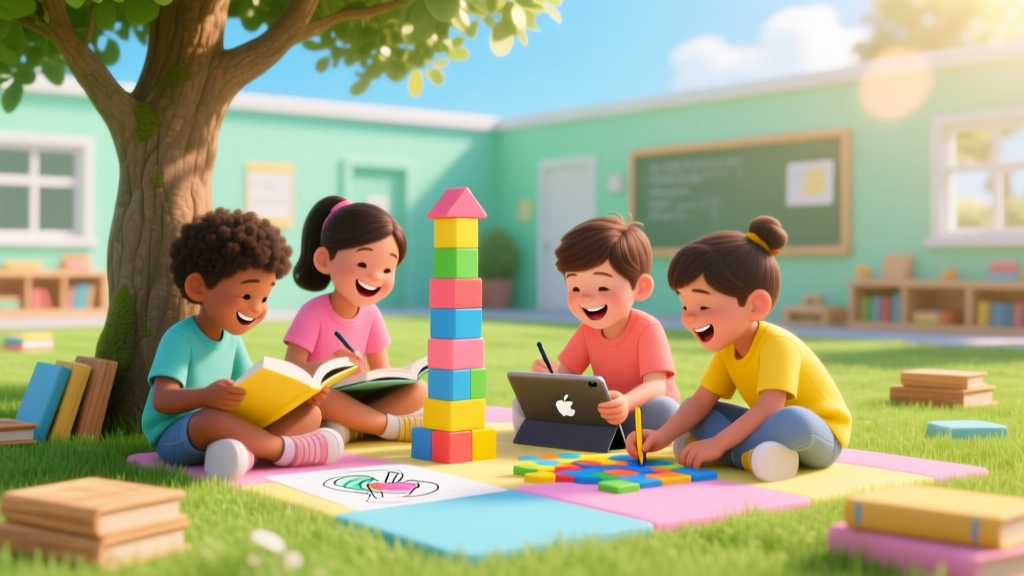
Creativity in Kids: 7 Science-Backed Ways (2026)
Why Your Child’s Creativity Isn’t ‘Running Out’—And Why Most Parents Are Accidentally Stifling It
If you’ve ever wondered how to encourage creativity in kids—especially when your child seems glued to screens, resists open-ended play, or says “I don’t know what to draw”—you’re not failing. You’re navigating a system stacked against imagination: standardized curricula, overscheduled calendars, and toy aisles full of single-purpose gadgets that do the thinking *for* them. But here’s the hopeful truth: creativity isn’t a fixed talent some kids are born with—it’s a learnable, trainable cognitive muscle. And according to the American Academy of Pediatrics (AAP), it’s as vital to long-term academic resilience and emotional regulation as literacy or numeracy. In fact, a landmark 2023 longitudinal study published in Child Development found that children who engaged in just 15 minutes of daily unstructured, choice-driven play before age 8 showed 42% higher divergent thinking scores at age 12—and significantly lower rates of anxiety in adolescence.
1. Redesign Your Home Environment for ‘Creative Friction’ (Not Just ‘Stimulus Overload’)
We’ve been sold a myth: that more toys = more creativity. The reality? A 2022 University of Toledo experiment observed 60 preschoolers across two identical playrooms—one stocked with 16 highly specific toys (e.g., a talking robot dog, a pre-assembled LEGO castle), the other with only 4 open-ended materials (a wooden box, fabric scraps, cardboard tubes, and masking tape). Children in the minimalist room generated 3.7x more unique play scenarios, sustained focus 58% longer, and initiated collaborative storytelling in 92% of sessions—versus just 24% in the high-toy room. Why? Because creativity thrives on *constraint*, not clutter. When options are too narrow or too abundant, the brain defaults to mimicry or disengagement.
So instead of adding more, try subtracting—and reorganizing:
- Rotate, don’t accumulate: Keep only 6–8 open-ended items visible at once (e.g., clay, loose parts like buttons or pinecones, blank sketchbooks, pipe cleaners). Store the rest and swap monthly—this mimics museum curation and sparks novelty without new purchases.
- Create ‘idea zones,’ not activity stations: Ditch the labeled ‘art corner’ or ‘building table.’ Instead, designate one shelf as the ‘What If?’ shelf: rotate prompts like “Build something that floats *and* sings” or “Draw a map of a place where shadows talk.” Include a small whiteboard for kids to add their own challenges.
- Embrace ‘productive mess’: Designate one low-traffic area (e.g., under the kitchen table, a garage corner) as a ‘no-wipe zone’ for 48 hours after creative work begins. Research from the MIT Media Lab shows that visible, unfinished projects trigger 3x more revisiting and iterative refinement than clean-slate starts.
2. Master the ‘Three-Question Reframe’ During Play (And Ditch Praise That Backfires)
Most parents instinctively say things like “That’s beautiful!” or “You’re so talented!”—but developmental psychologist Dr. Laura E. Berk, author of Infants, Children, and Adolescents, warns these phrases unintentionally train kids to seek external validation and avoid risk. In her classroom trials, children praised for effort (“You kept trying different ways to balance that tower!”) were 300% more likely to attempt harder challenges later than those praised for ability (“You’re a great builder!”).
Replace generic praise with curiosity-driven questions that deepen metacognition—the awareness of *how* they think. Use this exact sequence, no matter the medium (drawing, block-building, pretend play):
- “What part did you choose first—and why?” (Reveals intentionality and planning)
- “What surprised you while you were making it?” (Highlights observation, adaptability, and error-embracing)
- “If you made this again tomorrow, what’s one tiny thing you might change—and what would happen?” (Activates future-oriented, experimental thinking)
A real-world example: When 7-year-old Maya built a wobbly cardboard rocket, her mom asked the three questions. Maya replied, “I chose the tape first because glue dries slow… The box lid fell off—that was surprising!… Tomorrow I’d cut slits so it locks in.” That’s not just creativity—it’s engineering mindset in action.
3. Leverage ‘Boredom’ as Your Secret Curriculum (Yes, Really)
Here’s what pediatrician Dr. Jenny Radesky (co-author of Screen Time: A Parent’s Guide) tells exhausted parents in her clinical practice: “Boredom isn’t empty time—it’s the neurological green light for imagination to ignite.” Her research team tracked 120 families for 18 months and found that children granted ≥45 minutes of uninterrupted, screen-free, adult-unstructured time *three times per week* developed significantly stronger narrative skills and self-directed problem-solving—even when parents reported doing ‘nothing’ during those windows.
The key isn’t passive waiting—it’s intentional scaffolding:
- Start small: Begin with 10-minute ‘boredom buffers’ after school—no devices, no instructions, no hovering. Sit nearby reading your own book (modeling calm presence, not supervision).
- Normalize the discomfort: Say, “It’s okay to feel restless at first. That’s your brain waking up its idea engine.” Avoid rescuing with suggestions.
- Capture the spark: Keep a ‘Boredom Breakthrough Journal’—not for kids to write in, but for *you* to jot down what emerged (e.g., “Day 4: Built fort with couch cushions + flashlight → named it ‘Lunar Lighthouse’”). Review monthly to spot patterns in their self-initiated themes.
This isn’t permissiveness—it’s cognitive weight training. As Dr. Kathy Hirsh-Pasek, Temple University child development researcher and co-author of Becoming Brilliant, puts it: “When we rush to fill silence, we steal the very space where original thought is forged.”
4. Turn Everyday Routines Into Creative Incubators
Creativity doesn’t live only in art class or weekend projects. It flourishes in the mundane—when we reframe routine tasks as design challenges. Consider these evidence-backed micro-shifts:
- Grocery store as innovation lab: Give your child a $2 ‘invention budget’ to buy 3 random ingredients. At home, challenge them to create a new dish name, backstory, and presentation style (e.g., “Alien Antacid Smoothie served in a test tube”). This builds narrative, systems thinking, and sensory experimentation—all core creative competencies.
- Laundry as material science: Sort socks not by color, but by texture, stretch, or pattern repetition. Ask, “Which sock would make the best puppet mouth? Which feels most like dragon skin?” Turns chore into tactile inquiry.
- Bedtime as world-building: Replace “What did you do today?” with “If tonight’s dream had a director, what genre would it be? What’s the opening shot?” Encourages symbolic thinking and emotional processing through metaphor.
These aren’t ‘fun extras’—they’re neural priming. A 2024 study in Early Childhood Research Quarterly showed children who regularly engaged in routine reframing demonstrated 27% faster adaptive reasoning on novel problem-solving tasks than peers in control groups.
| Activity Type | Age-Appropriate Implementation | Key Developmental Benefit (Per AAP & NAEYC) | Time Commitment | Parent Role |
|---|---|---|---|---|
| Open-Ended Material Play | 3–5 yrs: Large loose parts (wood slices, scarves, foam blocks); 6–8 yrs: Recycled tech (old keyboards, circuit boards); 9–12 yrs: Digital+physical hybrids (stop-motion with phone + clay) | Executive function (planning, flexibility), fine motor integration, symbolic representation | 15–20 min/day, 4x/week | Curator & observer—not instructor. Ask the Three-Question Reframe *after*, never during. |
| ‘Boredom Buffer’ Time | 3–5 yrs: 8–12 min; 6–8 yrs: 15–25 min; 9–12 yrs: 30–45 min | Sustained attention, self-regulation, intrinsic motivation, tolerance for ambiguity | 3x/week minimum | Guardian of boundaries—ensure safety & silence, then disengage physically/emotionally. |
| Routine Reframing | All ages: Adapt language & complexity (e.g., ‘What if our toaster could tell jokes?’ for toddlers; ‘Design a toaster interface for astronauts’ for tweens) | Abstract thinking, perspective-taking, linguistic flexibility, humor development | Integrated into existing routines—no extra time needed | Co-designer & playful collaborator. Model absurdity and curiosity yourself. |
| Creative Conflict Resolution | 4+ yrs: “Let’s draw two versions of how this argument could end—with magic and without.” 7+ yrs: “Write a contract between Sibling A and Sibling B, but the rules must rhyme.” | Empathy, moral reasoning, negotiation, narrative coherence | As needed—turns tension into generative practice | Moderator & scribe. Never judge solutions—only ask “How would this work in real life?” |
Frequently Asked Questions
My child only draws the same thing (dinosaurs, princesses, cars). Does that mean they’re not creative?
Not at all—in fact, it’s a powerful sign of developing expertise and narrative mastery. Researchers at the University of Cambridge call this ‘focused exploration,’ and it’s how children build deep knowledge before branching out. Instead of steering them toward variety, ask: “What’s the *next chapter* for your T. rex? Does it have a secret friend? A problem only it can solve?” This honors their interest while stretching imaginative scope.
Is screen time always bad for creativity—or can some apps actually help?
It depends entirely on interactivity and agency. Passive streaming (YouTube, cartoons) correlates with reduced divergent thinking in longitudinal studies. But *open-ended* digital tools—like Scratch (coding stories), Tinkercad (3D designing), or even voice-recorded podcasting about their invented worlds—activate the same neural networks as physical creation. The AAP recommends the ‘3 C’s test’: Is it Controllable (child directs it?), Creative (does it generate new ideas, not just consume?), and Collaborative (can they share or remix?)? If yes—use it intentionally, not as background noise.
My kid gets frustrated and gives up fast during creative tasks. How do I help without taking over?
Frustration is often a signal of mismatched challenge—not lack of ability. Try the ‘Goldilocks Prompt’: Offer three versions of the same task (e.g., drawing a tree): Easy (trace a stencil), Medium (draw from a photo), Hard (draw a tree that lives on Mars). Let them choose. This builds autonomy *and* self-awareness. Also, normalize struggle aloud: “My painting got muddy too—I added salt to make it sparkle. Want to try a ‘messy fix’ together?” Modeling imperfection reduces performance pressure.
Does creativity look different in neurodivergent kids—and how should I adapt?
Absolutely—and that’s a strength, not a deficit. Autistic children may express creativity through intense pattern-making, system-building (e.g., elaborate train schedules), or sensory-rich repetition (spinning objects, arranging textures). ADHD kids often thrive in rapid-prototype mode—generating 10 wild ideas before refining one. According to Dr. Devon MacAllister, a developmental neuropsychologist specializing in neurodiversity, the goal isn’t to ‘normalize’ expression but to identify their unique creative signature (e.g., “Is your child’s creativity visual, kinetic, verbal, or systemic?”) and scaffold *that* pathway—whether it’s providing graph paper for spatial thinkers or voice-to-text tools for verbal processors.
Common Myths About Fostering Creativity
- Myth #1: “Creativity is just for ‘artistic’ kids.” Creativity is cognitive infrastructure—not a subject. A child negotiating playground rules, debugging a Lego robot, or inventing a new card game is exercising the exact same neural circuitry as a painter mixing pigments. It’s about generating *novel, useful responses* to any challenge.
- Myth #2: “Praising effort guarantees motivation.” While effort-praise beats ability-praise, blanket “You tried so hard!” backfires if the effort was misdirected. Better: Name the *specific strategy* (“You tested three bridge designs—that’s real engineering!”). This teaches kids *how* to think, not just that trying matters.
Related Topics (Internal Link Suggestions)
- Age-Appropriate Open-Ended Toys — suggested anchor text: "best open-ended toys by age"
- Screen Time Balance for Creative Development — suggested anchor text: "how much screen time is healthy for creativity"
- Montessori-Inspired Creativity at Home — suggested anchor text: "Montessori creativity activities for toddlers"
- Supporting Creative Confidence in School-Aged Kids — suggested anchor text: "helping kids believe in their creative ideas"
- Creative Problem-Solving Games for Families — suggested anchor text: "family games that build creative thinking"
Your Next Step Starts With One Tiny Shift
You don’t need a craft closet overhaul, a new curriculum, or hours of prep. Pick *one* strategy from this article—just one—and implement it consistently for 10 days: maybe the Three-Question Reframe after dinner, or a 12-minute boredom buffer every Tuesday/Thursday/Friday. Track what emerges—not perfection, but shifts: a longer focus span, an unexpected question, a story they initiate unprompted. Creativity isn’t ignited with grand gestures. It’s watered daily, quietly, with attention and trust. So go ahead—choose your one thing. Then watch what grows in the space you’ve made.
More Articles
 Finding Her Edge Kids’ Ages: What It Means for You
 Do Kids Gain Weight Before a Growth Spurt?
 Who Was The Kid Bad Bunny Gave Grammy To (2026)
 How Many Kids Does Rizzo Have? Parenting Insights (2026)
 Did Catherine O'Hara Adopt Her Kids? The Truth
 How Many Kids Does SGA Have? Truth & Parenting Insights
 Rotate Motrin and Tylenol for Kids: Safe Timing Guide
 Sarah Henderson Case: Mental Health Warning Signs
 When to Take Kids to Dentist: AAP & ADA Guidelines
 Raven Goodwin Kids: Truth About Her Family Life (2026)