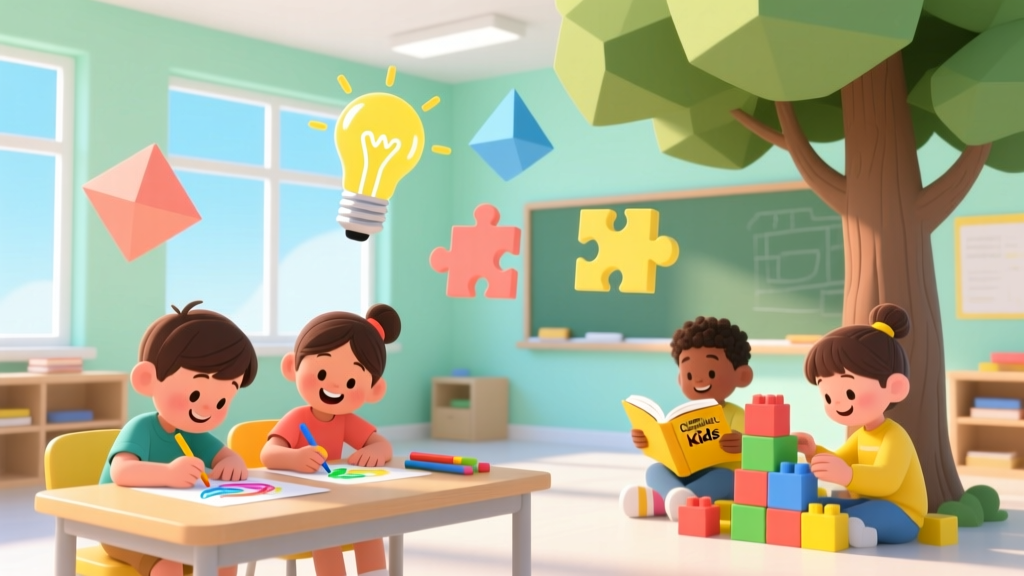
How to Develop Curiosity in Kids: Science-Backed Tips
Why Curiosity Isn’t Just ‘Nice to Have’—It’s the Engine of Lifelong Learning
Learning how to develop curiosity in kids is one of the most consequential parenting investments you’ll make—not because it makes them better test-takers, but because curiosity is the cognitive and emotional bedrock of resilience, critical thinking, and adaptive problem-solving. In a world where AI handles routine tasks and information is instantly accessible, what sets thriving humans apart isn’t memorization—it’s the drive to ask ‘why,’ ‘what if,’ and ‘how else?’ A landmark 2023 longitudinal study published in Child Development tracked 1,247 children from age 4 to 18 and found that those rated highest in curiosity at kindergarten were 37% more likely to graduate college, 2.1x more likely to pursue STEM degrees *without* parental pressure, and reported significantly higher life satisfaction in early adulthood—even after controlling for IQ and socioeconomic status. Yet most parents unintentionally suppress curiosity daily—not out of neglect, but because we’re wired to prioritize efficiency, safety, and correctness over open-ended exploration.
The ‘Curiosity Gap’: What Neuroscience Tells Us About Timing
Here’s what few parenting guides tell you: curiosity isn’t a trait you ‘build’ like muscle—it’s a biological state triggered by a precise neurochemical cocktail. When a child encounters something novel, ambiguous, or slightly mismatched with expectations, their brain releases dopamine (anticipation reward), norepinephrine (alertness), and acetylcholine (memory encoding). But this cascade only fires when two conditions are met: perceived safety and agency. If a child feels judged, rushed, or corrected mid-question—or if they sense your anxiety about mess, time, or ‘getting it right’—the amygdala overrides the prefrontal cortex, shutting down inquiry before it begins. Dr. Laura Jana, pediatrician and co-author of The Toddler Brain, puts it plainly: ‘Curiosity doesn’t bloom in perfectly scheduled routines. It thrives in the fertile cracks—between tasks, under loose supervision, and in the respectful silence after a question.’
So how do you create those cracks? Not by adding more activities—but by strategically subtracting interference. Below are four foundational, research-validated approaches—each grounded in developmental science and field-tested by educators across diverse settings (Montessori classrooms, Head Start programs, and pediatric wellness clinics).
Strategy 1: Master the ‘Pause-and-Reflect’ Response (Not the Answer)
When your 5-year-old asks, ‘Why is the sky blue?’ resist the reflex to explain Rayleigh scattering. Instead, pause for 3–5 seconds—longer than feels comfortable—and respond with: ‘What do you think?’ or ‘That’s such a great question—I wonder what you’ve noticed about light and color?’ This micro-intervention does three things: (1) signals their thinking matters more than your knowledge, (2) activates their working memory and hypothesis-generation, and (3) builds neural pathways for self-directed inquiry. A 2022 University of Michigan classroom trial showed teachers who used this ‘reflective pause’ technique saw a 68% increase in student-initiated follow-up questions within six weeks.
Try this today: Next time your child asks ‘why,’ ‘how,’ or ‘what happens if…’, commit to waiting 4 seconds before speaking. Use that time to breathe—and then mirror their language back: ‘You’re wondering why the ice melted so fast…’ Then add: ‘Let’s find out together.’ No need to know the answer. Your role isn’t oracle—it’s co-explorer.
Strategy 2: Design ‘Low-Stakes Wonder Zones’ (Not ‘Learning Stations’)
Forget Pinterest-perfect sensory bins. Real curiosity flourishes in low-pressure, high-ambiguity spaces where outcomes aren’t predefined. Think: a ‘mystery box’ with 3 natural objects (a pinecone, smooth stone, dried seed pod) and no instructions—just a magnifying glass and blank paper. Or a ‘question jar’ where family members drop anonymous ‘I wonder…’ notes weekly (e.g., ‘I wonder how ants carry things bigger than themselves’), then pick one to investigate together on Sunday afternoons.
These aren’t activities—they’re invitations. The magic lies in the ambiguity. As Dr. Alison Gopnik, developmental psychologist at UC Berkeley, explains: ‘Children learn best when they’re allowed to generate their own theories and test them—not when adults hand them conclusions wrapped in glitter.’ A ‘wonder zone’ works because it removes performance pressure while preserving autonomy. It also subtly teaches intellectual humility: not knowing is the starting point—not a failure.
Pro tip: Rotate materials monthly using themes tied to seasonal observation—not curriculum standards. Example: ‘Rainy Days’ could include water droplets on leaves (macro photography), rain gauge measurements, cloud journals, and stories about water cycles from Indigenous oral traditions. Contextual relevance > forced alignment.
Strategy 3: Normalize ‘I Don’t Know’—and Model the Search
Children absorb far more from what you do than what you say. When you confidently admit ignorance—then demonstrate how to find answers—you reframe uncertainty as exciting, not shameful. Try this: When asked ‘Where do babies come from?,’ instead of launching into anatomy, say: ‘That’s a huge, beautiful question—and I want to get it right. Let’s look at a trusted book together and talk about it slowly.’ Then do it. Show them how to find a reputable source (AAP’s HealthyChildren.org), how to skim headings, how to ask clarifying questions.
This models three critical skills: (1) intellectual honesty, (2) information literacy, and (3) collaborative learning. According to the American Academy of Pediatrics’ 2022 guidance on media and early development, children who observe adults modeling thoughtful information-seeking are 3.2x more likely to verify facts independently by age 10—and less susceptible to misinformation.
Real-world case: Maya, a homeschooling parent of twins (ages 6 & 8), started a ‘Family Wonder Log’—a shared notebook where every unanswered question goes. Each week, they pick one to explore using library books, museum websites, or short interviews (e.g., ‘What do bees eat?’ led to emailing a local beekeeper). The log isn’t about answers—it’s about documenting the process: dead ends, surprises, revised ideas. Their oldest recently wrote: ‘We thought flowers made honey. Turns out bees make it. And they dance to tell friends where flowers are. That’s cooler than honey.’
Strategy 4: Protect Curiosity’s Natural Rhythms (Especially in Early Childhood)
Curiosity isn’t evenly distributed across the day—or across ages. Neuroimaging shows preschoolers’ curiosity peaks during unstructured transitions (post-nap, pre-dinner), when executive function is low and sensory openness is high. Meanwhile, tweens show heightened curiosity during ‘liminal moments’—commutes, shower time, bedtime—when the default mode network activates.
Yet our schedules often bulldoze these windows. A 2024 Yale Child Study Center analysis found that children aged 3–7 spend 42% less unscheduled time than peers did in 2010—replaced by adult-led enrichment. The result? Diminished tolerance for ambiguity and shorter attention spans for open-ended tasks.
Protecting curiosity means protecting space—not filling it. That looks like: 20 minutes of true ‘do-nothing’ time after school (no screens, no prompts); leaving nature walks intentionally unguided (‘Let’s see what catches your eye’); or designating one ‘slow morning’ weekly where breakfast is silent, and the only agenda is noticing.
As Montessori educator Angeline Lillard writes in Montessori: The Science Behind the Genius: ‘The greatest gift we give young children is the permission to be unfinished—to hold questions without rushing to resolve them.’
Developmental Benefits of Curiosity-Focused Practices
Below is a research-synthesized overview of how specific curiosity-supporting actions map to measurable developmental domains. Data drawn from meta-analyses in Early Childhood Research Quarterly, AAP clinical reports, and longitudinal studies tracking executive function growth.
| Action | Cognitive Benefits | Social-Emotional Benefits | Language & Communication Benefits | Age Range Most Impactful |
|---|---|---|---|---|
| Using reflective pauses after questions | +23% growth in hypothesis generation (ages 4–7); +18% sustained attention on complex tasks | Builds self-efficacy; reduces fear of ‘wrong’ answers | Expands explanatory vocabulary; increases use of causal language (“because,” “so,” “then”) | 3–8 years |
| Creating open-ended ‘wonder zones’ | Strengthens pattern recognition; improves analogical reasoning | Increases tolerance for ambiguity; lowers frustration during trial-and-error | Encourages descriptive language; boosts narrative sequencing (“First… then… finally…”) | 2–10 years |
| Modeling ‘I don’t know’ + collaborative search | Improves metacognition (awareness of own thinking); enhances source evaluation skills | Fosters intellectual humility; strengthens trust in adult guidance | Introduces academic vocabulary (e.g., ‘hypothesis,’ ‘evidence,’ ‘compare’); normalizes asking clarifying questions | 5–14 years |
| Protecting unstructured transition time | Supports default mode network integration; correlates with stronger creative problem-solving scores | Reduces cortisol spikes; improves emotional regulation after demanding tasks | Increases spontaneous storytelling and imaginative play dialogue | 3–9 years |
Frequently Asked Questions
Can too much curiosity be harmful—or lead to dangerous experimentation?
No—curiosity itself is never harmful. What requires guidance is behavioral boundaries. Children naturally test limits, but curiosity-driven exploration (e.g., ‘What happens if I mix these?’) becomes risky only when safety scaffolding is absent. The solution isn’t suppression—it’s co-designing safe parameters. Example: Instead of ‘Don’t touch the stove,’ try ‘Stoves get very hot—let’s explore heat safely. Here’s a candle (supervised), a thermometer, and oven mitts. What can we learn?’ According to Dr. Tanya Altmann, AAP spokesperson and pediatrician, ‘Curiosity paired with consistent, calm boundaries creates the safest learning environment—not restriction.’
My child seems ‘uninterested’ in anything—could they just not be curious?
Extremely unlikely. Curiosity is a universal human drive rooted in survival wiring. What appears as disinterest is usually one of three things: (1) chronic stress or fatigue (e.g., sleep deprivation, family tension), (2) repeated experiences of shame or correction around questions, or (3) mismatched stimulation (e.g., overscheduled days with no downtime, or environments lacking novelty). Observe quietly for 24 hours: when does their gaze linger? What do they return to unprompted? That’s your curiosity entry point. Start there—even if it’s watching dust motes in sunlight.
Does screen time kill curiosity—or can it support it?
It depends entirely on agency and interactivity. Passive scrolling (TikTok, YouTube autoplay) correlates strongly with reduced curiosity persistence in longitudinal studies. But interactive, choice-driven digital tools—like NASA’s free ‘Space Place’ website (where kids choose missions, analyze real satellite data), or Scratch coding projects where they design their own animations—can deepen inquiry. Key question: Is your child directing the experience, or being directed by algorithms? AAP guidelines recommend co-viewing and asking ‘What would you change?’ or ‘How might this work differently?’ to maintain active engagement.
How early should I start nurturing curiosity—and is it ever ‘too late’?
You’re already doing it. Newborns track moving objects, turn toward voices, and stare longer at novel faces—these are curiosity behaviors. Start formally supporting it around 12–18 months, when toddlers begin pointing, dropping objects to observe cause-effect, and showing preference for new toys. And it’s never too late: adolescent brains retain remarkable neuroplasticity. A 2023 study in Nature Human Behaviour found teens who joined curiosity-focused clubs (e.g., citizen science projects, maker labs) showed significant growth in intrinsic motivation—even if they’d shown ‘low engagement’ earlier. Curiosity isn’t fixed—it’s renewable.
Are some kids ‘naturally’ more curious—or is it all nurture?
Temperament plays a role—some infants are more novelty-seeking—but environment dominates. Twin studies show only ~30% of curiosity variance is heritable; 70% comes from relational, linguistic, and experiential inputs. Crucially, ‘high-curiosity’ behaviors (asking questions, exploring, persisting with puzzles) are highly teachable and reinforceable. As Dr. Kathy Hirsh-Pasek, Temple University child development researcher, states: ‘Curiosity isn’t a trait you’re born with—it’s a habit you grow through daily micro-interactions.’
Common Myths About Developing Curiosity
- Myth #1: Curiosity is sparked by ‘fun’ activities or flashy toys. Reality: Novelty triggers initial attention—but sustained curiosity requires perceived competence and progressive challenge. A $200 robot kit gathers dust if the child feels overwhelmed; a cardboard box and tape inspires weeks of engineering because mastery feels achievable.
- Myth #2: Asking lots of questions = being curious. Reality: Question quantity ≠ curiosity quality. True curiosity involves follow-through—testing ideas, seeking evidence, revising theories. A child who asks ‘Why?’ 20 times but dismisses answers isn’t curious; they’re practicing language or seeking control. Look for questions that evolve: ‘Why is it blue?’ → ‘What makes other things blue?’ → ‘Can we make something blue ourselves?’
Related Topics (Internal Link Suggestions)
- How to encourage critical thinking in elementary kids — suggested anchor text: "critical thinking skills for 6- to 10-year-olds"
- Best open-ended toys for preschoolers — suggested anchor text: "Montessori-inspired toys that spark curiosity"
- Screen time guidelines by age (AAP-backed) — suggested anchor text: "healthy screen time for curious minds"
- Questions to ask kids that build emotional intelligence — suggested anchor text: "curiosity-driven conversations for feelings"
- How to handle ‘why’ questions without losing patience — suggested anchor text: "responding to endless whys with calm curiosity"
Ready to Cultivate Curiosity—Without Adding Another Thing to Your To-Do List
You don’t need lesson plans, subscriptions, or special equipment to help your child become a lifelong learner. You already have the most powerful tool: your attentive presence, your willingness to wonder alongside them, and your courage to say ‘I don’t know—let’s find out.’ Start small. Pick one strategy from this article—maybe the 4-second pause tomorrow morning, or placing a single intriguing object on the kitchen table tonight with no instructions. Notice what shifts. Curiosity isn’t built in grand gestures. It grows in the quiet, consistent soil of ‘What do you notice?’ ‘What if…?’ and ‘Tell me more.’ Your next step? Choose one moment this week where you’ll protect space—not fill it. Then watch what unfolds.
More Articles
 Excessive Blinking in Kids: What Actually Helps
 Child Support for 2 Kids in Florida: Exact 2026 Calculation
 Michael Bublé’s Kids and Privacy Reasons
 What Is Size 90 in Kids? A Pediatrician-Backed Guide
 How Many Kids Does Ti And Tiny Have (2026)
 Does Lauren Sanchez Have Kids? Step-Mom Truths (2026)
 Is Back to the Future Appropriate for Kids? (2026)
 How to Measure Kids for Golf Clubs (2026)
 Matt Campbell’s Kids & Parenting Insights
 Pepto for Kids: Pediatrician Advice & Safe Dosing (2026)