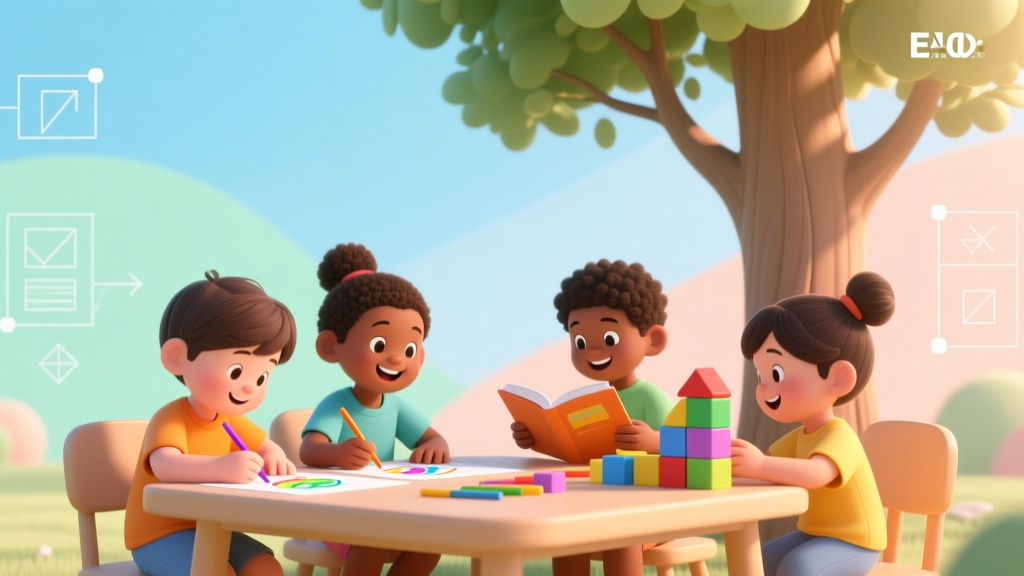
How to Be a Good Kid: Build Character, Not Perfection
Why 'How to Be a Good Kid' Isn’t About Obedience — It’s About Belonging
The phrase how to be a good kid carries quiet weight — often whispered by exhausted parents after a meltdown, typed into search bars late at night, or asked by an earnest 8-year-old who just got called "naughty" at school. But here’s the truth most adults miss: being a 'good kid' isn’t about flawless compliance. It’s about feeling safe enough to try, trusted enough to make mistakes, and guided enough to grow. According to Dr. Laura Jana, pediatrician and co-author of The Toddler Brain, 'Children don’t learn virtue through punishment — they internalize values through consistent, warm coaching embedded in daily routines.' This article reframes 'goodness' as developmental, relational, and deeply human — not moral perfection.
1. Redefine 'Good Behavior' Through Developmental Lenses (Not Adult Expectations)
What looks like 'bad behavior' is almost always unmet need or undeveloped skill. A 4-year-old who refuses to share isn’t 'selfish' — their prefrontal cortex is only 20% developed; impulse control is physiologically impossible without scaffolding. A 10-year-old who talks back isn’t 'disrespectful' — they’re practicing autonomy, a critical milestone in Erik Erikson’s psychosocial stage of Industry vs. Inferiority.
Instead of labeling, ask: What skill is missing? What need is unmet? What support can I offer right now? Research from the American Academy of Pediatrics (2023) confirms that children whose caregivers use 'skill-building language' ('Let’s practice taking turns') instead of 'character-labeling language' ('You’re so selfish') show 42% higher growth in executive function over 6 months.
Real-world example: Maya, a second-grade teacher in Portland, shifted her classroom language after attending a trauma-informed training. When a student threw crayons during writing time, she stopped saying, 'Don’t be disruptive!' and began asking, 'Are your hands feeling wiggly? Let’s try the squeeze-ball break before we write.' Within three weeks, incident reports dropped by 70% — not because kids became 'better,' but because their nervous systems felt regulated enough to access learning.
2. The 5-Minute Daily Connection Ritual (That Builds Moral Imagination)
Character doesn’t bloom from lectures — it grows in micro-moments of attuned connection. Neuroscientist Dr. Dan Siegel calls this 'mindsight': the ability to perceive one’s own and others’ internal states. Children who regularly practice mindsight become more empathetic, less reactive, and more ethically grounded.
Try this evidence-backed ritual (validated in a 2022 University of Wisconsin longitudinal study):
• Timing: 5 minutes, same time daily (e.g., bedtime, breakfast, car ride home)
• Structure: Ask two questions — "What made you feel proud today?" and "When did someone help you — or when did you help someone?"
• Rule: No fixing, no judging, no redirecting. Just listen, reflect feelings ('That sounded really hard'), and name values ('Helping your sister tie her shoes shows kindness and patience').
This simple habit strengthens neural pathways linking emotion recognition to prosocial action. In the UW study, children who practiced it 4+ times/week for 8 weeks showed measurable increases in oxytocin response during cooperative tasks — a biological marker of trust and bonding.
3. Responsibility ≠ Chores: Building Agency Through Meaningful Contribution
We often confuse responsibility with task completion — but real responsibility is rooted in contribution, not compliance. When children contribute meaningfully to family or classroom life, they develop intrinsic motivation, competence, and belonging — the three pillars of self-determination theory (Ryan & Deci, 2000).
Avoid generic chore charts. Instead, co-create roles tied to identity and impact:
• "You’re our Family Food Scout — you help pick veggies at the store and tell us which ones look happiest."
• "You’re our Library Keeper — you decide where new books live and help friends find stories about dragons or space."
This approach transforms duty into identity. As Montessori educator Angeline Lillard notes in Montessori: The Science Behind the Genius, 'When work has purpose, children don’t need rewards or punishments — they engage because the act itself satisfies deep psychological needs.'
4. Repair Over Punishment: Turning Mistakes Into Moral Practice
Every child will hurt someone’s feelings, break something, or lie. How adults respond determines whether that moment becomes shame or growth. The AAP strongly recommends restorative practices over punitive consequences — especially for children under 12, whose brains are still wiring cause-and-effect reasoning.
A repair sequence that works:
1. Pause & Name: "I see you’re upset. Let’s breathe together for 3 seconds." (Regulates amygdala)
2. Connect Before Correct: "I love you, and I know you didn’t mean to spill the paint." (Secures attachment)
3. Co-Create Repair: "What do you think would help fix this? Should we wipe it up together? Draw a new picture for your friend?" (Builds agency)
4. Reflect Gently: "Next time your body feels hot with anger, what’s one thing you could try?" (Scaffolds future skill)
This isn’t permissiveness — it’s precision teaching. A 2021 meta-analysis in Child Development found children taught repair skills showed 3.2x greater reduction in repeat conflicts than those given time-outs alone.
| Age Range | Core Developmental Task | “Good Kid” Habit That Supports It | Why It Works (Neuroscience/Developmental Basis) | Simple Implementation Tip |
|---|---|---|---|---|
| 3–5 years | Autonomy vs. Shame/Doubt (Erikson) | Choosing between two acceptable options (“Do you want the red cup or blue cup?”) | Supports prefrontal cortex development by exercising decision-making within safe boundaries | Offer choices only where both options are truly okay — never “Do you want to brush teeth?” but “Do you want the mint or strawberry toothpaste?” |
| 6–9 years | Industry vs. Inferiority (Erikson) | Leading one part of a family routine (e.g., setting the table, watering plants) | Builds dopamine-driven motivation through mastery experiences and visible contribution | Use a photo-based checklist they help design — visual cues reduce working memory load |
| 10–12 years | Identity vs. Role Confusion (Erikson) | Naming their own values (“What matters most to you in a friend?”) and connecting actions to them | Strengthens default mode network integration — key for self-concept formation | Ask weekly: “When did you act like the person you want to become? What helped you do that?” |
| 13+ years | Intimacy vs. Isolation (Erikson) | Practicing respectful disagreement (“I hear you think X. Here’s what I’m wondering…”) with adults | Develops theory of mind and emotional regulation via frontal lobe pruning and myelination | Hold monthly ‘idea swaps’ — no solutions, just listening. Model saying, “I hadn’t thought of it that way.” |
Frequently Asked Questions
Is it okay to praise my child for being ‘good’?
Use caution. Generic praise like 'You're such a good girl!' ties worth to performance — leading children to fear failure or seek external validation. Instead, praise effort, strategy, or character *in action*: 'You kept trying even when the puzzle was hard — that’s perseverance!' or 'You noticed Sam looked sad and asked if he wanted to play — that’s empathy in action.' A landmark 2017 Stanford study found children praised for process (not person) were 40% more likely to take on challenging tasks later.
My child compares themselves to siblings or classmates. How do I help them feel ‘good enough’?
Normalize comparison as natural — then reframe it. Say: 'Our brains compare to learn. But you’re not a copy — you’re a unique person with your own rhythm, strengths, and growing edges.' Then spotlight *their* growth: 'Remember last month when tying shoes took 5 minutes? Now it takes 30 seconds — that’s your brain getting stronger!' Pediatric psychologist Dr. Becky Kennedy emphasizes: 'Comparison loses power when children anchor to their own progress, not others’ benchmarks.'
What if my child says, 'I’m a bad kid'?
This is a distress signal — not defiance. Respond with warmth and specificity: 'I love you, and I know big feelings can make thoughts feel loud. Can you tell me what happened right before you said that?' Then separate behavior from identity: 'Throwing toys is unsafe — but *you* are safe, loved, and learning.' Avoid arguing ('No, you’re not!'). Instead, co-create a calm-down plan for next time. The AAP advises treating self-critical statements as invitations to co-regulate, not correct.
How much screen time is compatible with being a 'good kid'?
It’s not about minutes — it’s about intentionality. The AAP recommends co-viewing and discussing content: 'What did that character do when they felt angry? What else could they have tried?' High-quality, interactive media (like collaborative Minecraft servers or coding games) builds cooperation and problem-solving. Passive scrolling does not. Set boundaries *together*: 'We’ll watch one episode, then draw what we imagine happens next.' This transforms consumption into creation and reflection.
Does religion or spirituality belong in teaching kids to be 'good'?
Yes — if it’s values-centered, not fear-based. Research from the Harvard Graduate School of Education’s Making Caring Common project shows children raised with compassion-focused spiritual practices (e.g., gratitude circles, service projects, mindful breathing as 'filling your heart with light') demonstrate higher empathy and lower prejudice. Avoid 'good = obedient to rules'; emphasize 'good = caring for people, animals, and the Earth.' Even secular families can adopt rituals like 'Three Good Things' at dinner — grounding ethics in observable kindness.
Common Myths
- Myth #1: “Good kids are naturally well-behaved.” — Truth: All children experience big emotions and developing brains. 'Good behavior' is learned through repetition, modeling, and co-regulation — not innate temperament. Even the calmest toddler has meltdowns when tired, hungry, or overwhelmed.
- Myth #2: “If I’m kind and patient, my child will automatically be kind.” — Truth: Children need explicit coaching. Kindness is a skill — like riding a bike — requiring practice, feedback, and safe space to wobble. Modeling matters, but naming, reflecting, and rehearsing are essential.
Related Topics (Internal Link Suggestions)
- Positive Discipline Strategies for Toddlers — suggested anchor text: "gentle discipline techniques that build trust instead of fear"
- Emotional Regulation Activities for Kids — suggested anchor text: "age-appropriate tools to name, soothe, and express big feelings"
- Building Empathy in Elementary-Age Children — suggested anchor text: "story-based, play-based, and real-life ways to grow compassion"
- Screen Time Guidelines by Age — suggested anchor text: "what the AAP actually recommends — and how to make it work in real life"
- Montessori Principles for Home Life — suggested anchor text: "simple, research-backed ways to foster independence and respect"
Your Next Step: Start With One Micro-Moment
You don’t need to overhaul your parenting overnight. Today, choose just one 5-minute window — maybe while waiting for pasta to boil or walking to the bus stop — and ask your child: 'What’s one thing you did today that made you feel capable?' Listen without fixing. Reflect back what you heard: 'So you figured out the math problem all by yourself — that took focus and courage.' That tiny act of witnessing builds the foundation for everything else. Because being a 'good kid' isn’t about perfection — it’s about knowing, deep in your bones, that you are worthy of love exactly as you are, and that growth is always possible. Ready to go deeper? Download our free Connection Rituals Calendar — 30 age-adapted prompts designed by child psychologists to strengthen bonds and build character, one day at a time.
More Articles
 Where Are Brian and Ana Walshe’s Kids? (2026)
 Female Fertility Timeline: Science, Myths & Planning (2026)
 Is It Illegal to Leave Kids in the Car? (2026)
 How Old Were the Kids in Stranger Things Season 1?
 What Age Do Kids Lose Their First Tooth (2026)
 How to Fake Sick as a Kid: Red Flags & Parent Tips (2026)
 When Do Kids Typically Get Braces (2026)
 Gum in Kids’ Lunch Boxes: What’s Safe? (2026)
 Dolly Parton’s Choice: Why She Didn’t Have Kids (2026)
 How Many Kids Go Missing In A Year (2026)