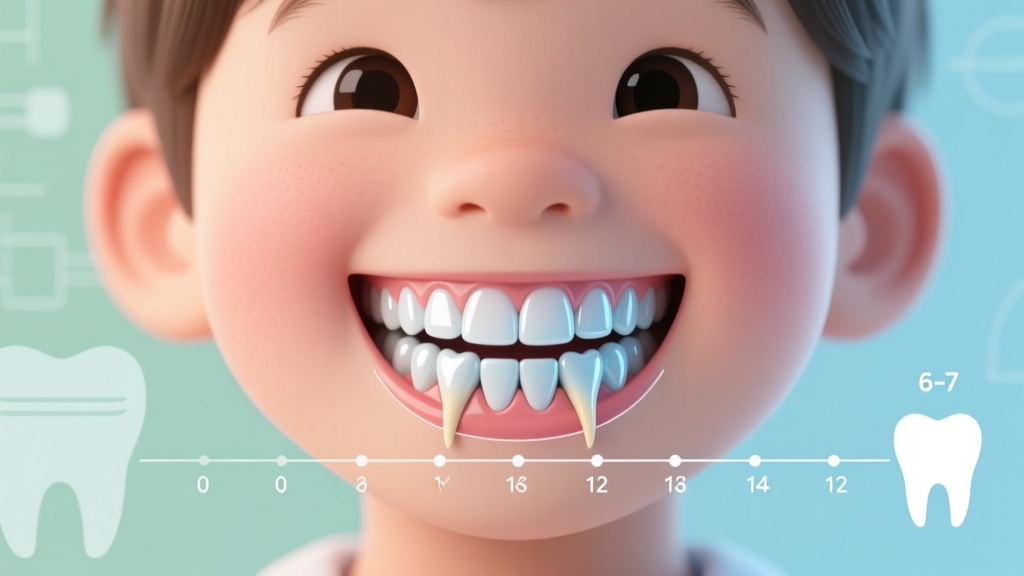
Kids' Teeth by Age: Eruption & Loss Timeline (2026)
Why This Question Matters More Than You Think Right Now
How many teeth do kids have? It’s a deceptively simple question that sparks real anxiety for parents: Is your 18-month-old behind if they only have 6 teeth? Should you worry when your 6-year-old loses a front tooth but hasn’t grown a permanent one yet? Or wonder whether crowded baby teeth mean braces are inevitable? Understanding the exact number—and timing—of children’s teeth isn’t just trivia; it’s a vital window into oral development, nutrition, speech acquisition, and even systemic health. According to the American Academy of Pediatrics (AAP), dental development is one of the most closely tracked pediatric milestones—and yet, nearly 42% of parents misidentify normal eruption patterns, leading to unnecessary stress or delayed intervention. Let’s cut through the confusion with science-backed clarity.
The Two Sets Explained: Deciduous vs. Permanent Dentition
Children develop two complete sets of teeth in their lifetime: the primary (deciduous or ‘baby’) teeth and the permanent (secondary) teeth. These aren’t just smaller versions of adult teeth—they serve distinct biological and functional roles. Primary teeth begin forming in utero around week 6 of pregnancy and start erupting between 4–12 months after birth. Their main jobs? Supporting jawbone growth, guiding permanent teeth into position, enabling chewing for nutrient-dense foods, and laying the groundwork for speech articulation (try saying “th” or “s” without incisors!).
Permanent teeth begin developing before birth too—but their mineralization accelerates around age 3–4, and eruption starts around age 6. Unlike primary teeth, which are fully present by age 3, permanent teeth emerge gradually over more than a decade. Crucially, the total count differs: children have 20 primary teeth, but will eventually develop 32 permanent teeth—including the four wisdom teeth that typically emerge between ages 17–25 (if at all).
Here’s what often trips parents up: those 20 baby teeth don’t all appear at once—and they don’t fall out in the same order they came in. In fact, the lower central incisors usually erupt first (around 6–10 months), but the lower lateral incisors may follow just weeks later—while the upper first molars might not break through until 13–19 months. That variability is normal—but knowing the expected windows helps spot true outliers.
Eruption & Exfoliation: The Real-World Timeline (Not Just Textbook Theory)
Let’s move beyond averages. Real-world data from the National Institute of Dental and Craniofacial Research (NIDCR) shows wide variation: 95% of children get their first tooth between 4–15 months. That’s an 11-month range! So while textbooks say “6 months,” your child’s first tooth at 14 months is still well within typical development—if other milestones (like sitting unassisted, babbling, responding to names) are on track.
What matters more than exact timing is sequence consistency. Pediatric dentists watch for predictable patterns—not rigid deadlines. For example, if a child gets their upper lateral incisors before their lower central incisors, that’s a mild deviation. But if they erupt four molars before any incisors? That warrants evaluation for underlying conditions like hypophosphatasia or cleidocranial dysplasia.
Here’s how exfoliation (tooth loss) actually works: It’s not random. Root resorption—the natural breakdown of baby tooth roots—begins months before the tooth wiggles. That’s why some kids lose teeth with zero discomfort, while others experience gum swelling or mild fever (a sign of active immune response, per Dr. Sarah Lin, pediatric dentist and AAP Oral Health Section advisor). And contrary to myth, losing baby teeth early (before age 5) doesn’t automatically cause crowding—unless there’s premature loss due to decay or trauma, which *can* shift adjacent teeth into the gap.
When to Worry: 5 Red Flags Every Parent Should Know
Most dental development unfolds smoothly—but certain signs signal it’s time for a pediatric dentist visit (not just a general dentist). The AAP recommends the first dental visit by age 1 or within 6 months of the first tooth erupting. Here’s what elevates concern:
- No teeth by 18 months: While rare (<0.5% of cases), this may indicate endocrine disorders (e.g., hypothyroidism), nutritional deficiencies (severe vitamin D or calcium insufficiency), or genetic syndromes like ectodermal dysplasia.
- Teeth erupting significantly out of sequence: e.g., molars before incisors, or upper teeth appearing months before lowers—with no other explanation like thumb-sucking pressure.
- Discolored, pitted, or translucent enamel: Could point to enamel hypoplasia (often linked to prenatal infection, high fever in infancy, or fluoride excess), not just surface staining.
- Pain-free, rapid tooth loss before age 4: Especially if multiple teeth loosen simultaneously—this may reflect inflammatory conditions like juvenile periodontitis or Langerhans cell histiocytosis.
- Over-retained baby teeth past age 8 with no permanent successor visible on X-ray: Suggests congenitally missing permanent teeth (most common with lateral incisors or second premolars)—affecting 2–10% of children, per a 2023 Journal of Clinical Pediatric Dentistry meta-analysis.
Pro tip: Don’t wait for pain. Early intervention—like space maintainers after premature loss—can prevent orthodontic complications down the line. As Dr. Lin emphasizes: “We’re not just counting teeth. We’re mapping a child’s lifelong oral architecture.”
What the Numbers Really Mean: A Developmental Care Timeline Table
| Age Range | Typical # of Primary Teeth | Key Eruption Events | Developmental Significance | Parent Action Step |
|---|---|---|---|---|
| 0–6 months | 0 | Teeth forming under gums; no eruption | Jaw growth supports future alignment; maternal nutrition (esp. vitamin D, calcium) influences enamel quality | Start prenatal vitamins with 600 IU vitamin D; avoid sugary drinks in bottles |
| 6–12 months | 2–8 | Lower central incisors first (6–10 mo); upper centrals follow (8–12 mo) | First bite-sized solids possible; chewing builds jaw muscles critical for speech | Begin brushing with rice-grain-sized fluoride toothpaste; schedule first dental visit |
| 12–24 months | 8–16 | Laterals, first molars, canines erupt; full set often complete by 33 months | Speech sounds like /t/, /d/, /n/ emerge; chewing efficiency impacts iron absorption from meats | Transition to sippy cup by 24 months; limit juice to 4 oz/day max (AAP guideline) |
| 2.5–6 years | 20 (full primary set) | All 20 teeth typically present; spacing (“primate spaces”) appears naturally | Spacing allows room for larger permanent teeth; crowding at this stage predicts future orthodontic need | Assess spacing at age 4–5; consult orthodontist if no gaps between front teeth |
| 6–12 years | Gradually 20 → 28 (by age 12) | “Mixed dentition”: baby teeth exfoliate as permanents erupt (lower incisors first, then first molars, laterals, etc.) | Permanent first molars (age 6) lack baby predecessors—often missed in hygiene, leading to 60% of childhood cavities | Use disclosing tablets to check brushing coverage; sealants on first molars by age 7 |
Frequently Asked Questions
Do all kids get exactly 20 baby teeth?
Yes—virtually all neurotypical children develop exactly 20 primary teeth: 10 in the upper arch (4 incisors, 2 canines, 4 molars) and 10 in the lower arch (same configuration). Congenitally missing primary teeth are extraordinarily rare (<0.1% of cases) and usually associated with syndromes like Down syndrome or cleft lip/palate. If your child has fewer than 20 by age 3.5, a panoramic X-ray can confirm presence of unerupted teeth or true absence.
Why do some kids have 24 teeth at age 7?
This is completely normal—and actually ideal. By age 7, most children have lost their lower central incisors and gained permanent replacements, while retaining their full set of primary molars and canines. Add the four permanent first molars (two upper, two lower), and you get 20 – 2 (lost incisors) + 2 (new permanents) + 4 (first molars) = 24 teeth. This “24-tooth window” signals healthy mixed dentition and proper sequencing.
Can baby teeth come in crooked? Does that mean braces later?
Baby teeth often appear slightly rotated or spaced—especially upper lateral incisors, which commonly flare outward. This is rarely a concern: primary teeth act as “space holders,” and jaw growth between ages 3–6 often self-corrects alignment. True predictors of future orthodontic need include crossbites (upper teeth inside lowers), severe crowding with no spacing, or persistent thumb-sucking past age 4. The AAP advises orthodontic screening by age 7—not because treatment starts then, but to identify issues requiring Phase I intervention (e.g., palate expanders).
What if my child’s permanent tooth comes in behind the baby tooth?
This “shark tooth” phenomenon is common (affects ~30% of kids) and usually resolves spontaneously. The permanent incisor erupts lingually (behind) the baby tooth because its root hasn’t fully resorbed yet. Encourage wiggling the loose baby tooth—but never force extraction. If the baby tooth remains firm after 2–3 months, or the permanent tooth is >50% erupted, see a pediatric dentist. They’ll assess root resorption via X-ray and extract only if needed—preserving the baby tooth’s function until natural exfoliation is imminent.
Are gaps between baby teeth normal?
Absolutely—and essential. Those “ugly gaps” (especially between upper front teeth) are called “primate spaces” and “leeway space.” They’re nature’s built-in orthodontic planning: primary teeth are smaller than permanent ones, so spacing ensures room for larger successors. Children with tightly spaced baby teeth at age 4–5 have a 70% higher likelihood of needing braces, according to a longitudinal study in the American Journal of Orthodontics and Dentofacial Orthopedics. So celebrate the gaps!
Common Myths Debunked
Myth 1: “More teeth earlier means smarter development.”
False. Teething timing correlates weakly with cognitive milestones—and more strongly with genetics and ethnicity. A 2022 cohort study of 2,100 infants found no association between first tooth timing and IQ at age 5. Early eruption (e.g., at 3 months) is sometimes linked to familial patterns or thyroid hormone variations—not intelligence.
Myth 2: “If baby teeth get cavities, it doesn’t matter—they’ll fall out anyway.”
Dangerously false. Untreated decay in primary teeth increases cavity risk in permanent teeth by 300%, per CDC data. Why? Bacteria like Streptococcus mutans colonize the entire oral microbiome—and inflamed gums impair permanent tooth development. Plus, infected baby molars can damage developing permanent tooth buds underneath.
Related Topics (Internal Link Suggestions)
- When to start brushing baby teeth — suggested anchor text: "first tooth brushing guide"
- Best fluoride toothpaste for toddlers — suggested anchor text: "toddler fluoride toothpaste safety"
- Signs of toddler tooth decay — suggested anchor text: "early childhood caries symptoms"
- Pediatric dentist vs. family dentist — suggested anchor text: "when to see a pediatric dentist"
- How to soothe teething pain naturally — suggested anchor text: "safe teething remedies for babies"
Your Next Step Starts Today
Now that you know exactly how many teeth kids have—and when, why, and how each milestone connects to their broader health—you’re equipped to move from worry to proactive care. Don’t wait for the first wiggly tooth or a cavity scare. Download our free Child’s Dental Development Tracker (with eruption charts, brushing checklists, and red-flag alerts), or book a no-pressure consult with a board-certified pediatric dentist using our provider finder tool. Because understanding your child’s smile isn’t about counting teeth—it’s about safeguarding their confidence, nutrition, and lifelong well-being, one healthy tooth at a time.
More Articles
 Who Did Eminem Have a Kid With? Co-Parenting Truths
 How Many Kids Does Gene Simmons Have? (2026)
 Beyoncé’s Kids Ages and Privacy in 2026
 Is Hazbin Hotel for Kids? Expert Analysis (2026)
 Are Kids Free on Royal Caribbean Cruises? (2026)
 Motrin & Tylenol for Kids: Safe Alternating Protocol (2026)
 First Dentist Visit for Kids: When & Why It Matters
 Can Kids See Scream 7? A Parent’s Research Guide
 Are Sour Patch Kids Halal? (2026)
 UTI Causes in Kids: Prevention & Early Signs