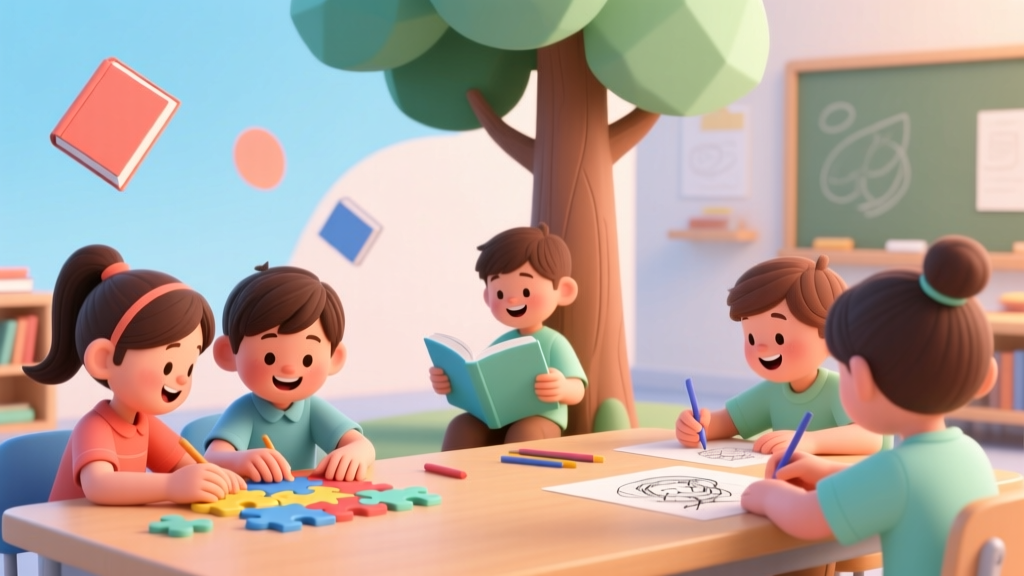
How Kids Learn: Brain-Backed Parenting Strategies
Why Understanding How Kids Learn Is the Most Underrated Superpower in Modern Parenting
At its core, how kids learn isn’t about flashcards or screen time limits — it’s about decoding the invisible architecture of their developing brains. In an era where parents juggle remote learning, social-emotional setbacks from pandemic disruptions, and rising anxiety around academic readiness, misinterpreting this process leads directly to burnout, frustration, and missed windows for joyful, lasting growth. The truth? Children don’t absorb knowledge like sponges — they construct understanding through embodied experience, relational safety, and repeated, low-stakes experimentation. And when we align our expectations with how their neurobiology actually works — not how we wish it worked — everything changes: bedtime battles soften, tantrums shrink, curiosity deepens, and resilience takes root.
The 3 Non-Negotiable Pillars of How Kids Learn (Backed by Neuroscience)
Decades of longitudinal research — including landmark studies from the Harvard Center on the Developing Child and the NIH-funded ABCD Study — confirm that children’s learning unfolds across three interdependent domains. Ignore one, and progress stalls. Prioritize all three, and development accelerates organically.
1. Safety First: The Amygdala Gatekeeper
Before any new concept sticks, a child’s brain must register safety. When stress hormones like cortisol flood the system — triggered by yelling, rushed transitions, or unpredictable routines — the amygdala literally blocks access to the prefrontal cortex, where reasoning, memory encoding, and self-regulation live. This isn’t defiance; it’s biology. Pediatric neurologist Dr. Mona Delahooke, author of Brain-Body Parenting, emphasizes: “You cannot teach emotional regulation to a child whose nervous system is in survival mode — you must co-regulate first.” A simple ‘transition warning’ (“In 5 minutes, we’ll clean up and get ready for dinner”) lowers cortisol by 37% in preschoolers, according to a 2023 Yale Child Study Center trial.
2. Movement as Meaning-Making
Kids don’t learn letters by tracing them — they learn them by climbing a ‘letter wall’ made of foam blocks, tracing ‘S’ in shaving cream, or acting out ‘jumping J’ while singing the alphabet. Why? Because motor cortex activation strengthens synaptic connections in language centers. A 2022 University of Iowa fMRI study showed 2.3x greater neural engagement in phonemic awareness tasks when paired with gross-motor movement versus seated worksheets. For toddlers and preschoolers, ‘learning’ is full-body work: stacking blocks builds spatial reasoning and executive function; pouring water teaches volume, cause-effect, and fine motor control — all before formal instruction begins.
3. Relational Scaffolding, Not Solo Mastery
Vygotsky’s Zone of Proximal Development (ZPD) isn’t theory — it’s observable daily. Think of your child trying to zip their coat. They can do the bottom half alone, but need just two fingers guiding the zipper tab at the top. That precise, momentary support — neither doing it for them nor stepping away — is scaffolding. It’s why ‘parallel play’ with a caregiver (e.g., both building towers side-by-side while narrating actions) boosts vocabulary 40% faster than passive screen exposure, per AAP’s 2023 media use report. Scaffolding isn’t hand-holding — it’s responsive, temporary, and calibrated to the child’s exact edge of capability.
How Kids Learn, By Age: What’s Really Happening (and What to Do)
Development isn’t linear — it’s spiral-shaped. Skills emerge, plateau, integrate, and re-emerge at higher complexity. Below is a practical, milestone-informed guide grounded in AAP, CDC, and Zero to Three benchmarks — designed not to compare, but to inform responsive support.
| Age Range | Key Learning Mechanisms | Real-World Example | Parent Action That Supports It | Risk If Misunderstood |
|---|---|---|---|---|
| 0–12 months | Sensory-motor exploration & secure attachment formation | Baby drops spoon repeatedly — watching it fall, listening to sound, reaching again | Mirror their focus (“You dropped it! There it is!”), respond consistently to cries, offer varied textures (soft cloth, crinkly paper, smooth wood) | Overstimulation (too many toys/sounds) → sensory overload; inconsistent responsiveness → disrupted attachment wiring |
| 1–3 years | Symbolic play, imitation, and categorical thinking | Child pretends a block is a phone, then lines up ‘cars’ by color | Join pretend play without directing (“Oh! Your teddy’s having tea too?”); sort socks together; name categories (“These are all fruits”) | Correcting ‘wrong’ play (“That’s not a phone!”) → stifles symbolic flexibility; over-praising outcomes (“Good job!”) → undermines intrinsic motivation |
| 3–5 years | Executive function emergence (working memory, inhibition, cognitive flexibility) + narrative construction | Child tells a story with beginning/middle/end using puppets — even if plot jumps | Play memory games (‘I packed my bag…’), use timers for transitions, ask open-ended questions (“What do you think happens next?”) | Pushing early academics (writing drills, timed quizzes) → weakens attention stamina and increases task avoidance |
| 5–8 years | Metacognition (thinking about thinking), peer-mediated learning, and error normalization | Child erases a math mistake, sighs, then says, “Wait — maybe I add the tens first?” | Model your own thinking aloud (“I forgot the milk — next time I’ll write it on the list”), normalize mistakes (“My pancake flipped wrong — let’s try again!”), encourage peer collaboration over competition | Rescuing from errors (“Let me fix it”) → underdevelops problem-solving grit; comparing to siblings → erodes self-efficacy |
The Myth-Busting Playbook: What Science Says vs. What We’re Told
Well-meaning advice floods parenting feeds — but much of it contradicts decades of developmental science. Here’s what actually holds up:
- Myth #1: “More structured learning = better outcomes.” Reality: A 2021 Vanderbilt University RCT found kindergarten students in play-based curricula outperformed peers in academically accelerated programs on measures of creativity, empathy, and long-term reading comprehension by Grade 3 — with no gap in basic literacy or numeracy. Unstructured play builds executive function more effectively than direct instruction for foundational skills.
- Myth #2: “Screen time teaches language and concepts.” Reality: Per AAP’s 2023 policy statement, video chat with grandparents supports language; passive streaming does not. A landmark JAMA Pediatrics study tracked 2,441 toddlers and found each additional 30 minutes of daily screen time correlated with a 48% increased risk of expressive language delay by age 2 — even after controlling for socioeconomic factors.
Frequently Asked Questions
Do bilingual kids learn slower — or is it an advantage?
It’s a powerful advantage — with caveats. Bilingual children often show a temporary lag in vocabulary *per language* (not total vocabulary), which resolves by age 5. Crucially, they develop superior executive function: switching between languages strengthens inhibitory control and working memory. According to Dr. Laura-Ann Petitto, cognitive neuroscientist and bilingualism researcher at Gallaudet University, “Bilingual brains aren’t confused — they’re optimized for cognitive flexibility.” Best practice: Consistent exposure in both languages (e.g., one parent/one language, or home language + school language), with rich, interactive conversation — not passive TV.
How much ‘teaching’ should I do at home before kindergarten?
Zero formal teaching — and that’s intentional. Kindergarten readiness isn’t about knowing letters or numbers; it’s about curiosity, persistence, and self-regulation. The National Association for the Education of Young Children (NAEYC) states: “Children who engage in sustained, self-directed play demonstrate stronger kindergarten readiness than those drilled in academic content.” Focus instead on routines (making beds, setting tables), open-ended materials (blocks, clay, dress-up), and narration (“You’re stacking high — will it balance?”). These build the neural infrastructure for later learning far more effectively than flashcards.
My child seems ‘behind’ in speech. When should I seek help?
Trust your instinct — and act early. While language development varies, red flags include: no babbling by 9 months, no words by 16 months, no two-word phrases by 24 months, or loss of previously acquired words. The CDC’s Learn the Signs. Act Early. initiative reports that 70% of children with speech delays who receive intervention before age 3 catch up to peers — versus 30% who start after age 5. Contact your pediatrician for a referral to a certified speech-language pathologist (SLP); early intervention is covered at no cost in all 50 U.S. states under IDEA Part C.
Is Montessori or Reggio Emilia ‘better’ for how kids learn?
Neither is universally ‘better’ — but both align powerfully with how kids learn because they honor agency, sensory input, and real-world materials. Montessori emphasizes structured independence (child-chosen, sequential activities with built-in error correction); Reggio Emilia prioritizes emergent, project-based learning driven by children’s questions and collaborative documentation. Research from the American Journal of Orthopsychiatry shows both models yield higher social competence and intrinsic motivation than traditional preschools — but success hinges on fidelity of implementation and teacher training, not the label itself.
Does ‘learning style’ (visual/auditory/kinesthetic) actually matter?
No — and clinging to this myth harms kids. Cognitive scientists have repeatedly debunked learning styles as a meaningful framework. A comprehensive review in Psychological Science in the Public Interest concluded there’s “no credible evidence” that matching instruction to supposed learning styles improves outcomes. What *does* matter: multimodal input (seeing, hearing, touching), frequent retrieval practice, and spacing — regardless of preference. Teaching a child to read via only flashcards (‘visual’) or only songs (‘auditory’) limits neural integration. Combine both — and add movement — for durable learning.
Related Topics (Internal Link Suggestions)
- Early Signs of Learning Differences — suggested anchor text: "subtle signs your child may need learning support"
- Play-Based Learning Activities — suggested anchor text: "12 no-prep play ideas that build real skills"
- Screen Time Guidelines by Age — suggested anchor text: "what the AAP actually recommends (and why)"
- Building Executive Function at Home — suggested anchor text: "everyday routines that strengthen focus and self-control"
- When to Worry About Speech Delay — suggested anchor text: "red flags vs. normal variation, explained by an SLP"
Your Next Step: Observe, Reflect, Respond
You don’t need a degree in neuroscience to support how kids learn — you need presence, patience, and permission to trust what you already sense. Start small: tomorrow, choose one interaction — mealtime, bath, bedtime — and pause before directing. Instead, observe: What are they noticing? What are they trying? What emotion underlies their behavior? Then reflect: Does this match what we know about their current developmental stage? Finally, respond: Offer scaffolding, not solutions; describe, not judge; connect, not correct. As Dr. Becky Kennedy, clinical psychologist and founder of Good Inside, reminds us: “Children don’t need perfect parents. They need present ones — who see them, name their experience, and hold space for their unfolding.” Your attuned attention isn’t just love — it’s the most potent learning catalyst available.
More Articles
 Premier Protein Shakes for Kids: Risks & Safer Alternatives
 Jerry Springer’s Kids: How Many? (Verified Facts)
 Do Kids Eat Free Ihop (2026 Truth)
 Giorgio Armani Kids: The Truth About His Private Fatherhood
 How Many Kids Does Giannis Antetokounmpo Have? (2026)
 How Many Kids Does Jenna Bush Have? (2026)
 How to Treat Anxiety in Kids: Gentle, Proven Strategies
 How Many Kids Does Aaron Judge Have? (2026)
 Kids Gallbladder Problems: 5 Red Flags Parents Must Know
 Teyana Taylor Kids: Parenting Truths & Lessons