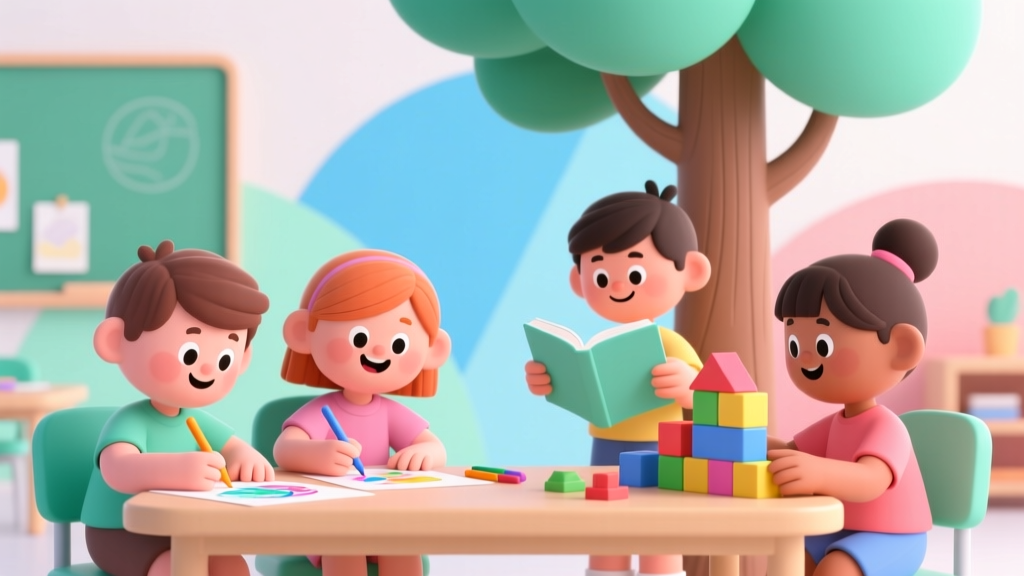
How Kids Learn Best: Science-Backed Truths (2026)
Why This Question Matters More Than Ever Right Now
How do kids learn best isn’t just a philosophical question — it’s the quiet crisis behind rising parental burnout, early academic stress, and declining curiosity in children ages 3–10. In an era of hyper-scheduled enrichment classes, algorithm-driven apps, and kindergarten ‘readiness’ checklists, parents are exhausting themselves trying to optimize learning — often without knowing what the science actually says. The truth? Kids don’t learn best through repetition, rote drills, or passive screen time. They learn best when their brains, bodies, emotions, and environments work together in ways that feel safe, meaningful, and intrinsically motivating. And the good news? You don’t need expensive kits, lesson plans, or teaching credentials — just awareness, presence, and small, intentional shifts rooted in decades of child development research.
The Science Behind How Kids Learn Best: It’s Not What You Think
Contrary to popular belief, young children’s brains aren’t miniature adult brains waiting to be ‘filled.’ Neuroscientist Dr. Adele Diamond, whose pioneering work on executive function appears in over 200 peer-reviewed studies, explains that learning happens through embodied experience — not instruction. When a 4-year-old stacks blocks, they’re not just practicing fine motor skills; they’re building prefrontal cortex connections for planning, inhibition, and working memory. When a 7-year-old negotiates rules during backyard soccer, they’re wiring neural pathways for perspective-taking and conflict resolution — far more complex than memorizing spelling lists.
This is why the American Academy of Pediatrics (AAP) explicitly recommends unstructured, play-based learning as the optimal foundation for early cognition, especially before age 8. Their 2023 policy statement reaffirms that ‘play is not frivolous — it is the work of childhood,’ citing longitudinal data showing children with rich play experiences demonstrate stronger language acquisition, emotional regulation, and academic resilience through adolescence.
Here’s the key insight: How kids learn best is fundamentally tied to three interlocking systems — neurobiological (brain development), relational (secure attachment and responsive interaction), and environmental (sensory-rich, predictable, low-threat spaces). Ignore any one, and learning stalls — no matter how ‘educational’ the toy or app claims to be.
The 4 Learning Pathways That Actually Work (and How to Activate Them Daily)
Forget ‘learning styles’ — that myth has been thoroughly debunked by cognitive psychologists (see the 2020 meta-analysis in Educational Psychology Review). Instead, developmental science identifies four high-leverage, biologically supported pathways. Use them intentionally — and you’ll see measurable shifts in focus, retention, and joy within 2–3 weeks.
1. The Movement-Memory Loop
Kids encode information deeply when movement is integrated. Why? Because motor cortex activation boosts hippocampal blood flow — literally fueling memory consolidation. A landmark 2022 University of Illinois study found kindergarteners who learned letter sounds while jumping, clapping, or tracing in sand retained 68% more than peers using worksheets alone.
Actionable tip: Turn routine tasks into kinesthetic moments. Spell words while stepping forward/backward on floor tape. Count by 3s while tossing a beanbag. Practice sight words by writing them in shaving cream on a tray. No prep needed — just intentionality.
2. The ‘Teach-Back’ Effect
When children explain concepts in their own words — even to a stuffed animal — they activate metacognitive networks. This isn’t about perfection; it’s about retrieval practice. As Dr. Robert Bjork, UCLA cognitive psychologist, states: ‘Explaining strengthens neural traces far more than re-reading or highlighting.’
Actionable tip: After reading a story, ask: ‘If you were the teacher, how would you tell this to your baby cousin?’ Or after a nature walk: ‘What’s one thing you noticed that surprised you — and why do you think it happened?’ Listen without correcting; prompt with ‘Tell me more’ instead of ‘That’s right!’
3. The Predictable Uncertainty Principle
Children thrive when routines provide safety and novelty introduces manageable challenge. Too much predictability breeds boredom; too much chaos triggers cortisol spikes that shut down learning. Think of it like scaffolding: consistent structure (same bedtime ritual, same ‘clean-up song’) creates security — then layer in gentle surprises (‘Today, let’s sort buttons by texture instead of color’).
Actionable tip: Build ‘micro-variations’ into daily anchors. Same snack time → new way to serve (bento box vs. muffin tin). Same walk route → ‘I spy’ game focused on sounds only. Same art supplies → challenge: ‘Make something that wobbles.’
4. The Co-Regulation Catalyst
Learning doesn’t happen in isolation — it’s co-created. When a caregiver stays calm during a child’s frustration (e.g., struggling with a puzzle), their regulated nervous system literally helps the child’s amygdala settle. This is called ‘interpersonal neurobiology,’ and it’s why responsive, attuned interaction is the single strongest predictor of academic success — stronger than family income or parental education level (Harvard Center on the Developing Child, 2021).
Actionable tip: Next time your child melts down over homework, pause. Breathe. Say: ‘This feels really hard right now. I’m here.’ Then wait 10 seconds before offering help. Your presence — not your solution — is the learning accelerator.
What Works (and What Doesn’t): An Age-Appropriate Guide to Real Learning
One-size-fits-all advice fails because brain development isn’t linear — it’s stage-specific. Below is a research-backed guide to aligning your support with your child’s current neurological readiness. Based on NAEYC (National Association for the Education of Young Children) benchmarks and Montessori developmental timelines, this table helps you spot mismatched expectations — the #1 source of friction in home learning.
| Age Range | Brain Development Priority | What Truly Supports Learning | What Often Backfires | Real-World Example |
|---|---|---|---|---|
| 2–4 years | Sensory integration & impulse control | Open-ended materials (sand, water, fabric scraps), parallel play, rhythmic songs with gestures | Workbooks, timed tasks, ‘sit still’ demands, excessive screen time | A 3-year-old learns volume concepts by pouring rice between containers — not by coloring ‘big/small’ worksheets. |
| 5–7 years | Executive function foundations (working memory, flexible thinking) | Games with rules (Uno, Red Light/Green Light), storytelling with props, cooking with measured steps | Long lectures, abstract math drills, multi-step verbal instructions without visual cues | A 6-year-old masters sequencing by baking cookies — cracking eggs, mixing, scooping — not by reciting number order. |
| 8–10 years | Metacognition & collaborative problem-solving | Family decision-making (‘How should we plan our weekend?’), design challenges (build a bridge from straws), peer teaching | Isolated worksheet practice, over-correction of ‘wrong’ answers, comparison to siblings/classmates | A 9-year-old grasps fractions by dividing pizza for a pretend party — then explaining their method to a younger sibling. |
Frequently Asked Questions
Does screen time help kids learn — or hurt?
It depends entirely on how it’s used — not just duration. High-quality, interactive co-viewing (e.g., watching a nature documentary together, pausing to ask questions and connect to real-life observations) can spark curiosity. But passive, solo consumption — especially fast-paced, algorithm-driven content — disrupts attention regulation and reduces verbal interaction, which is critical for language development. According to AAP guidelines, children under 18 months should avoid screens entirely (except video-chatting), and for ages 2–5, limit to 1 hour/day of high-quality programming with active adult engagement. The key isn’t banning screens — it’s reclaiming agency over when, why, and how they enter your child’s learning ecosystem.
My child hates ‘learning time.’ Is something wrong?
No — and this is vital to understand. What feels like resistance is often your child’s nervous system signaling overload, mismatch, or disconnection. Developmental psychologist Dr. Laura Markham reminds us: ‘When a child shuts down, it’s rarely defiance — it’s distress.’ Before assuming motivation issues, ask: Is the task developmentally appropriate? Is there physical discomfort (hunger, fatigue, sensory sensitivity)? Is the environment overly stimulating or emotionally unsafe? Try shifting from ‘Let’s learn letters’ to ‘Let’s find all the round things in the kitchen’ — same skill, zero pressure. Curiosity returns when autonomy and safety return.
Do learning styles (visual/auditory/kinesthetic) matter?
No — and this is one of the most persistent, harmful myths in parenting. Over 90 peer-reviewed studies have failed to find evidence that matching instruction to supposed ‘learning styles’ improves outcomes. What does matter is multi-sensory engagement: combining seeing, hearing, touching, and moving activates broader neural networks and builds stronger memory traces. So instead of asking ‘Is my child visual or auditory?,’ ask ‘How can I involve more senses in this concept?’ — e.g., spelling words by tracing in salt (touch + sight), saying them aloud (sound), and acting out their meaning (movement).
How much ‘academics’ should preschoolers do?
Zero formal academics — and that’s backed by global evidence. Finland, consistently ranked #1 in global education outcomes, starts formal reading instruction at age 7. Their secret? Rich play, outdoor time, and social-emotional coaching in preschool. Research shows that pushing early academics doesn’t create long-term advantage — it often leads to increased anxiety, decreased intrinsic motivation, and higher dropout rates later. What matters pre-K is vocabulary exposure (conversational richness), self-regulation (waiting turns, managing big feelings), and narrative skills (telling stories). These are the true predictors of future literacy — and they’re built at the dinner table, in the park, and during bath time — not at a desk.
Debunking 2 Common Myths About How Kids Learn Best
- Myth #1: “More practice = better learning.” Repetition without variation leads to shallow, inflexible knowledge. Cognitive scientists call this ‘overlearning’ — it feels productive but creates fragile memory. The brain learns best through spaced, interleaved, and varied practice. Example: Instead of 20 identical addition problems, mix in subtraction, use dice, draw pictures, and solve real-world problems (‘We need 3 apples each — how many total?’).
- Myth #2: “Smart kids learn faster — so I should push harder.” Intelligence isn’t fixed speed — it’s neuroplasticity in action. Dr. Carol Dweck’s growth mindset research proves that praising effort (“You kept trying different ways!”) — not outcome (“You’re so smart!”) — builds resilience and deeper learning. Children praised for intelligence avoid challenges; those praised for process embrace difficulty as growth fuel.
Related Topics (Internal Link Suggestions)
- Signs of Learning Differences in Early Childhood — suggested anchor text: "early signs your child learns differently"
- Montessori Principles for Home Learning — suggested anchor text: "Montessori-inspired activities at home"
- Screen Time Guidelines by Age — suggested anchor text: "healthy screen time for toddlers and kids"
- Play-Based Math Activities — suggested anchor text: "math games that don’t feel like math"
- Building Executive Function Skills — suggested anchor text: "how to strengthen focus and self-control"
Your Next Step: One Tiny Shift That Changes Everything
You don’t need to overhaul your schedule, buy new materials, or become a homeschool teacher to honor how kids learn best. Start with one 5-minute daily experiment: Replace one ‘teaching moment’ with a ‘noticing moment.’ Instead of saying ‘That’s a triangle,’ try ‘I notice three straight sides that meet at points — what else has that shape?’ Instead of correcting a misspelled word, ask ‘Which part felt tricky? Let’s say it slowly together.’ This tiny pivot — from directing to wondering — signals deep respect for your child’s mind, activates their curiosity, and builds the very neural pathways that make learning stick. Try it for three days. Notice what changes — in their engagement, your stress, and the quiet joy of discovery that was always there, waiting for space to grow.
More Articles
 How to Teach Kids to Swim: A Pediatrician-Backed Guide
 Missing Kids in Virginia: Facts & Safety Steps (2026)
 How Many Kids Does Catherine Paiz Have? (2026)
 7-Day School Reset Plan for Calm Mornings (2026)
 Does Morgan Wallen Have a Kid? Fatherhood Truths (2026)
 Do Brenda and Fritz Have Kids? The Truth (2026)
 Melatonin for Kids: What Pediatric Experts Say
 Autistic Hand-Walking: Meaning & Support Tips
 How Old Are Nancy Guthrie’s Kids? Grief & Faith Context
 When Can Kids Ride in Booster Seat? (2026)