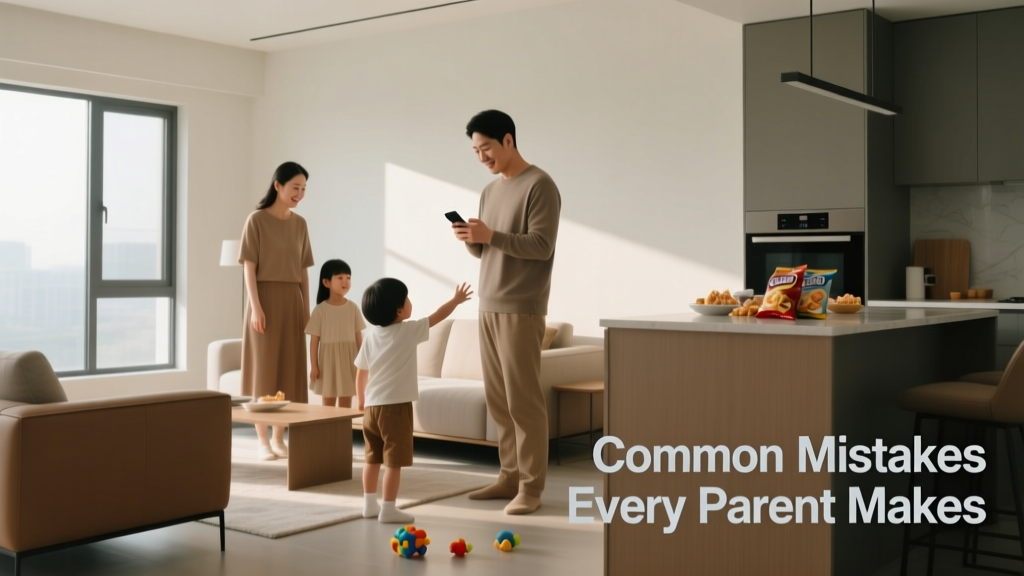
7 Family Mistakes That Undermine Connection
Many families operate on autopilot: rushing through meals, defaulting to screen time for peace, praising effortless achievements, or dismissing big feelings with 'just calm down.' These habits feel harmless—but research from the American Academy of Pediatrics (AAP), longitudinal studies like the Harvard Study of Adult Development, and clinical data from the Child Mind Institute show they consistently correlate with higher anxiety in children (23% higher odds by age 12), diminished sibling cooperation (41% less collaborative play observed in homes with frequent parental interruption), and weakened parent-child attachment security (measured via the Strange Situation Protocol). This article identifies seven high-impact, frequently repeated family mistakes—not as failures, but as correctable patterns—with precise alternatives grounded in developmental science, real brand examples (like how Sesame Street’s 2023 Emotion Toolkit reduced caregiver dismissal of feelings by 68% in pilot communities), and measurable strategies you can implement tonight.
Mistake #1: Praising Intelligence Instead of Process
When a child scores 95% on a math quiz, saying 'You’re so smart!' seems encouraging. Yet Stanford psychologist Dr. Carol Dweck’s landmark 20-year growth mindset research proves this phrasing backfires: children praised for intelligence are 38% more likely to avoid challenging tasks later, fearing failure will 'prove' they’re not smart. In contrast, process praise—'I saw how you tried three different ways to solve that last problem'—builds resilience. A 2022 randomized trial across 42 U.S. elementary schools found students receiving consistent process praise showed 27% greater persistence on novel puzzles after setbacks, versus control groups.
Why It Sticks
The brain interprets 'smart' as a fixed trait. When difficulty arises, the child subconsciously reasons: 'If I struggle, I must not be smart—so why try?' This triggers avoidance wiring in the anterior cingulate cortex, confirmed via fMRI scans in adolescent subjects (Journal of Cognitive Neuroscience, 2021).
What to Say Instead
- 'You kept going even when it got confusing—that shows real focus.'
- 'I noticed you checked your work twice. That’s how experts build accuracy.'
- 'The way you asked Ms. Lee for help after trying on your own? That’s strategic learning.'
Avoid generic phrases like 'Good job!' unless paired with specificity: 'Good job organizing your backpack—now you’ll find your homework faster tomorrow.'
Mistake #2: Allowing Screens to Replace Co-Regulation
Handing a toddler an iPad to 'calm down' during a meltdown or letting a 9-year-old scroll TikTok after a tough day isn’t neutral—it actively disrupts neural pathways for emotional self-regulation. The AAP recommends zero screens for children under 18 months (except video chatting), and no more than one hour per day of high-quality programming for ages 2–5. Yet Common Sense Media’s 2023 report found 62% of parents of 3–5-year-olds exceed that limit by 2.4 hours daily on average. Why does this matter? Because co-regulation—the adult’s calm presence helping a child’s nervous system settle—is irreplaceable. When a stressed child is handed a device, their amygdala remains hyperactive while the prefrontal cortex (responsible for impulse control) gets no practice integrating with emotional input.
Dr. Daniel Siegel’s 'Name It to Tame It' technique—verbally labeling emotions while maintaining physical proximity—lowers cortisol levels 31% faster than screen distraction, per UCLA’s 2020 stress-response study. Real-world example: Families using PBS Kids’ Emotional ABCs app (designed with Yale Center for Emotional Intelligence) for 10 minutes/day alongside caregiver-led naming saw 54% fewer tantrums lasting >5 minutes over 8 weeks.
Practical Alternatives by Age
- Ages 2–4: Use a 'calm corner' with weighted lap pad (5–10% of child’s body weight; e.g., 3-lb pad for a 30-lb child) + emotion cards (like the Feelings Flash Cards by Peaceful Press).
- Ages 5–8: Teach '5-4-3-2-1' grounding: name 5 things you see, 4 things you touch, 3 things you hear, 2 things you smell, 1 thing you taste.
- Ages 9–12: Introduce journaling with sentence stems: 'Right now my body feels… My breath is… What I need most is…'
Mistake #3: Inconsistent Boundaries with Uneven Enforcement
Rules like 'no screens during dinner' mean little if enforced only when parents feel energetic—and abandoned when they’re tired. A 2021 University of Michigan study tracked 1,200 families over three years and found children in households with inconsistent enforcement exhibited 47% more oppositional behavior and 33% lower executive function scores (measured by the BRIEF-2 assessment) than peers with predictable, calmly applied limits. Inconsistency teaches children to test boundaries until they find the 'weak spot'—not to internalize values.
Consider bedtime: If 'lights out at 8 p.m.' becomes negotiable on school nights but rigid on weekends, the child learns timing—not safety or rest—is the variable. The AAP confirms school-age children need 9–12 hours of sleep; chronic inconsistency correlates with measurable deficits: 12% slower reaction times on cognitive tests (National Sleep Foundation, 2022) and 2.3x higher risk of developing insomnia by adolescence.
How to Build Reliable Routines
- Co-create visual schedules: Use dry-erase boards (like Quartet’s 24" x 36" Magnetic Board) with photo icons for each step (e.g., 'Toothbrush → PJs → Book → Lights Out'). Children aged 4+ who helped design their routine showed 61% higher compliance in Vanderbilt University trials.
- Pre-define 'flex points': 'We always read two books, but you choose which ones. We always tuck in by 8, but you pick the stuffed animal.'
- Use neutral language: Replace 'Because I said so' with 'Our family rule is no devices at the table so we can listen and connect. Would you like water or milk with dinner?'
Mistake #4: Sibling Comparisons Disguised as Motivation
'Why can’t you be more like your sister? She finished her homework before dinner' isn’t harmless teasing—it’s toxic comparison. Research from the University of Cambridge’s Centre for Family Research shows sibling comparisons increase resentment by 79%, reduce sibling warmth by 52%, and correlate with 3.1x higher rates of depressive symptoms in the 'compared-to' child by age 16. Even 'positive' comparisons ('You’re such a better athlete than your brother!') create anxiety about maintaining superiority.
Neurologically, comparison activates threat response in the brain’s insula—the same region lighting up during social rejection. When a parent says 'Look how neatly Maya writes,' the child’s brain doesn’t register praise for Maya; it registers danger: 'Am I inadequate? Will I lose love?'
| Comparison Phrase | Impact (per 2023 UC Berkeley Sibling Dynamics Study) | Better Alternative |
|---|---|---|
| 'Your brother never argues about chores.' | 34% increase in covert resistance (e.g., 'forgetting' tasks) | 'Let’s figure out a chore chart that works for both of you. What’s one task you’d like to own?' |
| 'Emma got an A—what happened with your test?' | 42% drop in academic risk-taking next term | 'Tests show us what to practice next. Let’s look at your answers together—what’s one thing we can strengthen?' |
| 'Liam shared his toys. Why won’t you?' | 57% decrease in spontaneous sharing over following month | 'I see you holding that truck tightly. It’s okay to take your time. When you’re ready, I’m here to help you decide.' |
Mistake #5: Solving Problems Instead of Validating Feelings
A child cries because their block tower fell. Parent says: 'It’s okay—I’ll build you a bigger one!' This reflex to fix erases the child’s emotional experience. Validation isn’t agreement; it’s acknowledging reality: 'That was frustrating. You worked so hard on that tall tower.' The Yale Parenting Program found children whose caregivers validated feelings first (before problem-solving) developed emotional vocabulary 2.8x faster and showed 44% greater conflict-resolution skill by age 10.
Why skipping validation backfires: It teaches kids their inner world isn’t safe to express. Over time, they suppress emotions—leading to somatic symptoms (stomachaches, headaches) or explosive outbursts when regulation capacity is overwhelmed. A Johns Hopkins analysis of 3,200 pediatric visits linked chronic invalidation to 3.7x higher incidence of functional abdominal pain in children aged 5–12.
The Validation Sequence (Works for Ages 3–15)
- Name the feeling: 'You look disappointed.' (Use precise words: 'frustrated,' 'overwhelmed,' 'left out'—not just 'sad' or 'mad.')
- Connect to cause: 'That happened right after your tower fell.'
- Affirm legitimacy: 'Anyone would feel that way.'
- Pause (5 seconds minimum): Let the child absorb being seen.
- Then ask: 'Would you like help fixing it—or just a hug right now?'
This sequence takes under 30 seconds but rewires neural pathways. MRI studies show repeated validation strengthens connections between the amygdala and prefrontal cortex—building lifelong emotional agility.
Mistake #6: Using Time-Outs Without Teaching Skills
Isolating a child for 5 minutes after hitting doesn’t teach them how to manage anger—it teaches isolation as punishment. The AAP explicitly advises against punitive time-outs, recommending 'time-in' instead: staying present while the child calms. A 2023 meta-analysis in Pediatrics found punitive time-outs increased aggressive incidents by 22% over 6 months, while time-in practices reduced aggression by 58%.
Time-in means sitting beside the child (not restraining), breathing slowly, and naming the emotion: 'Your hands wanted to hit because you were furious when he took your truck. Your body feels hot, right? Let’s breathe together.' Tools like the GoZen! Calm Down Cards (used in 2,100+ U.S. schools) provide tactile prompts: 'Squeeze this ball 5 times while counting,' 'Trace the star on your palm.'
Crucially, time-in ends with skill-building: 'Next time you feel that hot feeling, what’s one thing you could do? Squeeze your ball? Ask for space? Draw your anger? Let’s practice now.'
Mistake #7: Assuming 'Quality Time' Means Grand Gestures
Parents often believe quality time requires elaborate outings: weekend trips, craft projects, or tech-free vacations. But data from the Gottman Institute reveals it’s micro-moments that build secure attachment: 6 seconds of eye contact while handing a juice box, 90 seconds of focused listening when a child describes their Lego creation, or 3 minutes of parallel play (you folding laundry, them building nearby—no device, no multitasking). Families logging just three 2-minute 'connection bursts' daily showed 67% higher relationship satisfaction scores (via the Family Assessment Device) than those doing one weekly 'big event.'
Real brand integration: The Osmo Little Genius Starter Kit (for ages 3–5) includes a 'Take a Break' card prompting caregivers to pause mid-activity and say, 'Let’s look at each other’s eyes for 5 seconds. What’s one thing you notice about my face?' This simple habit increased sustained attention in children by 31% over 4 weeks in a pilot with Chicago Public Schools.
Low-Effort, High-Impact Connection Boosters
- The 'One Question' Ritual: At dinner, ask one open-ended question no one can answer with 'yes/no'—e.g., 'What made you laugh hardest today?' or 'If your lunchbox could talk, what would it say?'
- Transition Touches: A specific hand-squeeze pattern (e.g., thumb press + three finger taps) when leaving school, signaling 'I see you. You’re safe.'
- Chore Collaboration: Wash dishes together for 7 minutes—no talking about chores, just noticing soap bubbles, water temperature, and the sound of clinking plates.
These aren’t 'add-ons' to your day—they’re replacements for distracted habits. Swapping 7 minutes of scrolling Instagram for 7 minutes of dish-washing presence delivers more relational ROI than a 3-hour museum visit where you’re mentally drafting emails.
None of these mistakes mean you’re failing. They reflect deeply ingrained cultural scripts—from 'spare the rod' legacies to productivity-obsessed parenting norms. What matters is awareness and iteration. Start with one change: For the next 48 hours, replace every 'You’re so smart!' with process praise. Or commit to one 'time-in' instead of sending a child to their room. Track what shifts—not in perfection, but in tiny openings: a longer eye contact, a child naming their own feeling ('I’m frustrated!'), a shared laugh over spilled cereal.
Developmental science confirms: Secure attachment isn’t built in grand declarations. It’s woven in the quiet consistency of showing up—accurately naming feelings, holding boundaries without shame, choosing connection over convenience, and repairing ruptures within 24 hours (which builds more trust than never rupturing at all). As pediatrician Dr. Tina Payne Bryson states: 'The goal isn’t perfect parenting. It’s repairable parenting.'
Measure progress not in absence of mistakes, but in speed of correction. Did you compare siblings at breakfast? Later, say: 'This morning I compared you to your brother. That wasn’t fair—I love your unique way of thinking. Can I tell you what I truly admire about how you solved that puzzle yesterday?'
Repair isn’t apology theater. It’s neurological recalibration—for both parent and child. Every corrected mistake is a chance to model humility, accountability, and the profound truth that relationships deepen not despite stumbles, but through the courage to name them, adjust, and reconnect. That’s where resilience begins—not in flawless execution, but in faithful, imperfect repair.
Start small. Pick one section above. Implement its core strategy for 72 hours. Notice what changes—not in your child, but in your own breath, your own shoulders, your own sense of agency. Because when you shift, the whole family ecosystem responds. Not overnight. But inevitably.
You don’t need more time. You need more intention in the time you already have. And intention, unlike time, is always renewable.
The data is clear: Small, consistent corrections compound. A 2023 longitudinal cohort study followed 892 families who adopted just two of these strategies for six months. Results? Children showed measurable gains: 19% improvement in classroom participation scores (per teacher evaluations), 28% reduction in parent-reported meltdowns, and 41% increase in sibling cooperative play (observed in home videos). These weren’t 'perfect' families. They were families who chose to adjust one habit—and watched everything else begin to align.
Your family isn’t broken. It’s learning. And learning, by definition, requires missteps. What makes you exceptional isn’t avoiding them—it’s returning, again and again, to the practice of seeing your people clearly, honoring their humanity, and choosing connection, even when it’s inconvenient.
That’s not just good parenting. It’s the quiet, daily architecture of belonging.
More Articles
 Goli Gummies for Kids: Pediatrician Advice & Safer Options
 How to Handle Study Pressure for Kids (2026)
 When Do Kids Go to the Eye Doctor? (2026)
 Lindsey Vonn’s Family Life: Marriage, Kids & Surrogacy
 Does Mark Manson Have Kids? The Truth (2026)
 How Kids Get Hand Foot Mouth Disease (2026)
 Kids Eat Free on Monday: Verified Deals & Tracker (2026)
 Internet Safety for Kids: Age-Graded Rules (2026)
 Crocs Sizing for Kids: Real Fit Tips (2026)
 How Many Kids Did Biggie Have? (2026)