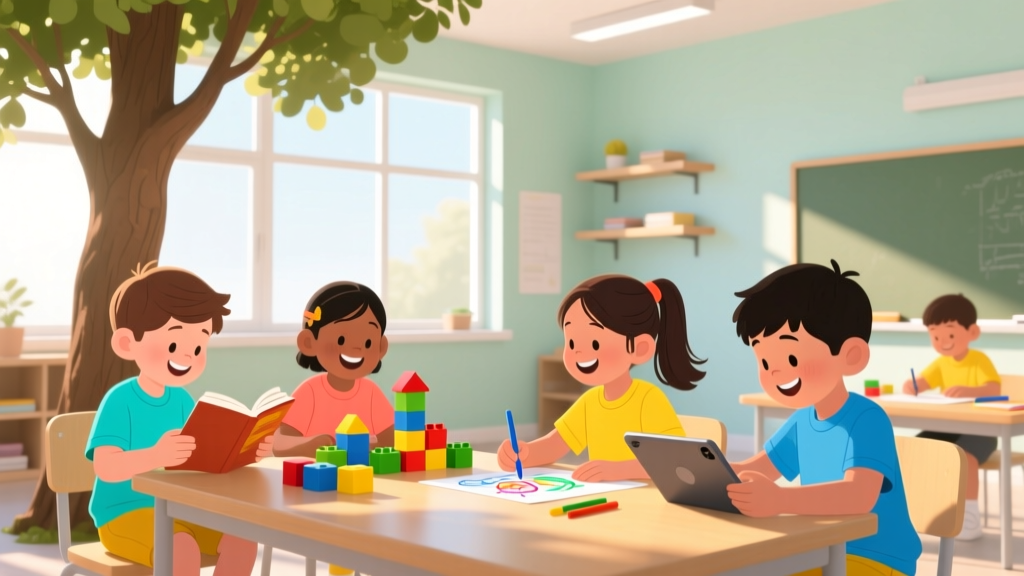
Do Nonverbal Kids Babble? 7 Therapist Tips
Why This Question Matters More Than You Think Right Now
Do non verbal kids babble? Yes—many do, but their babbling often looks, sounds, or functions differently than in neurotypical peers, leading well-meaning parents to miss critical early signals or misinterpret silence as absence of capacity. In fact, research from the American Speech-Language-Hearing Association (ASHA) shows that over 65% of children later diagnosed with autism or childhood apraxia of speech produced some form of canonical babbling (repetitive consonant-vowel syllables like "ba-ba" or "da-da") between 6–12 months—but those vocalizations were frequently dismissed as "just noise," "cooing," or "not real babbling" by caregivers and even some pediatricians. That gap between perception and developmental reality is where vital intervention windows quietly close. Understanding what counts as meaningful pre-verbal vocal play—and how to respond to it—isn’t just academic; it’s one of the most accessible, low-cost, and high-impact things you can do to support your child’s emerging communication system.
What ‘Babbling’ Really Means (and Why the Definition Has Changed)
Babbling isn’t just about making cute baby sounds—it’s a biologically driven, neurologically significant milestone reflecting maturation in the brain’s speech motor planning, auditory processing, and social attention networks. Traditionally, clinicians defined canonical babbling as reduplicated CV (consonant-vowel) syllables produced consistently between 6–10 months (e.g., "ma-ma," "pa-pa"). But that narrow definition fails children whose motor, sensory, or regulatory systems operate differently. According to Dr. Maura Mooney, a board-certified speech-language pathologist and researcher at the Vanderbilt Kennedy Center, "We now recognize at least four distinct babbling profiles in children who are nonverbal or minimally verbal: canonical babbling, marginal babbling (vocal play with consonant-like sounds but inconsistent timing), jargon babbling (melodic, rhythmic strings of syllables without clear meaning), and non-oral vocalizations (humming, growling, squealing used intentionally for interaction)." What matters less than perfect 'ba-ba' repetition is *intentionality*, *variability*, and *social reciprocity*—did your child pause after a sound and wait for your response? Did they repeat a squeal when you mirrored it? Did they use a grunt to protest or a hum to request? Those are functional precursors—not deficits.
Consider Liam, a 22-month-old with global developmental delay. His parents told his SLP he "never babbles." Yet video review revealed he regularly produced rhythmic, rising-falling vocalizations while stacking blocks—especially when his dad joined him. He’d hum a three-note pattern, pause, then watch his dad’s face. When Dad imitated the hum, Liam grinned and repeated it twice. That wasn’t random noise; it was turn-taking vocal play—the bedrock of conversation. His SLP reframed this as "interactive jargon babbling" and built therapy around expanding those shared sound games. Within 10 weeks, Liam began pairing vocalizations with gestures (point + hum = "more") and eventually approximated "uh-oh" during drop-and-retrieve play.
How to Spot Meaningful Pre-Speech Vocalizations (Even When They’re Not ‘Baby Talk’)
Not all babbling sounds like textbook examples—and that’s especially true for children with motor planning challenges (e.g., childhood apraxia), low muscle tone, sensory processing differences, or autism. Instead of listening for 'perfect' syllables, train yourself to notice five functional indicators—what ASHA calls the "Vocal Interaction Triad":
- Variability: Does your child produce different vowel qualities (ah, ee, oo), consonant-like sounds (lip pops, tongue clicks, throaty hums), or pitch contours (rising, falling, flat)? Even one consistent variation signals vocal exploration.
- Intentionality: Do sounds occur in context—with eye contact, gesture, or body orientation toward you or an object? A grunt while reaching for a cup is more meaningful than the same grunt during self-stimulatory spinning.
- Reciprocity: Does your child pause after vocalizing and orient to you? Do they smile, look away, or shift position in response to your imitation or comment? This back-and-forth is the engine of language learning.
- Consistency: Does a particular sound reliably accompany a specific action or need? A high-pitched whine every time the door opens may be a functional label—even if it’s not a word.
- Playfulness: Does your child experiment with voice—changing loudness, speed, or pitch for fun? Blowing raspberries, growling like a bear, or singing along to music (even off-key) reflects vocal agency.
A 2023 longitudinal study published in Journal of Speech, Language, and Hearing Research tracked 87 minimally verbal toddlers (ages 18–36 months) and found that children who demonstrated ≥3 of these 5 indicators before age 2 had 3.2x higher odds of developing functional single-word use within 12 months—even without traditional babbling. The takeaway? Your child’s unique vocal signature matters far more than whether it matches developmental checklists.
7 Evidence-Based Strategies to Nurture Vocal Play at Home
You don’t need flashcards or apps—you need attunement and playful responsiveness. These strategies are drawn from Hanen’s "More Than Words®" program, the SCERTS® model, and clinical practice guidelines endorsed by the American Academy of Pediatrics (AAP). All require zero materials and under 5 minutes per session—integrated seamlessly into daily routines.
- Pause & Wait Strategically: After your child makes any sound—even a sigh or cough—freeze for 3 full seconds with open posture and expectant facial expression. 70% of children who are nonverbal will fill that silence with another sound or gesture when given enough time (per Hanen research). Rushing to interpret or redirect kills the opportunity.
- Imitate With Variation (Not Perfection): If your child hums “nnn,” respond with “nnn-EE!” or “NNN-nnn-NNN!” Add rhythm, pitch change, or duration. This models sound manipulation without demanding replication—a key step toward intentional control.
- Pair Sound With High-Motivation Moments: Just before handing a preferred toy (e.g., wind-up car), make a brief, exaggerated sound: “WHEEE!” or “ZOOOM!” Pause. Repeat only if they vocalize—or even just lean in. The goal isn’t to get them to say “car”; it’s to link sound + desire.
- Use ‘Sound Scaffolding’ During Play: Narrate actions using simple, melodic, repetitive sounds—not words. Pushing a train? “Chug-chug… chug-chug…” (pause) “Chug?” Stacking blocks? “Up-up… up-up…” (pause) “Up?” This builds phonological awareness and invites vocal participation.
- Introduce Vocal Play Tools (Non-Speech First): Use kazoos, harmonicas, or bubble tubes—not to teach instruments, but to give tactile, visual, and auditory feedback for breath control and oral-motor coordination. A child who struggles to initiate vocalizations may easily blow a kazoo, then gradually shape that exhalation into voiced sounds.
- Label Their Sounds (Not Their Intent): Instead of saying “You want juice!” when they grunt, try: “You made a deep ‘UH-UH’ sound!” Then imitate it. This validates their vocal effort and separates sound production from demand fulfillment—reducing pressure and building confidence.
- Create ‘Sound Rituals’: Establish predictable, joyful sound routines: blowing bubbles while saying “POP!” (with mouth pop), rolling a ball while humming “WOOOOSH,” or opening a box while making a “TA-DA!” rasp. Repetition builds neural pathways for sound sequencing.
When to Seek Expert Support—and What to Ask For
While many children follow unique paths to speech, certain patterns warrant prompt evaluation by a pediatric speech-language pathologist (SLP)—not just a general developmental screening. The AAP emphasizes that referral should happen *before* age 2 if any of these are present:
- No canonical babbling (reduplicated CV syllables) by 12 months
- No gestures (waving, pointing, reaching) by 12 months
- No single words by 16 months
- No spontaneous two-word phrases by 24 months
- Loss of previously acquired words or social skills at any age
But here’s what most parents aren’t told: Ask for a dynamic assessment—not just a standardized test. Standardized tools like the PLS-5 or CELF-P may underestimate abilities in nonverbal children because they rely heavily on imitation or picture naming. Instead, request observation across naturalistic settings (play, mealtime, transitions) and ask: “Can you assess my child’s vocal repertoire, communicative intent, and responsiveness to sound-based interaction?” A skilled SLP will analyze vocal quality, variability, and social use—not just count syllables.
Also, insist on collaboration. According to the ASHA Practice Portal, the most effective early intervention involves coaching parents in real-time strategies—not just weekly therapy sessions. If your SLP doesn’t spend at least 30% of each visit modeling techniques *with you* and giving feedback on your interactions, ask for a referral to a provider trained in parent-mediated models like JASPER or Project ImPACT.
| Developmental Stage | Typical Vocal Behaviors (Neurotypical) | Common Variations in Nonverbal/Minimally Verbal Children | Parent Action Step | Evidence-Based Rationale |
|---|---|---|---|---|
| 6–9 months | Canonical babbling ("ba-ba," "da-da") | Marginal babbling (tongue clicks, lip smacks, raspberries); vocal play limited to vowels ("ah-ah-ah") or consonant-like straining sounds | Imitate their sounds with rhythmic variation (e.g., if they click tongue once, click twice with rising pitch) | Research (Yoder et al., 2019) shows rhythmic imitation increases vocal variability 4.7x faster than verbal labeling alone |
| 10–14 months | Jargon babbling (melodic, multi-syllabic strings) | Repetitive vocal stereotypy (same hum/squeal across contexts); vocalizations triggered only by sensory input (e.g., fan noise) | Introduce “sound swaps”: Pair their repetitive sound with a new, contrasting one (e.g., if they hum “mmmm,” respond with sharp “TCH!” then pause) | This builds auditory discrimination and primes neural circuitry for phoneme contrast (ASHA Clinical Guidelines, 2022) |
| 15–24 months | First words; sound combinations (“mama,” “dada”) | Vocalizations used functionally but not as words (e.g., grunt + reach = request; whine + turning away = protest); inconsistent sound production | Label the *function*, not the word: “You grunted and pointed—that means ‘give me!’” Then model a simplified sound: “Giiive!” | Labeling intention strengthens joint attention and maps sound to meaning before articulation matures (Project ImPACT RCT, 2021) |
| 24+ months | 2–3 word phrases; expanding vocabulary | Emerging approximations (“buh” for ball); echolalia (immediate or delayed repetition); vocalizations paired with AAC use | Expand their approximation *without correcting*: If they say “buh,” respond with “Buh-ball! Bouncing ball!” while rolling it | Expansion—not correction—builds confidence and provides rich, contextual input (Hanen, 2020) |
Frequently Asked Questions
Do nonverbal kids ever start babbling late—and is that still helpful?
Yes—absolutely. While canonical babbling typically emerges by 10 months, many children with developmental differences begin producing functional vocal play between 18–30 months. A landmark 2020 study in Autism Research followed 124 children with ASD and found that 41% developed canonical babbling after age 18 months—and those children showed significantly stronger receptive language gains over 2 years compared to peers who remained completely silent. Late babbling isn’t ‘too little, too late’; it’s a sign the vocal motor system is maturing and ready for targeted support.
My child babbles sometimes—but only when alone. Is that meaningful?
Yes—and it’s actually promising. Self-directed babbling indicates vocal experimentation and motor planning practice, even without social motivation yet. The next step is bridging that skill into interaction. Try joining their solo play *without talking first*—mirror their sounds silently for 10 seconds, then add gentle rhythm (tap a beat on your leg matching their tempo). Often, that shared rhythm becomes the entry point for reciprocal vocal exchange.
Could lack of babbling indicate hearing loss—even if newborn screening passed?
Yes. Newborn hearing screens detect profound loss but can miss mild-to-moderate or unilateral (one-ear) hearing loss—conditions that directly impact babbling onset and quality. The AAP recommends diagnostic audiology for *any* child with delayed babbling, especially if accompanied by inconsistent responses to sound, preference for very loud volumes, or frequent ear infections. Don’t assume “passed screening = perfect hearing.” Request a full diagnostic ABR or behavioral audiogram.
Will using AAC (like picture cards or speech-generating devices) stop my child from babbling or talking?
No—robust evidence shows the opposite. A 2022 meta-analysis in Journal of Developmental & Behavioral Pediatrics confirmed that AAC use *increases* vocalizations in 83% of minimally verbal children. Why? Because AAC reduces frustration-driven silence and provides cognitive space to focus on sound production instead of struggling to convey meaning. Think of AAC as training wheels for communication—not a replacement for speech.
My pediatrician said ‘wait and see’—but I’m worried. What should I do?
Trust your instinct. Pediatricians receive minimal training in early speech-language development. Document your concerns: record 3 short videos (play, mealtime, transition) showing vocalizations (or lack thereof), note dates of first smiles, gestures, and responses to name. Then request a referral to a pediatric SLP *in writing*. In the U.S., early intervention (birth–3) is free and federally mandated—if delays are suspected, you don’t need a diagnosis to access services. Call your state’s Early Intervention program directly if your doctor delays referral.
Common Myths Debunked
Myth #1: “If they’re not babbling by 12 months, they’ll never talk.”
False. While early babbling predicts better outcomes, many children develop functional speech after age 3—even after years of minimal vocalization. Dr. Connie Kasari, UCLA autism researcher, states: “We’ve documented children with no vocalizations at age 4 who began speaking in full sentences by age 7 after intensive, individualized intervention targeting vocal motor planning and social motivation.” Neuroplasticity remains strong throughout early childhood.
Myth #2: “Babbling only counts if it sounds like real words.”
False. True babbling is defined by its structure (CV syllables) and function (social engagement, variability), not its resemblance to English. A child producing “k-k-k-ee” with eye contact and smiling is engaging in canonical babbling—even if it bears no resemblance to “key.” Focus on the *process*, not the product.
Related Topics (Internal Link Suggestions)
- Early Signs of Autism in Toddlers — suggested anchor text: "early autism signs before age 2"
- Best AAC Apps for Nonverbal Toddlers — suggested anchor text: "top evidence-based AAC apps for preschoolers"
- Speech Therapy Activities for Home — suggested anchor text: "speech therapist-approved play ideas for nonverbal kids"
- When to Worry About Speech Delay — suggested anchor text: "red flags for speech delay by age"
- Sensory Processing and Speech Development — suggested anchor text: "how sensory differences affect babbling and talking"
Your Next Step Starts With One Sound
You now know: Do non verbal kids babble? Often—yes, in ways that are meaningful, measurable, and malleable. You don’t need to wait for perfect syllables to begin building your child’s vocal foundation. Today, pick *one* strategy from this guide—maybe pausing for 3 seconds after their next sound, or imitating their hum with a playful pitch change—and try it three times before bedtime. Track what happens: Did they pause? Smile? Repeat? Make a note. Small, consistent interactions rewire brains. And when you share your observations with a qualified SLP, you’re not bringing ‘a problem’—you’re bringing invaluable data about your child’s unique communication profile. That’s the most powerful advocacy tool you have. Ready to go deeper? Download our free Vocal Play Tracker (with video prompts and progress notes) at [YourSite.com/vocal-play-toolkit].
More Articles
 Kids Contact Sports: Risks, Benefits & Safety (2026)
 What Is Good for Diarrhea in Kids: Pediatrician Tips (2026)
 Anna’s Kids After His & Hers: Custody, Impact, Advice
 When Can Kids Get Out of Booster Seats? (2026)
 How Many Teeth Will Kids Lose (2026)
 Medicaid Vision Coverage for Kids: State Guide (2026)
 How Many Kids Does Dolly Parton Have? (2026)
 Do Penny and Leonard Have Kids? The Truth (2026)
 Does Emily Compagno Have Kids? The Truth (2026)
 Can You Have Kids After Chemo? Fertility Facts (2026)