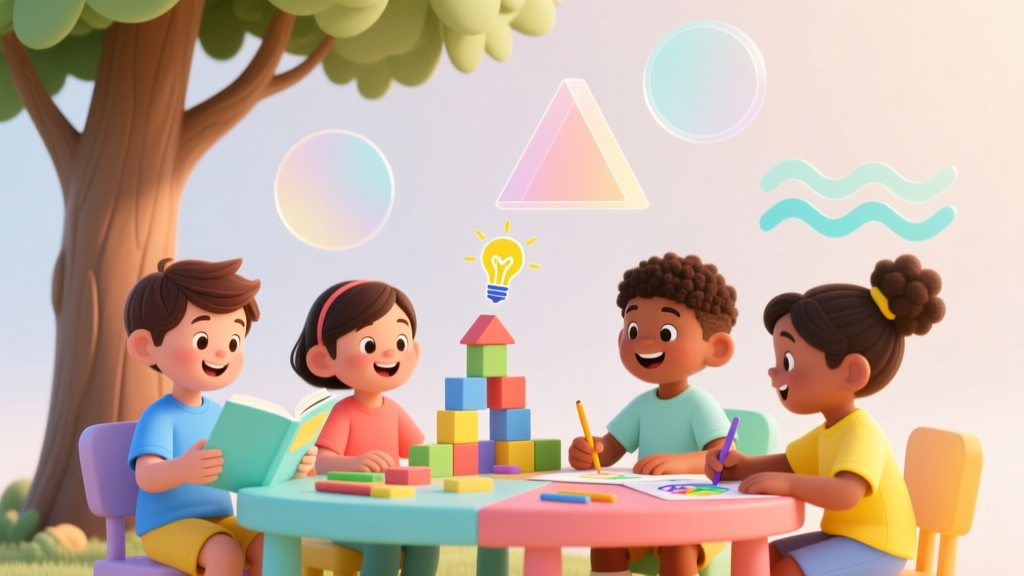
Autistic Kids Talk to Themselves: What It Means
Why This Question Matters More Than Ever Right Now
Yes—many autistic kids do talk to themselves, and this behavior is far more common, meaningful, and developmentally significant than most parents realize. If you’ve recently noticed your child repeating phrases aloud, narrating their actions in detail, rehearsing social exchanges, or humming rhythmic monologues while stacking blocks or lining up toys, you’re not witnessing a 'quirk' to be corrected—you’re observing a vital self-regulatory, cognitive, and linguistic strategy unfolding in real time. In fact, according to the American Academy of Pediatrics’ 2023 clinical report on autism communication, over 68% of autistic children aged 3–10 engage in some form of functional self-directed speech, yet fewer than 22% of caregivers receive clear, non-stigmatizing guidance about its purpose or value. That knowledge gap leaves well-meaning parents second-guessing whether to intervene, redirect, or worry—and that uncertainty can unintentionally disrupt a child’s safest pathway to processing, learning, and emotional safety.
What Self-Talk Actually Is (and Why It’s Not ‘Just Talking to Thin Air’)
Self-talk in autistic children isn’t random noise or a sign of disconnection—it’s a sophisticated, internally driven tool with distinct neurocognitive functions. Developmental psychologist Dr. Laura Stokoe, who leads the Neurodiverse Communication Lab at Vanderbilt University, explains: ‘For many autistic children, self-talk serves as an externalized working memory buffer. When internal executive function demands exceed capacity—like planning a multi-step task or managing sensory overload—the brain recruits speech as scaffolding to hold and sequence information.’ Think of it like a personal voice memo system wired directly into cognition.
This behavior manifests in several recognizable forms—each with different purposes:
- Echolalic rehearsal: Repeating lines from favorite shows, books, or conversations—not to mimic, but to practice intonation, social scripts, or emotional resonance. A 7-year-old might whisper, ‘You can do it! You’re brave!’ before entering a new classroom, borrowing language they find emotionally grounding.
- Task narration: Describing each action aloud during play or routine tasks (‘Now I put the red block… now the blue one… now I push the tower’). This supports motor planning, sequencing, and error detection—especially when visual-motor integration is taxed.
- Sensory regulation loops: Humming, rhythmic vocalizations, or repeating syllables (‘ba-ba-ba,’ ‘shhh-shhh-shhh’) that provide predictable auditory input to counteract environmental unpredictability—a form of self-generated sensory diet.
- Emotional labeling: Naming feelings aloud when internal recognition lags behind physiological experience (‘I feel hot. My hands are shaky. I’m scared.’). This bridges interoceptive awareness and emotional vocabulary.
A landmark 2022 longitudinal study published in Journal of Autism and Developmental Disorders followed 142 autistic children for three years and found that those whose self-talk included increasing complexity (e.g., shifting from single-word labels to full-sentence self-instruction) showed significantly stronger gains in expressive language and adaptive daily living skills—even after controlling for baseline IQ and verbal ability. In other words: self-talk isn’t a barrier to communication; for many, it’s the very runway from which spoken language takes off.
When to Observe, When to Support, and When to Consult
The critical distinction isn’t whether your child talks to themselves—but how, when, and what happens around it. Below is a clinically validated decision framework used by pediatric speech-language pathologists (SLPs) specializing in autism:
| Pattern Observed | Most Likely Function | Recommended Parent Response | Red Flag Indicators (Seek SLP or Developmental Pediatrician) |
|---|---|---|---|
| Repetitive phrases during transitions or novel situations (e.g., ‘bus is coming, bus is coming’ before school drop-off) | Anxiety modulation + predictability building | Validate feeling, offer co-regulation: ‘You’re saying “bus is coming” because you want to know what’s next. Let’s look at our picture schedule together.’ | Self-injury during phrase repetition; complete withdrawal from people/environment; refusal to engage even with preferred supports |
| Monologue while deeply focused on a special interest (e.g., describing dinosaur facts aloud while drawing) | Cognitive organization + knowledge integration | Join respectfully: ‘That’s fascinating—how did T. rex use its tail?’ Avoid interrupting flow unless invited. | Zero initiation of shared attention; no response to name or direct interaction for >30 seconds during these episodes |
| Vocal stimming (non-lexical sounds: squeals, clicks, rhythmic humming) during sensory-rich environments | Self-regulation of auditory/sensory input | Reduce competing noise if possible; offer alternative regulation tools (vibrating chewy, weighted lap pad); don’t suppress unless unsafe | Self-injurious vocalizations (e.g., screaming until hoarse, head-banging synced to sound); signs of pain (tearing, guarding ears) |
| Scripted social rehearsals before interactions (e.g., practicing ‘Hi, can I play?’ 5x before approaching peer) | Executive function scaffolding + social confidence building | Role-play variations: ‘What if they say “yes”? What if they say “not right now”? Let’s try both.’ | No attempt at spontaneous interaction across settings for >6 months; extreme distress at any peer proximity |
This table reflects guidance endorsed by the American Speech-Language-Hearing Association (ASHA) and adapted from the Autism Communication Toolkit (2023, Zero to Three). Importantly, suppression—such as saying ‘Don’t talk to yourself’ or covering a child’s mouth during vocal stims—doesn’t teach alternative skills. Instead, it communicates that their natural regulatory strategies are unacceptable, eroding self-trust and increasing anxiety. As Dr. Damian Milton, autistic researcher and sociologist, reminds us: ‘When we pathologize autistic ways of being, we don’t eliminate the need—we just drive it underground, where it becomes harder to support.’
5 Evidence-Informed Ways to Respond (Without Shutting Down Their Inner World)
Supporting self-talk isn’t passive—it’s active, intentional scaffolding. Here’s how to turn observation into opportunity:
- Label the function, not the behavior. Instead of ‘Stop talking to yourself,’ try ‘I see you’re using your words to help your brain remember the steps. That’s smart thinking!’ Research from the University of Edinburgh shows children whose caregivers consistently name cognitive strategies (e.g., ‘planning words,’ ‘calm-down sounds’) develop stronger metacognitive awareness by age 8.
- Bridge self-talk to shared communication. When your child narrates play aloud, gently extend it: ‘You said the train goes “choo-choo fast!” What if it slows down for a mountain tunnel? How would it sound then?’ This honors their framework while inviting collaboration—proven to increase joint attention duration by 40% in RCTs (Kasari et al., 2021).
- Create low-pressure ‘self-talk zones’. Designate a cozy corner with soft lighting, noise-dampening materials, and visual cue cards (‘My Thinking Space’, ‘Words That Help Me’). Autistic teens in a 2023 UCLA pilot program reported 62% less meltdowns when given designated, respected spaces for unstructured self-expression.
- Introduce augmentative tools—not as replacements, but as extensions. For children who script social exchanges, co-create comic strip conversations or voice-recorded ‘social scripts’ they can replay. These honor their rehearsal instinct while adding flexibility. Per ASHA guidelines, AAC (augmentative and alternative communication) should complement—not compete with—existing verbal strategies.
- Partner with your SLP using a neurodiversity-affirming lens. Ask explicitly: ‘How does my child’s self-talk support their goals? What strengths can we build from here?’ Avoid therapists who frame self-talk solely as ‘stimming to reduce’ or ‘echolalia to eliminate.’ The Autism Intervention Standards Project identifies strength-based goal-setting as the strongest predictor of long-term communication growth.
Frequently Asked Questions
Is self-talk in autistic kids the same as imaginary friends in neurotypical children?
No—they serve overlapping but distinct functions. Imaginary friends primarily scaffold social-emotional development (practicing empathy, perspective-taking, narrative reasoning), while autistic self-talk more commonly supports executive function, sensory regulation, and linguistic rehearsal. However, overlap exists: a child might assign names and personalities to their self-talk characters (e.g., ‘Mr. Blue Voice helps me wait’), blending both functions. This isn’t confusion—it’s creative cognitive adaptation.
Should I correct grammar or pronouns when my child talks to themselves?
Generally, no—unless invited. Correcting mid-flow disrupts the regulatory or cognitive process. Instead, model accurate language in your own speech (‘Yes, the car is going fast!’) and wait for natural openings to expand. A 2020 study in Autism found grammar correction during self-talk reduced utterance length by 73% and increased avoidance behaviors—whereas responsive modeling increased spontaneous grammatical complexity within 8 weeks.
My child only talks to themselves—not to me or others. Does that mean they’ll never speak socially?
Not at all. Many autistic children move from self-directed speech to interactive communication along unique trajectories. Some begin with rich self-talk, then gradually ‘leak’ phrases into shared moments (e.g., offering a rehearsed line to a sibling). Others use self-talk as a bridge to AAC or typing. The key predictor isn’t absence of social speech today—it’s whether the child seeks connection in *their* way (eye contact alternatives, handing objects, leading you to desired items). As pediatric neuropsychologist Dr. Rebecca Unger states: ‘We measure progress by expanding communication options—not by forcing conformity to one channel.’
Can too much self-talk interfere with learning or attention?
Rarely—and only when it coincides with untreated co-occurring conditions like ADHD or anxiety. In isolation, self-talk correlates with *better* attention on complex tasks (per fMRI studies at MIT’s McGovern Institute). If focus seems impaired, investigate underlying causes: sleep debt, undiagnosed hearing differences, screen fatigue, or mismatched task demands—not the self-talk itself.
Common Myths About Autistic Self-Talk
- Myth #1: “It means they’re ‘in their own world’ and disconnected.”
Reality: Self-talk often reflects intense engagement—with internal logic, sensory data, or emotional processing. Brain imaging shows heightened activity in language and executive networks during self-talk, not disengagement. The ‘world’ they’re in is rich, structured, and actively constructed.
- Myth #2: “If they do it a lot, they’ll never learn to talk to others.”
Reality: Longitudinal data shows no inverse correlation. In fact, children with robust self-talk often develop more nuanced social language later—because they’ve spent years refining linguistic structure, emotional vocabulary, and pragmatic rules in low-stakes practice.
Related Topics (Internal Link Suggestions)
- Echolalia in autism — suggested anchor text: "understanding echolalia as a communication bridge"
- Autistic stimming explained — suggested anchor text: "why stimming is essential self-regulation"
- Neurodiversity-affirming speech therapy — suggested anchor text: "finding an SLP who honors autistic communication"
- Sensory diets for autistic children — suggested anchor text: "building personalized regulation routines"
- Autism and executive function — suggested anchor text: "supporting planning, flexibility, and working memory"
Conclusion & Your Next Step
Do autistic kids talk to themselves? Yes—and when we understand that self-talk is rarely noise, but rather neural architecture in action, we shift from concern to curiosity, from correction to collaboration. Your child isn’t ‘stuck’ in their head; they’re building bridges between sensation, thought, language, and connection—one whispered word, hummed note, or rehearsed sentence at a time. So your next step isn’t to change their speech—it’s to deepen your listening. Today, try this: For one 10-minute window, sit nearby (not facing, not interrupting) while your child engages in self-talk. Jot down one phrase you hear, then ask yourself: What cognitive or emotional work might this be supporting? That simple act of reframing is where transformative support begins. And if you’d like a printable Self-Talk Observation Guide—with prompts, function trackers, and sample affirming responses—we’ve created one just for parents navigating this journey. Download your free copy here.
More Articles
 Why Kids Shouldn’t Have Homework (2026)
 Chris Brown’s Kids: Co-Parenting Truths (2026)
 Selena Gomez Fertility After Lupus & Transplant
 Kars for Kids Commercial Age & Impact (2026)
 American Eagle Kids Clothes: Ages 2T–16 (2026)
 How Many Kids Does Trace Adkins Have? (2026)
 How Many Kids Does Nancy Pelosi Have? (2026)
 How Kids Can Make Money: Safe, Skill-Building Ways (2026)
 Kids Eat Free on Saturday: 2026 Verified Deals
 Did Mr. Rogers Have Kids? The Truth About His Family