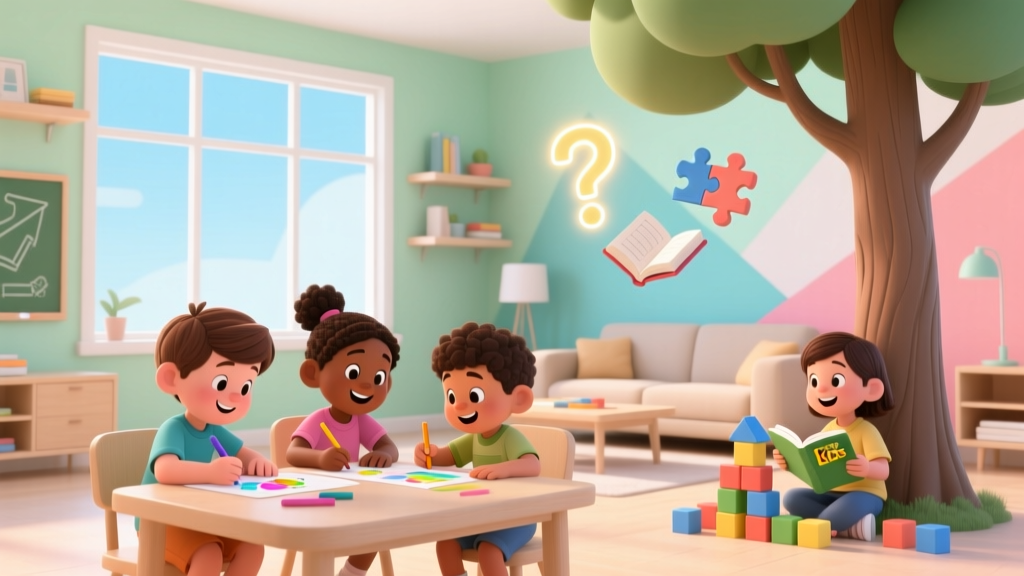
Autistic Kids Play With Peers: A Support Guide
Why This Question Matters More Than Ever
Many parents ask, do autistic kids play with other kids—not out of doubt about their child’s capacity for connection, but from deep concern about isolation, missed developmental windows, and the emotional toll of watching their child stand apart at recess or birthday parties. The truth is nuanced: autistic children absolutely *can* and *do* play with peers—but often in ways that differ from neurotypical expectations. And those differences aren’t deficits—they’re valid expressions of social wiring, sensory processing, and communication style. What’s changed in the last five years is our understanding: research now confirms that successful peer play isn’t about mimicking neurotypical norms—it’s about designing supportive conditions where autistic children initiate, sustain, and enjoy interactions on their own terms. That shift—from ‘fixing’ to facilitating—is where real progress begins.
What ‘Play’ Really Looks Like for Autistic Children
First, let’s reframe ‘play.’ For many autistic children, play isn’t always verbal, reciprocal turn-taking, or sustained joint attention in the way early childhood assessments traditionally define it. It might look like parallel play with shared focus (e.g., two children lining up toy cars side-by-side while humming the same tune), collaborative building without spoken dialogue, or intense role-play centered on a special interest (like reenacting dinosaur migration patterns with precise accuracy). According to Dr. Rebecca Landa, Director of the Center for Autism and Related Disorders at Kennedy Krieger Institute, ‘Joint engagement doesn’t require eye contact or verbal back-and-forth—it can be achieved through shared rhythm, synchronized movement, or mutual fascination with an object or idea.’
This matters because well-meaning adults often misinterpret quiet observation, delayed responses, or preference for solitary exploration as disinterest—when in fact, the child may be deeply engaged, processing socially, or conserving energy for moments they find truly rewarding. A 2023 longitudinal study published in Journal of the American Academy of Child & Adolescent Psychiatry followed 127 autistic children aged 4–8 and found that 68% initiated at least one sustained peer interaction per week when matched with neurodiversity-affirming play partners and given structured yet flexible entry points—like shared sensory bins or cooperative board games with visual rules.
So instead of asking, ‘Why won’t my child join the group?,’ try asking: ‘What conditions help them feel safe, regulated, and intrinsically motivated to connect?’ That pivot changes everything.
Building Bridges: 4 Evidence-Based Strategies That Work
Supporting peer play isn’t about teaching autistic children to ‘act more normal.’ It’s about co-creating ecosystems where connection flourishes naturally. Here are four high-impact, research-backed approaches—each grounded in real-world implementation:
1. Start With ‘Play Partners,’ Not ‘Peer Groups’
Large, unstructured groups overwhelm most autistic children—not because they lack social desire, but due to sensory load (noise, movement, unpredictable social cues) and cognitive demand (tracking multiple speakers, shifting topics, interpreting sarcasm or indirect requests). Instead, begin with dyadic pairings: one trusted peer + your child, supported by a trained adult who facilitates *without directing*. The key is choosing the right partner—not the ‘most popular’ classmate, but one whose temperament, interests, and communication style align. Look for peers who: ask open-ended questions, respect pauses, enjoy tactile or system-based play (e.g., LEGO, coding games, gardening), and respond warmly to nonverbal cues.
In a pilot program across six Baltimore County elementary schools, teachers used interest-matching surveys (co-created with students) to form ‘play partnerships’ based on shared passions—like space facts, origami, or animal care. Within 8 weeks, 82% of participating autistic children showed measurable increases in spontaneous initiations (e.g., handing a peer a puzzle piece, pointing to a book page, offering a turn with a fidget tool).
2. Scaffold With Visual, Sensory, and Scripted Supports—Then Fade Them
Scripts aren’t about rote memorization—they’re cognitive scaffolds. Think of them as temporary training wheels for social thinking. A child might use a laminated card saying, ‘I want a turn. Can I have the blue marker?’ during art time—not as a rigid line to recite, but as a reference point when anxiety spikes. Over time, the script shortens: ‘Blue marker, please?’ → ‘Can I…?’ → just a hand gesture + eye contact (if comfortable). Crucially, scripts should always be co-developed with the child and tied to *their* goals—not adult-imposed expectations.
Sensory supports are equally vital. One parent shared how her 7-year-old son, who covered his ears during circle time, began joining peer reading circles after his teacher introduced ‘sound buffers’: noise-dampening headphones he could wear *while still participating*, plus a weighted lap pad for proprioceptive input. He wasn’t ‘tuning out’—he was regulating so he *could* tune in.
3. Leverage Special Interests as Social Bridges
Special interests aren’t barriers to connection—they’re superpowers. When harnessed intentionally, they become natural conduits for shared joy and collaboration. A boy obsessed with subway maps co-designed a classroom ‘Transit Challenge’ game with his teacher and two classmates—creating routes, calculating travel times, and presenting findings using stop-motion animation. His peers didn’t just tolerate his passion; they asked questions, contributed ideas, and celebrated his expertise.
Dr. Wenn Lawson, an autistic psychologist and author of The Passionate Mind, emphasizes: ‘When we treat special interests as assets—not quirks to suppress—we signal that the child’s mind is worthy of respect. That dignity becomes the foundation for all other relationships.’
4. Teach Neurotypical Peers—Not Just Autistic Children
Most social skills curricula focus exclusively on the autistic child. But inclusion fails when only one party adapts. Effective programs train neurotypical peers in ‘neurodiversity literacy’: recognizing different communication styles (e.g., monotone voice ≠ boredom; looking away ≠ disengagement), understanding sensory needs (‘She wears sunglasses indoors because light hurts—can we dim the lights during science?’), and practicing flexible collaboration (‘Let’s take turns choosing the game—and if someone needs a break, we pause and reset together’).
A landmark 2022 study in Autism journal compared two elementary classrooms: one using traditional social skills groups for autistic students only, and another implementing peer-mediated intervention (PMI) with weekly 20-minute ‘Friendship Labs.’ In the PMI classroom, neurotypical students learned how to invite participation without pressure, interpret stimming as self-regulation (not distraction), and offer choices instead of directives. By spring, autistic students in the PMI group initiated 3.2x more peer interactions—and neurotypical students showed significantly higher empathy scores on standardized assessments.
Developmental Readiness & Realistic Timelines
Parents often wonder: ‘Is my child *ready* to play with others?’ There’s no universal age or milestone—but there *are* observable signs of emerging social readiness that go beyond speech or eye contact. These include:
- Noticing when others enter or leave a room
- Showing excitement (smiling, jumping, vocalizing) when a familiar peer appears
- Using objects to share attention (e.g., holding up a toy car toward someone)
- Imitating actions—even nonverbal ones like clapping or stacking blocks in sequence
- Seeking comfort or help from peers (e.g., tugging a friend’s sleeve to reach a shelf)
If these occur even occasionally, the foundation is present. What’s needed isn’t ‘more therapy’—it’s opportunities calibrated to their current capacity. As pediatric occupational therapist and autism consultant Maureen Dunphy advises, ‘Don’t wait for “perfect” readiness. Meet them where they are—and build the bridge *from* there.’
| Play Activity Type | Primary Developmental Benefit | Ideal Age Range | Neurodivergent Adaptation Tips |
|---|---|---|---|
| Cooperative Building (e.g., LEGO, Magna-Tiles) | Cognitive flexibility, joint problem-solving, spatial reasoning | 4–10 years | Provide visual step guides *and* open-ended challenge cards (‘Build something that rolls’); allow silent collaboration; use color-coded parts for predictability |
| Sensory Exploration Stations (e.g., water tables, kinetic sand, sound tubes) | Sensory integration, shared attention, nonverbal reciprocity | 3–8 years | Label stations with icons + words; offer noise-canceling headphones & tactile gloves; designate ‘quiet zones’ within the station |
| Interest-Based Role-Play (e.g., ‘Dinosaur Park Rangers,’ ‘Robot Repair Shop’) | Language development, narrative sequencing, perspective-taking | 5–12 years | Let child co-write the ‘rules’; use props aligned with their special interest; allow monologue-style narration alongside dialogue |
| Music & Movement Circles (e.g., drumming, scarf dancing, echo songs) | Motor planning, rhythmic entrainment, emotional regulation | 3–9 years | Offer instrument choice cards; use visual beat charts; permit standing/sitting/rocking—no ‘expected posture’ |
Frequently Asked Questions
Will my child ever develop friendships—or is this just wishful thinking?
No—it’s not wishful thinking. Longitudinal research shows that autistic individuals form deep, lasting friendships throughout life—though the pathways differ. A 2021 study tracking 142 autistic adults found that 74% reported at least one close, reciprocal friendship, with 41% describing friendships formed in childhood that endured into adulthood. Key predictors? Early access to interest-aligned peer groups, adults who modeled respectful curiosity (not correction), and environments where authenticity was valued over conformity. Friendships may center around shared passions, online communities, or low-pressure in-person meetups—not playground banter. That’s not lesser—it’s different, and deeply valid.
My child seems happy playing alone. Should I push them to interact?
No—unless *they* express desire for connection. Solitary play is essential for cognitive processing, creativity, and sensory regulation. Forcing interaction risks anxiety, shutdowns, and eroded trust. Instead, gently expand options: ‘Would you like to watch Leo build his tower? Or draw dinosaurs beside him?’ Offer presence without pressure. Watch for subtle bids—like glancing at peers, moving closer to a group, or handing a toy to someone. Respond to *those*, not assumptions. As Dr. Barry Prizant, author of Uniquely Human, reminds us: ‘Behavior is communication. When a child chooses solitude, they’re telling us what they need—not what they lack.’
Are there specific toys or games proven to support peer play for autistic children?
Yes—but effectiveness depends on fit, not features. Research consistently highlights three categories: (1) Cooperative games (e.g., Outfoxed!, Hoot Owl Hoot!) where players work toward a shared goal—not competition; (2) Open-ended construction systems (LEGO, Tegu, wooden blocks) allowing varied expression and parallel or collaborative building; and (3) Sensory-rich interactive tools (light projectors, musical floor mats, marble runs) that invite shared exploration without verbal demands. Crucially, avoid toys marketed as ‘autism-friendly’ that prioritize compliance (e.g., ‘look at me’ prompts, forced imitation). Instead, choose items rated highly by autistic reviewers on sites like Autistic Mama or recommended by occupational therapists specializing in sensory integration.
How do I talk to my child’s teacher about supporting peer play at school?
Lead with collaboration, not critique. Request a brief meeting and say: ‘We’d love to partner with you to help [Child] connect meaningfully with peers—what’s working well in the classroom, and where could we add small, sustainable supports?’ Bring concrete examples (e.g., ‘At home, they engage deeply when building with trains alongside a cousin—could we explore similar paired activities during free choice time?’). Ask about existing structures: Is there a ‘buddy bench’? Are interest-based clubs available? Can transitions be signaled visually to reduce anxiety before group work? Frame requests as shared goals: ‘Our aim isn’t more socializing—it’s more joyful, low-stress connection.’
What if my child experiences rejection or bullying during peer play attempts?
This is heartbreaking—and unfortunately common. First, validate their feelings without minimizing: ‘It makes sense you felt hurt. No one deserves to be laughed at for loving robots or needing quiet time.’ Then, debrief *with* them—not about what they ‘did wrong,’ but what happened and how they’d like to respond next time. Role-play assertive phrases: ‘I’m taking a break,’ ‘That joke didn’t feel kind,’ or ‘Let’s try a different game.’ Partner with school staff using the Stop-Walk-Talk framework (developed by the National Bullying Prevention Center): teach your child to stop, walk away, and tell a trusted adult—while simultaneously advocating for systemic change: inclusive curriculum, peer mentoring, and clear anti-bullying policies enforced consistently. Remember: resilience isn’t built by enduring pain—it’s built by knowing you’re seen, believed, and protected.
Common Myths
Myth #1: Autistic children don’t want friends—they’re just ‘in their own world.’
Reality: Desire for connection is nearly universal among autistic people. What differs is *how* connection feels safe, sustainable, and rewarding. Many autistic adults describe profound loneliness—not from lacking desire, but from repeated experiences of misunderstanding, masking exhaustion, or being excluded for communicating authentically. A 2020 survey by the Autistic Self Advocacy Network found 92% of respondents expressed strong interest in friendships, with barriers cited as inaccessible environments (78%), lack of neurodiversity-literate peers (65%), and pressure to conform (81%).
Myth #2: If my child doesn’t make eye contact or speak much, they can’t form peer bonds.
Reality: Connection transcends verbal fluency and gaze. Autistic children communicate through gestures, assistive tech, shared laughter, synchronized movement, or passing objects. A child who hands a peer a favorite book, lines up toys side-by-side while humming the same melody, or taps a drum in rhythm with a friend is engaging in rich, reciprocal social exchange—even if it looks nothing like a conversation. As autistic educator and speaker Siena Castellon states: ‘My friendships are built on shared values, deep listening, and mutual respect—not on how long I can hold someone’s gaze.’
Related Topics (Internal Link Suggestions)
- Autism-friendly birthday party ideas — suggested anchor text: "stress-free autism birthday party planning"
- Best cooperative board games for autistic kids — suggested anchor text: "cooperative games that build connection without pressure"
- How to explain autism to neurotypical siblings — suggested anchor text: "talking to siblings about autism with empathy"
- Sensory-friendly playground equipment — suggested anchor text: "inclusive playground design for autistic children"
- IEP goals for social-emotional development — suggested anchor text: "meaningful IEP goals for peer interaction"
Your Next Step Starts With One Small Shift
You don’t need to overhaul your child’s world overnight. Start with one observation this week: notice *how* your child already connects—even quietly. Do they linger near a sibling’s art project? Hand a neighbor’s dog a treat? Hum along when a friend sings? Those are not ‘small’ moments. They’re data points revealing their unique social language. Capture one, celebrate it, and build *from there*. Because the question ‘do autistic kids play with other kids’ isn’t binary—it’s an invitation to witness, honor, and nurture connection in all its diverse, resilient, beautiful forms. Ready to create your first low-pressure play opportunity? Download our free Play Partnership Starter Kit—including interest-matching templates, visual script cards, and a checklist for neurodiversity-affirming play spaces.
More Articles
 Motrin vs Tylenol for Kids: What Pediatricians Won’t Say
 Is 2 Kids Enough? The Evidence-Based Truth
 How Old Are Britney Spears’ Kids in 2026?
 How Many Kids Are on Snap? (2026)
 Make-A-Wish Eligibility: Life-Threatening ≠ Terminal
 How Old Are the Kids in Stand by Me? (2026)
 Foster Care Statistics 2026: Numbers, Myths & How to Help
 Who Claims Kids on Taxes? IRS Rules & Tips (2026)
 Trisha Paytas’ Kids’ Names and Privacy Explained
 Did Selena Quintanilla Have Kids? The Truth (2026)