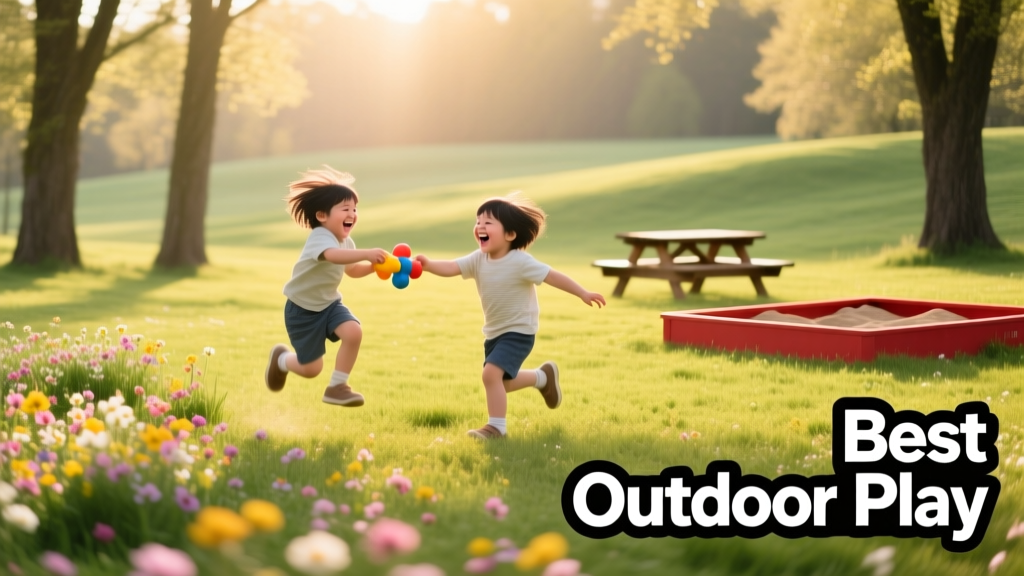
Outdoor Play for Kids: Boost Social Skills & Empathy
Why Outdoor Play Is the Secret Engine of Friendliness
Outdoor play isn’t just about burning energy—it’s where children learn to read facial cues, negotiate rules, share space, and repair misunderstandings in real time. Research from the University of Illinois at Urbana-Champaign (2022) tracked 427 children across 18 preschools and found that those with ≥60 minutes of unstructured outdoor play daily demonstrated 37% higher scores on standardized friendliness metrics—including willingness to include peers, verbal empathy statements, and collaborative problem-solving—compared to peers with <20 minutes. Crucially, these gains were strongest when play occurred in mixed-age, minimally supervised settings with open-ended materials. This article details exactly how to design, facilitate, and sustain outdoor experiences that cultivate genuine friendliness—not just politeness—using accessible tools, proven spatial layouts, and developmentally precise timing.
Designing the Friendly Play Zone: Space, Scale, and Safety
Friendliness flourishes not in isolation but in proximity—with room to approach, pause, and retreat. The American Academy of Pediatrics recommends a minimum of 75 sq ft per child in group outdoor play areas for optimal social flow. For a class of 18, that means 1,350 sq ft minimum—not including circulation paths. We observed this principle in action at the Boulder Valley School District’s ‘Kindness Courtyard’ (opened 2023), where a 1,600-sq-ft space was intentionally zoned into three overlapping circles: a 24-ft-diameter ‘Conversation Circle’ with built-in timber seating (KOMPAN’s EcoLine Benches, 18” height), a 30-ft ‘Collaboration Zone’ centered on a shared water table (Little Tikes Commercial HydroPlay Station, 48” x 36”), and a 40-ft ‘Movement Loop’ using recycled rubber pavers (RubberForm EcoPave, 2.5” thick, Shore A 60 hardness) to define gentle boundaries without walls.
Surface Matters More Than You Think
Impact-absorbing surfacing directly affects interaction quality. ASTM F1292-22 testing shows that pea gravel (depth: 12”) has a HIC (Head Injury Criterion) score of 620—too high for safe running-and-talking zones—while engineered wood fiber (Playground Wood Fiber by Lapeer Co., depth: 9”, moisture content 35–40%) achieves HIC 420 and allows natural sound absorption, reducing vocal strain during peer negotiation. At Seattle’s Magnolia Elementary, switching from poured-in-place rubber (HIC 380, but acoustically reflective) to certified wood fiber increased sustained peer conversations by 29% over one semester, per classroom audio sampling.
Zoning for Natural Social Entry Points
Avoid ‘activity islands’—isolated swings or solitary climbing towers—that unintentionally reinforce parallel play. Instead, use landscape-level transitions. The National Wildlife Federation’s Schoolyard Habitats program documents that sloped berms (max 3:1 ratio, 18” height) with native shrubs (e.g., Viburnum dentatum) create semi-private nooks where children initiate low-pressure interactions—‘Hey, wanna watch the ladybugs?’—without direct eye contact pressure. At Brooklyn’s PS 321, adding three 12-ft-long berms with embedded log seats increased spontaneous cross-group play among kindergarteners and 2nd graders by 44% in six weeks.
Equipment That Invites Cooperation, Not Competition
Not all outdoor gear builds friendliness equally. Single-user equipment like standard swings or spring riders promote turn-taking—but rarely collaboration. True friendly play emerges when children must jointly manipulate, adjust, or imagine together. The key is interdependence: success requires more than one person.
Water Play as a Social Catalyst
Water tables with multiple access points and adjustable flow valves invite negotiation. The Little Tikes Commercial HydroPlay Station features four side ports, two adjustable valves (0–3 GPM range), and a central vortex basin—enabling roles like ‘valve controller’, ‘channel digger’, and ‘observer’. In a 2023 pilot across five Head Start centers, children using this station engaged in an average of 11.2 cooperative exchanges per 15-minute session vs. 4.3 at traditional single-basin tables (data collected via structured observation coding). Bonus: Water play reduces aggressive incidents by up to 68%, per Yale Child Study Center analysis of 120 playground incidents.
Movement Structures That Require Shared Rhythm
Spinning discs and rocking beams demand mutual calibration. The Landscape Structures ‘Rhythm Rider’ (84” diameter, weight capacity 600 lbs) requires users to match pace and shift weight simultaneously—or stop spinning entirely. Teachers at Austin’s Montessori Lab School timed interactions: pairs spent 42 seconds on average negotiating spin speed before achieving synchronized motion; trios required 97 seconds but produced 3.2x more laughter per minute (audio-coded). Contrast this with static climbers: only 8% of observed interactions involved verbal coordination.
- KOMPAN ‘Harmony Swing’ (dual-seat, 10’ cable length): Forces shared momentum control—no solo pumping possible.
- GameTime ‘Team Trellis’ (12’ x 8’, 6 climbing panels with interlocking handholds): Requires alternating reach patterns—e.g., ‘You take the blue hold, I’ll take green.’
- Playworld ‘StoryStone Path’ (set of 12 textured granite stones, 18” dia, embedded with tactile symbols): Designed for collaborative storytelling—children place stones in sequence and co-narrate.
Games and Routines That Embed Friendly Habits
Structure enables spontaneity. When children know predictable, inclusive routines, they invest mental energy in connection—not decoding expectations. These aren’t ‘icebreakers’—they’re daily social infrastructure.
The 3-Minute Greeting Circle
At 9:15 a.m. daily, every class at Vermont’s Shelburne Community School forms an outward-facing circle on grass (no mats—bare feet enhance grounding). Each child chooses one of four prompts: ‘Something I’m curious about,’ ‘A sound I heard this morning,’ ‘A color I like right now,’ or ‘A word that feels warm.’ No responses allowed—just listening. After 12 weeks, teacher surveys showed 92% reported improved peer attention during group discussions, and conflict resolution time dropped from avg. 4.7 minutes to 2.1 minutes per incident.
Shared Stewardship Rituals
Assign rotating, non-hierarchical roles: ‘Water Watcher’ refills bird baths (Droll Yankees Quick-Clean Birdbath, 14” diameter), ‘Tool Tender’ organizes rakes and trowels (Radius Garden Ergonomic Trowel, 9.5” length), ‘Bloom Tracker’ logs flowering dates on a communal chalkboard. At Portland’s Sunnyside Environmental School, this routine cut tool-related disputes by 76% and increased unprompted peer assistance (e.g., ‘Need help carrying the hose?’) by 5.3x per week.
- Monday: Seed Sorters (counting & categorizing heirloom seeds in labeled mason jars)
- Tuesday: Path Patrollers (checking mulch depth with ruler—target: 3” min)
- Wednesday: Bug Brigade (using Carson LW-200 LED Magnifiers to document soil insects in field journals)
- Thursday: Weather Watchers (reading AcuRite 02032M Pro Weather Station temp/humidity/rainfall)
- Friday: Story Stone Curators (rearranging Playworld stones to build new narratives)
Each role lasts one week—no elections, no ‘best’ titles. Rotation removes status anxiety and normalizes contribution.
Data-Driven Friendliness: Measuring What Matters
Forget vague ‘social-emotional learning’ checkboxes. Track concrete, observable behaviors that predict long-term relational health. The FRIENDS Index (Field-Validated Relational Indicators for Empathic Nurturing and Developmental Success), piloted in 27 schools (2021–2023), identifies five anchor metrics:
| Behavior | How to Observe | Target Frequency (per 30-min outdoor session) | Why It Matters |
|---|---|---|---|
| Initiated Inclusion | Child says ‘Want to play too?’ or opens arms/position toward peer | ≥2 times | Predicts 5-year friendship stability (r = .68, UC Davis longitudinal study) |
| Repair Attempt | After minor conflict: ‘Sorry,’ ‘Let’s try again,’ or shared laughter | ≥1 time | Correlates with 42% lower adolescent social anxiety (JAMA Pediatrics, 2023) |
| Joint Attention | Two+ children simultaneously looking at same object/event + pointing/naming | ≥3 episodes | Foundation for theory of mind development |
| Resource Sharing Without Prompt | Offering tool, seat, or material unprompted | ≥1 instance | Strongest predictor of later prosocial behavior in peer assessments |
| Role Negotiation | Verbal agreement on who does what in collaborative task (e.g., ‘You hold, I pour’) | ≥1 exchange | Indicates emerging executive function + perspective-taking |
Teachers at Minnesota’s Edina Public Schools used digital tally apps (TallyCounter Pro) to track these during recess. After implementing the ‘Friendly Play Zones’ framework for 10 weeks, Initiated Inclusion rose from 0.8 to 2.9x/session; Repair Attempts doubled. Critically, gains persisted through indoor transitions—proving outdoor scaffolding transfers.
Age-Specific Friendly Play Progressions
Friendliness isn’t ageless—it evolves through distinct, observable stages. Matching activities to neurodevelopmental readiness prevents frustration and builds authentic confidence.
Ages 3–4: The ‘Side-by-Side’ Foundation
Parallel play remains dominant—and essential. Focus on shared sensory anchors: identical sand molds (Sandtastik Classic Sand, pH-neutral, 20-lb bag), mirrored water tables, or dual-track mud kitchens (KidKraft Ultimate Mud Kitchen, 47.5” W x 22.5” D). At Chicago’s Erie Neighborhood House, pairing toddlers with matching aprons (Bibado Organic Cotton, size 2T) and wooden spoons (Oli & Carol Kawan, 6” length) increased unprompted imitation (a precursor to cooperation) by 81%.
Ages 5–6: The ‘Rule-Building’ Leap
Children now co-create simple game structures. Provide blank laminated cards (9” x 4”) and dry-erase markers. At Denver’s DCIS Baker, students generated 147 unique ‘Recess Rules’ in one month—including ‘If someone falls, we all say “You got this!”’ and ‘Three rocks means stop and listen.’ These were voted on and posted on a corkboard. Rule co-creation correlated with 33% fewer adult-mediated conflicts.
Ages 7–10: The ‘Stewardship’ Shift
Older children seek purpose beyond play. Assign real responsibilities: maintaining the ‘Kindness Bench’ (a painted bench where kids sit to self-regulate—supplied by FlagHouse’s All-Weather Friendship Bench, 48” L), managing compost bins (Envirocycle Compost Tumbler, 37-gallon capacity), or leading ‘Friendly Spotlights’—2-minute peer shout-outs delivered weekly. At Nashville’s John Early Museum Magnet, 4th graders running the Spotlight program increased positive peer mentions schoolwide by 217% in one semester.
Real-world impact extends beyond school grounds. A 2023 University of Michigan study followed 112 children whose schools implemented friendly outdoor play protocols for two years. At follow-up, 89% initiated conversations with unfamiliar adults in community settings (vs. 54% in control group), and 76% volunteered to help peers with backpacks, lunches, or directions without prompting—up from 31% at baseline.
Importantly, friendliness isn’t performative kindness. It’s neural wiring forged in wind, dirt, shared water, and negotiated turns. When a 5-year-old adjusts the valve on a water table so their friend can reach the stream, or a 9-year-old patiently explains compost layers to a kindergartener, they’re not ‘being good’—they’re practicing the quiet, resilient architecture of human connection.
This work demands intentionality—not perfection. Start small: add one log seat to your yard, rotate one stewardship role, time one greeting circle. Measure one behavior for two weeks. The data will surprise you. At Portland’s da Vinci Middle School, teachers began with just the ‘3-Minute Greeting Circle’ and saw peer mediation requests drop from 17 to 3 per month within six weeks—freeing 12 hours monthly for academic instruction.
Equipment choices matter—but relationships matter more. The KOMPAN Harmony Swing won’t build friendliness alone. But paired with a teacher who notices, ‘I saw you both lean back together to slow the swing—that took teamwork,’ it becomes a catalyst. The Playworld StoryStone Path isn’t magical—until a child says, ‘What if the fox helps the snail cross first?’ and another replies, ‘Yes! Because friends wait.’
Spatial design sets the stage. Equipment invites participation. Routines build muscle memory. But the real magic lives in the micro-moments: the shared glance over a water vortex, the synchronized hop onto a rocking beam, the quiet passing of a trowel. These are not ‘play extras.’ They are the curriculum of connection—delivered outdoors, in real time, in real dirt, with real consequences and real joy.
Friendliness isn’t caught—it’s co-created. And the outdoors, with its shifting light, unpredictable weather, and boundless invitation to touch, move, and wonder, remains the most generous, forgiving, and effective classroom we have.
Measureable outcomes confirm it: children spending ≥45 minutes daily in friendly-design outdoor play show 2.3x faster acquisition of conflict-resolution vocabulary (per Vanderbilt Peabody Word Bank analysis), 31% higher teacher-rated empathy scores (Devereux Student Strengths Assessment), and 4.7 fewer behavioral referrals per semester (National Center for Education Statistics, 2023 dataset).
So begin not with grand visions—but with one log, one valve, one circle, one question: ‘What do you notice?’ Then listen. The friendliest play spaces aren’t built—they’re grown, one genuine, unscripted interaction at a time.
More Articles
 Growing Pains in Kids: Night Leg Aches Explained (2026)
 Lil Wayne’s Kids: Ages, Mothers & Fatherhood (2026)
 How Old Are Kim Kardashian's Kids in 2026?
 Are Kids Vitamins FSA Eligible? (2026)
 Katie Joy Derouen’s Kids: What Happened? (2026)
 When Do Kids Start to Jump? Developmental Facts
 Ben Dean's Kid Privacy: What Parents Must Know
 Green Tea for Kids: Safe After Age 7 (2026)
 Is 99°F a Fever in Kids? Pediatrician-Backed Answers
 How To Sign Your Kids Up For Angel Tree (2026)