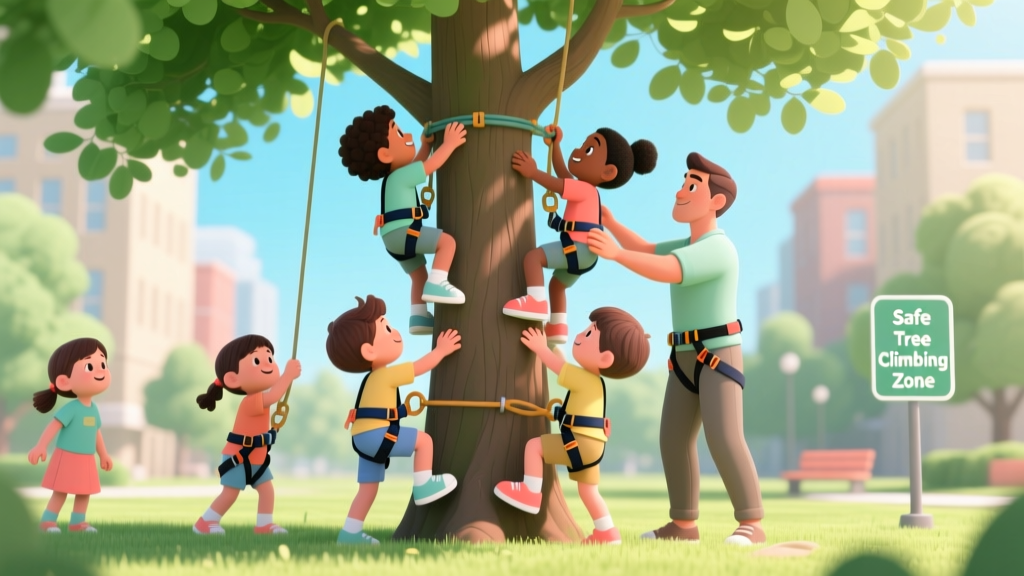
Tree Climbing Safety Rules and Benefits for Children (2026)
The Science Behind Tree Climbing
Developmental psychologists increasingly identify tree climbing as a "keystone play activity" — one that simultaneously develops multiple domains:
- Proprioception: Knowing where your body is in space without looking
- Motor planning: Sequencing movements to reach a goal
- Risk assessment: Evaluating branch strength, height, and escape routes
- Confidence: The pride of reaching a new height is unmatched
A 2022 study in the Journal of Adventure Education found that children who regularly climbed trees scored significantly higher on tests of spatial working memory compared to peers who did not engage in climbing play.
The 5-Point Safety Check
Teach children to evaluate every tree before climbing using the "TRUNK" acronym:
| Letter | Check | What to Look For |
|---|---|---|
| T | Trunk | Solid, no cracks, no fungal growth at base |
| R | Roots | Firm in ground, not exposed or rotting |
| U | Up high | No dead branches that could fall |
| N | No hazards | Power lines, wasp nests, or poison ivy nearby |
| K | Know your limits | Only climb as high as you're comfortable coming down |
Age-Appropriate Climbing Guidelines
Ages 3-4: Ground Level Exploration
Low, wide branches that are easy to sit on. Adult spots at all times. Focus on pulling up and sitting, not climbing higher.
Ages 5-7: Beginner Climbing
Branches within reach of an adult's arms. Three points of contact rule (two feet + one hand, or two hands + one foot). Maximum height: parent's reach.
Ages 8-12: Intermediate Climbing
Can assess branches independently. Teach the "dead branch test" (shake before trusting weight). Maximum height: where they can still call for help and be heard.
Ages 13+: Advanced Climbing
May climb higher with permission. Must demonstrate consistent judgment about branch strength and route planning.
Teaching the Three-Point Rule
The most important climbing safety rule: always maintain three points of contact with the tree. This means:
- Two feet and one hand, OR
- Two hands and one foot, OR
- One foot, one hand, and your body wedged against the trunk
Only move one limb at a time. Test each branch before putting full weight on it — push down first, then step.
Branch Strength Guide
| Branch Diameter | Safe Weight (approx.) | Notes |
|---|---|---|
| 2 inches (wrist-thick) | Up to 40 lbs | Good for hands, not feet for bigger kids |
| 3 inches (arm-thick) | Up to 80 lbs | Safe for most children to stand on |
| 4+ inches (thigh-thick) | 150+ lbs | Safe for adults |
Best Trees for Climbing
- Oak: Strong, wide branches; excellent for beginners
- Maple: Good branching structure; watch for brittle dead branches
- Apple/Crabapple: Low, spreading branches perfect for young climbers
- Pine: Avoid — branches can break unexpectedly and sap is messy
- Willow: Fun for hanging but branches are weak; sit only on trunk forks
Coming Down Safely
Most climbing injuries happen on the way down. Teach children to:
- Plan the descent route before going up (look down and remember footholds)
- Climb down backward — face the trunk
- Never jump from a height taller than themselves
- If stuck, call for help rather than attempting a risky move
When NOT to Climb
⚠️ No-Climb Conditions
- After rain — wet bark is extremely slippery
- During wind — branches sway and can snap
- At dusk or in darkness
- If the tree shows signs of disease (fungus, hollow trunk, many dead branches)
- If power lines are within 10 feet of any branch
More Articles
 Time Educational Toys for Outdoor & Home Learning
 Do Kids Need a Fishing License in NC? (2026)
 Family Bike Riding Safety Tips
 Math for Outdoor Pros: Essential Precision Calculations
 What to Do in Broken Bow with Kids (2026)
 Kids Water Play Ideas for Hot Summer Days
 New Mexico with Kids: 17 Low-Stress Outdoor Adventures
 Backyard Zip Line for Kids: Safety Guide 2026
 Nature Scavenger Hunt: Free Ideas for Kids
 How to Find Safe Trees for Kids to Climb