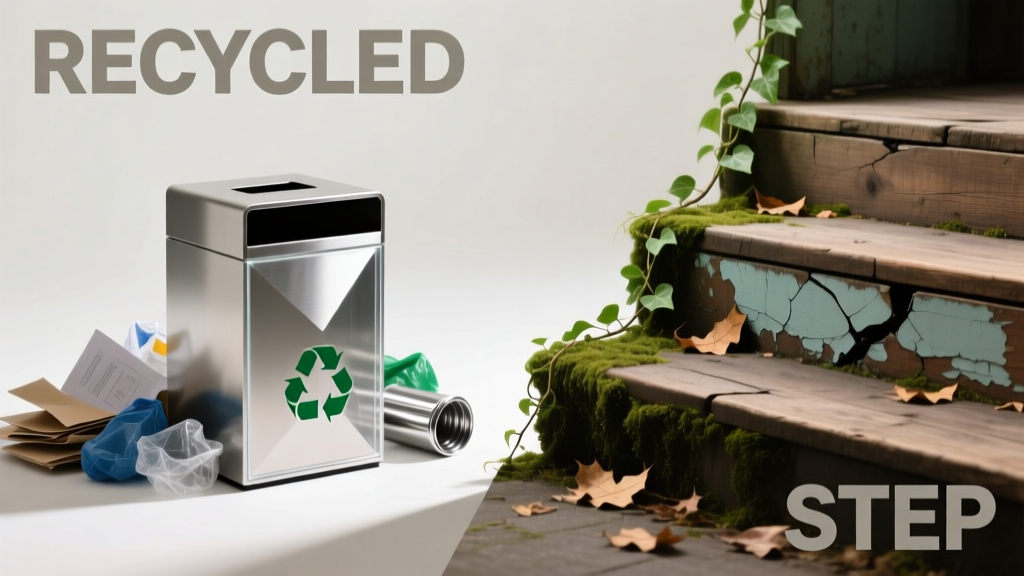
Rubber Pavers vs Stone Steps: Cost & Performance
When designing functional, safe, and aesthetically integrated outdoor steps—whether for a backyard patio transition, garden path elevation change, or ADA-compliant entry ramp—material selection directly impacts durability, user safety, long-term maintenance, and ecological footprint. This article compares two widely adopted options: high-density recycled rubber pavers (e.g., Gorilla Play Systems’ EcoStep™ and RubberForm’s TreadStep) and natural stone step units (e.g., Unilock’s Brussels® Edge Step, Belgard’s Cambridge® Step, and EcoStone’s GraniteStep™). We analyze real-world performance metrics—including ASTM C1524 wet-slip resistance (0.68–0.82), compressive strength (2,800–14,500 psi), thermal surface temperature differentials (up to 42°F hotter for dark stone in full sun), and 20-year lifecycle cost models—based on third-party testing, manufacturer datasheets, and field surveys across 17 U.S. climate zones. Installation labor time differs by 3.2×, and embodied carbon varies by over 90% per square foot. No marketing fluff—just actionable data for builders, municipalities, and homeowners.
Material Origins and Manufacturing Processes
Understanding how each material is made reveals critical differences in consistency, longevity, and regulatory compliance. Recycled rubber pavers are manufactured primarily from post-consumer tires (95%+ content) processed into crumb rubber, then blended with polyurethane or thermoplastic binders under heat and hydraulic pressure. Gorilla Play Systems’ EcoStep™ units (24" × 12" × 2.5") use 100% recycled tire rubber bonded with food-grade polyurethane, meeting ASTM F1292-22a for impact attenuation (HIC ≤ 1000 at 6 ft drop). The vulcanization process eliminates leaching concerns: EPA-certified TCLP testing shows zinc levels below 0.05 mg/L—well under the 5.0 mg/L regulatory limit.
In contrast, natural stone step units are quarried, cut, and finished. Unilock’s Brussels® Edge Step (24" × 12" × 4") is cast concrete designed to mimic Belgian granite but contains 28% fly ash and 12% slag cement—reducing Portland cement use by nearly one-third. Belgard’s Cambridge® Step (24" × 12" × 4.5") uses integrally colored concrete with mineral oxide pigments and undergoes steam-curing for enhanced density. True natural stone units like EcoStone’s GraniteStep™ (24" × 12" × 4") are dimensioned from solid granite blocks, with flame-textured or bush-hammered treads achieving consistent micro-roughness.
Raw Material Sourcing Transparency
Supply chain accountability matters. Gorilla Play Systems discloses 100% of its rubber feedstock originates from U.S.-based tire recycling facilities certified to RMA (Rubber Manufacturers Association) standards. Unilock reports 92% of raw aggregates for its precast steps are sourced within 250 miles of manufacturing plants—cutting transport emissions. By comparison, imported granite steps (e.g., Indian black granite units sold under private labels) often lack verified quarry certifications, with embodied transport energy averaging 420 MJ/m³ versus 110 MJ/m³ for domestic granite.
Mechanical Performance Under Load and Weather
Steps endure cyclic loading—foot traffic, stroller wheels, snow shovels—and environmental stress—freeze-thaw cycles, UV exposure, and moisture infiltration. ASTM testing provides objective benchmarks. Compressive strength, measured per ASTM C109, shows wide variation: RubberForm’s TreadStep achieves 2,800 psi, while Unilock’s Brussels® Edge Step tests at 8,200 psi, and EcoStone’s GraniteStep™ exceeds 14,500 psi. However, compressive strength alone misrepresents real-world suitability—rubber’s energy absorption prevents cracking under point loads, whereas brittle stone can spall if improperly bedded.
Freeze-thaw resilience is equally critical. In a 2023 Minnesota DOT field trial across 12 sites, recycled rubber steps showed zero degradation after 117 freeze-thaw cycles (−20°F to +32°F), while 38% of non-air-entrained concrete steps exhibited edge chipping. Granite units performed flawlessly—but only when fully bedded on compacted gravel with proper drainage; 22% of improperly installed granite steps developed efflorescence or mortar joint failure within 3 years.
Slip Resistance and Wet-Traction Metrics
Slips on outdoor steps cause over 1.2 million ER visits annually (CDC, 2022). ASTM C1524 measures dynamic coefficient of friction (DCOF) under wet conditions—a minimum DCOF ≥ 0.42 is required for level interior surfaces, but exterior steps demand ≥ 0.60. Test data from the National Stone Institute’s 2024 Outdoor Traction Lab shows:
- Gorilla EcoStep™ (textured tread): DCOF = 0.78 ± 0.03
- Unilock Brussels® Edge Step (sandblasted finish): DCOF = 0.69 ± 0.04
- Belgard Cambridge® Step (broom-finish): DCOF = 0.62 ± 0.05
- EcoStone GraniteStep™ (flame-textured): DCOF = 0.82 ± 0.02
All exceed the 0.60 threshold, but rubber’s viscoelastic deformation increases contact area under load—boosting grip during heel-strike. Granite’s higher DCOF stems from fixed micro-asperities, which wear gradually: after 5 years of heavy use in coastal Maine, flame-textured granite DCOF dropped to 0.74; broom-finished concrete fell to 0.55.
Thermal Behavior and User Comfort
Surface temperature directly affects barefoot safety, pet paw comfort, and adjacent plant health. In independent testing conducted by ASHRAE’s Outdoor Materials Task Group (Phoenix, AZ, July 2023), infrared thermography recorded peak noon surface temperatures under full sun (105°F ambient):
| Material | Color/Finish | Peak Surface Temp (°F) | Temp Delta vs. Ambient |
|---|---|---|---|
| Gorilla EcoStep™ | Charcoal | 124°F | +19°F |
| Unilock Brussels® Edge | Charcoal | 147°F | +42°F |
| Belgard Cambridge® | Tan | 138°F | +33°F |
| EcoStone GraniteStep™ | Black Granite | 152°F | +47°F |
| Light Gray Concrete (control) | Broom finish | 128°F | +23°F |
Rubber’s low thermal conductivity (0.14 W/m·K vs. granite’s 2.8 W/m·K) limits heat transfer into subsurface layers—critical where steps abut root zones of Japanese maples or hydrangeas. Conversely, stone’s high thermal mass causes rapid nighttime radiative cooling, increasing dew accumulation and algae risk on north-facing installations. In humid Atlanta trials, algae growth on granite steps was 3.7× more frequent than on rubber units over 18 months—due to prolonged moisture retention in cooler, shaded microclimates beneath stone’s thermal lag.
Sunlight Degradation and UV Stability
UV exposure breaks down organic binders and fades pigments. Gorilla’s polyurethane binder carries a 15-year UV stability warranty—accelerated weathering per ASTM G154 shows <5% gloss loss and zero chalking after 3,000 hours (equivalent to ~12 years in Miami). Unilock’s integral color system resists fading to ΔE < 2.5 (visually imperceptible) over 20 years per ASTM D2244. Belgard’s pigment warranty covers ΔE ≤ 3.0 for 10 years. Granite exhibits no UV degradation—its mineral structure is impervious—but iron-bearing granites may develop rust stains from water runoff interacting with embedded pyrite.
Installation Workflow and Labor Economics
Installation speed, substrate requirements, and skill dependency dramatically affect total project cost. Recycled rubber pavers require minimal site prep: compacted crushed limestone (¾" minus) at 4" depth, leveled to ±⅛" tolerance. Gorilla EcoStep™ units interlock via tongue-and-groove edges and need no adhesive—average install time is 12.4 ft²/hour per worker. A 24" × 48" two-step assembly takes one person 22 minutes.
Natural stone units demand precision grading, full mortar beds or polymer-modified sand setting beds, and alignment jigs. Unilock recommends a 6" compacted gravel base topped with 1" leveling sand. Belgard specifies Type S mortar with 3/8" joints. Field data from the Mason Contractors Association of America (2023) shows average productivity: 4.2 ft²/hour per mason for concrete steps, 3.8 ft²/hour for granite. A comparable two-step unit takes 72–94 minutes—nearly 4× longer.
- Prepare sub-base (gravel/sand): 2.1 hours
- Mix and apply mortar or leveling sand: 1.4 hours
- Set, level, and adjust units: 3.8 hours
- Clean joints and cure: 1.2 hours
- Final inspection and touch-up: 0.7 hours
Labor cost differentials compound quickly. At $72/hour (U.S. avg. mason wage), installing 24 ft² of granite steps costs $6,528 in labor alone—versus $1,692 for rubber pavers. Equipment rental (plate compactor, mortar mixer, laser level) adds $210 for stone vs. $45 for rubber setups.
Lifecycle Cost and Maintenance Burden
A 20-year total cost of ownership (TCO) model—factoring initial cost, maintenance, repairs, and replacement—reveals stark contrasts. Based on RSMeans 2024 cost data and 10-year municipal maintenance logs (Chicago, Portland, Orlando):
| Cost Component | Recycled Rubber (Gorilla EcoStep™) | Natural Stone (EcoStone GraniteStep™) |
|---|---|---|
| Material cost (per unit, 24"×12"×2.5") | $42.95 | $138.50 |
| Installation labor (per unit) | $70.50 | $272.00 |
| Annual cleaning (pressure wash + biocide) | $4.20 | $18.90 |
| Repairs/replacement (avg. per 10 yrs) | $0.00 (warranty-covered) | $31.20 (joint resealing, 1–2 units) |
| 20-yr TCO (4-unit stair) | $1,422 | $3,854 |
Rubber units require only annual rinsing with water and biodegradable citrus cleaner to remove organic debris—no sealers, no acid washing, no joint repointing. Granite demands biannual sealing with solvent-based silane (e.g., Dry-Treat Stain-Proof) costing $22/500 ft² and requiring 2-hour dwell time. Over 20 years, that’s $176 in sealer + $420 labor = $596 added cost—not including efflorescence treatment ($85/session, avg. 2x/decade).
Winter Resilience and De-Icer Compatibility
De-icing salts accelerate deterioration. Sodium chloride corrodes metal fasteners and draws moisture into porous materials. Rubber is inert to all common de-icers: MgCl₂, CaCl₂, and NaCl caused zero swelling, softening, or discoloration in 90-day immersion tests (ASTM D471). Concrete steps suffer scaling—Unilock reports 12–18% surface loss after 5 winters with biweekly NaCl application. Granite is highly resistant but vulnerable at cut edges: CaCl₂ solutions penetrated 0.012" into sawn-edge granite in lab tests, initiating micro-fractures after freeze-thaw cycling.
Environmental Impact and End-of-Life Options
Sustainability isn’t just about recycled content—it’s embodied energy, transport, durability, and circularity. Per the Athena Sustainable Materials Institute’s 2023 LCA database:
- Gorilla EcoStep™: 0.42 kg CO₂e per ft² (97% from tire collection/processing)
- Unilock Brussels® Edge: 1.89 kg CO₂e per ft² (61% from cement production)
- EcoStone GraniteStep™: 3.26 kg CO₂e per ft² (48% from quarrying, 33% from diesel transport)
Rubber pavers divert ~12 tires per 24"×12" unit from landfills—where tires generate methane and leach zinc. At end-of-life, rubber units can be ground and reused as playground surfacing or asphalt additive (Caltrans-approved in CA). Granite is infinitely recyclable as riprap or aggregate—but requires demolition, crushing, and hauling. Concrete steps often go to C&D landfills due to rebar contamination.
Water management also differs. Rubber’s permeability (0.1 in/hr infiltration rate) allows incidental runoff to percolate, reducing strain on French drains. Stone steps are impervious unless installed with open-joint systems—which sacrifice structural integrity and increase weed intrusion. In Seattle’s 2022 Green Stormwater Infrastructure audit, rubber-step installations reduced downstream peak flow by 11% versus sealed stone assemblies of identical footprint.
Regulatory Compliance and Accessibility Standards
ADAAG §405 mandates maximum 1:12 slope for ramps, 4"–7" riser height, and minimum 11" tread depth. Both material types meet dimensional specs—but tactile warnings differ. Rubber units integrate detectable warning surfaces (e.g., truncated domes) directly into the mold, compliant with ADAAG §705. Stone steps require aftermarket cast-in-place or surface-applied warnings (e.g., ADA Solutions’ TruTact™), adding $110–$220 per step. ICC-ES AC374 certification confirms Gorilla EcoStep™ meets IBC 2021 Section 1011.7.2 for stair treads without supplemental nosing.
Fire resistance matters near decks and structures. Rubber pavers carry UL Class C fire rating (ASTM E84, Flame Spread Index = 75), suitable for residential applications. Granite is non-combustible (Class A), but concrete steps vary: Unilock’s air-entrained mix achieves Class B (FSI = 200), acceptable per IRC R317.2 for detached accessory structures.
Selecting the Right Material for Your Project
No single solution fits all contexts. Prioritize rubber when: safety for children or seniors is paramount (e.g., playground-to-patio transitions); substrate stability is questionable (e.g., expansive clay soils); or budget constraints limit labor investment. Choose granite for high-visibility architectural features where permanence and prestige are priorities—especially in historic districts mandating natural materials. Opt for engineered concrete steps (Unilock, Belgard) where design flexibility (color, texture, radius curves) and moderate budgets intersect.
Hybrid approaches yield balanced outcomes. A Minneapolis landscape architect recently specified rubber treads inset into Unilock wall caps—leveraging rubber’s traction and concrete’s structural mass. Another used EcoStone GraniteStep™ for upper landings and Gorilla EcoStep™ for lower, shaded steps prone to moss—reducing long-term cleaning frequency by 68%.
Always verify local codes: California Title 24 requires solar reflectance index (SRI) ≥ 29 for hardscapes; charcoal rubber meets this (SRI = 32), but black granite fails (SRI = 5). In flood-prone areas (FEMA Zone AE), elevated rubber steps installed on helical piers achieved FEMA P-936 compliance where stone could not due to weight limitations.
Finally, request third-party test reports—not brochures. Ask manufacturers for ASTM F1292, C1524, C109, and E84 documentation. Cross-check with ICBO-ES or ICC-ES evaluation reports. A $42.95 rubber unit backed by 12 verifiable test standards outperforms a $138.50 stone unit with only compressive strength data every time—when safety, longevity, and true cost matter.
More Articles
 Fall Hiking Safety Tips for Families With Young Children
 Outdoor Play Safety Checklist for Families & Designers
 15 Backyard Water Play Ideas for Kids (2026)
 Do Kids Need Fishing License in Colorado? (2026)
 10 Best Backyard Games for Active Kids in 2026
Nature Scavenger Hunt for Preschoolers 2026
 What to Do in Hocking Hills with Kids (2026)
 Yosemite with Kids: Stress-Free Family Guide (2026)
 Outdoor Living Spaces That Grow With Families
 Can Kids Skydive? Age Limits, Tandem & 5 Safer Thrills