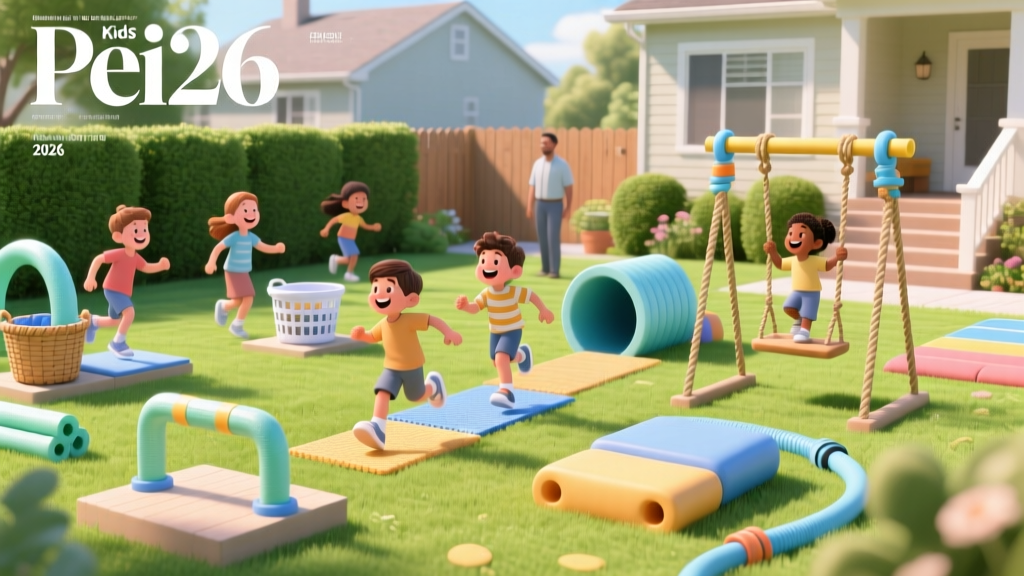
Backyard Obstacle Course for Kids (2026)
Why Obstacle Courses Are a Developmental Powerhouse
Pediatric occupational therapists consistently recommend obstacle courses because they simultaneously engage multiple developmental domains:
- Proprioception: Navigating varied surfaces teaches body awareness
- Vestibular processing: Spinning, balancing, and climbing develop inner ear coordination
- Executive function: Remembering the sequence and planning movements builds working memory
- Social skills: Taking turns, cheering, and collaborative problem-solving
A 2024 study in the Journal of Motor Learning and Development found that children who engaged in structured obstacle play showed 40% faster improvement in balance tasks compared to free play alone.
15 Backyard Obstacle Course Stations
Station 1: The Noodle Arch Limbo
Ages 3+ Setup: 2 minutes
Stick two pool noodles in the ground (or tape them to chairs) and drape a third across as a limbo bar. Kids crawl under without touching it.
Progression: Lower the bar each round, or add "no hands" rules for older kids.
Station 2: Hula Hoop Hop
Ages 3+ Setup: 3 minutes
Lay 5-8 hula hoops in a zigzag pattern on the ground. Kids hop from hoop to hoop on one foot (two feet for toddlers).
Materials: Hula hoops or chalk circles drawn on pavement.
Station 3: The Cardboard Tunnel
Ages 2-8 Setup: 5 minutes
Open large delivery boxes on both ends and tape them together into a tunnel. Kids army-crawl through.
Pro tip: Cut peek-a-boo windows for younger kids who might feel anxious in enclosed spaces.
Station 4: Balance Beam Challenge
Ages 4+ Setup: 2 minutes
Use a 2x4 board laid flat on the ground, or draw a line with chalk. Walk heel-to-toe without stepping off.
Progression: Add a beanbag on the head, or make them carry a cup of water.
Station 5: The Web (Yarn Maze)
Ages 5+ Setup: 10 minutes
String yarn between trees or fence posts to create a laser-maze style web. Kids navigate through without touching the strings.
Attach bells to the yarn for instant feedback when touched.
Station 6: Tire Run (or Chalk Ladder)
Ages 3+ Setup: 3 minutes
Lay old tires flat in a row (or draw a ladder pattern with chalk). Step in and out of each space quickly.
Focus: Speed and coordination — this builds fast-twitch muscle response.
Station 7: Water Bucket Relay
Ages 4+ Setup: 3 minutes
Fill a large bucket at the start, give kids a small cup. They must transfer water to an empty bucket 20 feet away — through the obstacle course.
Summer bonus: Getting wet is part of the fun.
Station 8: Target Throw
Ages 3+ Setup: 2 minutes
Set up a laundry basket or cardboard box. Kids throw 3 beanbags (or rolled-up socks) and must get at least 1 in before moving on.
Station 9: The Floor Is Lava
Ages 4+ Setup: 3 minutes
Place cushions, stepping stones, or paper plates as "safe zones." Kids must cross the area without touching the ground.
Station 10: Jump Rope Station
Ages 6+ Setup: 1 minute
10 consecutive jumps (5 for younger kids). Older kids try double-unders or criss-cross.
Station 11: Crawling Under Rope
Ages 2+ Setup: 3 minutes
String rope between two posts at about 18 inches high. Belly-crawl underneath without touching it.
Station 12: Simon Says Stop
Ages 3+ Setup: 0 minutes
At this station, a parent or older kid calls out a movement (spin, hop, touch toes). The runner must do it before proceeding.
Station 13: Puzzle Pit
Ages 5+ Setup: 2 minutes
Scatter 5-10 pieces of a simple jigsaw puzzle at this station. Kids must assemble it before moving on. Use a 12-piece puzzle for younger kids, 24+ for older.
Station 14: Sack Race Sprint
Ages 4+ Setup: 1 minute
Pillowcases or burlap sacks — hop 20 feet to the next station marker.
Station 15: The Finish Line Bell
All ages Setup: 2 minutes
Hang a bell or wind chime at the finish. Every runner rings it and gets their time recorded. Post a leaderboard on the back door.
Age-Based Course Design
| Age Group | Recommended Stations | Course Length | Adult Supervision |
|---|---|---|---|
| 2-4 years | 5-7 simple stations | 10-15 minutes | 1 adult per 2 kids |
| 5-7 years | 8-12 stations | 20-30 minutes | 1 adult per 4 kids |
| 8-12 years | 12-15 stations | 30-45 minutes | 1 adult per 6 kids |
Safety Checklist
⚠️ Before Starting
- Walk the course yourself first — check for sharp edges, tripping hazards, and loose stakes
- Ensure 3+ feet of clearance around each station
- Have a first-aid kit and water station accessible
- Apply sunscreen 20 minutes before outdoor courses
- Set clear rules: one kid per station at a time, no pushing
Making It a Regular Event
The magic of backyard obstacle courses is their replay value. Here's how to keep it fresh:
- Theme days: "Ninja Warrior Monday," "Olympic Saturday," "Pirate Treasure Run"
- Time trials: Record personal bests on a whiteboard
- Team mode: Pair kids up for relay-style races
- Seasonal swaps: Add water stations in summer, leaf piles in fall, snow stations in winter
- Design challenges: Let older kids redesign one station each week
Frequently Asked Questions
How much space do I need for a backyard obstacle course?
A 20x30 foot area is sufficient for a 10-station course. Even a narrow side yard can work if you arrange stations in a linear path rather than a loop.
What if I don't have a backyard?
Many of these stations work in a park, driveway, or even indoors. The hula hoop hop, balance beam, target throw, and puzzle pit all work on a flat indoor surface.
How do I keep kids motivated to repeat the course?
Time trials with a visible leaderboard are the most effective motivator. Add small rewards for personal bests, not just fastest times — this keeps slower kids engaged.
Is this safe for toddlers?
Yes, with modifications. Use the age guide above, keep stations low to the ground, and maintain close supervision. Avoid any station with heights over 12 inches for children under 4.
More Articles
 How to Plan a Family Camping Trip with Young Kids (2026)
 Backyard Kids Agility Course 2026: Pool Noodles & Cones
 Nature Exploration Activities for Young Kids
 Do Kids Need a Fishing License in MN? (2026)
 What to Do in Helen GA With Kids: Outdoor Adventures
 Boulder with Kids: 12 Low-Stress Outdoor Adventures
 Best Playground Games for Groups of Kids
 Outdoor Water Games for Hot Days
 Backyard Camping Games for Families
 How to Make an Igloo for Kids: Safe & Easy Guide