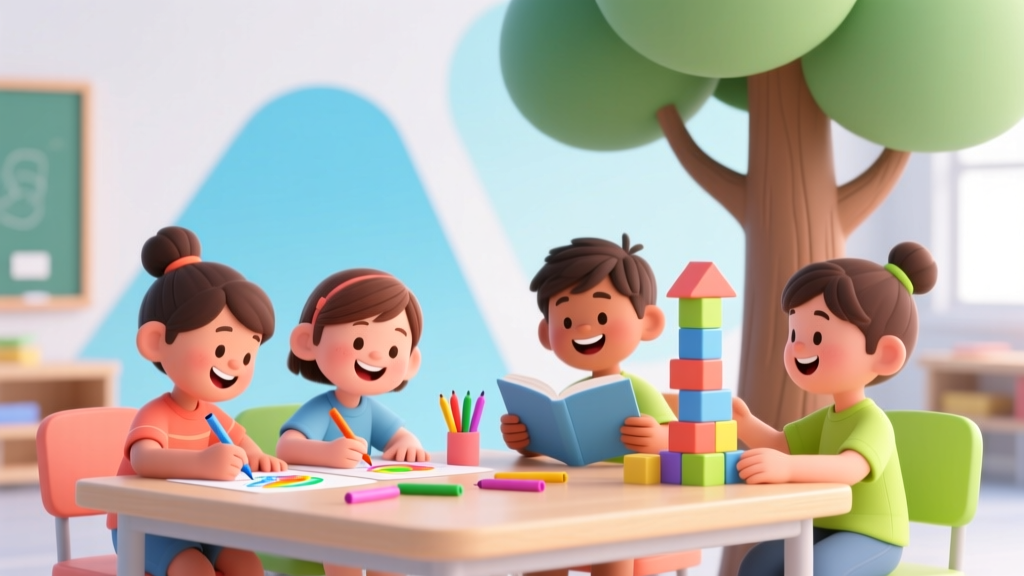
What Kids Do in Preschool: Real Activities That Build Brains
Why Understanding What Kids Do in Preschool Matters More Than Ever
If you've ever stood outside a preschool gate wondering, What do kids do in preschool? — you're not just curious. You're weighing a foundational decision that shapes your child’s social-emotional resilience, executive function, language fluency, and lifelong learning identity. In an era where screen time competes with sandbox time and academic pressure creeps into pre-K curricula, knowing what truly happens behind those brightly painted doors isn’t optional — it’s essential parental intelligence. And the truth? Most preschools aren’t delivering flashcards or worksheets. They’re engineering micro-experiences that wire neural pathways through play, routine, and relational safety.
1. The Rhythm Behind the Play: How Daily Structure Drives Development
Preschool isn’t unstructured chaos — it’s intentionally paced scaffolding. According to the National Association for the Education of Young Children (NAEYC), high-quality programs follow a predictable yet flexible daily rhythm designed to honor children’s biological needs while building self-regulation. A typical 3-hour morning session might include arrival rituals (e.g., name-tagging, weather charting), small-group rotations, outdoor movement, snack with conversation modeling, and closing circle. This consistency reduces anxiety and builds working memory — because when children know what comes next, their brains free up cognitive bandwidth for deeper thinking.
Take Maya, a 4-year-old in a Reggio Emilia-inspired Chicago co-op. Her teacher begins each day with a ‘wonder walk’ — not a hike, but a slow, sensory-focused 8-minute stroll around the schoolyard where kids collect one natural object (a pinecone, smooth stone, feather) and describe its texture, weight, or sound. That simple ritual activates proprioception, vocabulary, observation skills, and shared attention — all before 9 a.m. It’s not ‘just walking.’ It’s neurodevelopmental architecture in action.
Key structural elements include:
- Transitions as teachable moments: Instead of shouting “Line up!”, teachers use songs (“The Wiggle Worm Song”), visual timers, or tactile cues (passing a smooth river stone) to build impulse control and sequencing skills.
- Choice within boundaries: During center time, children select between 3–4 activity zones — but each zone has embedded learning goals (e.g., block area = spatial reasoning + cooperative negotiation; writing center = fine motor prep + emergent literacy).
- Intentional downtime: Naps or quiet rest periods aren’t relics — they’re non-negotiable for memory consolidation. A 2023 longitudinal study in Early Childhood Research Quarterly found children who engaged in consistent rest periods showed 27% stronger recall of morning vocabulary lessons.
2. Beyond Finger Paints: The 5 Core Activity Domains That Actually Move the Needle
When parents ask, What do kids do in preschool?, they often picture art and storytime — and those are vital. But what separates transformative programs from babysitting centers is how deeply those activities map to evidence-based developmental domains. Here’s how five core activity types translate into measurable growth:
- Sensory-Integration Play: Think water tables with pipettes and funnels, kinetic sand with hidden counting tokens, or scented playdough infused with lavender and peppermint. These aren’t just ‘fun’ — they regulate the nervous system and build neural connections for math and science reasoning. Occupational therapists emphasize that tactile input strengthens hand muscles needed for pencil grip and improves focus in later grades.
- Language-Rich Small Groups: Not ‘circle time’ as passive listening — but dialogic reading (teacher asks open-ended questions like “What do you think will happen *before* we turn the page?”), puppet interviews (“Ask the dragon why he’s sad”), and shared journaling where children dictate stories to teachers who scribe verbatim — preserving voice, syntax, and narrative structure.
- Real-World Responsibility: Children water plants, set tables with child-safe utensils, feed classroom pets, and help wipe spills. These tasks build executive function (planning, task initiation, self-monitoring) and intrinsic motivation. As Dr. Laura Jana, pediatrician and co-author of The Toddler Brain, explains: “Giving 3- and 4-year-olds authentic jobs doesn’t burden them — it tells their brain, ‘You belong here. Your actions matter.’”
- Outdoor Risk-Taking: Yes — climbing, balancing on logs, using child-sized pruners to harvest herbs, or building stick forts. The UK’s Forest School Association reports children in nature-rich programs show 40% fewer conflict incidents and significantly higher persistence on challenging tasks. Controlled risk teaches assessment, consequence prediction, and physical confidence — none of which develop behind plastic slides.
- Conflict Mediation Rituals: When two children argue over a tricycle, teachers don’t ‘solve it’ — they guide with scripts: “I see you both want the red bike. What’s one thing you need right now?” Then they coach negotiation: “Can you take turns? How will you remember whose turn is next?” This builds theory of mind, empathy, and verbal problem-solving — far more than any ‘sharing lesson’ lecture ever could.
3. What the Data Shows: Which Activities Deliver the Highest ROI in School Readiness
Not all preschool activities yield equal developmental returns. A 2022 meta-analysis of 68 studies (published in Developmental Psychology) ranked activity impact by standardized gains in kindergarten readiness assessments. Below is a distilled comparison of time-invested versus outcomes across six common preschool modalities:
| Activity Type | Avg. Weekly Time (in high-quality programs) | Strongest Developmental Domain Impact | Measured Outcome Gain (vs. control group) | Key Research Source |
|---|---|---|---|---|
| Collaborative Block Building (with guided challenges) | 45–60 min | Cognitive & Social-Emotional | +18% in spatial reasoning tests; +22% in cooperative problem-solving scores | National Institute for Early Education Research (NIEER), 2021 |
| Dialogic Storytelling Circles | 20–30 min | Language & Literacy | +31% in vocabulary acquisition; +26% in narrative retell accuracy | Journal of Educational Psychology, 2022 |
| Outdoor Nature Journaling (drawing + dictated captions) | 30–40 min | Scientific Reasoning & Fine Motor | +15% in observational accuracy; +19% in letter formation fluency | Early Childhood Education Journal, 2023 |
| Music & Movement with Intentional Tempo Shifts | 15–20 min | Executive Function & Auditory Processing | +24% in impulse control (stop-signal task); +17% in phonological awareness | American Academy of Pediatrics, Bright Futures Guidelines, 2023 |
| Structured Pretend Play (e.g., ‘post office,’ ‘veterinary clinic’) | 35–50 min | Social-Emotional & Language | +29% in perspective-taking; +23% in complex sentence usage | Child Development, 2020 |
| Free Art with Open-Ended Materials (no templates) | 25–35 min | Creative Expression & Self-Regulation | +12% in frustration tolerance; +14% in divergent thinking scores | International Journal of Early Years Education, 2022 |
Note the pattern: activities with embedded intentionality — clear goals, adult scaffolding, and reflection — outperform passive or loosely guided ones. Free play matters, but *guided* free play transforms it into developmental leverage.
4. The Hidden Curriculum: What Kids Learn Without Being Taught
Beyond the visible activities lies a subtle, powerful curriculum — one no lesson plan outlines but every child absorbs: the culture of belonging. How teachers respond to tears, how conflicts are resolved, how mistakes are framed (“Oops — let’s try again!” vs. “That’s wrong”) — these shape a child’s internal narrative about competence, safety, and worth.
In a Portland Montessori program, 3-year-olds rotate through ‘grace and courtesy’ lessons: how to blow your nose without making noise, how to interrupt politely (“Excuse me, I have a question”), how to carry a tray without spilling. These aren’t etiquette drills — they’re embodied lessons in respect, autonomy, and interdependence. As Maria Montessori wrote, “The child is both a hope and a promise for mankind.” Preschool is where that promise begins its first, quiet fulfillment.
Equally critical is what’s not happening: no standardized testing, no timed worksheets, no ‘homework.’ According to AAP guidelines, formal academic instruction before age 5 shows no long-term advantage in reading or math achievement — and can increase anxiety and reduce intrinsic motivation. What does predict kindergarten success? Self-regulation, oral language, curiosity, and secure attachment — all cultivated through the very activities listed above.
Frequently Asked Questions
How much time should preschoolers spend on academics vs. play?
Zero minutes on formal academics — and 100% of their time on play-based learning. The American Academy of Pediatrics states unequivocally that ‘academic push-down’ to preschool is developmentally inappropriate and counterproductive. Letters and numbers emerge naturally through play: counting shells at the water table, tracing letters in shaving cream, matching rhyming words in songs. When play is rich and supported, literacy and numeracy bloom organically — not as isolated skills, but as tools for meaning-making.
Is outdoor play really that important — or just ‘nice to have’?
It’s non-negotiable — and research treats it as foundational. A landmark 2021 study tracking 2,800 children across 12 countries found that preschoolers with ≥60 minutes of daily unstructured outdoor time had 34% lower odds of developing attention-deficit symptoms by age 7. Nature exposure regulates cortisol, boosts vitamin D (linked to mood and immunity), and develops gross motor coordination — which directly supports fine motor control needed for writing. Rain or shine, quality preschools prioritize daily outdoor immersion — with appropriate gear, not excuses.
What if my child ‘just plays’ — does that mean they’re not learning?
Exactly the opposite. Play is the highest form of research — for young children. Neuroscientists confirm that during imaginative, sensory-rich, socially negotiated play, children activate multiple brain regions simultaneously: prefrontal cortex (decision-making), Broca’s area (language), mirror neurons (empathy), and cerebellum (motor planning). When your child spends 20 minutes building a ‘dragon cave’ with blocks, they’re integrating physics (balance, gravity), storytelling (sequencing, cause-effect), collaboration (negotiating roles), and emotional regulation (managing frustration when it collapses). Play isn’t the break from learning — it’s where the deepest learning lives.
How can I tell if a preschool’s activities are truly developmentally appropriate?
Look for these 4 hallmarks: (1) Child-led choice within structured environments (not ‘free-for-all’ or rigid schedules), (2) Teachers narrating thinking aloud (“I notice you’re stacking the blue blocks first — are you planning a tower or a bridge?”), (3) Materials that invite open-ended use (loose parts, natural objects, blank paper) over single-purpose toys, and (4) Documentation — photos, transcripts, and samples of children’s work displayed with their words explaining it. If the walls are covered in identical crafts or alphabet charts, keep looking. If you see process journals, child-dictated stories, and ‘How We Solved It’ charts, you’ve found gold.
Common Myths
Myth #1: Preschool is mainly about socialization — learning to ‘play nice.’
Reality: While peer interaction is vital, socialization in high-quality preschool is intentional skill-building — teaching children how to read facial cues, negotiate fairness, repair ruptures, and advocate for needs. It’s not just ‘getting along’ — it’s building the relational infrastructure for future teamwork, leadership, and emotional intelligence.
Myth #2: Learning letters and numbers early gives kids a head start.
Reality: Rushing academics backfires. A 2023 Vanderbilt University study followed children from play-based vs. academically focused preschools for 8 years — the play-based cohort outperformed on creativity, problem-solving, and high-school graduation rates. Early rote memorization doesn’t build neural flexibility; inquiry-based exploration does.
Related Topics (Internal Link Suggestions)
- Preschool vs. Pre-K: Key Differences Parents Need to Know — suggested anchor text: "preschool vs pre-k differences"
- How to Choose a Preschool: A 12-Point Checklist Backed by Early Childhood Experts — suggested anchor text: "how to choose a preschool"
- Red Flags in Preschool Programs: What to Watch For (and Walk Away From) — suggested anchor text: "preschool red flags to avoid"
- At-Home Preschool Activities That Mirror Classroom Best Practices — suggested anchor text: "preschool activities at home"
- Montessori, Waldorf, Reggio Emilia: Decoding Preschool Philosophies — suggested anchor text: "Montessori vs Waldorf vs Reggio"
Your Next Step Starts With Observation — Not Enrollment
Now that you know what kids do in preschool — not as a list of cute activities, but as a dynamic ecosystem of brain-building, relationship-forging, and identity-shaping experiences — your power shifts. You’re no longer shopping for a place to ‘keep your child busy.’ You’re selecting a developmental partner. So before signing any contract, visit — not once, but twice, at different times of day. Sit quietly. Watch how teachers speak to children (do they kneel to eye level? Do they pause after asking questions?). Notice where children’s focus lands (are materials inviting investigation or just decoration?). And most importantly: listen for the hum of joyful, purposeful engagement — not silence, not chaos, but the vibrant, messy music of growing minds at work. Ready to compare programs side-by-side? Download our free Preschool Program Scorecard — a printable checklist vetted by NAEYC-certified early childhood specialists.
More Articles
 Who Was Bad Bunny’s Breakdancer? (2026)
 Hubie Halloween for Kids: Age Guide & Scare Level (2026)
 17 Low-Cost, Expert-Approved Kid-Friendly Spots
 Construction Play for Ages 2–4: Build Lifelong Skills
 Savannah GA with Kids: 17 Stress-Free Activities
 Grinch Meal for Kids: Age Range & Sugar Facts (2026)
 Ya Kida: Boost Toddler Confidence & Language (2026)
How to Repair Base: Kid-Tested Guide for Parents
Ya Kida: Boost Toddler Confidence & Language (2026)
How to Repair Base: Kid-Tested Guide for Parents
 What Is a Scene Kid? Identity, Culture & 2026
 Rainy Day Learning Games for Home (2026)