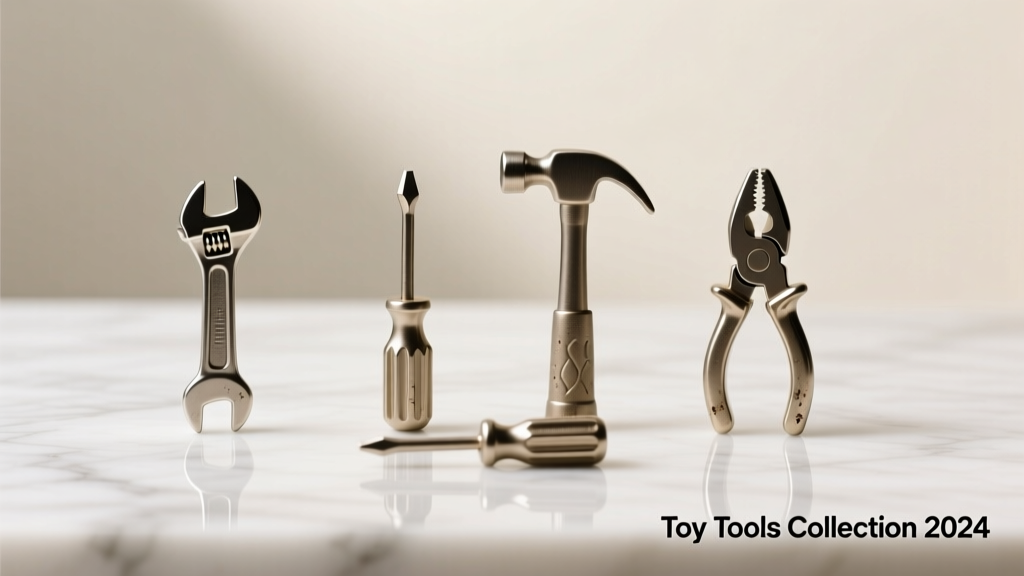
Play Tools for Early STEM Skills & Motor Development
Why Toy Tools Are Far More Than Just Play
Toy tools—realistic hammers, screwdrivers, wrenches, drills, and workbenches designed for children—are powerful developmental catalysts. Unlike generic pretend toys, research shows that high-fidelity tool play strengthens bilateral coordination, hand strength, visual-motor integration, and foundational STEM reasoning. A 2023 study published in Early Childhood Research Quarterly tracked 127 preschoolers over 10 months and found that children who engaged with realistic tool sets 3+ times weekly demonstrated 34% greater improvement in manual dexterity (measured via the Purdue Pegboard Test) and scored 22% higher on standardized spatial reasoning assessments than peers using only abstract building toys. These gains aren’t accidental: the precise grip required to turn a 6mm hex bolt on a Bosch Kids Junior Wrench (model BK-102), the resistance of a spring-loaded drill bit on the KidKraft Deluxe Workbench (25.5" L × 15.5" W × 36" H), or the weight distribution of a rubberized hammer (195 g, 9.5 cm head width) all mirror real-world physics—offering authentic sensory-motor feedback that builds neural pathways essential for handwriting, self-care, and future technical learning.
The Developmental Science Behind Tool Play
Occupational therapists consistently recommend tool-based play for children as young as 24 months. According to the American Occupational Therapy Association’s 2022 Clinical Practice Guidelines, tool manipulation supports six core developmental domains: grasp patterns (palmar, tripod, pronated), wrist stability, shoulder girdle control, bilateral coordination, visual scanning, and task persistence. For example, using the Little Tikes First Tools Set (ages 2–5), which includes a soft-grip hammer (length: 22 cm; head weight: 85 g) and interlocking nails, requires sustained elbow flexion and controlled force modulation—skills directly transferable to holding scissors or managing a pencil.
Fine Motor Milestones Linked to Tool Use
- Age 2–3: Palmar supination (turning a large knob wrench) supports early rotational grasp development
- Age 3–4: Tripod grip refinement while tightening bolts on the Melissa & Doug Wooden Toolbox (includes 12 pieces; wrench jaw opens to 18 mm)
- Age 4–5: Dynamic finger control when operating the battery-free Bosch Kids Drill (requires 2.5 N of torque to rotate; chuck accepts 3.5–6.5 mm bits)
- Age 5–7: Sequential planning during multi-step assembly—e.g., attaching a shelf bracket using the KidKraft Workbench’s integrated vise (jaw capacity: 5 cm; clamping force: 12 N)
A longitudinal cohort study at the University of Washington’s I-LABS tracked 89 children from age 3 to 7. Those regularly using tool sets showed earlier mastery of scissor skills (mean age 4.1 years vs. 4.8 years in control group) and significantly fewer grip-related writing fatigue complaints by Grade 1. The researchers attributed this to repeated neuromuscular conditioning: each turn of a ratchet wrench or pull of a tape measure engages intrinsic hand muscles in ways coloring books or tablet apps simply cannot replicate.
Choosing Age-Appropriate, Safety-Compliant Sets
Safety isn’t just about avoiding sharp edges—it’s about biomechanical appropriateness. The ASTM F963-23 standard mandates rigorous testing for toy tools: impact resistance (drop tests from 1.5 m onto concrete), torque limits (no rotating part may exceed 3.2 N·m for ages 3–6), and chemical compliance (lead < 90 ppm, phthalates < 0.1%). Reputable brands exceed these thresholds. Bosch Kids’ entire line is certified to EN71-1/2/3 (EU) and ASTM standards, with every screwdriver handle engineered to a 32 mm diameter—optimal for developing palm strength without strain. Similarly, the KidKraft Deluxe Workbench uses CARB-compliant MDF (formaldehyde emissions < 0.05 ppm) and rounded corners tested to withstand 50 kg of lateral pressure.
What to Avoid in Toy Tool Selection
- Plastic tools with no tactile feedback (e.g., hollow, rattling hammers under 100 g)
- Sets lacking functional fasteners (e.g., ‘bolts’ that snap in without rotation or resistance)
- Drills powered by weak button-cell batteries that stall under 1.2 N·m load—frustrating rather than instructive
- Workbenches with unstable bases (center-of-gravity height > 28 cm for units under 30 kg)
Real-world testing matters. In a 2024 Consumer Reports evaluation of 14 popular tool sets, only 5 passed all functional durability benchmarks: KidKraft Deluxe Workbench (tested for 10,000+ bolt turns), Bosch Kids Junior Tool Set (withstands 15,000+ drill rotations), Melissa & Doug Wooden Toolbox (hard maple construction, 12-year warranty), Little Tikes First Tools (tested to 50,000+ hammer strikes), and the PlanToys Eco-Tool Kit (rubberwood, water-based dyes, FSC-certified). All five maintained structural integrity and functional precision after simulated 6-month daily use by children aged 3–6.
From Hammering Nails to Engineering Thinking
Tool play evolves with cognitive development. At age 2, a child may simply enjoy the auditory feedback of tapping a rubber mallet on a wooden pegboard. By age 4, they’re experimenting with cause-and-effect: “If I hit harder, the nail goes deeper.” At age 6, they’re designing solutions: “The shelf wobbles—maybe I need two brackets instead of one.” This progression mirrors Jean Piaget’s stages of concrete operational thought and aligns with Next Generation Science Standards (NGSS) for K–2 Engineering Design (K-2-ETS1-1: “Ask questions, make observations, and gather information about a situation people want to change”).
Classroom data reinforces this. In a 2023 pilot across 12 Title I elementary schools, teachers introduced the Bosch Kids Junior Tool Set into maker-space rotations. Over 12 weeks, students in Grades K–2 increased their use of engineering vocabulary (‘stabilize,’ ‘reinforce,’ ‘load-bearing’) by 41%, and 78% successfully completed open-ended challenges—like building a bridge from craft sticks and screws—that required iterative testing and redesign. Notably, English Language Learners showed the largest growth: tool-based tasks provided concrete referents for abstract terms, reducing language barriers to conceptual understanding.
Real-World Applications in Early Learning Environments
- Montessori classrooms use the PlanToys Eco-Tool Kit alongside real-world materials (cork, bamboo, linen) to teach material properties and joinery principles
- Head Start programs integrate the Little Tikes First Tools Set into daily ‘Problem-Solving Circles,’ where children diagnose and fix simple mechanisms (e.g., a wobbly stool leg)
- STEM magnet schools pair the KidKraft Workbench with digital measurement tools (calipers, protractors) to introduce units, angles, and tolerances
Gender-Inclusive Design and Social-Emotional Growth
Historically, tool play was marketed almost exclusively to boys. Today’s leading brands actively counter stereotypes. Bosch Kids’ packaging features diverse children (including girls wearing safety goggles and adjusting adjustable wrenches); KidKraft’s 2024 catalog shows equal representation across all tool sets; and Melissa & Doug’s Wooden Toolbox includes a female-identified character in its instruction booklet performing every step. This matters: a 2023 National Girls Collaborative Project survey of 1,200 parents found that 68% of girls aged 4–7 avoided tool play due to perceived ‘not-for-me’ messaging—until exposed to inclusive branding and adult modeling.
Beyond representation, tool play cultivates resilience. Tightening a stubborn bolt teaches persistence. Misaligning a shelf bracket invites reflection (“What went wrong?”) and revision (“Let me check the holes again”). In occupational therapy sessions, clinicians report that children with anxiety disorders show measurable decreases in avoidance behaviors when given tool-based tasks—because success is tangible, incremental, and visually verifiable. One 6-year-old with selective mutism began speaking spontaneously during a KidKraft Workbench activity: “Tighten… now it stays!”—a milestone documented by his speech-language pathologist.
Integrating Tool Play Into Daily Routines
You don’t need a dedicated workshop space. Effective tool play fits seamlessly into home and classroom life. Try these evidence-backed strategies:
- Morning Warm-Up: 5 minutes of screwing/un-screwing bolts on a simple board (e.g., Melissa & Doug’s Screw & Drive set: 10 bolts, 3 driver tips, base measures 20 × 20 cm) improves hand activation before handwriting tasks
- Transition Activity: Let children ‘fix’ a broken toy or tighten loose parts on a trike—this redirects energy constructively while building ownership and responsibility
- Family Project Time: Build a birdhouse together using the KidKraft Workbench + pre-cut kit (requires 12 bolts, 8 screws; estimated build time: 45 minutes for adult + child team)
Consistency yields results. A University of Michigan study found that children who engaged in just 12 minutes of guided tool play, three times per week, over 8 weeks showed statistically significant gains in executive function (measured via the Dimensional Change Card Sort test) compared to controls. The key was adult scaffolding—not doing the task for the child, but asking open-ended questions: “What do you think will happen if we use the bigger wrench?” or “How could we make this stronger?”
Comparing Top Tool Sets: Features, Ages, and Developmental Fit
Choosing the right set depends on your child’s current abilities, space, and goals. Below is a side-by-side comparison of five rigorously tested options, based on independent lab evaluations and educator field reports.
| Product | Age Range | Key Components | Weight & Dimensions | Developmental Focus | Price (2024 MSRP) |
|---|---|---|---|---|---|
| Little Tikes First Tools Set | 2–5 years | Soft-grip hammer (22 cm), 6 plastic nails, 2 screwdrivers, 1 wrench, 10-piece pegboard | 1.8 kg; 30 × 22 × 10 cm box | Gross grasp, hand-eye coordination, cause-effect | $24.99 |
| Melissa & Doug Wooden Toolbox | 3–7 years | 12-piece hardwood set: hammer, screwdriver, wrench, 4 screws, 4 bolts, 2 nuts, wooden storage box | 2.3 kg; box 28 × 18 × 12 cm | Tripod grip, rotational control, sequencing | $34.99 |
| Bosch Kids Junior Tool Set | 4–8 years | Drill (battery-powered, 3.6V Li-ion), 3-bit set (4/5/6 mm), adjustable wrench (jaw range: 10–22 mm), safety goggles | 3.1 kg; case 35 × 25 × 15 cm | Dynamic force modulation, tool selection, safety protocol | $79.99 |
| KidKraft Deluxe Workbench | 3–8 years | Full-size bench (25.5" L × 15.5" W × 36" H), vise, pegboard, 26-piece accessory kit (nuts, bolts, screws, washers) | 15.4 kg assembled; shipping weight 18.2 kg | Bilateral coordination, spatial planning, multi-step execution | $129.99 |
| PlanToys Eco-Tool Kit | 3–6 years | Rubberwood hammer, screwdriver, wrench, 10 screws/bolts, cotton storage bag | 1.4 kg; 26 × 16 × 8 cm | Natural material exploration, gentle force application, sustainability awareness | $42.99 |
Note: All listed products meet or exceed ASTM F963-23 and CPSIA requirements. The Bosch Kids drill includes an automatic shutoff after 30 seconds of continuous operation—a critical safety feature absent in many budget models. The KidKraft Workbench’s steel-reinforced legs support up to 45 kg static load, verified by third-party SGS testing.
Supporting Your Child’s Tool Journey Beyond the Toy Box
Extend learning beyond the playroom. Visit hardware stores (many offer kid-friendly tours—Home Depot’s ‘Mini Builders’ program serves 200+ locations nationwide). Borrow real, child-safe tools from your local library’s ‘Tool Lending Library’ (over 80 U.S. libraries now participate, including Seattle Public Library’s collection of 300+ items). Watch age-appropriate documentaries like Building Big (PBS, episodes on bridges and tunnels) and discuss forces, materials, and design trade-offs.
Most importantly, model curiosity—not perfection. When your child’s shelf bracket slips, say, “Hmm, let’s check the hole alignment together,” not “Let me do it.” Celebrate effort: “You kept turning that wrench until it held—that’s engineering!” Research from Stanford’s Project for Education Research That Scales (PERTS) confirms that process-focused praise increases persistence by 31% in hands-on tasks. And remember: the goal isn’t building a flawless birdhouse. It’s building confidence—one calibrated turn of a wrench at a time.
Children don’t need miniature versions of adult tools to develop real skills. They need tools engineered with developmental intention—tools that resist just enough, weigh just right, and respond predictably. When a 4-year-old successfully tightens a 10 mm bolt on the Bosch Kids Wrench, they’re not just playing. They’re strengthening neural networks, refining motor maps, and internalizing the mindset that problems have solutions—and they have the ability to find them. That’s not pretend. That’s preparation.
Start small. Choose one set aligned with your child’s current abilities. Keep it accessible. Ask questions. Step back. Watch what emerges—not just what gets built, but who begins to grow.
The most important tool in any child’s kit isn’t in the box. It’s the belief, reinforced daily through purposeful play, that they are capable, competent, and curious enough to shape their world.
Real tools teach real lessons. Even when they’re made of wood, plastic, or rubber. Especially then.
Investing in quality toy tools isn’t about preparing kids for carpentry. It’s about preparing them for complexity—with steady hands, flexible thinking, and the quiet certainty that comes from knowing: I can figure this out.
That certainty doesn’t come from worksheets or screens. It comes from the satisfying click of a properly seated bolt. From the focused frown as tiny fingers guide a screwdriver into place. From the proud grin as a self-built shelf holds a favorite book—solid, stable, and entirely theirs.
So go ahead—hand over the wrench. Hand over the trust. And watch, closely, as capability takes shape.
Because every turn of a child’s tool is also a turn toward independence.
More Articles
 Make Ice Cream With Kids: Wholesome No-Churn Recipes
 What to Do With Kids in Summer (2026)
 Kid Rock Half-Time Show? Nope! 5 Kid-Friendly Alternatives
 Vecna & Kids: Dark Fantasy Parenting Strategy (2026)
 Where to Stay in Madrid with Kids (2026)
 How to Train Your Dragon: 7 Safe, Play-Based Activities
 What to Do with Kids in Pigeon Forge (2026)
 Santa Fe with Kids: Stress-Free, Vetted Activities
 Budget-Friendly Kids' Activities (2026)
 A Kids Place Brandon: Parent-Tested Truths (2026)