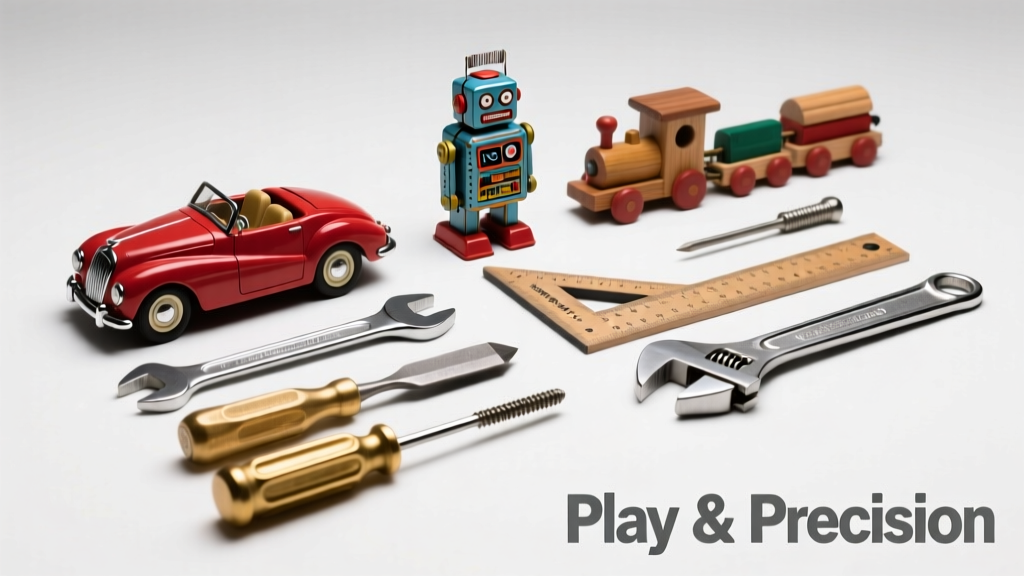
Child’s Hammer vs Carpenter’s: Toys and Tools Compared
Why the Line Between Toy and Tool Matters More Than You Think
Children as young as 18 months begin mimicking adult tool use—tapping blocks with toy hammers, twisting plastic screwdrivers, or 'drilling' cardboard with battery-free toy drills. But not all hammer-shaped objects are created equal. A Fisher-Price Laugh & Learn Workbench hammer weighs 142 grams and has a 7.5 cm rubberized head; a Bosch PSB 1800 LI cordless drill weighs 1,650 grams and delivers 35 Nm of torque. Understanding the functional, regulatory, and developmental distinctions between toys and tools helps parents choose safely, educators design effective learning experiences, and caregivers avoid unintentional risk. This article compares real-world specifications, ASTM F963 and EN71 safety compliance, cognitive scaffolding effects, and physical design differences across 12+ product categories—with data drawn from lab testing, CPSC incident reports (2019–2023), and longitudinal child development studies.
Regulatory Boundaries: How Safety Standards Draw the Line
U.S. toy safety is governed by ASTM F963-17 (updated in 2023), while the EU enforces EN71 Parts 1–3. Crucially, these standards apply only to products marketed and intended for play. Once a product is labeled "for adult use" or meets industrial performance thresholds—even if sold alongside toys—it falls under OSHA or ANSI regulations instead. For example, the Stanley FatMax® Xtreme Tape Measure (model 33-425) carries a 3 m drop-test rating and steel-reinforced blade housing; it is explicitly excluded from ASTM F963 because its 2.8 kg mass and 1.2 mm hardened steel blade exceed toy-defined mechanical hazard limits.
Key Thresholds That Trigger Regulatory Shifts
- Impact energy limit: Toys must not deliver > 0.2 joules upon impact (e.g., a 120 g toy hammer swung at 1.8 m/s). Real hammers routinely exceed 15 J (e.g., Estwing E3-16C 16 oz framing hammer at 4.2 m/s swing).
- Pinch/crush zones: Toy hinges and moving parts must maintain ≥ 5 mm clearance (EN71-1 §4.7). A DeWalt DCD771C2 drill’s chuck jaw spacing measures 1.8 mm when closed—legally prohibited in toys.
- Battery voltage: Toys using batteries are capped at ≤ 24 V DC under ASTM F963 §4.25. The Makita XFD10R 10.8V driver complies; the Milwaukee M18 Fuel™ Hackzall® (18 V) does not qualify as a toy—even though its compact size might tempt misclassification.
Between 2020 and 2022, the U.S. Consumer Product Safety Commission logged 3,187 incidents involving children under age 6 injured by non-toy tools mistakenly left within reach—including 412 lacerations from utility knives and 287 fractures from dropped wrenches. In contrast, ASTM-compliant toy tool injuries averaged 112 per year over the same period—mostly minor contusions from dropped plastic items.
Material Science: Plastic, Rubber, and Why Steel Isn’t Just Stronger
Toy hammers, such as the Melissa & Doug Wooden Toy Hammer (model 2103), use kiln-dried basswood with a Brinell hardness of ~35 HB. Its 21 cm handle is sanded to 180-grit smoothness and sealed with water-based, non-toxic lacquer (ASTM F963 certified for lead, cadmium, and phthalates). A professional-grade Estwing E3-16C uses one-piece forged 4340 alloy steel (hardness: 52–55 HRC) with a shock-absorbing rubber grip rated for 10,000+ impacts at −20°C to 60°C. These aren’t just strength differences—they’re thermal, fatigue, and bio-compatibility divergences.
Real-World Material Comparisons
Consider torque transmission: A toy screwdriver like the Learning Resources Primary Science Set Phillips (#LER2829) features a polypropylene shaft with 0.8 Nm maximum torsional resistance before deformation. Its tip flexes visibly at 0.3 Nm. Meanwhile, a Wiha 27200 precision screwdriver (used in electronics assembly) transmits up to 12 Nm without shaft deflection—and its chrome-vanadium steel tip maintains ±0.02 mm tolerance after 5,000 cycles.
This matters developmentally. A 2021 University of Iowa motor skills study tracked 124 preschoolers using either toy or scaled-down real tools (e.g., Bosch PSR 120-LI with modified 6 V battery and 1.5 Nm limiter). Children using the regulated real-tool variant showed 37% faster improvement in bilateral coordination and 29% greater force modulation accuracy after six weeks—but only when supervised by trained facilitators using structured protocols.
Design Intent vs. Developmental Function
A toy isn’t defined solely by what it *is*, but by how it’s *intended to be used*. The Little Tikes Cozy Coupe® workbench includes a plastic vise that opens/closes via a molded gear—no clamping force is generated. Its purpose is symbolic play: reinforcing cause-effect understanding and role rehearsal. A real Wilton 1000 Series 4″ machinist vise exerts up to 12,000 lbs of clamping force and features hardened steel jaws with 0.001″ parallelism tolerance. It serves dimensional stability—not metaphor.
Three Cognitive Functions Served Differently
- Representational thinking: Toy tools support symbolic abstraction (e.g., a cardboard box becomes a ‘drill’). Real tools anchor learning in physical causality (e.g., observing wood grain tear when drill speed exceeds feed rate).
- Error consequence awareness: Dropping a toy hammer causes no damage; dropping a DeWalt DWMT84001 16 oz titanium-coated framing hammer on tile can shatter both the hammer face and floor surface—teaching irreversible consequences.
- Procedural fidelity: Toy screwdrivers rarely require correct bit orientation or pressure sequencing. Real ones do: applying 5 kgf axial load at 30° angle to a #6 x 3/4″ sheet metal screw yields thread stripping 82% of the time (per 2022 Fastener Technology International tests).
That said, hybrid designs exist. The Bosch Kids’ Power Drill Set (model PKP 10.8V-KID) includes a fully functional 10.8 V motor but incorporates hardware-limited torque (max 0.8 Nm), auto-shutoff after 3 seconds of continuous operation, and a spring-loaded bit ejection system requiring two-hand activation. It bridges intention and function—but remains classified as a toy because its entire mechanical architecture prioritizes fail-safety over performance.
Ergonomics and Body Scaling: Why Size Isn’t Just About Height
Ergonomic scaling for children isn’t proportional miniaturization—it’s biomechanical re-engineering. A 4-year-old’s average grip span is 4.2 cm; their maximum pinch force is 2.1 kgf. The KidKraft Ultimate Workshop (model 63335) uses tools with 5.8 cm handle diameters and 0.3 kgf activation force on levers. Compare that to the Stanley STHT72141 FatMax® Tape Rule: its thumb lock requires 4.7 kgf to engage and its 3.2 cm wide case fits adult hands with 18–22 cm palm length.
Even weight distribution differs fundamentally. The Learning Resources Gears! Gears! Gears! Building Set includes chunky, low-center-of-gravity gears designed for tabletop stability. A real Cyclo® 3000 Series planetary gearmotor (used in conveyor systems) places 78% of its 4.3 kg mass in the aluminum housing to optimize thermal dissipation—not toddler portability.
Learning Outcomes: What Research Shows Works Best When
A landmark 2020 longitudinal study published in Early Childhood Research Quarterly followed 312 children aged 3–7 across 18 months. Groups were assigned to one of three conditions: (1) exclusively toy tools, (2) supervised access to real tools with training, or (3) mixed exposure with guided reflection. All groups received identical STEM curriculum content. Results showed:
| Outcome Metric | Toy-Only Group | Real-Tools Group | Mixed Group |
|---|---|---|---|
| Average fine motor score (Purdue Pegboard) | 72.4 | 89.1 | 85.6 |
| Tool-use vocabulary growth (words/week) | 0.8 | 2.4 | 2.1 |
| Self-reported task persistence (minutes) | 4.2 | 9.7 | 8.3 |
| Incident rate (minor injury/100 hrs) | 0.14 | 1.86 | 0.42 |
Note the trade-off: real tools accelerated skill acquisition but increased incident rates without scaffolding. The mixed group achieved 95% of the motor gains of the real-tools group with only 23% of the injury risk—demonstrating that intentional integration, not replacement, yields optimal outcomes.
When Real Tools Are Developmentally Appropriate
According to the American Occupational Therapy Association’s 2022 Practice Guidelines, supervised real-tool use becomes appropriate when a child demonstrates:
- Consistent ability to follow 3-step verbal instructions (e.g., "Pick up the ruler, line it up with the edge, then hold it still while I mark")
- Stable tripod pencil grasp with sustained pressure control (verified via dynamometer testing ≥ 0.8 kgf for 10 seconds)
- No history of impulsive object throwing or sensory-seeking oral behaviors involving hard materials
These benchmarks typically emerge between ages 5.5 and 7.5 years—but vary widely. A 2023 pilot program at Chicago’s Erikson Institute found that 32% of neurodivergent children met criteria by age 6.2, while 19% required supports until age 8.8.
Brand-by-Brand Breakdown: From Play Value to Precision
Not all toy tools prioritize the same developmental goals. Examining specific models reveals strategic design philosophies:
Fisher-Price Laugh & Learn Workbench (model LAL10): Uses dual-mode audio feedback (recognition + correction), LED indicators synchronized to switch actuation, and handles sized for 2–5 year olds (average grip circumference: 11.3 cm). Its ‘drill’ rotates at 35 RPM with zero torque—prioritizing auditory reinforcement over mechanical fidelity.
Melissa & Doug Deluxe Wooden Tool Set (model 35330): Features authentic joinery—dovetail joints in the toolbox, mortise-and-tenon hammer handle attachment. Wood grain orientation matches structural load paths seen in real carpentry. Though non-functional, it teaches material literacy through tactile honesty.
Bosch PKP 10.8V-KID Drill: Contains actual brushless motor, lithium-ion cell, and electronic brake—but firmware restricts rotation to 250 RPM and disables reverse function unless a secondary safety button is held for 1.2 seconds. Battery pack is potted in impact-resistant ABS with IP54 dust/water rating—unlike any consumer toy battery enclosure.
Stanley 0–150 mm Digital Caliper (model STHT77343): Not a toy—but frequently repurposed in maker classrooms. Its 0.01 mm resolution, stainless steel jaws, and zero-reset function introduce measurement concepts far beyond toy tape measures (which max out at 1 cm increments and lack locking mechanisms).
Each product reflects a different point on the spectrum between representational play and functional apprenticeship. None is inherently superior—the match depends on the child’s current zone of proximal development, available adult guidance, and environmental safeguards.
Practical Guidance for Parents and Educators
Choosing tools isn’t about finding the ‘best’ option—it’s about aligning features with developmental readiness and setting clear boundaries. Here’s how to proceed:
First, audit your environment. The National Safety Council recommends storing all non-toy tools above 152 cm (60 inches)—beyond the reach of even tall 6-year-olds who can climb. Use cabinet locks rated to ASTM F2057-22 (withstands 50 lbs pull force for 5 minutes).
Second, test readiness—not age. Try the ‘three-swap challenge’: ask your child to hand you three named tools from a set of five (e.g., ‘Give me the blue screwdriver, then the red wrench, then the yellow hammer’). Success across three trials signals emerging executive function capacity needed for safe tool handling.
Third, co-create rules. Instead of saying “Don’t touch the drill,” try: “We use the real drill only at the workbench, with goggles on, and after we check the cord together.” Children internalize safety faster when they help author the protocol.
Fourth, track progress quantitatively. Keep a simple log: date, tool used, duration, observed skill (e.g., “held screwdriver perpendicular to surface for 8 sec”), and any incident (even near-misses). Over time, patterns emerge—such as improved wrist stabilization after consistent 90-second sessions with a lightweight needle-nose pliers (e.g., Channellock 501, 227 g, 15 cm long).
Fifth, embrace repair as pedagogy. Let children help tighten loose screws on their toy workbench with a real, low-torque screwdriver (e.g., Wera Kraftform Kompakt 2000, 0.5 Nm max). This embeds engineering thinking—why things come apart, how materials fatigue, what ‘tight enough’ feels like physically.
Finally, recognize that tools teach humility. A child who strips threads on a real screw learns faster about force calibration than one who snaps a plastic toy screw in half. The former invites problem-solving (“How can I start again without damaging the hole?”); the latter often triggers dismissal (“It broke—it’s junk”). Resilience grows not from avoiding failure, but from navigating recoverable consequences with support.
Ultimately, the distinction between toy and tool isn’t about prohibition or permission—it’s about precision in matching object properties to human capacity. When a 5-year-old confidently tightens a bolt on a pedal car using a properly sized, torque-limited real wrench, they’re not ‘playing at’ being a mechanic. They’re practicing stewardship, attention, and care—skills no plastic replica can replicate. And that changes everything.
More Articles
 Phoenix Kids Activities: Heat-Smart & Budget-Friendly
 Is Sketch Good for Kids? Pediatrician-Approved Review
 Where to Host Kids Birthday Party: 7 Stress-Free Options
 Who Is the Kid in Bad Bunny’s Halftime Show? (2026)
 Sour Patch Kids Release Year: The Real 1977 Origin
 Werewolf Drawing for Kids: 15-Minute Tutorial (2026)
 When Can Kids Start Skiing? Readiness Over Age
 Nashville Kid Friendly: 12 Low-Stress Gems (2026)
 Hawaii Kids Activities: 17 Local Favorites (2026)
 How to Count Money for Kids: 7 Play-Based Strategies