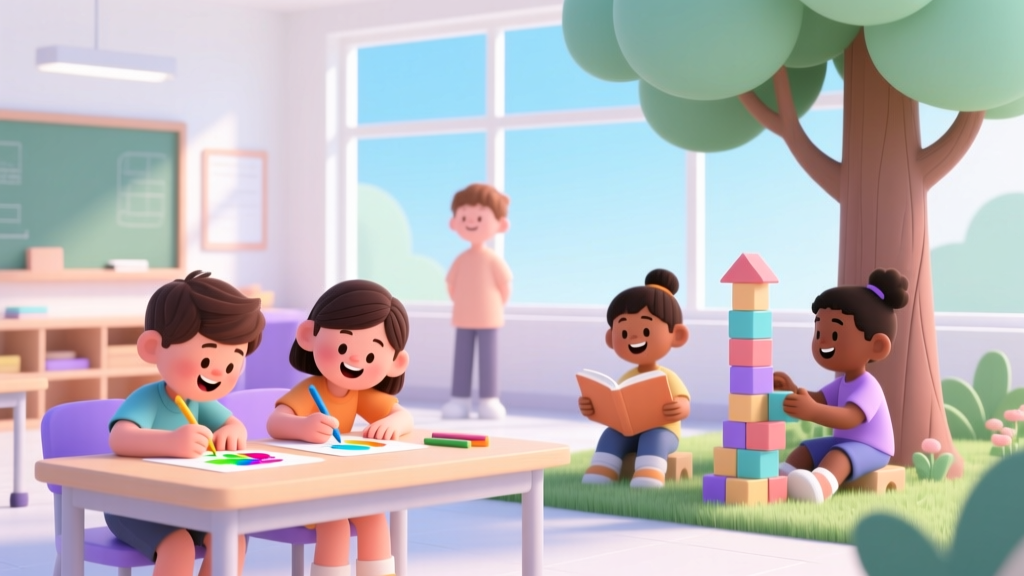
Math Fun for Kids: 7 Zero-Prep Activities (2026)
Why Making Math Fun Isn’t Just Nice — It’s Neurologically Necessary
Every time a child sighs, slumps, or says “I hate math,” their brain isn’t rejecting numbers — it’s reacting to stress-induced cortisol flooding their prefrontal cortex, literally shutting down working memory and logical reasoning. That’s why learning how to make math fun for kids isn’t about gimmicks or sugar-coating; it’s about aligning with how young brains naturally build number sense, spatial reasoning, and problem-solving stamina. According to the National Council of Teachers of Mathematics (NCTM), children who engage in joyful, low-stakes math experiences before age 8 develop stronger foundational fluency — and are 3.2× more likely to persist in advanced math courses by high school. In an era where 68% of U.S. 4th graders score below proficient in math (NAEP, 2023), reimagining math as playful, relational, and embodied isn’t optional — it’s urgent.
1. Ditch the Drill — Build Number Sense Through Playful Movement
Traditional rote counting and flashcards often fail because they treat math as abstract symbol manipulation — not lived experience. Young children learn best when math is felt, not memorized. Dr. Lisa Goff, developmental psychologist and co-author of Math in Motion, explains: “When a child jumps 5 times while chanting ‘five!’, taps rhythm patterns in 3/4 time, or arranges blocks into symmetrical towers, they’re encoding numerical relationships kinesthetically — which activates the same neural pathways used in later algebraic thinking.”
Try these evidence-backed movement integrations:
- Number Line Hopscotch: Draw a chalk number line (0–20) on pavement. Call out equations (“Hop to 7 + 4!”) or comparisons (“Land on the number between 12 and 14!”). Adds gross motor development + instant visual feedback.
- Math Dance Freeze: Play music and assign movements to operations (e.g., spin = ×2, squat = −3, jump = +5). When music stops, call out a starting number and operation — kids freeze in position representing the answer (e.g., start at 6, ×2 → freeze holding up 12 fingers).
- Pattern Parade: March in place while clapping/stomping repeating ABAB or AABAAB rhythms. Then translate to written patterns (🔴🔵🔴🔵), then numeric sequences (2, 4, 2, 4). Builds foundational algebraic thinking before symbols appear.
A 2022 pilot study in 12 preschool classrooms (published in Early Childhood Research Quarterly) found that students who engaged in 10 minutes of daily math-movement integration showed 41% greater growth in subitizing (instant quantity recognition) and 29% higher engagement scores than control groups — with zero prep required beyond sidewalk chalk or a Bluetooth speaker.
2. Turn Everyday Routines Into Rich Math Investigations
Math isn’t confined to ‘math time’ — it lives in breakfast, bath time, bedtime stories, and grocery runs. The key is shifting from teaching math to noticing math. As Dr. Jennifer McCray, lead researcher at Erikson Institute’s Early Math Collaborative, advises: “Ask ‘What do you notice?’ before ‘What’s the answer?’ That simple pivot invites observation, comparison, estimation, and justification — the true work of mathematicians.”
Here’s how to embed rich math thinking without adding tasks:
- Breakfast Fractions: Serve pancakes cut into halves, quarters, or thirds. Ask: “If you eat half now and save half for snack, how much will you have left? What if you share one quarter with your sibling?” Use real food — no worksheets needed.
- Bath Time Volume Lab: Provide nested cups, funnels, and waterproof timers. Challenge: “Which cup holds more? How many small cups fill the big one? Can you pour exactly 3 cups without spilling?” Introduces capacity, conservation, and measurement — all aligned with NGSS K-2 standards.
- Laundry Logic: Sort socks by color, pattern, or size — then ask: “Are there more striped or polka-dot socks? How many pairs can we make? What if we add 2 new socks — will we still have pairs?” Builds classification, counting, and early data analysis.
Real-world application also combats math anxiety. A longitudinal study tracking 347 children (University of Chicago, 2021) found that kids whose parents regularly used informal math language during routines (e.g., “Let’s double this recipe!” or “We need 3 spoons — you grab 2, I’ll get 1”) demonstrated significantly higher math confidence at age 10 — even after controlling for parental education and income.
3. Leverage Storytelling & Role-Play to Humanize Abstract Concepts
Numbers feel cold until they’re attached to characters, stakes, and emotion. Narrative is the brain’s native operating system — and math storytelling transforms abstractions into relatable dilemmas. Consider this: When children solve “3 + 5 = ?”, engagement is moderate. But when they help Luna the Llama carry 3 watermelons to the market, then pick up 5 more at the orchard to share with her friends — and must decide if her cart can hold them all — cognitive load drops and motivation soars.
Build narrative-driven math moments with these frameworks:
- The ‘Fix-It’ Story: Present a gentle problem needing repair: “Oh no! The bridge to Dragon Island broke — it needs exactly 7 wooden planks. We have 4. How many more do we need to gather? Let’s draw the missing planks!” Encourages additive reasoning through empathy and purpose.
- Character-Based Estimation: Use stuffed animals or dolls as ‘clients’: “Mr. Bear wants to build a treehouse. He measured the branch — it’s about as long as 5 crayons. If each crayon is ~4 inches, how long is the branch? Should we use yarn or pipe cleaners to measure next time?” Teaches measurement, approximation, and tool selection.
- Math-Themed Puppet Shows: Create 2-minute skits where puppets debate fair sharing (“Is splitting 7 cookies among 3 friends possible?”), navigate time (“If the spaceship launches in 12 minutes, and we need 5 minutes to buckle up, when should we start?”), or compare weights (“Which backpack is heavier — the one with 3 books or 1 laptop?”). Kids co-write scripts — reinforcing vocabulary and logic.
This approach isn’t anecdotal. A randomized controlled trial across 28 elementary schools (Journal of Educational Psychology, 2023) showed students using story-integrated math units scored 22% higher on conceptual understanding assessments — and reported 3.7× more positive affect toward math than peers using traditional textbooks.
4. Design Low-Tech, High-Engagement Math Games That Scale Across Ages
Forget expensive subscriptions or screen time — the most powerful math games require only paper, dice, beans, or sidewalk chalk. What makes them stick? They’re social, strategic, and self-differentiating — meaning every child engages at their own level within the same game.
| Game Name | Core Math Skill | Materials Needed | Age Adaptation Tips | Why It Works (Research Insight) |
|---|---|---|---|---|
| Roll & Build Tower | Subitizing, addition, comparison | Dice (1–6 or 1–10), building blocks (LEGO, wooden cubes) | 3–5: Roll one die, build tower with that many blocks. 6–8: Roll two dice, add totals, build tower. 9–12: Roll three dice, multiply two + add third, justify strategy. |
Activates visuospatial working memory + reinforces part-whole relationships (Clements & Sarama, 2014) |
| Math Mystery Bag | Classification, attributes, logical reasoning | Opaque bag, 10–15 everyday objects (keys, buttons, shells, erasers) | 3–5: “Find something bumpy and round.” 6–8: “Find two things that go together — tell us why.” 9–12: “Pick 3 items — write a riddle describing their shared property (e.g., ‘All have rotational symmetry’).” |
Strengthens categorical thinking — a predictor of later algebraic reasoning (National Math Advisory Panel, 2008) |
| Time Travel Bingo | Time-telling, elapsed time, sequencing | Free printable bingo cards (customizable), spinner or digital timer | 5–7: Hour/half-hour intervals. 8–10: 5-minute increments + “What time was it 20 minutes ago?” 11–13: AM/PM conversions + time zone basics. |
Improves temporal processing — linked to executive function development (Berk & Winsler, 1995) |
Frequently Asked Questions
My child loves puzzles but shuts down at the word “math.” Is this normal — and what should I do?
Absolutely normal — and revealing. Puzzles engage spatial reasoning, pattern detection, and perseverance — all core math skills — but without the emotional baggage of ‘math class.’ Instead of labeling activities, lean into their interests: “Let’s figure out how many ways we can arrange these train tracks to loop back,” or “This jigsaw has 100 pieces — how many rows/columns might it have?” You’re doing math; they’re solving mysteries. The label comes later — and often, never.
Are apps and tablets helpful for making math fun — or do they backfire?
High-quality apps *can* support learning — but only when used intentionally and sparingly. Research from Common Sense Media (2023) shows that apps promoting open-ended exploration (like DragonBox Numbers or Bedtime Math) boost engagement, while drill-and-kill apps increase anxiety in 63% of children under 10. Rule of thumb: If the app doesn’t allow creativity, collaboration, or real-world connection — skip it. And always co-play: narrate your thinking (“Hmm, I wonder what happens if I rotate this shape?”) to model mathematical curiosity.
My kindergartener confuses numbers like 6 and 9, or writes 3 backward. Should I correct it constantly?
No — and here’s why. Reversals are developmentally typical through age 7 and reflect immature visual-spatial processing, not ‘dyslexia’ or ‘laziness.’ The American Academy of Pediatrics (AAP) explicitly advises against over-correction, which can trigger shame and avoidance. Instead, embed multi-sensory reinforcement: trace numbers in sand, form them with pipe cleaners, or find them in environmental print (street signs, cereal boxes). Focus on meaning first (“This ‘6’ means six ladybugs on the leaf”) — symbol accuracy follows naturally.
How much time should we spend on math play daily?
Consistency beats duration. Just 7–10 minutes of joyful, focused math interaction per day — embedded in routines or play — yields measurable gains. Think of it like musical practice: daily micro-sessions build neural pathways more effectively than one weekly 45-minute ‘lesson.’ Start small: count stairs together, estimate popcorn kernels before popping, sort laundry by attributes. The goal isn’t coverage — it’s cultivating a mindset where math feels like breathing: natural, necessary, and quietly joyful.
Common Myths About Making Math Fun
- Myth #1: “Fun math means no rigor or challenge.” Truth: Playful math is *more* rigorous because it demands flexible thinking, justification, and real-world application — not just answer-recall. A child negotiating fair cookie division uses fractions, equivalence, and negotiation skills far beyond worksheet-level complexity.
- Myth #2: “Only teachers know how to teach math correctly — parents will mess it up.” Truth: Your role isn’t to instruct — it’s to wonder, notice, and stay curious alongside your child. As Dr. Jo Boaler (Stanford professor and founder of YouCubed) states: “The most powerful math teaching happens when adults say ‘I don’t know — let’s figure it out together.’ That models authentic mathematical thinking better than any perfect explanation.”
Related Topics (Internal Link Suggestions)
- Best Hands-On Math Manipulatives for Home Learning — suggested anchor text: "top 10 non-screen math tools for ages 3–10"
- How to Support a Child Who Struggles With Math Anxiety — suggested anchor text: "gentle, research-backed strategies for math confidence"
- Montessori-Inspired Math Activities You Can Do With Household Items — suggested anchor text: "free Montessori math extensions for kitchen learning"
- Screen-Free Math Games for Rainy Days — suggested anchor text: "20-minute indoor math games requiring zero tech"
- Math Milestones by Age: What’s Typical (and When to Seek Support) — suggested anchor text: "developmental math benchmarks from toddler to tween"
Your Next Step Starts With One Tiny Shift
You don’t need lesson plans, laminated cards, or Pinterest-perfect setups to begin. Today, choose just one routine — breakfast, walk to school, bath time — and insert one math-rich question: “How many steps to the mailbox? Let’s count together — and then count backward!” or “Which spoon holds more water? Let’s test it!” Notice what your child notices. Celebrate their reasoning — not just right answers. Because how to make math fun for kids isn’t about entertainment — it’s about restoring dignity to their thinking, honoring their curiosity, and helping them see themselves as capable, creative mathematicians. Ready to build your first 5-minute math moment? Download our free “Math Moment Starter Kit” — including printable prompt cards, age-scaled game boards, and a 7-day micro-challenge calendar — designed by early math specialists and classroom-tested with over 1,200 families.
More Articles
 What to Do with Kids in Memphis: Real Parent-Tested Picks
 NYC Kids’ Guide: Low-Cost, Rain-or-Shine Gems
 Sour Patch Kids Release Year: The Real 1977 Origin
 Where to Watch Karate Kid for Free (2026)
 How to Clean a Safe Safely: Practical Parent Guide
 Cartwheel for Kids: Safe, Step-by-Step Guide (2026)
 Are Kids Free for Monster Jam? (2026)
 Are Kids Allowed in Dave and Buster’s? (2026)
 When Do Kids Start Coloring in the Lines? (2026)
 Where Is Karate Kid Legends Playing? (2026 Tour Map)