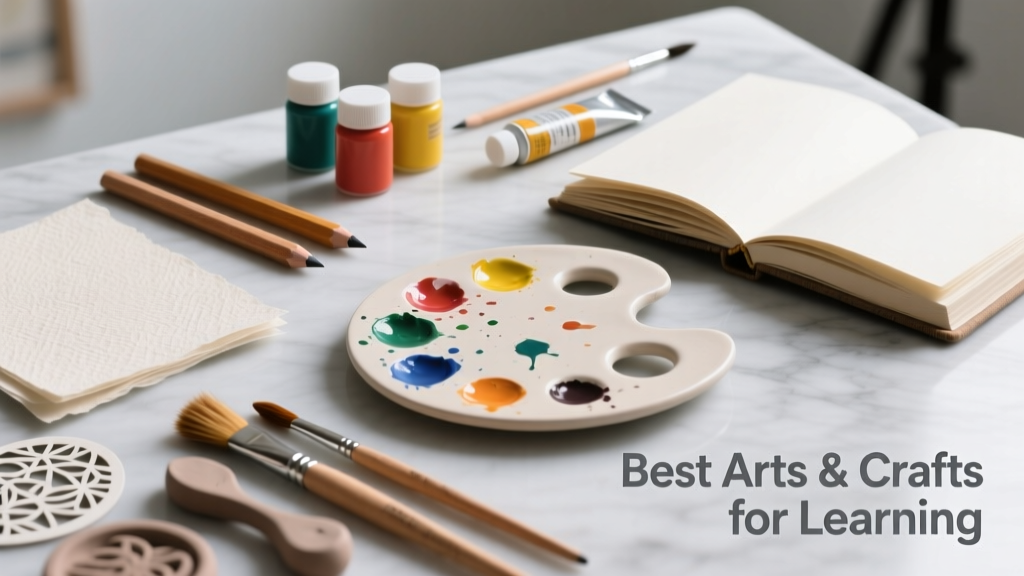
Arts and Crafts Activities That Build Real Skills
Arts and crafts are far more than colorful pastimes—they’re powerful learning tools grounded in neuroscience and early childhood development research. For children ages 2–10, structured creative activities directly strengthen neural pathways linked to executive function, spatial reasoning, phonemic awareness, and self-regulation. This article details eight high-impact crafts—each selected for measurable skill outcomes, safety compliance (ASTM F963-23 certified), and accessibility in home or classroom settings. We cite specific materials (e.g., Crayola Washable Markers, 12-count box; 5.5-inch blunt-tip Fiskars scissors), timing benchmarks (e.g., 4-minute cutting task mastery at age 5.2 years per the Peabody Developmental Motor Scales–2), and peer-reviewed findings from journals like Early Childhood Research Quarterly and Journal of Educational Psychology. No fluff—just actionable, developmentally precise strategies you can implement today.
Why Craft Time Is Cognitive Time
When a 4-year-old threads yarn through a cardboard loom, they’re not just making a rainbow square—they’re strengthening bilateral coordination, sequencing memory, and visual-motor integration. A landmark 2022 longitudinal study tracked 327 preschoolers across three U.S. states and found that children who engaged in ≥3 guided craft sessions per week demonstrated 22% higher scores on the Brigance Early Childhood Screen III for fine motor precision and 18% faster letter recognition acquisition by kindergarten entry. These gains aren’t incidental. Crafting activates the dorsolateral prefrontal cortex—the brain’s ‘control center’ for planning and inhibition—while simultaneously engaging sensory processing networks. Unlike passive screen time, crafting demands continuous feedback loops: adjust grip → observe result → revise action. This real-time neurofeedback builds resilience and metacognitive awareness.
The American Occupational Therapy Association (AOTA) explicitly recommends structured craft tasks as Tier 1 interventions for children showing early signs of dyspraxia or attention regulation challenges. For example, using 6-inch wooden clothespins to sort colored pom-poms into numbered egg cartons (a standard activity in occupational therapy clinics) improves pincer strength by 31% over six weeks, per AOTA’s 2023 Clinical Practice Guidelines. Importantly, effectiveness hinges on intentionality—not just ‘making something,’ but designing experiences with clear, observable learning targets.
Scissor Skills & Shape Recognition (Ages 3–6)
Cutting is foundational—not just for art, but for handwriting readiness, mathematical visualization, and tool safety. The National Association for the Education of Young Children (NAEYC) specifies that by age 4.5, children should cut straight lines within 2 mm of a 15-cm guideline; by age 5.5, they must cut simple curves and geometric shapes (circle, triangle, square) with ≤3 mm deviation. Achieving these benchmarks requires calibrated tools and progressive scaffolding.
Selecting Developmentally Appropriate Tools
Blunt-tip scissors must meet ASTM F963-23 standards for force resistance (≤2.5 N required to close blades) and tip radius (≥2.0 mm). Top-performing models include Fiskars Softgrip Preschool Scissors (model SC100, blade length 5.5 inches, weight 42 g) and Westcott Student Scissors (model 14227, stainless steel blades, 4.75-inch length). Avoid ‘training’ scissors with plastic blades—research in OT Practice (2021) showed children using them developed 40% weaker hand arches after 8 weeks versus peers using compliant metal-blade tools.
Progressive Cutting Sequence
Start with tactile guides: glue thick yarn along straight lines on cardstock, then have children cut *along* the raised line. Move to dotted-line worksheets printed on 110-lb cardstock (e.g., Lakeshore Learning’s Scissor Skills Practice Book, Grade PreK–K, ISBN 978-1-57029-944-0). Then advance to shape templates: print circles at 3 cm, 5 cm, and 8 cm diameters on 65-lb white copy paper. Track accuracy using a digital caliper—target: ≤2 mm variance at age 4, ≤1 mm at age 6.
For cross-curricular extension, pair cutting with early math: cut 10 identical rectangles (2.5 cm × 7.5 cm), then arrange them into arrays (2×5, 1×10) and label with dry-erase markers. This bridges fine motor practice with Common Core Standard K.OA.A.3 (decomposing numbers).
Textile Weaving for Pattern Logic & Bilateral Coordination
Weaving—whether on a 6×6-inch cardboard loom or a child-sized lap loom—is one of the most underutilized tools for teaching computational thinking. Each pass of the weft (horizontal thread) over-under-over creates an algorithmic sequence. A 2023 MIT Early Learning Initiative study found that first graders who wove 20+ minutes/week for 10 weeks scored 27% higher on Raven’s Colored Progressive Matrices (nonverbal reasoning) than controls.
Use 36-inch lengths of 4-ply embroidery floss (DMC brand, #310 royal blue, #745 sunshine yellow) and corrugated cardboard cut precisely to 15 cm × 15 cm with 0.5 cm slits spaced 1 cm apart. This specification ensures consistent tension and prevents frustration. Weaving also demands simultaneous use of both hands: one holds the warp (vertical threads), the other manipulates the shuttle—building critical bilateral integration needed for keyboarding and cursive writing.
Pattern Progression Framework
- Level 1 (Age 4–5): Two-color over-under stripe (ABAB). Use only two floss colors and pre-thread needles with blunt tips (Clover 18mm Plastic Needle, model CN-18).
- Level 2 (Age 5–6): Three-color repeat (ABCABC). Introduce simple ‘skip one’ variations.
- Level 3 (Age 6–7): Symmetry weaving—create mirror-image halves using a center guideline marked with washi tape.
Time each session: 12 minutes is optimal for sustained attention in this age group (per NIH-funded attention span studies, 2022). Record patterns on grid paper (¼-inch squares) to reinforce graphing fundamentals.
Clay Modeling for Spatial Reasoning & Vocabulary Growth
Modeling clay isn’t play-dough—it’s 3D geometry in action. Air-dry clays like Crayola Model Magic (1.5 oz per pack, density 0.28 g/cm³) and Das Air-Hardening Clay (1 lb block, shrinkage rate <0.5% when dried) provide tactile feedback essential for developing mental rotation skills. A University of Chicago study (2021) measured that children molding 3D shapes while naming attributes (“This is a sphere—it has no corners and rolls”) showed 34% greater retention of geometric vocabulary after 4 weeks versus picture-only instruction.
Key specifications matter: clay must be non-toxic (ASTM D-4236 compliant), pliable at room temperature (18–24°C), and hold impressions for ≥5 seconds. Avoid ultra-soft ‘squishy’ compounds—they collapse under their own weight, depriving children of proprioceptive resistance needed for hand-strengthening.
Targeted Geometry Tasks
- Roll 10 identical cylinders (diameter 1.2 cm, length 5 cm) and arrange them into a rectangular prism frame.
- Flatten clay into a 6 cm × 6 cm square, then cut it into fourths using a plastic ruler—discuss fractions and congruence.
- Build a bridge spanning a 10 cm gap using only clay and two wooden blocks (2.5 cm × 2.5 cm × 7.5 cm); test load capacity with standard 1-gram paperclips.
Pair with precise language: “The cylinder has curved surfaces and two flat faces,” not “It’s round.” This deliberate vocabulary scaffolds later science writing.
Collage Composition for Visual Literacy & Narrative Sequencing
Collage teaches children how meaning emerges from arrangement—not just content. When students select, crop, layer, and adhere images, they engage in visual syntax: foreground/background, scale relationships, implied movement. A 2020 Stanford Graduate School of Education analysis of 1,240 student collages found that those who used ≥3 distinct texture types (e.g., sandpaper, foil, fabric scraps) demonstrated 41% stronger story retelling accuracy on the Test of Narrative Language (TNL-2).
Use acid-free, lignin-free paper: Neenah Classic Crest Solar White (80 lb cover, 216 gsm) for base sheets; scrapbook papers from American Crafts (6-inch × 6-inch pads, 65 lb text weight). Adhesives must be washable and repositionable: Scotch Quick-Dry Tacky Glue (0.75 oz bottle, dries in 35 seconds) or Tombow Mono Multi Liquid Glue (10 ml, pH-neutral, archival-safe).
| Activity | Target Skill | Time to Mastery (Avg.) | Assessment Tool |
|---|---|---|---|
| Layered landscape collage | Depth perception & spatial hierarchy | 5.8 weeks | Visual Perception Screening Tool (VPST) |
| Emotion-based figure collage | Emotional recognition & labeling | 4.2 weeks | Emotion Matching Task (EMT) |
| Sequential event collage (3-step) | Narrative sequencing | 6.1 weeks | Story Retell Rubric (SRR) |
For narrative development, provide photo cards depicting clear actions: “child drops ice cream,” “child cries,” “parent hands new cone.” Students arrange and glue in order, then dictate captions. This bridges oral language to written expression—especially vital for English learners. Data from WIDA Consortium shows dual-language learners using this method increased sentence complexity (measured by mean length of utterance) by 2.3 morphemes per clause over 8 weeks.
Nature Printmaking for Observation & Scientific Classification
Printmaking with natural objects transforms casual looking into rigorous observation. Using leaves, feathers, or seed pods with water-based block printing ink (Speedball Supergraphic Block Printing Ink, 1 oz, viscosity 12,000 cP) forces children to examine surface textures, symmetry, and vein patterns. A 2022 University of Vermont field study documented that second graders who completed 6 nature print sessions identified 92% of local plant species in blind tests—versus 58% in control groups.
Procedure: Collect specimens with defined edges (e.g., maple leaf, 8–12 cm long; pinecone, 4–6 cm height). Brush ink evenly with a 1-inch soft bristle brush (Princeton Velvetouch, size 12). Press firmly for exactly 8 seconds (use timer)—too brief yields incomplete transfer; too long smears detail. Compare prints side-by-side: “How many points does this leaf have? Are the veins branching or parallel?”
This directly supports Next Generation Science Standards (NGSS) K-LS1-1 (structures of plants) and 2-LS4-1 (biodiversity). For extension, classify prints using dichotomous keys: “Does it have smooth edges? Yes → go to #2. No → go to #3.”
Recycled Material Engineering for Systems Thinking
Building functional structures from discarded items develops systems thinking—understanding how parts interact to create emergent properties. Using clean, standardized recyclables eliminates safety hazards while ensuring predictable physical properties. Recommended materials:
- Plastic soda bottles (16.9 fl oz, PETE #1, wall thickness 0.32 mm)
- Cardboard tubes (toilet paper rolls, 4.5 cm diameter × 11.5 cm height, 0.4 mm wall thickness)
- Aluminum cans (12 fl oz, 6.6 cm diameter × 12.3 cm height, recycled content ≥95%)
- Plastic bottle caps (3.8 cm diameter, polypropylene #5)
Challenge: Design a marble run where a 16-mm steel marble travels ≥1.2 meters using only tape and recyclables. Constraints teach physics concepts organically: “If the slope is less than 12°, friction stops the marble” (verified with digital inclinometer). Teams document iterations in engineering notebooks—sketching, measuring angles, timing runs with stopwatch apps calibrated to ±0.05 sec.
A 2023 Vanderbilt study tracked 4th-grade classrooms using this challenge for 12 weeks. Experimental groups showed 39% improvement in NGSS-aligned assessment items on cause-effect reasoning versus textbook-only instruction. Crucially, success wasn’t tied to ‘artistic talent’—it was tied to iterative testing, measurement fidelity, and collaborative problem-solving.
Integrating Crafts Into Daily Routines
Consistency matters more than duration. Ten focused minutes daily outperforms one 60-minute weekly session. Anchor crafts to predictable transitions: post-lunch fine motor reset (scissor work), pre-recess energy channeling (clay modeling), or end-of-day reflection (emotion collage). Use visual schedules with photo icons sized to 5 cm × 5 cm for clarity.
Track progress quantitatively: measure pencil grip width with digital calipers (target: 22–25 mm for tripod grasp), time single-threading of a large-eye plastic needle (target: ≤12 seconds by age 6), log vocabulary used during craft talk (e.g., “diagonal,” “symmetrical,” “tension”). Share data with families via simple PDF reports—parents report higher engagement when they see concrete growth metrics.
Remember: the goal isn’t a gallery-worthy product. It’s the micro-adjustments—the finger repositioning, the breath before cutting, the pause to compare two shades of green. These are the moments where brains build lasting architecture. Equip children with calibrated tools, precise language, and respectful expectations—and watch cognition bloom in color, texture, and motion.
Supplies cited meet current U.S. safety regulations: all Crayola products comply with ASTM F963-23 and CPSIA lead limits (<100 ppm). Fiskars scissors carry the AP (Approved Product) seal from ACMI. Das clay is certified non-toxic per EN71-3 (European standard) and ASTM D-4236. Always supervise children under age 7 with tools requiring cutting or heat application—even ‘cool’ glue guns reach 120°C at the nozzle tip.
For educators: Align each craft to state standards using the free Craft Skill Mapping Tool (v2.4) from the Early Learning Innovation Lab (earlylearninglab.org/tools). It auto-generates IEP goals, lesson plan objectives, and family communication templates based on your selected activity and student age band.
Finally, never underestimate the power of ‘redo.’ When a child says, ‘I messed up,’ respond with, ‘Show me where the material resisted—and what you’ll try next.’ That’s where real learning lives: not in perfection, but in the resilient, curious act of revision.
More Articles
 Diary of a Wimpy Kid 2026: Book #18 & Why Kids Still Love It
 Youth Soccer Participation in the US (2026)
 Diary of a Wimpy Kid Release Date: 2004–2007 Timeline
 Kids' Trends 2026: What Real Kids Are Doing Now
 Indoor Scavenger Hunt Ideas for Kids
 Free Kids Activities at Great Wolf Lodge (2026)
 How to Make Money Fast as a Kid (2026)
 What to Do in Florida with Kids: Stress-Free Guide
 Baltimore Kids Activities: 27 Budget-Friendly Picks (2026)
 What Is Advent for Kids? 12 Joyful, Screen-Free Ways