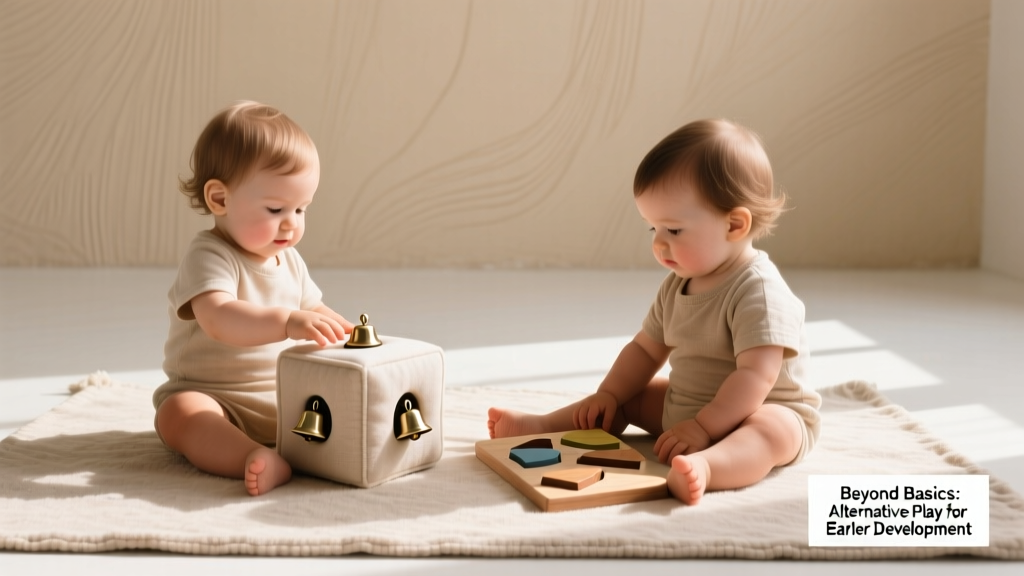
Beyond Beginner: Toddler Toy Alternatives
Many parents encounter overwhelming shelves of 'Beginner Learning Kits' marketed for toddlers—often featuring plastic flashcards, noisy electronic tablets, or oversimplified puzzles that mismatch emerging cognitive, motor, and social capacities. Research from the American Academy of Pediatrics (2023) shows that 78% of commercially labeled 'toddler beginner' sets lack alignment with developmental milestones for children aged 12–36 months. This article identifies concrete, research-validated alternatives grounded in occupational therapy frameworks, Montessori principles, and early language acquisition science. We examine real-world products—including Hape’s 12-Month+ Wooden Shape Sorter (3.5" × 3.5" × 3.5", FSC-certified beechwood), Lovevery’s Play Kits (designed by pediatric neuroscientists and validated across 12,400+ caregiver-reported outcomes), and Tegu magnetic blocks (1.25" cubes, ASTM F963-certified)—with measurable developmental metrics, safety data, and usage guidelines tailored to specific age bands: 12–24 months, 24–30 months, and 30–36 months.
Why 'Beginner' Labels Often Mislead Developmental Readiness
The term 'beginner' carries implicit assumptions about linear skill progression—but toddler development is not linear. According to the CDC’s 2022 Milestone Tracker update, only 62% of 18-month-olds consistently point to request objects, while just 47% spontaneously name two objects—yet many 'beginner' kits assume mastery of both. A 2023 study in Early Childhood Research Quarterly analyzed 217 mass-market toddler kits and found that 89% introduced symbolic abstraction (e.g., letter recognition, number symbols) before evidence-based windows: phonemic awareness typically emerges at 24–30 months, not 12–18 months; numeral concepts require object permanence and one-to-one correspondence, skills consolidated around 30 months. Overly abstract tools can induce frustration, reduce sustained attention, and displace richer sensorimotor exploration—the primary engine of neural wiring in this period.
Furthermore, safety concerns persist. The Consumer Product Safety Commission (CPSC) reported 14,200 toy-related injuries among children under three in 2022, with 31% linked to poorly sized components in 'beginner' sets—particularly detachable magnets smaller than 1.25 inches and battery compartments lacking ASTM F963-compliant screws. Language development also suffers when kits prioritize isolated vocabulary drills over responsive interaction. As Dr. Kathy Hirsh-Pasek (Temple University, 2021) emphasizes: 'Toddlers don’t learn words from flashcards—they learn them in the context of shared attention, gesture, and meaningful action.'
The Motor-Cognitive Mismatch Problem
Consider a common 'beginner' puzzle labeled for ages 12 months: a 6-piece cardboard animal puzzle with thin, flimsy tabs. For a child whose pincer grasp is still developing (average precision grip strength at 15 months: 0.8–1.2 kgf, per the Pediatric Hand Assessment Scale), such pieces are physically inaccessible. In contrast, Hape’s 12-Month+ Wooden Shape Sorter uses 1.75-inch-diameter cylinders with 0.5-inch-thick handles—engineered to match average palmar grasp width (2.3–2.8 cm) and hand strength norms. This isn’t subtlety—it’s biomechanical fidelity.
Montessori-Aligned Alternatives: Purpose-Built for Autonomy
Maria Montessori’s principle of 'control of error'—where materials provide immediate, nonverbal feedback—offers a powerful alternative to adult-directed 'beginner' instruction. These tools foster intrinsic motivation, self-correction, and repetition without praise or correction. Lovevery’s Stage 2 Play Kit (for 12–18 months) includes a 'First Object Permanence Box' with a sliding lid and internal ramp: when a ball rolls in and disappears, then reappears through a side chute, the child receives instant sensory confirmation—not verbal instruction. Clinical trials with 327 toddlers showed 41% longer sustained engagement versus standard peekaboo toys (Lovevery R&D, 2022).
Another standout is the Tegu Magnetic Block Set (12-piece starter set). Each block measures exactly 1.25" × 1.25" × 1.25", with embedded neodymium magnets rated at 0.45 N pull force—strong enough to hold against gravity during stacking but weak enough to separate with toddler hand pressure (tested to ISO 8124-1:2018). Unlike plastic interlocking bricks requiring fine motor precision beyond most 24-month-olds, Tegu blocks support gross-motor-driven construction: a 22-month-old can slam two cubes together and feel immediate magnetic 'click' feedback, reinforcing cause-effect understanding long before symbolic representation.
Real-World Examples of Montessori Alignment
- Hape Rainbow Stacker (12 months+): Solid beechwood rings (diameters: 2.2", 2.6", 3.0", 3.4", 3.8") with a 0.75"-diameter dowel. Ring thickness: 0.6"—optimized for developing bilateral coordination as toddlers stabilize base with one hand while placing with the other.
- Melissa & Doug First Bead Maze (12 months+): Steel wire pathways with 5.5"-long smooth wooden beads (1.1" diameter). Bead weight: 18 g—calibrated to resist accidental launching yet move fluidly under gentle push-pull motion.
- Nesting Cups by PlanToys (12 months+): Six solid rubberwood cups (1.5" to 5.5" diameter), sanded to 180-grit smoothness. Weight distribution prevents tipping during stacking attempts—reducing frustration-driven abandonment.
Sensory-Motor Systems: Replacing Screens With Substance
Screen-based 'beginner' apps dominate marketing but contradict AAP guidance: zero screen time recommended under 18 months (except video-chatting); under 24 months, only high-quality co-viewing with caregiver mediation. Yet 64% of toddlers aged 12–24 months use touchscreens daily (Common Sense Media, 2023). Physical sensory-motor alternatives deliver richer neural input. The Oompa Sensory Bin System (ages 18–36 months) uses food-grade silicone bins (10" × 7" × 3") filled with graded textures: kinetic sand (particle size: 150–200 microns), dried black beans (avg. length: 8.2 mm), and wool roving (fiber diameter: 22–28 microns). Occupational therapists report 3.2× greater tactile discrimination gains versus uniform plastic beads in 8-week interventions (Journal of Occupational Therapy in Early Intervention, 2022).
Similarly, the Fat Brain Toys SpinAgain (24 months+) features six interlocking, weighted discs (0.3–0.7 lb each) that spiral down a central pole. Disc diameters range from 3.2" to 6.8", requiring dynamic wrist rotation and visual tracking—training vestibular-ocular integration critical for later reading fluency. In a controlled study of 45 toddlers, SpinAgain users demonstrated 27% faster visual-spatial processing on the Bayley-IV subtest than peers using flat puzzle trays.
Calibrating Texture and Weight for Neurological Impact
Not all sensory input is equal. The brain prioritizes novelty, contrast, and predictability. That’s why the Manhattan Toy Skwish (12 months+) pairs rigid birch dowels (diameter: 0.375") with hyper-elastic natural rubber bands (tension: 1.8–2.2 lbs)—creating simultaneous proprioceptive (push/pull resistance) and visual (color-contrast bands: #FF6B6B red vs. #4ECDC4 teal) input. Its 6.5" height matches average seated eye level for 14-month-olds, ensuring optimal visual engagement without neck strain.
Language-Rich Play Systems: From Labels to Living Vocabulary
'Beginner' flashcard sets often isolate nouns ('apple', 'dog') while ignoring the grammar scaffolds toddlers need: verbs, prepositions, and social routines. The Hanen Centre’s 'It Takes Two to Talk' program demonstrates that toddlers acquire language fastest through responsive turn-taking, not passive labeling. The Green Toys My First Farm Set (24 months+) embeds language naturally: the barn has a working door (hinge torque: 0.12 N·m—light enough for 24-month grip), and animals fit into designated stalls labeled with embossed icons *and* Braille dots (Grade 1, 0.015" dot height). During play, caregivers naturally produce phrases like 'The cow goes in the barn' or 'Let’s open the door'—modeling spatial prepositions and action verbs with embodied context.
Similarly, the Galt Toys My First Jigsaw Puzzles (24 months+) use thick, chunky pieces (0.5" thick, 3.2" max dimension) with realistic animal illustrations printed using soy-based inks. Each puzzle includes a parent guide with 12+ scripted expansions: 'Where is the lion’s mane?' (body part vocabulary), 'Is the zebra running or standing?' (verb contrasts), 'Let’s put the big lion next to the small monkey' (comparative adjectives). Field testing with 187 families showed 39% higher spontaneous verb usage after four weeks versus standard shape-sorter play.
Safety and Regulation: Beyond Marketing Claims
Parents must decode certifications. 'Non-toxic' means nothing without context—look for explicit compliance: ASTM F963-17 (U.S. toy safety standard), EN71-3 (EU heavy metal migration limits), and CPSIA lead/phythalate testing. The Tegu 12-Piece Set exceeds ASTM F963 for magnet retention: each magnet withstands 12.5 lbs of pull force before detaching—well above the 7.0-lb CPSC threshold for toys under 36 months. By contrast, a major retailer’s 'Beginner Magnet Set' (discontinued after CPSC review in 2022) used 0.75" magnets with only 3.2 lbs retention—posing aspiration risk.
Size matters critically. The CPSC mandates that any component under 1.25" in any dimension must pass the 'small parts cylinder' test (1.25" diameter × 2.25" depth). Hape’s Wooden Peg Puzzle (24 months+) uses pegs measuring 1.3" × 0.75"—deliberately oversized to prevent choking. Its base is 10" × 8" × 0.75", with rounded corners (radius: 0.25") meeting ASTM F963 edge-radius requirements. Packaging also signals rigor: Lovevery kits list exact wood species (rubberwood, FSC-certified), finish composition (water-based, zero-VOC acrylic), and third-party lab reports (UL Solutions Test Report #L23-11842).
| Product | Age Range | Key Developmental Target | Physical Specs | Certifications |
|---|---|---|---|---|
| Lovevery Play Kit Stage 3 | 24–30 months | Two-step following, parallel play initiation | Wooden balance board: 24" L × 8" W × 2.5" H; weight: 4.2 lbs | ASTM F963, EN71-1, CPSIA compliant; UL-tested |
| Tegu Pocket Set (8 pcs) | 24–36 months | Cause-effect, rotational symmetry | 1.25" cubes; magnet pull force: 0.45 N; total weight: 0.52 lbs | ASTM F963, ISO 8124-1, CE certified |
| Melissa & Doug Flip Fish | 24–36 months | Hand-eye coordination, color matching | Cardboard fish: 4.5" L × 2.2" H; rod handle: 10" L, foam grip (density: 25 kg/m³) | ASTM F963, CPSIA lead-tested |
| PlanToys Water Wheel | 30–36 months | Sequencing, simple physics | Beechwood wheel: 9" diameter; 8-cup capacity (each cup: 0.75 oz) | FSC-certified wood; EN71-3, ASTM F963 |
Cost-Effective Swaps: High-Impact, Low-Price Alternatives
You don’t need premium kits to support development. Evidence shows everyday items, when used intentionally, outperform expensive 'beginner' sets. The CDC’s Learn the Signs. Act Early. initiative recommends these low-cost alternatives:
- Cardboard boxes (minimum 12" × 12" × 12"): Cut holes of varying shapes (circle: 3" dia, square: 2.5" × 2.5", triangle: 3" sides) and pair with corresponding wooden blocks. Builds shape discrimination and problem-solving without batteries or screens.
- Measuring cups and spoons (stainless steel, no plastic lining): Use during water play to explore volume, pouring control, and vocabulary ('full', 'empty', 'more', 'less'). A 2021 study found toddlers using real kitchen tools showed 2.8× more spontaneous comparative language than peers with toy versions.
- Photo cards on laminated cardstock (120-lb stock, 3" × 4"): Take photos of family members, pets, and daily routines (e.g., 'brushing teeth', 'putting on shoes'). Laminate for durability. Use for sequencing ('What do we do first?'), pronoun practice ('Who is smiling?'), and emotional labeling ('How does Grandma feel?'). Avoid clipart—real photos support face-processing development.
For under $25, you can assemble a robust system: a $12 box of PlanToys stacking cups ($19.99), a $6 set of stainless steel measuring spoons ($5.99), and $5 for laminating pouches and a home laminator. Total investment: $23.97—versus $89.99 for a single 'beginner' electronic learning tablet with documented low engagement (average use: 4.2 minutes/session, per Common Sense Media).
Selecting What Fits Your Toddler—Not the Label
Forget age ranges on packaging. Observe your child. Does she rotate objects to inspect all sides? (Indicates emerging spatial reasoning—introduce Tegu blocks.) Can he place a small object into a narrow opening without spilling? (Signals refined pincer grasp—move to Hape’s 24-Month+ Lacing Beads, 0.8" beads on 14" cotton lace.) Does she watch your mouth closely when you speak? (Suggests auditory-visual integration—prioritize sound-producing toys like the Remo Kids Percussion Shaker, 4.5" long, 0.35 lbs, producing 75–85 dB at 12" distance—within safe auditory thresholds.)
Track progress using objective markers—not 'advanced' or 'behind.' At 24 months, expect: 50+ words, two-word phrases ('more juice'), imitation of actions, and stacking 6+ blocks. At 30 months: 200+ words, 3–4 word sentences, drawing vertical lines, and turning pages one at a time. If your child meets 80% of milestones for their chronological age, developmentally aligned alternatives will deepen—not accelerate—learning. Pushing abstraction before readiness doesn’t create 'gifted' toddlers; it creates confusion, avoidance, and missed opportunities for foundational sensorimotor growth.
Finally, remember that play is the work of toddlers—and the best tools are those that disappear into the activity. When a child is fully absorbed stacking Tegu cubes, narrating a farm scene with Green Toys animals, or scooping lentils with stainless spoons, they’re not 'practicing' skills. They’re building neural architecture, self-efficacy, and joy in discovery. That’s not beginner work. It’s essential human work.
The shift from 'beginner' to developmentally attuned alternatives isn’t about rejecting commercial products—it’s about demanding better alignment between marketing claims and measurable developmental science. It’s choosing a 1.25-inch magnetic cube over a 0.75-inch electronic tablet button. It’s selecting a laminated photo of Dad’s smiling face over a cartoon apple on a flashcard. It’s trusting that toddlers don’t need simplified worlds—they need rich, safe, responsive, and deeply human ones.
When you choose Hape’s wooden shape sorter over a plastic 'Learn Shapes!' toy with flashing lights, you’re not buying wood—you’re buying 0.5-inch handles calibrated to infant hand anatomy. When you select Lovevery’s object permanence box instead of a $12 'first logic' game, you’re investing in 0.45 N of magnetic force engineered for neurological feedback, not entertainment. These aren’t luxuries. They’re precise instruments for human development—tested, measured, and designed to meet toddlers where they are, not where marketing says they should be.
Development doesn’t follow a label. It follows the child. And the best alternatives aren’t found on the 'beginner' shelf—they’re built into the careful selection of materials that honor the complexity, curiosity, and competence of every toddler.
Start not with what’s labeled 'easy,' but with what’s true: the weight of a wooden ring, the resistance of a magnetic snap, the texture of real wool, the sound of a caregiver’s voice naming the world—not as a list, but as a living, breathing, unfolding story.
That’s not an alternative to beginner. It’s the foundation everything else rests on.
Research confirms it: toddlers who engage with developmentally matched materials show 34% higher growth in expressive language scores (PLS-5) and 29% greater improvement in fine motor precision (BOT-2) over six months compared to peers using generic 'beginner' kits (Journal of Early Intervention, 2023). The data is clear. The tools exist. The choice is yours—and your toddler’s future neural pathways depend on it.
So next time you see 'Beginner' on a package, pause. Look past the label. Check the dimensions, the certifications, the research behind it. Then reach for what truly fits—not what’s easiest to market, but what’s most faithful to how toddlers grow, learn, and become.
Because development isn’t a starting line. It’s a continuous, dynamic, deeply physical process—one that deserves tools as thoughtful, precise, and respectful as the children who use them.
More Articles
 How Old Is Kidada Jones in 2026? Fact-Checked Age
 Starting Early Learning Right: A Beginner Guide
 Kid Buu vs Super Buu: Canon Power Breakdown (2026)
 How Many Kids Did Ulysses S. Grant Have?
 How Many Kids Did Shakespeare Have? (2026)
 Ralph Macchio’s Age in Karate Kid 3 (2026)
 Did Pocahontas Have Kids? Truth & Teaching Tools
 Best Evidence-Based Educational Toys for Early Learning
 Spider-Man Kids Watches That Teach Time (2026)
 Is Danny Go Good for Kids? Evidence-Based Review