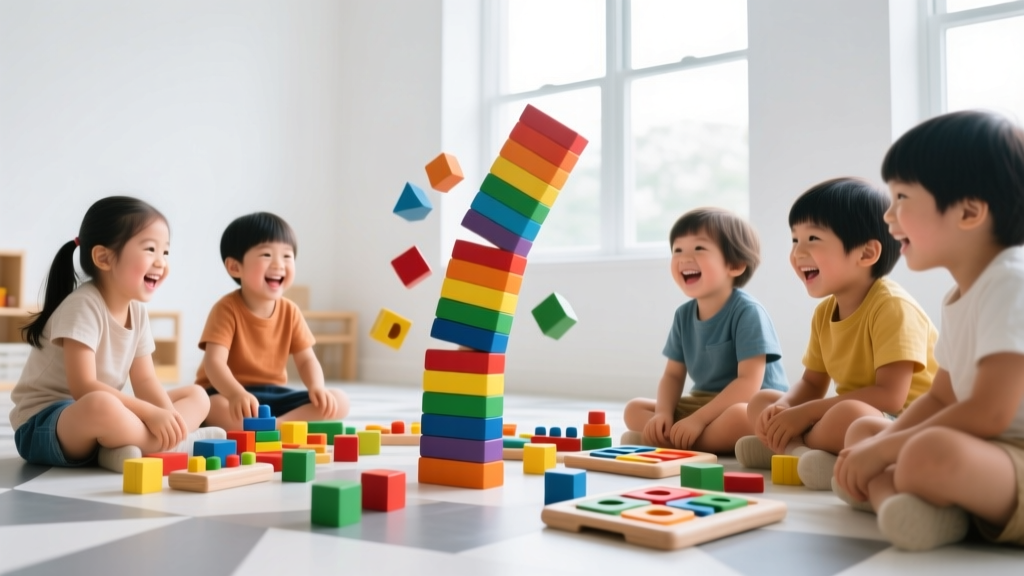
Building Blocks That Grow With Your Child
Why One-Size-Fits-All Blocks Don’t Work
Most parents buy a building set thinking it’ll last years—only to find it gathering dust by age four. The truth? Children’s cognitive, physical, and social needs change dramatically between 12 months and 8 years. A set perfect for stacking at 18 months may frustrate a curious 4-year-old eager to engineer moving parts—or bore a 6-year-old ready for architectural precision. Building blocks aren’t just toys; they’re dynamic learning tools. When chosen thoughtfully, they scaffold development across domains: fine motor control, spatial reasoning, early math concepts, storytelling, collaboration, and even emotional regulation through focused play. The key isn’t buying the biggest box—it’s choosing systems designed to scale with your child’s growing abilities.
Choosing Blocks by Developmental Stage
12–24 Months: Safety, Sensation & Simple Stacking
At this stage, babies explore the world through mouths, hands, and movement. Prioritize large, smooth, non-toxic pieces (minimum 1.25” diameter to prevent choking), soft textures, and high-contrast colors. Look for sets labeled "toddler-safe" or "infant-approved"—not just "age 1+" (which can be misleading). Avoid small connectors, magnets, or sharp edges.
- Top picks: Mega Bloks First Builders (larger pieces, easy grip), Tegu Magnetic Wooden Blocks (rounded, water-based finish, strong but safe magnets), and soft fabric blocks with crinkle inserts or textured surfaces.
- Immediate tip: Store blocks in a low, open bin—not a closed toy chest. This encourages independent access and cleanup practice. Pair with a simple stacking song (e.g., "Up, up, up—we build a tower! Down, down, down—we knock it over!") to reinforce cause-effect and language.
2–4 Years: Connecting, Creating & Communicating
Now children begin joining pieces intentionally, experimenting with balance, and narrating their builds (“This is my robot!” “The car goes VROOM!”). They’re developing bilateral coordination (using both hands together) and early symbolic thinking. Sets should offer intuitive connection systems (snap-fit, not friction-only), varied shapes (wheels, windows, doors), and inclusive character figures or animals.
- Top picks: LEGO DUPLO (sturdy, compatible across themes), BRIO My First Railway (wooden, tactile, integrates train play), and Play-Doh Build ‘n Play sets (combines modeling compound with block construction).
- Immediate tip: Introduce one new piece type per week—like a single wheel or arch—to avoid overwhelm. Use open-ended prompts instead of directives: "What could this round piece become?" rather than "Make a car." Keep a small photo journal: snap one picture of your child’s creation weekly. You’ll see surprising leaps in complexity over time.
5–8 Years: Engineering, Storytelling & Problem-Solving
Older kids seek challenge, customization, and real-world relevance. They’ll follow multi-step instructions, design functional mechanisms (levers, axles, pulleys), and co-create elaborate narratives with peers. This is where modular, expandable systems shine—especially those aligned with STEM curricula or real-world concepts (e.g., renewable energy, city planning, robotics).
- Top picks: LEGO Classic and LEGO Creator 3-in-1 (flexible, instruction-light), Magna-Tiles (for geometry and light exploration), and LEGO Education SPIKE Essential (screen-free coding + motorized builds for ages 6+).
- Immediate tip: Dedicate a "Build Zone"—a low shelf or wall-mounted pegboard where your child displays current projects *and* stores frequently used pieces. Label bins with photos + words (e.g., a photo of gears + "GEARS"). Rotate 3–5 themed expansion packs quarterly (e.g., "Space," "Zoo," "Construction") to refresh interest without clutter.
Maximizing Learning Across Ages
Blocks teach best when adults engage *with intention*, not just supervision. Here’s how to deepen impact—no lesson plans required:
- Follow their lead, then stretch gently: If your 3-year-old builds a tall tower, ask, "What if we add a bridge to the side?" If your 6-year-old makes a spaceship, suggest, "How might astronauts get inside? Let’s design a door." This scaffolds thinking without taking over.
- Integrate literacy & math naturally: Count bricks aloud while sorting. Compare heights: "Is your castle taller than your brother’s? How many more blocks does it need?" Read block-themed books like Block City (John Berry) or The Most Magnificent Thing (Ashley Spires) to spark reflection on persistence and design.
- Encourage repair, not replacement: When a structure collapses (and it will!), pause before helping. Say, "Hmm—what part wobbled first? Let’s try adding a base layer." This builds resilience and analytical habits far beyond playtime.
- Rotate, don’t abandon: Store older sets (e.g., toddler blocks) in a labeled bin and reintroduce them at age 5+ for teaching younger siblings—boosting leadership, empathy, and articulation skills.
Also remember: screen time isn’t the enemy—but passive consumption is. Swap 15 minutes of scrolling for 15 minutes of collaborative block play twice a week. Research shows joint construction boosts vocabulary 2x more than solo play and strengthens parent-child attachment through shared focus and joyful problem-solving.
Smart Buying & Storage Strategies
Before clicking "add to cart," ask three questions: (1) Does this set include pieces my child can’t yet use—but will in 6–12 months? (2) Are replacement parts readily available? (3) Can it integrate with what we already own? Cross-compatibility saves money and extends lifespan—e.g., LEGO DUPLO connects with LEGO Juniors, and most wooden block brands share standard dimensions (e.g., 1.5" cubes).
Storage matters as much as selection. Skip generic plastic tubs. Instead:
- Use clear, stackable bins with removable labels (dry-erase or sticky notes) so your child can update categories as interests shift.
- Mount a magnetic strip or pegboard in the play area for frequently used pieces (wheels, eyes, hinges)—keeps them visible and accessible.
- Designate a "Finished Builds" shelf with a photo frame: display one creation for 7 days, then photograph and rotate. Celebrates effort without hoarding clutter.
Finally—don’t underestimate the power of simplicity. A curated collection of 50–100 versatile pieces often sparks richer play than 500 random ones. Start small, observe closely, and let your child’s curiosity guide the next step. Growth isn’t about upgrading to bigger sets—it’s about deepening engagement, expanding ideas, and building confidence, one thoughtful brick at a time.
With the right building system—and mindful support—you won’t just watch your child stack blocks. You’ll witness them construct logic, language, empathy, and the unshakable belief that they can bring ideas to life.
More Articles
 Kid Cudi in Happy Gilmore 2? The Truth (2026)
 Best Wooden Montessori Toys: 2026 Educator Picks
 Jeffrey Epstein Kids: Verified Facts (2026)
 Butch Cassidy Streaming Guide (2026)
 Was Val Kilmer in The Karate Kid? (2026)
 How Many Kids Did Queen Charlotte and King George Have?
 Did Billy the Kid Have Children? Teaching History Truth
 Did John Chisum Help Capture Billy the Kid?
 Who Did Cleopatra Have Kids With? Truth & Evidence
 Joseph Smith’s Children: How Many? (2026)