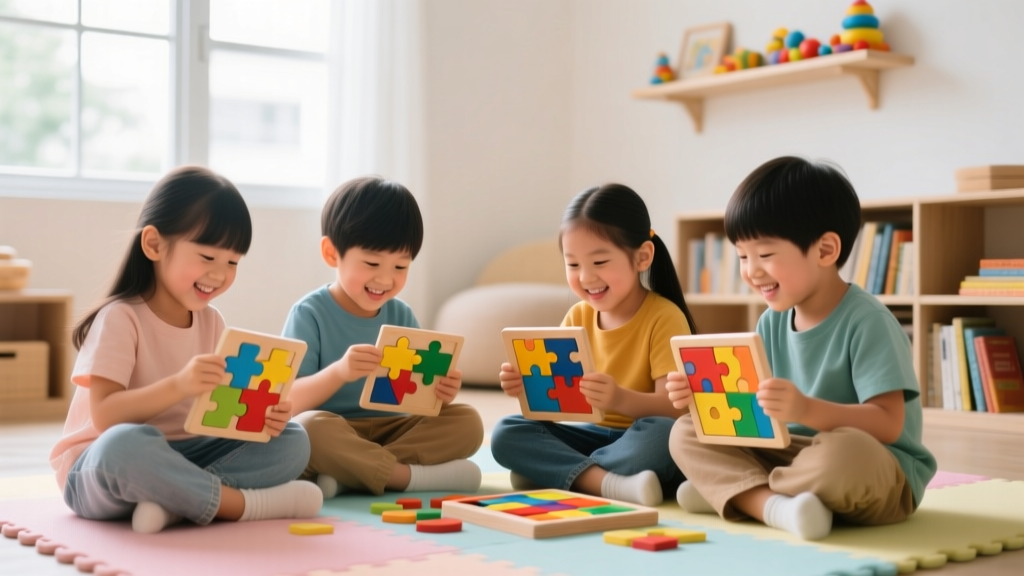
20 Best Puzzles for Kids Ages 4–8: Brain Development
20 Best Puzzles for Brain Development (Ages 4-8): Cognitive Skills Builder
Puzzles are among the most research-backed educational tools. University of Chicago found children who complete puzzles at 2-4 score significantly higher on spatial and math tests at age 8.
What Puzzles Build
- Jigsaw: Visual-spatial reasoning, part-to-whole relationships
- Logic puzzles: Deductive reasoning, working memory
- Pattern puzzles: Sequential thinking, prediction
- 3D puzzles: Mental rotation, spatial visualization
Difficulty Progression
| Age | Jigsaw Pieces | Logic Level |
|---|---|---|
| 4 | 24-48 | Simple matching |
| 5 | 48-100 | Pattern completion |
| 6 | 100-200 | Basic deduction |
| 7-8 | 200-500 | Multi-step logic |
Top Recommendations
Floor Puzzles (Ages 4-5)
Oversized 24-48 piece puzzles with educational themes. Full-body engagement and collaborative solving. $10-20.
Tangrams (Ages 5+)
Seven geometric pieces forming hundreds of shapes. Start with templates, progress to silhouettes. Teaches spatial rotation. $8-15.
Sudoku for Kids (Ages 6+)
4x4 grids with pictures, progressing to 9x9 numbers. Builds deductive reasoning. $5-10.
Rubik's Cube (Ages 7+)
Develops extraordinary spatial reasoning. Modern speed cubes are smoother. $10-25. May need guided instruction initially.
Tips for Parents
- Start below their level — early success builds confidence
- Offer hints, not solutions
- Celebrate process: You worked 30 minutes without giving up!
Frequently Asked Questions
My child gets frustrated. Should I push or back off?
Back off and try easier level. Frustration means it is beyond their zone of proximal development. Build confidence first.
Final Thoughts
A puzzle is a brain workout. Each piece placed strengthens neural pathways for all future learning. Rotate between puzzle types to exercise different cognitive muscles.
More Articles
 Best Musical Instruments for Kids That Teach Real Notes
 Beyond Safety: Judgment-Building Game Alternatives
 9 Best Toys for Kids' Executive Function Development
 Montessori Toys on a Budget: 12 Essentials Under $25 Each
 Ed Gein Kids? Forensic Truth Revealed
 Ed Gein Babysat Kids? The Truth Behind the Myth
 Did Billy the Kid Have Children? Teaching History Truth
 Thomas Jefferson’s Children: Truth Behind His Family Life
 Was Billy the Kid a Good Guy? The Moral Truth
 Piece by Piece for Kids: Best Building Toys (2026)