Kids' Watercolor Techniques: 12 Beginner Methods (2026)
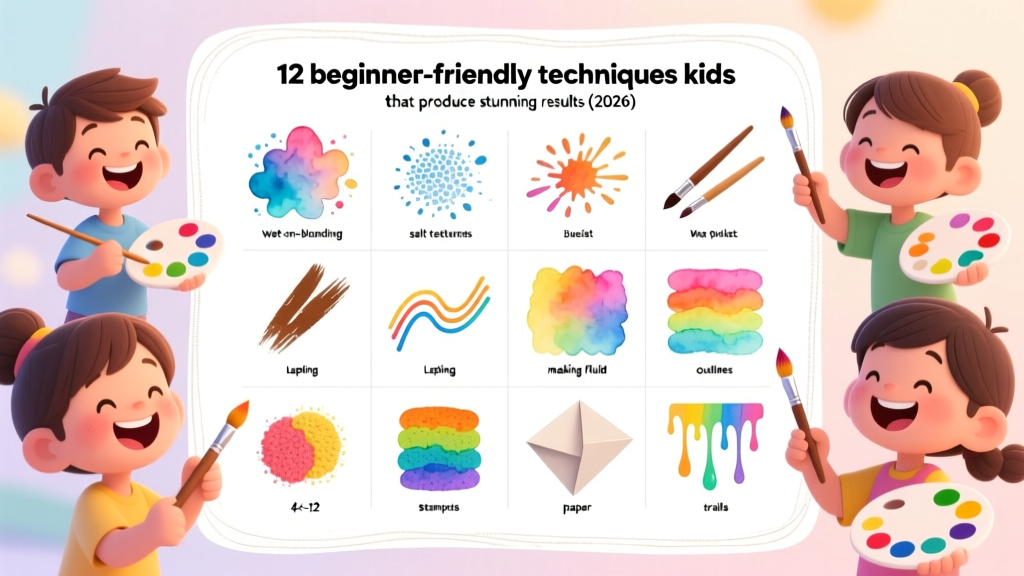
Watercolor intimidates many adults, let alone children — but it shouldn't. The beauty of watercolor is that its "uncontrollable" nature produces happy accidents that look intentional and beautiful. As an occupational therapist and art enthusiast, I've found that watercolor uniquely develops fine motor control, color theory understanding, and creative risk-taking. These 12 techniques are designed to guarantee stunning results regardless of skill level.
Essential Supplies
- Pan watercolors: A basic 12-color set is sufficient ($5–15)
- Watercolor paper: 140 lb cold-press is ideal (prevents buckling). Budget option: heavy cardstock
- Brushes: Round sizes 4, 8, and 12. Synthetic is fine for beginners
- Two water cups: One for rinsing, one for clean water
- Paper towels: Essential for blotting and texture effects
- Salt (table + kosher): Creates beautiful star-burst textures
- White crayon or candle: For resist technique
12 Watercolor Techniques for Kids
1. Wet-on-Wet (Ages 4+)
Wet the entire paper with clean water. Drop different colors onto the wet surface and watch them bloom and blend. No "wrong" results — every painting looks like an abstract galaxy. Perfect for building color mixing understanding.
2. Salt Texture (Ages 5+)
Paint a wet area with color, then sprinkle salt while still damp. As it dries, salt absorbs water and pigment, creating crystalline star patterns. Kosher salt = large stars, table salt = fine stars. Magical for ocean, sky, or galaxy paintings.
3. Wax Resist (Ages 4+)
Draw with white crayon on white paper (invisible). Paint over with watercolor — the wax repels paint, revealing the hidden drawing. Children feel like magicians. Great for secret messages, snow scenes, or underwater creatures.
4. Splatter Technique (Ages 6+)
Load a brush with watery paint. Tap the handle to splatter paint onto paper. Creates star fields, snow scenes, or abstract energy. Cover areas with paper shapes for silhouettes against the splatter background.
5. Blot and Lift (Ages 5+)
Paint an area, then press a crumpled paper towel onto wet paint. Creates cloud-like textures, foliage, or rock surfaces. Teaches that removing paint is as creative as adding it.
Technique Difficulty Guide
| Technique | Age | Difficulty | Best For |
|---|---|---|---|
| Wet-on-wet | 4+ | Easy | Skies, galaxies, backgrounds |
| Salt texture | 5+ | Easy | Ocean, snow, starfields |
| Wax resist | 4+ | Easy | Hidden drawings, snow scenes |
| Splatter | 6+ | Medium | Stars, energy, abstract |
| Blot/lift | 5+ | Easy | Clouds, foliage, rocks |
Frequently Asked Questions
My child's watercolors always look "muddy." How do I fix this?
Muddy colors happen when complementary colors (red+green, blue+orange) mix. Teach children to use fewer colors per painting and let each color dry before adding an adjacent one. Start with cool colors (blues, greens, purples) or warm colors (reds, oranges, yellows) — not both — until they understand color mixing.
Is watercolor paper really necessary?
For best results, yes — watercolor paper (140 lb) handles water without buckling or pilling. But for practice and exploration, heavy cardstock or even coffee filters work well. The technique matters more than the paper for beginners.
The Bottom Line
Watercolor teaches children that art doesn't have to be controlled to be beautiful. The flowing, blending, unpredictable nature of water and pigment creates results that surprise and delight — building creative confidence that transfers to every artistic medium. Start with wet-on-wet, add techniques gradually, and display every painting proudly.
More Articles
 Clay Modeling Projects for Preschoolers
 Sensory Experiences and Craft Practice
 Puppet Making With Items You Already Have
 How to Draw the Eiffel Tower for Kids (2026)
 DIY Puppet Theater: Build and Perform
 Easy Friendship Bracelet Patterns for Kids 6+
 How to Draw a Witch for Kids: Easy & Confidence-Boosting
 Kids Artwork Storage: A Practical, Emotional Guide
 How to Draw an Octopus for Kids (Ages 4–10)
 Kids Art Studio Setup in Small Space Under $200