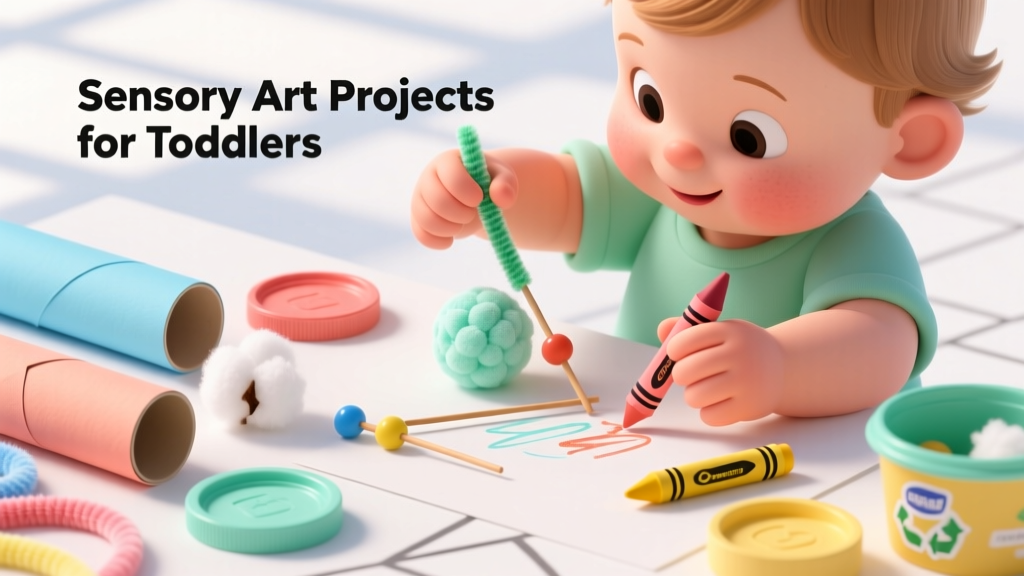
Sensory Art Projects for Toddlers (2026)
Why Sensory Art Matters for Brain Development
Fine motor development in toddlers (ages 1-4) follows a predictable sequence: palmar grasp to pincer grasp to tripod grasp to dynamic tripod grasp. Each stage requires specific types of hand practice that everyday activities alone don't provide enough of.
Sensory art fills this gap because it naturally incorporates:
- Graded force control: Squeezing paint bottles teaches how much pressure to use
- Bilateral coordination: Holding paper with one hand while painting with the other
- Cross-body movements: Reaching across the midline to paint on the other side
- Proprioception: Knowing where their hands are in space without looking
Fine Motor Milestones (CDC/AOTA)
12-18 months: Palmar grasp, scribbles with fist, stacks 2 blocks
18-24 months: Beginning pincer grasp, turns pages, uses spoon
2-3 years: Static tripod grasp, copies vertical/horizontal lines
3-4 years: Dynamic tripod grasp, copies circles/crosses, cuts with scissors
20 Projects Ranked by Mess Level
Minimal Mess (5-Minute Cleanup)
1. Ziplock Bag Painting (Ages 12-24 months)
Materials: Ziplock bag, 3 colors of paint, tape, paper
Target: Palmar grasp, cause-and-effect, color mixing
Squeeze paint blobs into bag, seal with tape, tape to window. Toddler presses paint from outside. Zero skin contact.
2. Sticker Art (Ages 18-36 months)
Materials: Sticker sheets, paper with outlines
Target: Pincer grasp, hand-eye coordination
Draw a shape, toddler places stickers inside. Peeling stickers is one of the best pincer-grasp exercises.
3. Contact Paper Collage (Ages 18-36 months)
Materials: Clear contact paper, tissue paper squares, feathers
Target: Pincer grasp, bilateral coordination
Stick contact paper sticky-side-up to table. Place materials on it. Seal with another sheet.
4. Dot Marker Art (Ages 2-4 years)
Materials: Dot markers (bingo daubers), paper with circles
Target: Tripod grasp, graded force, spatial accuracy
The thick barrel naturally encourages tripod grasp formation.
5. Water Painting (Ages 1-3 years)
Materials: Paintbrush, cup of water, dark paper or sidewalk
Target: Grip strength, wrist control
Toddler "paints" with plain water. Watch it appear and evaporate. Zero mess, endlessly repeatable.
Low Mess (10-Minute Cleanup)
6. Playdough Stamping (Ages 2-4 years)
Materials: Homemade playdough, stamps/textured objects
Target: Hand strengthening, bilateral coordination
Playdough is the gold standard for hand strengthening — activates 30+ hand muscles simultaneously.
7. Pom-Pom Glue Art (Ages 2-4 years)
Materials: Pom-poms, glue stick, paper
Target: Pincer grasp, bilateral coordination
Small pom-poms require refined pincer; large ones practice whole-hand grasp.
8. Tape Resist Painting (Ages 2-4 years)
Materials: Painter's tape, paper, washable paint
Target: Pincer grasp (tape peeling!), brush control
Place tape in patterns, paint over everything, peel to reveal white lines.
9. Coffee Filter Color Bleeding (Ages 2-4 years)
Materials: Coffee filters, washable markers, spray bottle
Target: Tripod grasp, hand strengthening (spray bottle)
Spray bottles are exceptional for hand strengthening — the trigger mimics scissor motion.
10. Bubble Wrap Stamping (Ages 1-3 years)
Materials: Bubble wrap, paint, paper
Target: Palmar grasp, force control
The popping sensation provides additional tactile feedback.
Moderate Mess (15-Minute Cleanup)
11. Shaving Cream Writing (Ages 2-4 years)
Materials: Shaving cream, tray
Target: Pre-writing strokes, finger isolation
Low-friction surface reduces motor planning demands of writing.
12. Salt Tray Drawing (Ages 2-4 years)
Materials: Shallow tray, salt or sand
Target: Finger isolation, pre-writing strokes
Tactile feedback helps toddlers with proprioceptive difficulties "find" their fingers.
13. Edible Finger Paint (Ages 12-24 months)
Materials: Greek yogurt + food coloring
Target: Palmar grasp, sensory tolerance
100% edible if they taste it (they will). Reduces anxiety about "icky" textures.
14. Tissue Paper Stained Glass (Ages 3-4 years)
Materials: Tissue paper, glue, wax paper
Target: Scissor skills, tearing, bilateral coordination
Tearing tissue paper is excellent preparation for scissor skills.
15. Clay Coil Pots (Ages 3-4 years)
Materials: Air-dry clay, rolling pin
Target: Hand strengthening, bilateral coordination
Rolling coils requires sustained bilateral hand movement.
Full Engagement (20-Minute Cleanup)
16. Nature Paintbrushes (Ages 2-4 years)
Materials: Sticks, leaves, flowers, rubber bands, paint
Target: Grip variation, force control
Unconventional brushes force grip adaptation.
17. Threading Necklaces (Ages 3-4 years)
Materials: Yarn (taped end), large beads or penne pasta
Target: Pincer grasp, bilateral coordination, patience
Threading is one of the best bilateral coordination activities.
18. Cardboard Loom Weaving (Ages 3-4 years)
Materials: Cardboard with notches, yarn
Target: Bilateral coordination, sequential planning
The over-under pattern builds motor sequencing for handwriting.
19. Marble Painting (Ages 2-4 years)
Materials: Shallow box, paper, marbles, paint
Target: Wrist control, graded movement
Tilting the box requires precise wrist control and proprioception.
20. Collaborative Mural (Ages 2-4 years, multiple kids)
Materials: Large paper, all available art supplies
Target: All skills plus social skills, turn-taking
Working on a large vertical surface activates shoulder stabilizers.
FAQ: Common Parent Concerns
My toddler is sensory-avoidant. What do I do?
Start with Minimal Mess projects. Introduce textures gradually. Never force contact — forced exposure can increase aversion. Most warm up within 2-3 weeks.
How often should we do sensory art?
3-5 times per week for optimal development. Even 15 minutes counts. Consistency matters more than duration.
When should I worry about fine motor delays?
Consult an OT if: cant pick up small objects by 12 months, doesn't scribble by 18 months, cant stack 4 blocks by 24 months, or cant copy a circle by 36 months.
More Articles
 Paper Origami Projects for Kids (Easy Steps)
 May Crafts for Kids: Mess-Free & Educator-Tested (2026)
 How to Draw a Dolphin for Kids (Ages 4–10)
 Paper Quilling: Easy Starter Projects
 How to Draw a Scarecrow for Kids: Easy 5-Step Guide
 Best Outdoor Play Equipment for First-Time Parents
 How to Draw Sonic for Kids: Easy 4–10 Guide
 How to Draw a Pumpkin for Kids (2026)
 How to Draw a Parrot for Kids (2026)
 Watercolor Painting for Kids: Beginner Tips