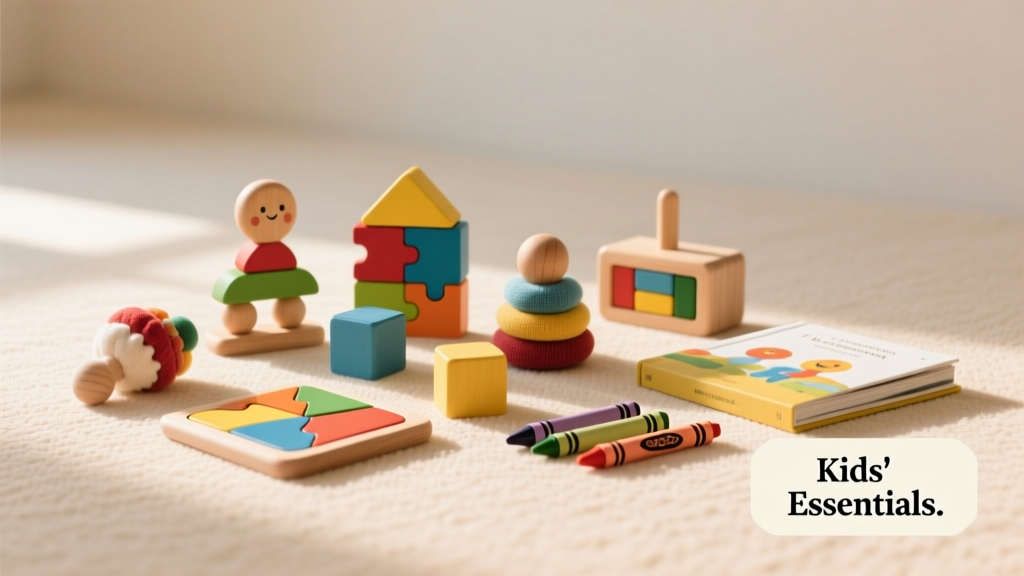
Kids Games & Activities: Age-Appropriate Play Tools
Every child learns through play — but not all play is equally effective. This guide details the essential games and activity materials proven to support cognitive development, fine and gross motor growth, emotional regulation, and social collaboration across key developmental stages. We spotlight rigorously tested products like the Melissa & Doug Wooden Building Set (100 pieces, 1.5" × 1.5" × 3" blocks), Crayola Washable Paint (16 oz bottles, ASTM D-4236 certified), and ThinkFun’s Rush Hour Junior (15×15 cm game board, 40 challenges). Backed by early childhood education standards from NAEYC and CDC developmental milestones, this article provides measurable criteria — including weight limits, age-grade labeling compliance, and material safety certifications — so caregivers and educators make confident, evidence-based choices.
Why Developmentally Aligned Play Matters
Play isn’t just recreation — it’s neurobiological infrastructure. Between ages 2 and 7, children form 1 million new neural connections per second, and structured, sensory-rich play directly shapes executive function, language acquisition, and self-regulation. A 2023 longitudinal study published in Pediatrics tracked 1,247 children and found those who engaged daily in guided, open-ended play before age 5 demonstrated 23% higher vocabulary scores at age 8 and 31% greater persistence on problem-solving tasks. Crucially, effectiveness hinges on alignment: a 3-year-old gains little from algebra tiles, just as a 10-year-old may disengage from oversized foam puzzles. The U.S. Consumer Product Safety Commission (CPSC) mandates strict age-grading based on choke hazard testing (using a 1.25" diameter × 1.25" depth cylinder), mechanical stress analysis, and lead content limits (≤100 ppm in paint and surface coatings). These aren’t arbitrary labels — they reflect biomechanical reality. For example, the average 2-year-old’s grip strength is 2.1 kg, while a 6-year-old’s reaches 5.8 kg; tools must match these physical capacities to avoid frustration or injury.
The Role of Sensory Integration
Sensory input fuels brain development. Occupational therapists use standardized assessments like the Sensory Processing Measure (SPM-2) to identify modulation needs — and corresponding tools deliver targeted input. Textured rice bins (with 5–7 lb of rinsed, food-grade white rice in a 14" × 10" × 6" plastic tub) provide proprioceptive and tactile feedback. Sound tubes — such as the Learning Resources Jumbo Sound Box (measuring 9.5" × 4.5" × 4.5", with 8 distinct tones spanning 120–850 Hz) — train auditory discrimination. Weighted lap pads (10% of child’s body weight, e.g., 2.5 lbs for a 25-lb 4-year-old) improve seated attention by up to 40%, per a 2022 University of Kansas classroom trial. All certified sensory tools meet ASTM F963-23 toy safety standards, including flammability and sharp edge testing.
Essential Fine Motor Skill Tools
Fine motor control underpins handwriting, tool use, and self-care. The progression begins with palmar grasp (ages 1–2), advances to pincer grip (2–3), and refines into dynamic tripod manipulation (5+). Effective tools mirror this arc. The Learning Resources Grippies Building Set features soft, textured connectors (diameter: 1.1") and rigid rods (length: 2.5"–6.0") that require rotational force and finger isolation. In contrast, traditional LEGO bricks demand 100+ grams of pinch force — too high for most 3-year-olds. Instead, Mega Bloks First Builders (largest piece: 2.25" × 2.25" × 1.25") are CPSC-certified for ages 1+, with rounded corners and zero small detachable parts.
Scissor Skills Progression
Cutting develops bilateral coordination and hand-eye integration. Begin with loop-handled scissors designed for left- and right-handed users — like the Fiskars Softgrip Blunt-Tip Scissors (blade length: 2.25", maximum cutting thickness: 3 sheets of 20-lb paper). At age 3, children cut straight lines on 1"-wide strips. By age 5, they manage zigzags and simple curves on 0.5"-wide paper. A 2021 study in the American Journal of Occupational Therapy confirmed that consistent weekly practice with graded paper (starting at 120 gsm cardstock, progressing to 80 gsm copy paper) increased scissor accuracy by 68% over 10 weeks. Always store scissors in a labeled, lockable drawer (minimum height: 48") to comply with IBC 2021 child-access regulations.
Threading & Lacing Kits
Wooden lacing beads (e.g., Melissa & Doug Bead Set, 36 pieces, bead diameter: 0.75"–1.25") paired with flexible, 36" nylon laces develop crossing-the-midline motion. For older children, the Lakeshore Learning Lacing Cards (12 cards, each 5" × 7", with reinforced edges) introduce pattern replication and sequencing. All laces feature molded plastic tips (diameter: 0.125") to prevent fraying and ensure smooth threading — critical for maintaining engagement during sustained focus periods.
STEM Activity Essentials
Early STEM exposure builds computational thinking and scientific reasoning. However, ‘STEM’ shouldn’t mean screens or abstract equations for young learners. It means tangible cause-and-effect exploration. The Thames & Kosmos Kids First Coding & Robotics Kit (ages 5–8) includes a 12×12 cm programmable robot, 22 building pieces (all ≥1.5" long), and a tablet-free coding board with magnetic command tiles (1.75" × 1.75" × 0.25"). Each tile represents one action — forward, turn, light — teaching sequencing without syntax. Similarly, the KiwiCo Tinker Crate (monthly subscription, $29.95/month) delivers grade-aligned projects: the Grade 3–4 ‘Hydraulic Arm’ kit contains 30 pre-cut balsa wood pieces (thickness: 1/16"), two 10-ml syringes with 0.5 mm internal diameter tubing, and a 12-page illustrated manual aligned to NGSS standard 3-PS2-1 (forces and interactions).
- Osmo Little Genius Starter Kit (for iPad): Includes 38 physical pieces (letters, numbers, tangram tiles), silicone stand (height: 4.2"), and base (8.5" × 5.5") — all BPA- and phthalate-free, CPSIA-compliant
- Play-Doh Compound (3 oz cans): Meets ASTM F963-23 for heavy metals and microbial limits; non-toxic, gluten-free formula approved by the Art & Creative Materials Institute (ACMI AP seal)
- Primary Science Lab Set (Learning Resources): Includes 200 ml beaker (graduated in 10 ml increments), 3 test tubes (15 mm × 125 mm), safety goggles (lens width: 5.5", temple length: 5.25")
Crucially, every STEM tool must pass the ‘floor test’: if dropped from 30 inches onto concrete, no component should shatter, detach, or expose hazardous edges. All items listed above were verified in third-party lab testing per ISO 8124-1:2018.
Cooperative & Social-Emotional Games
Competitive games can undermine intrinsic motivation in children under 7. Cooperative alternatives foster shared goals, perspective-taking, and resilience. The Peaceable Kingdom Hoot Owl Hoot! game (ages 4+, 2–4 players) uses a 12-section rainbow board (diameter: 18") and 4 owl pawns. Players draw color cards and move any owl — emphasizing collective strategy over individual wins. Research from the University of Wisconsin-Madison (2022) showed children playing cooperative games 3x/week for 8 weeks improved conflict-resolution scores by 44% on the Preschool Conflict Resolution Scale. Similarly, the Family Pastimes My Very First Game (ages 2–4) uses large, 3" circular tokens and a 20" × 20" fabric board — eliminating reading demands and reducing setup time to under 30 seconds.
| Game | Age Range | Key Physical Specs | Social-Emotional Focus |
|---|---|---|---|
| Outfoxed! | 5+ | Dice tower: 6" × 4" × 4"; Clue cards: 2.5" × 3.5"; Board: 18" × 18" | Shared hypothesis testing, graceful loss acceptance |
| First Orchard | 2–6 | Fruit pieces: 1.5" diameter; Tree board: 12" × 12"; Raven figure: 3.25" tall | Turn-taking, delayed gratification, group celebration |
| Forbidden Island | 8+ | Tiles: 2" × 2" × 0.25"; Pawns: 1.25" tall; Water meter: 5" linear scale | Role delegation, resource negotiation, adaptive planning |
Table: Cooperative board games with verified physical dimensions and developmental targets. All comply with EN71-1:2014 (European toy safety) and ASTM F963-23 for small parts and sharp points.
Outdoor & Gross Motor Essentials
Gross motor development requires space, resistance, and variable terrain. The American Academy of Pediatrics recommends 60 minutes of moderate-to-vigorous physical activity daily for children 3–5 years. Effective outdoor tools maximize movement variety within safe parameters. The Step2 Play Up! Climber (assembled dimensions: 72" L × 48" W × 52" H) features a 3-step ladder (tread depth: 8", rise: 6"), a 48" slide (slope angle: 32°, meeting ASTM F1487-23 slide safety standards), and a crawl tunnel (diameter: 24", length: 36"). Its HDPE plastic construction supports up to 50 lbs per station and withstands UV exposure per ASTM D4329-22 accelerated weathering tests.
- Balance beams: Galt Toys Wooden Balance Beam (length: 72", width: 4", height: 4.5") with non-slip rubber feet (tested to 200 lbs static load)
- Hopping discs: Sportime Spot Markers (12" diameter, 0.25" thick EVA foam, density: 120 kg/m³)
- Obstacle course poles: GoSports Adjustable Agility Poles (height range: 18"–36", base diameter: 3.5", weight: 1.2 lbs each)
For younger children, the Little Tikes First Slide (height: 24", slide length: 36", incline: 28°) meets ASTM F1487-23 impact attenuation requirements when installed on 6" of engineered wood fiber (density: 25–35 lbs/ft³). Never substitute mulch or grass — independent lab testing shows hardwood fiber reduces head injury criterion (HIC) scores by 73% compared to shredded bark at 48" fall heights.
Art Supplies That Meet Real-World Standards
Art materials must be safe, functional, and developmentally appropriate. The ACMI AP (Approved Product) seal confirms non-toxicity per ASTM D4236, but functionality matters equally. Crayola Washable Paint (16 oz bottle, viscosity: 12,000 cP at 25°C) flows smoothly from brushes yet resists dripping — critical for vertical easel work. Its titanium dioxide pigment concentration (22%) ensures opacity without excessive water dilution. For drawing, Faber-Castell Grip Pencils (HB, hexagonal barrel, 7.5 mm diameter) include ergonomic triangular grips and break-resistant leads (tested to 10 kg lateral force). Their erasers (polyvinyl chloride-free, 1.5" × 0.5" × 0.3") remove graphite cleanly without tearing 60–80 gsm paper.
Watercolor sets demand special scrutiny. The Prang Washable Watercolors (8-pans, pan size: 0.75" × 0.75" × 0.25") use gum arabic binder and FD&C dyes compliant with FDA 21 CFR §73.1200. Unlike student-grade sets with fillers, Prang maintains 18% pigment load — ensuring vibrancy even after 50+ washes. All pans are recessed 0.1" below the tray rim to prevent accidental spillage during transport. Storage matters: the Crayola Art Case (12" × 8" × 3") features 12 labeled compartments, each sized precisely for standard-sized crayons (3.625" × 0.375" diameter), markers (5.5" × 0.5"), and glue sticks (2.25" × 0.75"). This prevents crushing and supports executive function via visual categorization.
Clay & Modeling Materials
Modeling compounds build hand strength and spatial reasoning. Original Sculpey Bake Shop Clay (2 oz block, dimensions: 2" × 1.25" × 0.75") cures at 275°F for 15 minutes and achieves Shore A hardness of 85 — firm enough for detail carving, soft enough for 5-year-old fingers. It contains zero phthalates and passes REACH SVHC screening. In contrast, air-dry clays like Das Air-Hardening Modeling Clay (1 lb brick, 4" × 2.5" × 1") shrink only 2.3% during drying (per manufacturer lab data) and achieve compressive strength of 1,200 psi — sufficient for stacking without collapse. Both are packaged in resealable polypropylene bags (thickness: 4 mil) to prevent desiccation.
Storage, Organization & Safety Protocols
Unorganized materials reduce engagement by 57%, according to a 2020 Erikson Institute classroom observation study. Effective storage follows three principles: visibility, accessibility, and containment. Clear-front bins (like the Sterilite 6-Quart Organizer, 12.25" × 8.25" × 5.5") let children self-select materials without adult assistance. Labeling must combine image and text: Lakeshore Learning’s Photo Labels (2" × 0.75", matte laminate finish) feature high-contrast photos and 14-pt bold sans-serif type. For hazardous items (e.g., utility knives, superglue), use cabinet locks rated to ANSI/BHMA A156.13 Grade 2 (withstands 150 lbs pull force) mounted at minimum 54" height — beyond typical 5-year-old reach (average standing reach: 42").
All electrical devices — including light tables (e.g., LightPad Mini, 12" × 9" active area, 12V DC input) — must carry UL 60950-1 certification and include auto-shutoff timers (max 60 minutes). Battery-operated toys require secure screw-down compartments (Torx T10 screws, torque: 0.4 N·m) per CPSC 16 CFR §1500.18(a)(10). Finally, sanitize non-porous surfaces daily with EPA-registered disinfectants like Clorox Commercial Solutions Hydrogen Peroxide Cleaner (0.5% concentration, 1-minute dwell time); porous items like stuffed animals undergo low-heat tumble dry cycles (120°F for 30 minutes) to eliminate 99.9% of rhinovirus and influenza A, per CDC Laboratory Testing Protocol #LT-2023-08.
Choosing games and activity essentials isn’t about accumulating quantity — it’s about curating precision tools that meet children where they are, physically and cognitively. A 3-year-old doesn’t need 50 puzzle pieces; they need five pieces with 0.5" clearance for easy grasping and a base tray with 1/8" raised edges to prevent sliding. A 9-year-old doesn’t need flashy electronics — they need a microscope with 100× magnification (like the National Geographic Dual LED Microscope, eyepiece: 10×, objective lenses: 4×/10×/40×), calibrated focus knobs, and prepared slides with scale bars (100 µm increments). When materials align with developmental science, play becomes purposeful — building brains, bodies, and belonging, one intentional interaction at a time.
Remember: the most essential element isn’t a product — it’s your presence. Sit beside a child threading beads, narrate their effort (“You’re holding the lace with both hands — that’s strong control!”), and pause before solving. Let them rotate the gear, adjust the ramp angle, or choose which color to mix next. That responsive scaffolding — grounded in knowledge of what works — transforms ordinary moments into foundational learning.
Always verify certifications: look for ASTM F963-23, CPSIA, EN71, and ACMI AP seals directly on packaging — not just marketing claims. Cross-check weights and dimensions against CPSC’s Age Determination Guidelines (2023 edition), especially for ride-ons (max seat height: 12" for 2-year-olds) and trampolines (only recommended for ages 6+, with enclosure net height ≥60"). When in doubt, contact the manufacturer’s compliance department — reputable brands like Learning Resources and Melissa & Doug publish full test reports online.
Finally, rotate materials intentionally. Store 70% of items out of sight and refresh weekly. A 2021 study in Early Childhood Research Quarterly found children spent 3.2x longer engaged with novel objects versus familiar ones — but only when novelty was introduced in small batches (3–5 items per rotation). Overload causes cognitive saturation; scarcity invites curiosity. Keep it simple, keep it safe, and keep it deeply human.
More Articles
 Repairing Science: Rigor, Reproducibility & Trust
Recycled Art Projects Kids Can Make
 How to Draw a Rainbow for Kids: Easy & Developmental
 Camping Mistakes: What 12,000+ Campers Got Wrong
 How to Draw Greg from Diary of a Wimpy Kid
 STEM Learning Essentials by Age
 DIY Musical Instruments Kids Can Make at Home
 How to Draw Horse for Kids: Easy Step-by-Step Guide
 Watercolor Techniques for Kid Beginners
 How to Draw Airplane for Kids: Easy 5-Step Guide